


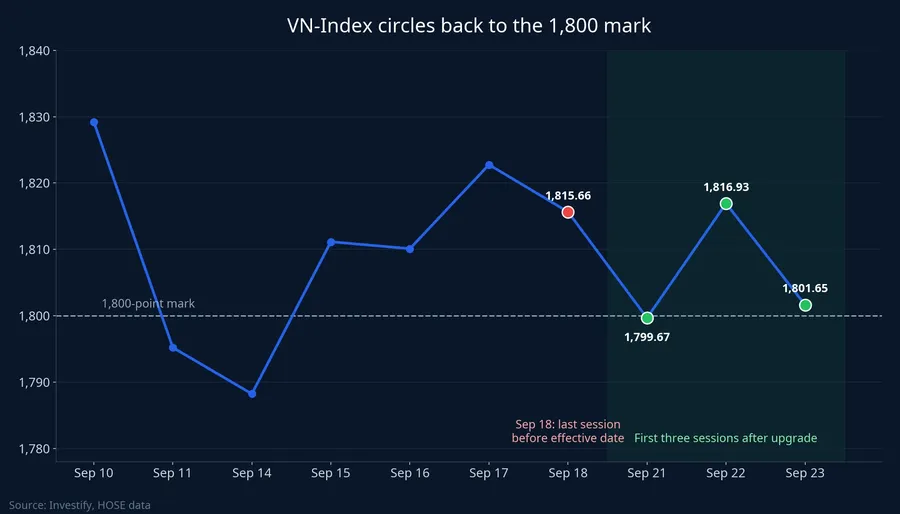
Judged by the final number, the first three sessions after FTSE Russell's upgrade of Vietnam took effect left almost no trace. VN-Index closed on September 23 at 1,801.65 points, roughly 14 points below the 1,815.66 it posted on September 18, the last session before the effective date. One down day, one rebound, another down day: the index went full circle and ended up close to where it started.
A flat index does not mean nothing happened. The three sessions show liquidity thinning out noticeably, an index whose direction leans heavily on a single stock, VIC, and foreign investors who have not yet bought in the way many expected. This piece walks through each session to show how an index can travel a full loop without setting a clear direction.
The baseline: September 18
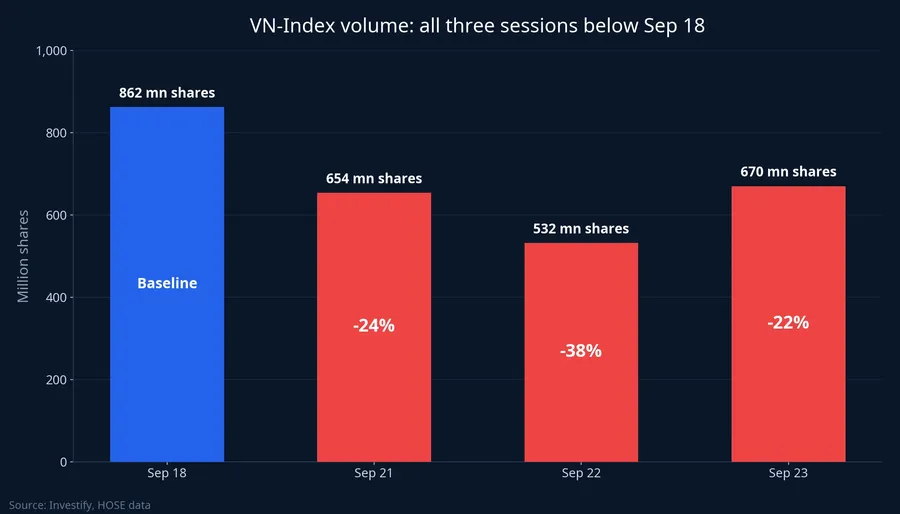
September 18 was the session in which index funds rebalanced their portfolios ahead of the effective date. VN-Index volume that day reached about 862 million shares, the highest in roughly two weeks of trading. That is the yardstick for the three sessions that followed.
The key point is that most of the index-fund money had already been matched before the effective date. When the market opened on September 21, that large, pre-scheduled buying was no longer standing behind the order book. Every number below should be read with that in mind.
September 21: day one of the upgrade, the index slips below 1,800
On the first day the upgrade was in effect, VN-Index fell 15.99 points (-0.88%) to 1,799.67.Vietstock On HOSE, 97 stocks rose and 200 fell, so decliners outnumbered advancers two to one. A sub-1% drop is not large, but the breadth shows the selling was widespread.
Foreign investors returned to net selling, offloading more than VND 663.6 billion on HOSE.Vietstock The selling concentrated in the Vingroup family, with about VND 291.9 billion in VHM and about VND 114.7 billion in VIC.Thương Trường Prices followed: VHM dropped 4.08% to VND 68,100 and VIC fell 2.57% to VND 235,000.
VN-Index volume slipped to about 654 million shares, roughly 24% below September 18. So day one of the upgrade era brought no fresh wave of buying. One group sold, and the bid side was not deep enough to absorb it.
Why would foreign investors sell on upgrade day itself? At least three explanations are plausible. The first is that frontier-market funds had to exit as Vietnam left that basket, while emerging-market money is being allocated in several tranches. The second is the familiar pattern of profit-taking after a long-awaited event. The third is macro: Vietstock noted a cautious mood as the average lending rate had just risen to 10.7% a year and the exchange rate was under pressure after the Fed raised rates.Vietstock
Three sessions of data are not enough to say which weighed most. The fact that selling targeted exactly the heaviest index constituents lends some support to the timing-gap explanation between the two baskets. Still, that is an inference from aggregate data, not fund-level disclosure.
September 22: a 17-point rebound, mostly from one stock
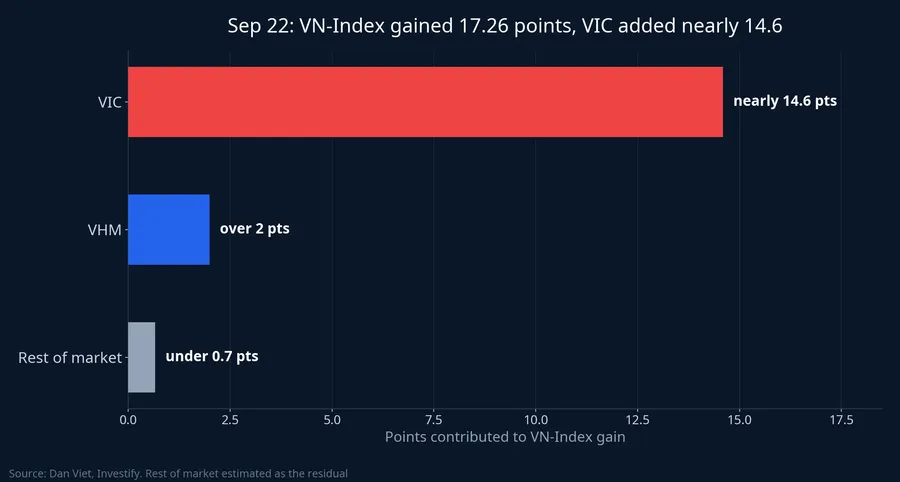
On September 22, VN-Index rose 17.26 points (+0.96%) to 1,816.93, recovering everything it had lost the day before.Dân Việt On the closing board, it looked like a clean recovery.
The composition tells a different story. VIC alone contributed nearly 14.6 of the 17-plus points, VHM added over 2 points, and names such as MSN, VNM and MWG each contributed less than 1 point.Dân Việt VIC climbed 3.74% to VND 243,800. Breadth improved, with 157 gainers against 120 decliners on HOSE, but most of the point gain came from a single stock.
The weak spot was liquidity. VN-Index volume fell to about 532 million shares, roughly 38% below September 18 and the lowest of the three sessions. Matched-order value on HOSE was down by more than half compared with the pre-upgrade session.Người Quan Sát Vietstock described money flow fading through the afternoon even as the large caps pushed the index to its intraday high.Vietstock
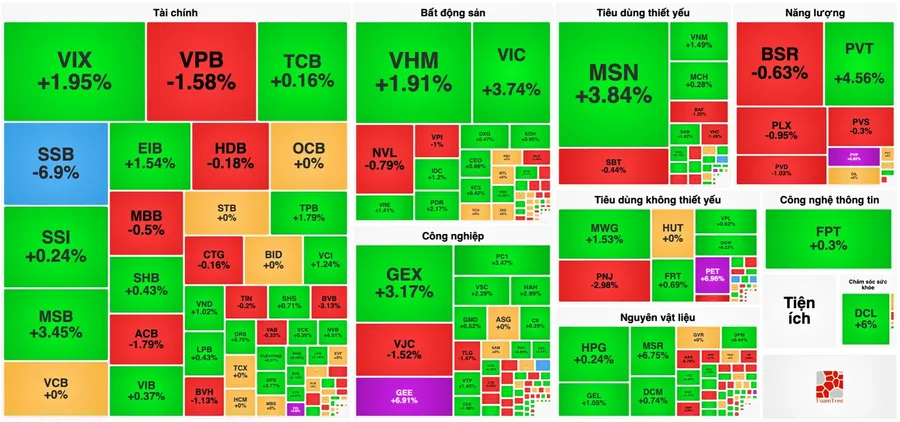
Foreign investors flipped to a small net buy of about VND 63 billion.Dân Việt They net bought about VND 140 billion of SBT and about VND 49 billion of VIC, while TCB saw the heaviest net selling at about VND 87 billion.Người Quan Sát Set against more than VND 663.6 billion of net selling the day before, about VND 63 billion of net buying is far too small to call a return of foreign capital.
The mechanism is simple. When an index rises mainly on one large-cap stock over thin volume, the gain depends almost entirely on that stock holding its price. Without money spreading into other sectors, there is nothing to catch the index when the leader turns.
September 23: banks draw money in the morning, the index still loses ground
September 23 showed exactly that risk. In the morning the market chopped in a narrow range, with VN-Index at one point up more than 2 points to around 1,819. Banks drew in more than VND 2,800 billion during the morning session, concentrated in TCB and HDB, and HOSE morning turnover reached nearly VND 8,500 billion, up 18% from the same point a day earlier.Người Quan Sát
That same morning, foreign investors net sold more than VND 590 billion, concentrated in two other banks, ACB and VPB.Người Quan Sát Meanwhile, VIC reversed lower and became the main drag on the index.
At the close, VN-Index was down 15.28 points (-0.84%) at 1,801.65, with 140 gainers and 191 decliners. VIC ended 3.2% lower at VND 236,000, giving back nearly all of the previous day's 3.74% gain. VHM also fell 1.73%.
This is the crux of all three sessions. The stock that lifted the index by nearly 14.6 points on September 22 was the same one that pulled it down on September 23. The money flowing into banks was real, but a sector drawing a few thousand billion dong cannot offset a heavyweight like VIC falling more than 3%.
Full-day volume on September 23 edged up to about 670 million shares, still roughly 22% below September 18. Liquidity improved, but it improved on a down day with decliners in the majority, which is not a good sign for buyers. Full-day foreign trading data had not been fully published at the time of writing, so this piece uses only the morning figure.
What three sessions say about upgrade expectations
The upgrade is a long-term change in the market's standing, while the first three sessions only capture the short-term reaction of money flows. Put together, that reaction has three features.
First, liquidity has not followed expectations. All three sessions traded below September 18 volume, by roughly 22% to 38%. The strongest up day was also the thinnest, and September 23 illustrated directly how hard it is to hold a rally that lacks volume behind it.
Second, one stock is dominating the index. When VIC alone can contribute nearly 14.6 points in a session, the VN-Index level reflects VIC more than the market's overall health. Investors who see the index rise and assume their own portfolio will follow can easily misread the tape.
Third, foreign investors have not turned net buyers. They net sold more than VND 663.6 billion on day one and more than VND 590 billion in the morning of day three alone, while the only net-buying session came to about VND 63 billion. Active emerging-market money, if it is coming, will need more than three sessions to show itself.
Brokerages are reading the market cautiously as well. VPBankS placed support at 1,790-1,800 points and recommended limiting high leverage.VPBankS Vietstock pointed to the 200-day moving average as short-term support while noting that volume remains low.Vietstock At 1,801.65, VN-Index sits right at the upper edge of that support zone.
Signals to watch in the coming sessions
On the numbers, the reasonable reading for now is a sideways market waiting for money, not a post-upgrade acceleration phase. That reading changes only when volume returns to near September 18 levels on an up day with broad participation. The signals below are best read together rather than in isolation:
- Volume. The reference point is roughly 862 million shares on September 18. If the index rises while volume stays around 530-670 million shares, as in the past three sessions, it is still a rally carried by a few large caps.
- Market breadth. Count advancers versus decliners on HOSE instead of watching only the index level. A healthy rally needs advancers to dominate over several consecutive sessions.
- VIC's contribution. When VIC accounts for most of the points gained or lost, strip it out to see how the rest of the market is actually moving.
- Foreign flows and the 1,790-1,800 zone. Holding that support while foreign net selling eases would give the market a basis to consolidate. A close below 1,790 on rising volume, on the other hand, would signal that selling pressure is outweighing support.
In short, the past three sessions have not answered when upgrade-driven capital will arrive. They only show that the answer is not in the index level. It lies in the volume and breadth of the sessions ahead.