


On September 22, 2026, shares of Thien Viet Securities (TVS) closed at VND 15,600, up 6.85%, hitting the HOSE daily ceiling.DNSE Matched volume reached 754,300 shares, more than 5 times the average of the prior 20 sessions. In a session where the VN-Index rose 0.96%, only 6 stocks on the entire HOSE hit the ceiling, and TVS was one of them.
What stands out is that this price move ran directly counter to the company's earnings. TVS's first-half net profit came in at just VND 9 billion, down 90.6% year-on-year.Nguoi Dua Tin Two separate stories were unfolding at once, and neither shares the same source: one is a pure bookkeeping formality, the other is an unlisted investment the market is re-pricing on expectations.
A stock dividend brings the company zero new cash
The news underpinning the September 22 session was published the evening before. The Ho Chi Minh City Stock Exchange issued Decision No. 718, approving TVS's amended listing registration, effective September 22, 2026.Nguoi Dua Tin Under that decision, 16,003,560 shares issued as the 2025 stock dividend were formally added to the listing, equivalent to more than VND 160 billion at par value. That lifted TVS's listed charter capital from over VND 2,286 billion to over VND 2,446 billion.
This is where new investors commonly get confused. A stock dividend is not cash paid to shareholders. It's an accounting entry that moves a sum sitting in retained earnings into charter capital. Total equity stays unchanged, and each shareholder's ownership percentage stays unchanged too, since everyone receives 7 new shares for every 100 they already hold.
The price dilution was already priced in more than a month earlier, not on this date. The ex-dividend date was August 19, 2026: TVS closed at VND 14,450 on August 18, and the reference price was reset to VND 13,500 the next morning, exactly VND 14,450 divided by 1.07. The chart below marks both milestones across the last 60 trading sessions.
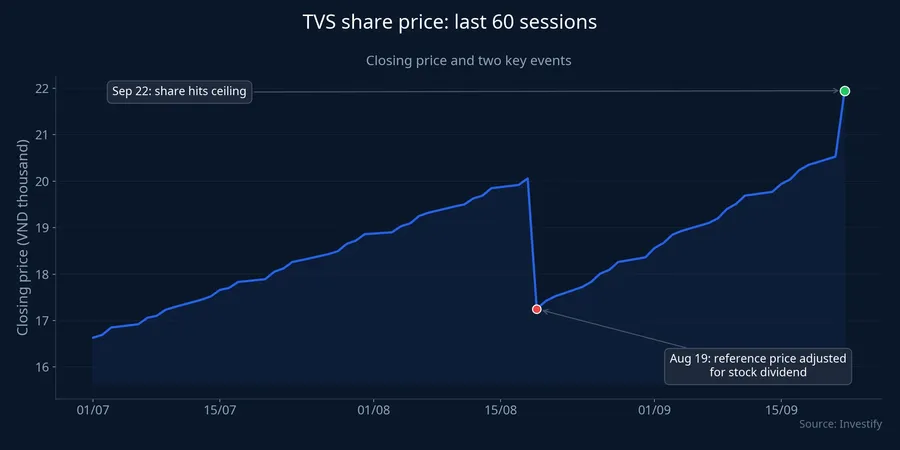
So what actually happened on September 22? It was the final procedural step: shares already distributed to shareholders were formally added to the official listing and cleared for trading. That changes the denominator of every per-share metric. It does not change the numerator, meaning the profit the company actually generates stays the same.

Meanwhile, the numerator is shrinking fast
Basic earnings per share for the half fell from VND 574 to just VND 24, while profit attributable to parent-company shareholders dropped 94.4% to roughly VND 5.4 billion.
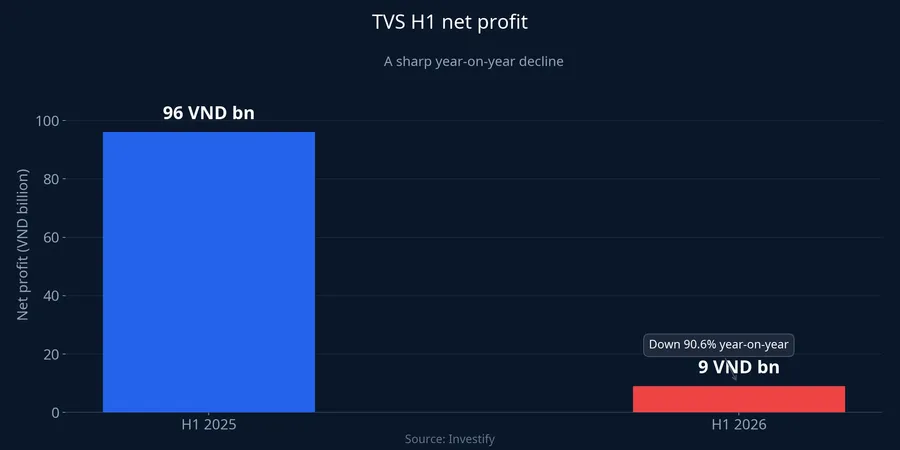
H1 operating revenue actually rose 8.1% to roughly VND 435.5 billion, which means the shortfall sits in costs and taxes, not in business scale. But in Q2 2026 alone, operating revenue fell 21.5% year-on-year to VND 176.8 billion, and gains on financial assets at fair value through profit or loss (FVTPL) dropped 57.8% to VND 56.1 billion.Bao Moi That line reflects proprietary trading, which carries heavy weight at TVS: it accounted for 73.4% of H1 operating revenue, versus just 2.0% from brokerage. The FVTPL portfolio itself also shrank to VND 1,185.7 billion as of June 30, 2026.
The result: profitability nearly vanished. Q2 2026 ROE stood at just 0.2% and ROA at 0.1%. Against securities firms with comparable charter capital, TVS sits at the bottom of the pack: BSI posted VND 212 billion in H1 net profit on VND 2,699 billion of charter capital, while FTS posted VND 238 billion on VND 3,811 billion. TVS also trails its own plan by a wide margin: shareholders approved a 2026 net profit target of VND 340 billion, meaning the company has completed roughly 2.6% of it after half the year.Bao Dau Tu
The second explanation: MoMo's bidding deadline is closing in
It would be inaccurate to attribute the entire September 22 rally to the supplementary listing decision. A purely procedural decision rarely drags a stock to its daily limit with volume 5 times the average on its own.
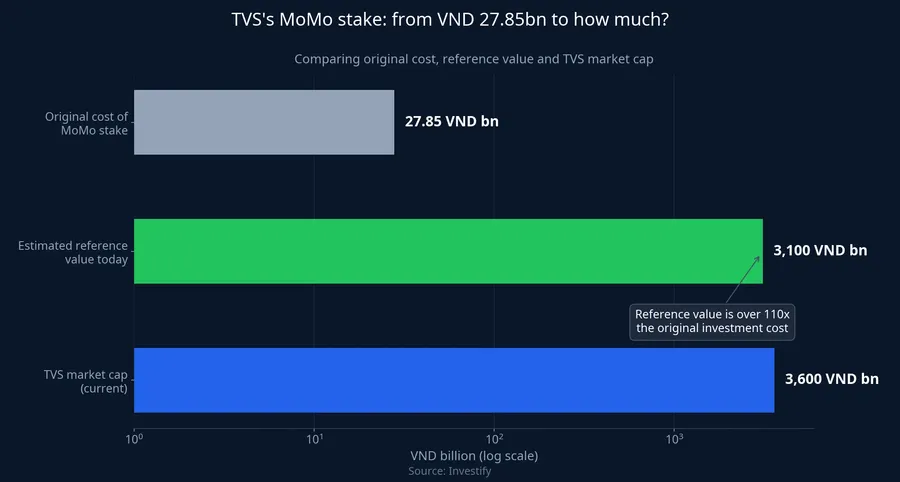
TVS is an early investor in M_Service, the operator of e-wallet MoMo. Per its 2025 consolidated financial statements, TVS holds roughly a 6% stake in MoMo at an original cost of more than VND 27.8 billion.CafeF Since MoMo shares are unlisted, the books still carry this stake at original cost.
On July 3, 2026, Reuters reported that Blackstone, CVC Capital Partners and Mitsubishi UFJ Financial Group were among the bidders for a stake in MoMo, with binding bids due in September and a possible valuation above $2 billion.TradingView If TVS still holds roughly 6% and MoMo is valued at $2 billion, that stake would carry a reference value of more than VND 3,100 billion, about 112 times the original cost.CafeF This is only an estimate based on the valuation being floated in the bidding process, not a closed transaction price. For scale: TVS's own market cap at the September 22 close was roughly VND 3,600 billion.
The market has reacted this way once before. On June 23, 2026, right after news broke that MoMo was shopping around a roughly 50% stake, TVS also hit its daily ceiling, up 6.98% to VND 13,800, and hit the ceiling again the next session.CafeF
So which driver dominated on September 22? The most recent news before the session was Decision 718, which is purely procedural. The more plausible reading is that it served as a trigger for money that was already waiting on MoMo news, arriving in the same month binding bids are due. The possibility that the market is simply re-rating the core business is ruled out by the H1 numbers themselves, since the core business is contracting, not improving. What both remaining explanations share is clear: neither comes from TVS's core operations. One is an accounting transfer within equity; the other is an expectation attached to an unlisted investment the company itself hasn't been able to value on its own books.
The unlisted portfolio is what really shapes the TVS story
At the end of 2025, the total original cost of TVS's unlisted-company portfolio stood at more than VND 407 billion, up nearly 31% from end-2024.CafeF The largest positions include Finhay at nearly VND 126.9 billion, Nam Technology at VND 59.7 billion, and Galaxy Education at VND 51 billion, alongside MoMo at VND 27.85 billion.
This structure explains why TVS's share price and its profit can diverge for long stretches of time. The value of the unlisted portfolio only shows up in the income statement at exactly one moment: when TVS sells that investment. Before that point, it sits at cost on the books while the market prices it however it likes based on expectations. That's a legitimate way to invest, but it puts investors in the position of having to judge an asset with no public reference price of their own.
Individual investors should separate two kinds of events
When a stock hits the ceiling alongside corporate news, the first question should be: does this news change the company's future cash flow or profit, or does it just change how the books are recorded?
Events that only change the bookkeeping include stock dividends, stock splits, bonus shares from capital surplus, and supplementary listings that follow them. These increase the share count without bringing new cash into the company, and the reference price is already adjusted on the ex-dividend date itself. Events that change cash flow include share offerings that raise real capital, divestments, major contracts signed, or policy changes with a direct revenue impact. This second group is the one worth re-rating a business over. Even then, the specific number still needs to be asked about.
For TVS specifically, two upcoming milestones will answer most of this story. The first is the Q3 2026 financial report, expected in late October, which will show whether proprietary trading has recovered. The second is official news on the MoMo deal: if it's announced with a specific valuation and TVS divests part of its stake, the entire expectation currently priced in converts into a real number on the income statement. If the deal drags on or the valuation lands below expectations, the only anchor left for the share price will still be the half-year's VND 9 billion in profit.