

On the morning of September 22, shares of National Citizen Bank (NCB, ticker NVB) hit the daily ceiling at VND 14,600 per share, up 9.77%.CafeF It was the second limit-up session in four trading days, and from the September 17 close of VND 11,700, the stock has climbed nearly 24.8% in just four sessions.
At the same time, NCB's board is asking shareholders to approve a private placement of 3.3 billion new shares at VND 10,000 each, raising VND 33,000 billion and lifting charter capital past VND 62,000 billion.DNSE That new share count equals 112.7% of shares currently outstanding, more than the entire existing float. Conventional intuition says an issuance that large should drag the price down. The data says otherwise, and the explanation lies in three prices that need to be placed side by side.
Three prices for the same stock
NVB currently carries three different prices depending on how you measure it. NCB's charter capital after completing a 1 billion-share offering in late June 2026 stood at VND 29,280 billion, equal to 2.928 billion shares.Tin nhanh Chứng khoán The consolidated Q2 2026 financial statements still show accumulated losses of VND 5,036.9 billion.Báo Mới Subtracting those losses from charter capital and dividing by the share count leaves a book value of roughly VND 8,300 per share, a bare-bones calculation that excludes reserves and could run slightly higher in practice.
The offering price under the proposal is VND 10,000, exactly at par and the same level NCB used in its three most recent private placements. The market price on the morning of September 22 was VND 14,600.
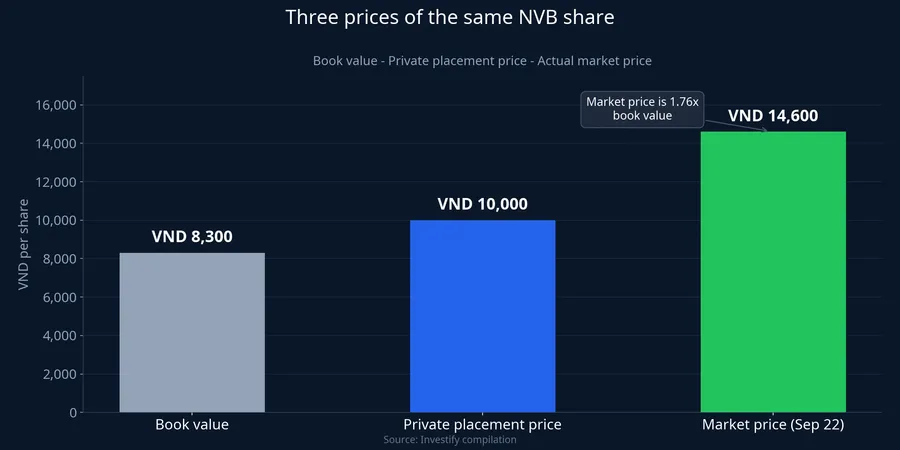
Line the three numbers up and the mechanism becomes clear. The VND 10,000 offering price sits above the roughly VND 8,300 book value, which means this issuance doesn't dilute existing shareholders' book value. It thickens it. If the plan goes through as proposed, actual book value per share would rise from about VND 8,300 to roughly VND 9,190, a gain of about 11%. This is where the phrase "112.7% dilution" is most likely to mislead: a large dilution ratio only hurts existing shareholders when new shares are sold below intrinsic value. In NCB's case, years of accumulated losses had pushed book value below par, so selling exactly at par is still selling above book value.
What actually gets diluted is profit
A thicker book doesn't mean existing shareholders lose nothing. In exchange, profit per share gets split thinner. In the first half of 2026, NCB posted after-tax profit of VND 726.7 billion, up 57% year-on-year.Thời báo Tài chính Việt Nam Q2 alone brought after-tax profit of VND 510.7 billion, the bank's highest quarterly figure on record.VnExpress Divide that half-year profit by 2.928 billion shares and each share earned about VND 248. If the 3.3 billion new shares are issued and profit stays flat, the same profit divided by 6.228 billion shares comes to only about VND 117.
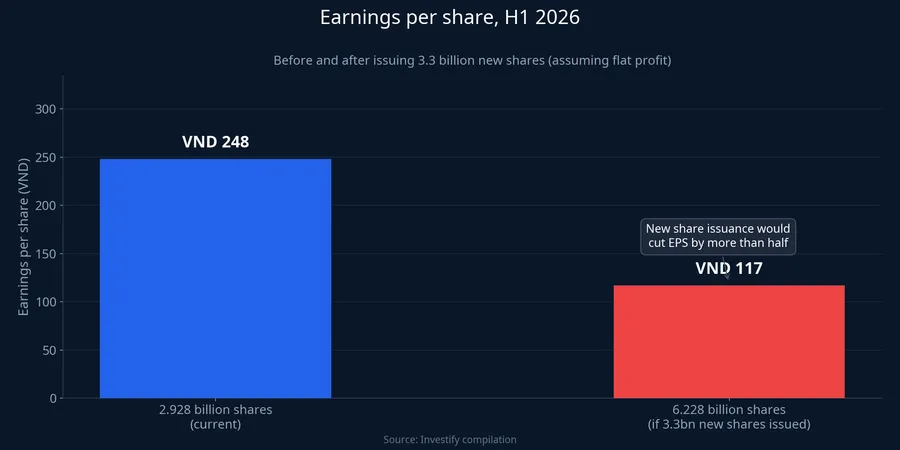
For existing shareholders to avoid a drop in earnings per share, NCB's absolute profit would need to grow by exactly 112.7%, matching the dilution ratio. The new VND 33,000 billion in capital is earmarked for credit funding in 2027-2028, not for directly resolving old bad debt.Vietstock Capital only turns into profit if it's lent out effectively, and that's the part with no data to verify yet. NCB's Q2 2026 ROE stands at just 3.63%, with NIM at 2.37%, both near the bottom of the banking sector.
A capital-raising roadmap years in the making
This issuance isn't a one-off event; it sits inside a roadmap that's been running for years. NCB's charter capital rose from VND 4,100 billion in 2021 to VND 29,280 billion by June 2026, with each prior round completing ahead of schedule.
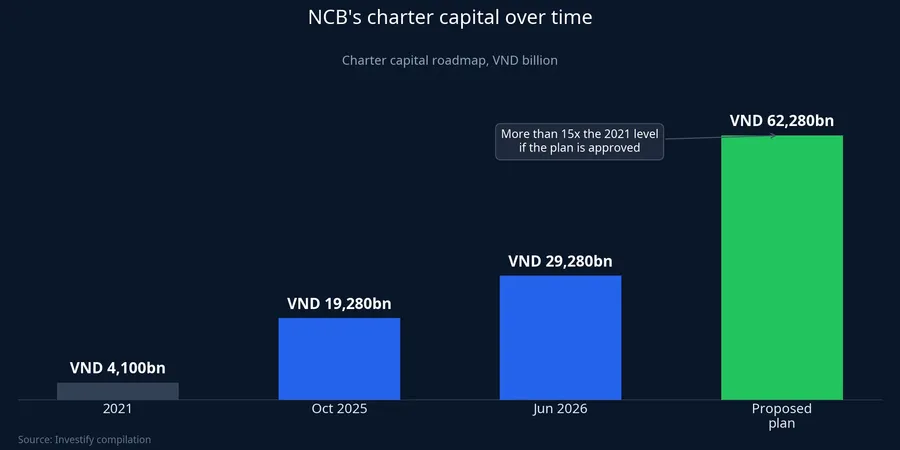
For investors who have tracked the bank closely, each new capital round signals that NCB's restructuring plan, submitted to the State Bank of Vietnam back in 2022, is on track. The capital adequacy ratio (CAR) reached 14.0% in Q2 2026, a clear improvement from the 9.6-10.2% range in 2023-2024, and that ratio is exactly what each capital round directly reinforces.
A very thin free float
The valuation mechanics explain why the market isn't reading this as bad news, but hitting the ceiling requires one more ingredient: very little stock is actually changing hands. After the 1 billion-share offering completed in late June 2026, 22 individual investors, including several board members and members of the Supervisory Board, held more than 75% of NCB's charter capital.Thương hiệu Công luận All privately placed shares remain locked up for one year from completion, except for transfers between professional securities investors or by court order.FireAnt

The trading volume reflects exactly that. On the morning of September 22, NVB traded just 1.62 million shares, worth about VND 23 billion, a very thin figure for a bank with nearly VND 29,280 billion in charter capital. When free-floating supply is small, a few tens of billions of dong is enough to push the price to the ceiling, and the reverse holds just as true when money flows out.
Where is the rally really coming from
The nearly 25% gain shouldn't be pinned on a single cause. Three explanations are equally plausible: the Q2 earnings results, the restructuring narrative described above, and thin liquidity.
The data leans toward the latter two more than the first. Q2 results were published back in late July, while the price only took off starting September 18, right as the 112.7% dilution ratio became public on September 11 and spread across the market. Earnings are likely the foundation for longer-term expectations, while the immediate catalyst for the past four sessions is tied to news of the upcoming capital round and the thin free float. That's the most reasonable reading of the available data, not a conclusion that can be verified with certainty.
The risk that hasn't been resolved
NCB's balance sheet still carries an unresolved piece. Bad debt stood at VND 8,592 billion at the end of Q2 2026, and the non-performing loan ratio at the end of Q1 2026 was 7.25%, among the highest in the banking system.Báo Mới The loan-loss coverage ratio is only about 14.75%, meaning the provisioning buffer is thin compared to the industry average. Part of the drop in the NPL ratio comes from rapidly growing loan balances inflating the denominator, not from fully resolving old bad debt.
What stage is the plan actually at
This is the detail most likely to get skipped when reading the news. The 3.3 billion-share plan was proposed by the board on August 18, 2026, is currently under shareholder consultation, and still needs approval from the State Bank of Vietnam and the State Securities Commission before it can proceed, with issuance expected in 2027. No shares have been sold under this plan as of now.
At VND 14,600, investors are paying roughly 1.76 times book value for a bank with a 3.63% ROE and bad debt among the highest in the system. The gap between market price and book value can only close in one of two ways: profit rising fast enough to offset the new capital, or the price falling. Much of this story hinges on the final offering price once the shareholder resolution is published. If the price holds at the proposed VND 10,000, the gap versus market price accrues to the private buyers; if it's raised closer to the market price, the loss to existing shareholders narrows considerably. That's the signal worth watching most closely in the coming weeks, once the resolution is formally approved.