


On September 21, 2026, the overnight lending rate between Vietnamese banks jumped 2.5 percentage points to 7.0% a year.FireAnt The same week, the four state-owned banks' online savings rate for a 12-month term stayed at 6.8% a year.Kenh14
Money borrowed for a single night is now more expensive than money deposited for a full year. The bigger picture here isn't the headline 7% figure, it's what three separate rates placed side by side actually reveal, and that story runs counter to first impressions. For anyone sitting on a few hundred million dong and wondering whether to lock in a deposit now or wait for rates to climb further, reading that story correctly matters more than any forecast.
The spike hit exactly one tenor
The most notable feature of September 21 wasn't the 7% print, it was how flat the rest of the curve stayed: the 1-week tenor held at 4.8% a year, 2-week held at 6.0%, and only the 1-month tenor ticked up 0.5 percentage points to 6.5%.FireAnt
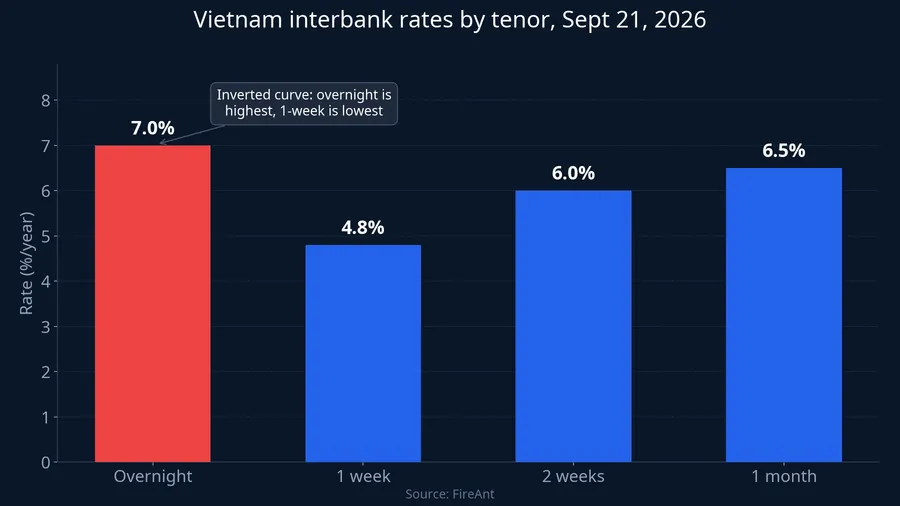
Line up those four figures and the curve breaks: overnight at 7.0% is the highest, dropping to 6.5% at 1 month, 6.0% at 2 weeks, and lowest at 4.8% for 1 week. Longer loans normally command higher rates because the lender carries risk for longer, so an inverted curve at exactly the shortest end signals a same-day cash mismatch, not a systemwide repricing of funding costs. The reason the curve breaks precisely there comes down to volume: in early September, overnight lending turnover hit roughly VND 898.8 trillion and 1-week turnover topped VND 1.11 quadrillion in a single week.Thời báo Tài chính Việt Nam When that much volume concentrates into a one-day tenor, it only takes a handful of large banks running short on cash at period-end to push the price sharply higher.
Three explanations, none sufficient alone
Money is moving for three reasons at once. As of September 3, outstanding credit of VND 20.45 quadrillion had exceeded deposits of VND 19.13 quadrillion by more than VND 1.3 quadrillion, though that gap has narrowed from roughly VND 2 quadrillion mid-year.Tin nhanh Chứng khoán The Treasury's bond issuance calendar is also running hot: the full-year 2026 plan calls for VND 500 trillion, with Q3 already at roughly 68% of target, meaning cash keeps flowing out of the banking system into the state budget.FireAnt On top of that, on September 16 the Fed raised rates 25 basis points to the 3.75-4% range, its first hike since 2023, leaving the State Bank of Vietnam with little room left to ease further.CNBC
These three forces don't cancel each other out, but they explain different things: quarter-end settlement demand explains why the spike hit exactly the overnight tenor, the credit-deposit gap explains why short-term rates have stayed elevated for weeks, and the Fed move explains why the SBV has little room left to cut. For September 21 specifically, the evidence points to the first explanation, since the other two forces had already been present for weeks while longer tenors stayed unmoved.
The SBV's response says more than the 7% figure
The week before, the SBV had been moving in the opposite direction: on the open-market repo channel, the week of September 14-18 saw a net withdrawal of VND 62,543 billion, the second straight week of net withdrawals.CafeBiz
By September 21, the direction reversed almost immediately: the SBV offered VND 63,000 billion via the repo channel at a 4.5% rate, credit institutions won VND 57,066 billion of it against just VND 9,151 billion maturing, for a net injection of roughly VND 47,915 billion.FireAnt That 4.5% is the SBV's official 7-day lending rate, well below the 7% banks were charging each other overnight, so any bank still holding eligible collateral had an incentive to borrow from the SBV instead. That's the mechanism that pulls the overnight rate back down on its own.
The same day, a second valve opened: a 7-day FX swap facility with credit institutions, capped at USD 2 billion, roughly VND 48,800 billion.VietnamFinance Banks sell dollars for dong and buy the dollars back when the contract matures a week later, so the injected liquidity flows back out on its own. The SBV had room to do this because the exchange rate was calm: the USD/VND spot rate on September 21 stood at 26,006.50 dong, up just 0.31% from a week earlier, leaving no acute FX pressure forcing it to keep dong liquidity tight. The very next session, the injection size shrank sharply to a modest net withdrawal of VND 650 billion.Người Quan Sát Injecting heavily for one session and then tapering right after is how a shock gets managed, not how an easing or tightening cycle begins.
Does the interbank shock reach your savings account
September already ran one test of that question. Right after the National Day holiday, the overnight rate jumped from roughly 1% at the end of August to 6% a year on September 3, a bigger move than the one on September 21.Thời báo Tài chính Việt Nam Deposit rates never followed: the state-owned group held its online 12-month rate at 6.8% through the first half of September, while August deposit growth came in at 0.99%, nearly five times August's 0.2% credit growth.Tin nhanh Chứng khoán
The reason is simple. The interbank market is where banks patch cash gaps over a few days; retail deposits are where they lock in stable funding for months at a time. The two markets serve different needs, so their prices don't have to move together, and waiting for an overnight spike to pull savings rates up means waiting for a transmission mechanism that this month's evidence doesn't support.
The gap savers control is far bigger
While the overall deposit rate level holds steady, the gap between specific choices is wide, and that's the part depositors actually control.
The first choice is the channel: within the same state-owned group and the same 12-month term, online deposits earn 6.8% a year, while over-the-counter rates at Vietcombank, BIDV, and VietinBank commonly sit around 5.9-6% a year, a gap of nearly 0.9 percentage points based purely on where you sign up.VOH The second is the bank itself: in the online rate table from September 20, ACB posted 7.8% a year for 12 months, the highest in the market, while Sacombank sat at 7.5%, LPBank and Saigonbank both at 7.2%.Kenh14 The state-owned group's 6.8% is a full percentage point below ACB's.
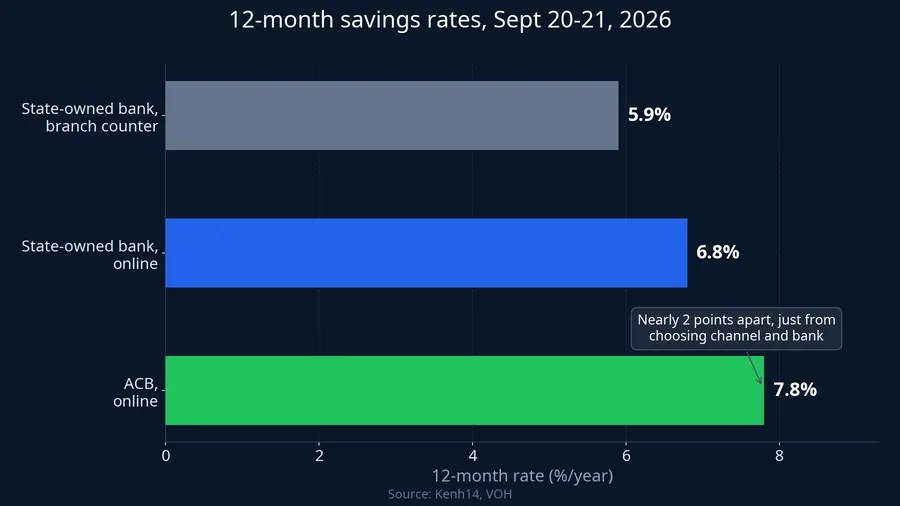
Put both choices together, and a VND 500 million, 12-month deposit could earn roughly VND 29.5 million in interest at a state-owned bank's branch counter, or roughly VND 39 million online at the highest-paying bank. That nearly VND 10 million gap is entirely within the depositor's control, and it dwarfs anything an interbank liquidity shock could deliver.
The trade-off deserves a mention too, since the higher rate isn't free. Deposit insurance covers only up to VND 125 million per person per institution, so anything above that at a smaller bank rides on that bank's own financial health. A fixed-income product outside the banking system, without that insurance layer, needs a wide enough spread over the 6.8% already available at a state-owned bank to compensate for issuer risk.
What to watch next
Whether the deposit rate floor actually moves will show up in the 1-week interbank tenor, not the overnight one. The 4.8% a year seen on September 21 is the reference point: if the 1-week tenor drifts away from that level and climbs toward the 1-month rate, the cash crunch has outlasted a single day and the deposit rate table would have reason to adjust. If the 1-week tenor keeps hovering near 4.8% while the overnight rate cools off, then September 21 closes out just like September 3 did, one tight cash session, not a new interest-rate floor. The Treasury's two remaining bond auctions on September 23 and September 30 are Q3's main remaining source of liquidity drain, making them the nearest checkpoints for this picture.