


On September 21, Wall Street closed out a record-setting session for semiconductor stocks. The Nasdaq Composite closed at 27,122.09, up 2.26%, its highest close ever and its first record since June.Doanh Nhan VN AMD shares jumped more than 9% and crossed a $1 trillion market cap intraday for the first time, becoming the fourth US chipmaker to hit that mark after Nvidia, Broadcom, and Micron, while Intel shares gained more than 11%.Tin Tuc Bitcoin AMD's $1 trillion milestone happens to line up with another trillion-dollar figure that is shaping how Wall Street prices the entire tech sector. At JPMorgan's Q2 earnings call in July, Chairman and CEO Jamie Dimon forecast that global AI spending would climb from $400 billion last year to $700 billion this year, then "a bit more than $1 trillion" next year.Motley Fool That same month, Dimon said he would not buy stocks or long-dated Treasury bonds at current prices.CNBC The bigger picture here is telling: the man forecasting the biggest wave of capital is also the one most wary of it.

Two camps that don't actually disagree on the spending number
The common framing pits AI bulls against AI skeptics and asks who's right. But the data shows that framing is wrong from the start, because both camps are working off the same set of numbers.
All four of America's largest cloud providers raised their investment plans this past earnings season. In Q2 2026 alone, Alphabet spent $44.9 billion on property and equipment, double the year-ago quarter; for the full year, it raised its target to $195-205 billion.MarketTimes Amazon is planning around $200 billion, Meta $135-145 billion. Total AI infrastructure spending across the four companies this year is estimated at roughly $700-725 billion, and Moody's estimates that figure will approach $1 trillion by 2027.FireantMarketTimes
Neither camp disputes that trajectory. What they disagree on is whose pocket that spending ultimately fills, and how long it takes to pay off. These are two separate questions, and the market is starting to grade them separately.
Branch one: real demand is footing the bill
In this branch, spending converts into revenue fast enough to justify current valuations. The most recent evidence is fairly strong.
Nvidia reported its latest quarter, ended July 26, 2026, with revenue of $96.2 billion, up 106% year over year. The Data Center segment alone brought in $89.0 billion, up 117%.Nvidia Gross margin came in at 75.0%, expanding from 72.4% a year earlier on the strength of the Blackwell Ultra product line. The company guided next quarter's revenue to around $108 billion, with gross margin easing to 74.0%, below the 75.0% it just posted.
Cloud services are accelerating in the same direction. Microsoft's Azure topped $100 billion in annual revenue for the first time, growing 43%; Amazon's AWS grew 37% to $42.2 billion in Q2; Google Cloud grew 82% off a smaller base.Vietstock This is revenue from outside customers, not internal transactions between AI companies. The September 21 rally fits the same logic: the market is paying for an AI product with real users, not for an announcement about building another data center.
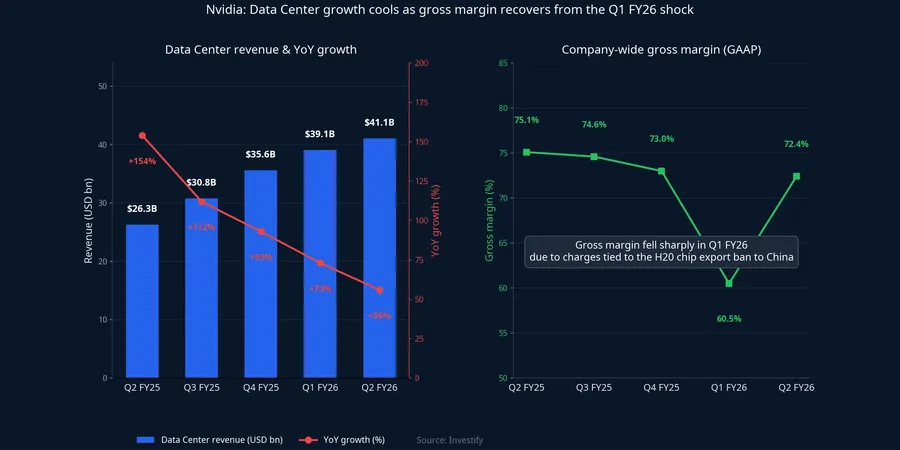
The tell for this branch is Nvidia's gross margin. Holding the 74.0% level the company guided to, alongside revenue that meets plan, means chip sellers are still passing component costs through to buyers. If that margin breaks meaningfully below guidance, that would be the first sign that competitive pressure is winning out over demand.
Branch two: money circulating inside a closed loop
In this branch, much of the headline revenue comes from within the same small circle of players, so when one link runs short on capital, the whole chain feels the pressure at once.
The structure raising concern is very specific. Nvidia invests in OpenAI, OpenAI commits to buying Nvidia chips and signs a $300 billion compute contract with Oracle, and Oracle then buys chips from Nvidia. Of the $638 billion in unfulfilled contract value Oracle reports, the OpenAI deal alone accounts for $300 billion.Seeking Alpha To fund the buildout, Oracle issued nearly $26 billion in bonds in 2025, pushing total debt above $100 billion; its credit-default insurance costs have climbed to multi-year highs, and the company cut 13% of its workforce in 2026.Bao Moi
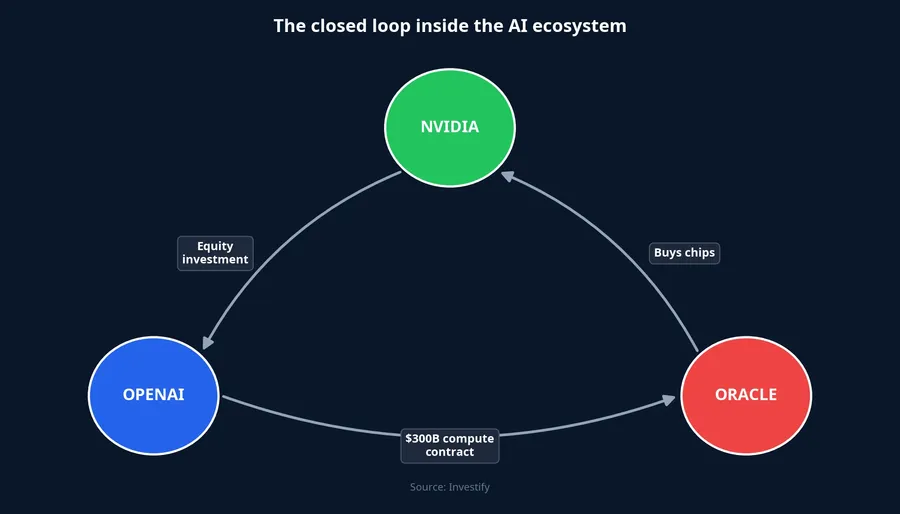
On the other end of that thread sits OpenAI. The company burned roughly $9 billion in cash in 2025, a figure projected to rise to about $17 billion in 2026, while its total long-term infrastructure commitments run to $1.4 trillion spread over eight years.Motley Fool The pressure has even reached the best-capitalized players: Alphabet posted its first quarterly cash-flow deficit since Google went public in 2004.Fireant There's another layer of risk sitting off the balance sheet: the off-balance-sheet financial obligations of Alphabet, Microsoft, Amazon, Meta, and Oracle combined are estimated at roughly $1.65 trillion, an eightfold increase in four years.Vietstock That figure needs to be read correctly: it's an undiscounted, multi-year spending commitment, not outstanding debt at a single point in time.
The tell for this branch is the cost of capital for the biggest borrower in the chain. Oracle's credit-default insurance costs and the funding rates on data-center projects keep climbing, meaning the bond market is demanding a higher risk premium than the stock market has priced in.
The market has started grading differently
There's one detail more telling than either branch above. This earnings season, Microsoft signaled lower-than-expected capital spending and committed to strong free cash flow in fiscal 2027, and its stock reacted positively. Amazon, by contrast, announced plans to spend around $200 billion, above expectations, and its stock fell more than 10% in after-hours trading. In the same vein, Fortune reported on September 14 that a trade is forming on Wall Street: chipmakers are weakening while cloud operators are strengthening.Fortune
These price reactions deserve caution in interpretation, since every session is also shaped by bond yields, index-driven flows, and results from non-AI business lines. But the pattern has repeated enough times to say the reward is gradually shifting from scale of capacity to capital discipline.
Vietnam's tech stocks are caught between the two branches
Domestic tech stocks were already under pressure before this debate reached its peak. From the August 28 session through September 21, the VN-Index fell 1.77%, while CMG dropped 6.97% and ELC dropped 11.19%. On September 21, the VN-Index closed at 1,799.67, down 0.88%, with foreign investors net-selling VND 666.5 billion on the HOSE.
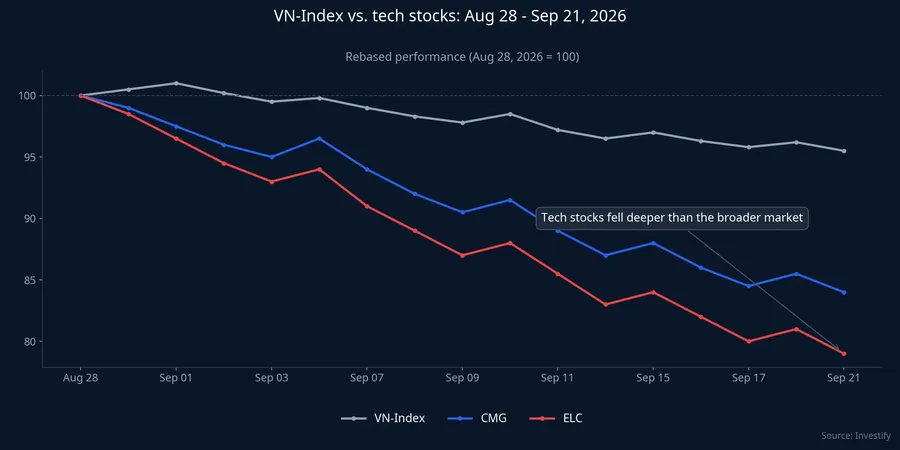
The gap between narrative and revenue is what deserves the closest look. FPT is the only company in the group that discloses specific AI revenue figures: its AI and data segment brought in VND 2,612 billion in 2025, up 40.7%.Nguoi Quan Sat As a share of the business, AI- and data-related contracts account for roughly 7% of foreign IT services revenue.Vietcap FPT stock is currently trading at a P/E of roughly 46.6x based on Q2 2026 reported earnings.

The rest of the group has even thinner disclosure. CMG operates three data centers with roughly 12MW of combined capacity and targets 70MW by 2030; its digital infrastructure segment generated VND 987.5 billion in 2025 and is forecast at VND 4,618 billion for 2026, though AI's specific contribution isn't broken out and its larger-scale data centers aren't expected to contribute until 2027.ASEAN Securities ELC discloses no AI revenue at all; its smart-transportation segment accounts for roughly 80% of Q2 2026 revenue.Tin Nhanh Chung Khoan VGI is a foreign telecom investment vehicle, and the Viettel ecosystem's AI data centers sit under Viettel IDC, not under VGI.
One easy point of confusion worth flagging: the heatsink maker benefiting from Nvidia server demand and investing nearly $1 billion in Vietnam is Taiwan's Asia Vital Components.CafeF The ticker AVC on Vietnam's UPCoM board is A Vuong Hydropower, a completely unrelated power company, not connected to this AI story at all.
What to watch
Both branches point to the same practical conclusion for domestic investors: Vietnam's tech valuations are currently anchored more to AI-revenue expectations than to AI revenue actually booked. At a few percentage points of total revenue, the AI story isn't yet strong enough to support a near-47x P/E if the global investment cycle slows. This isn't a verdict that Vietnamese tech stocks are mispriced, it's a reminder that most of that valuation is borrowing against a future that hasn't happened yet.
Three data points will resolve this story over the next two months. First, Nvidia's gross margin against its 74.0% guidance when it reports next quarter. Second, the capital spending plans the major cloud providers lay out during Q3 earnings season, and the price reactions that follow, per the pattern of Microsoft being rewarded and Amazon being punished. Third, domestically, the AI and data revenue line in FPT's Q3 report: a rising share means the story is finally backed by real money, while a flat share means the valuation is still borrowing against the future.