


On September 17, VietinBank's board approved a plan to offer 160 million bonds to the public, worth VND 16,000 billion at face value.CafeF This is only an approved plan, not an offering that has actually launched. But one detail puts it directly in front of ordinary depositors: the bonds will be distributed through VietinBank's own branches, priced at VND 100,000 each, with a minimum purchase of 100 bonds, or VND 10 million. Someone who walks into a branch to open a savings account could just as easily walk out holding a bond certificate instead.
The first tranche offers VND 12,000 billion between Q4 2026 and Q2 2027; the second offers VND 4,000 billion through Q4 2027. Unlike private placements, which are reserved for professional investors with a listed securities portfolio of at least VND 2 billion, this public offering — once the State Securities Commission issues its registration certificate — opens to any individual with VND 10 million. Most buyers will likely compare it to a savings account without realizing the two instruments sit in very different places if the bank ever runs into trouble.
Why the bank doesn't need collateral
This bond fits a familiar mold in Vietnamese banking: non-convertible, no warrants, no collateral, and structured to qualify as Tier 2 capital.Mekong ASEAN Tier 2 is the second layer of capital buffer in the capital adequacy formula. A bank that wants to lend more needs more buffer capital, and issuing new shares dilutes existing shareholders. Tier 2 bonds solve exactly that problem: they raise long-term funding, count toward the buffer, and leave the shareholder structure untouched.
Someone pays for that convenience, and it isn't the bank. For a debt instrument to be recognized as buffer capital, it has to be able to absorb losses when the bank runs into trouble, which means its creditors have to accept standing behind everyone else. The absence of collateral isn't an oversight. It's built into what this instrument is, and that's the first thing to understand before looking at the headline interest rate on the flyer.
Where you stand in the repayment line
This is the question to check before yield, not after. Subordinated bonds rank below other creditors in the repayment order if the issuer becomes insolvent.VnEconomy Depositors get paid first; Tier 2 bondholders only get whatever is left over, if anything is left over. This type of bond also lets the bank defer interest payments if paying them would push the bank into a loss for the fiscal year. No savings passbook carries that provision.
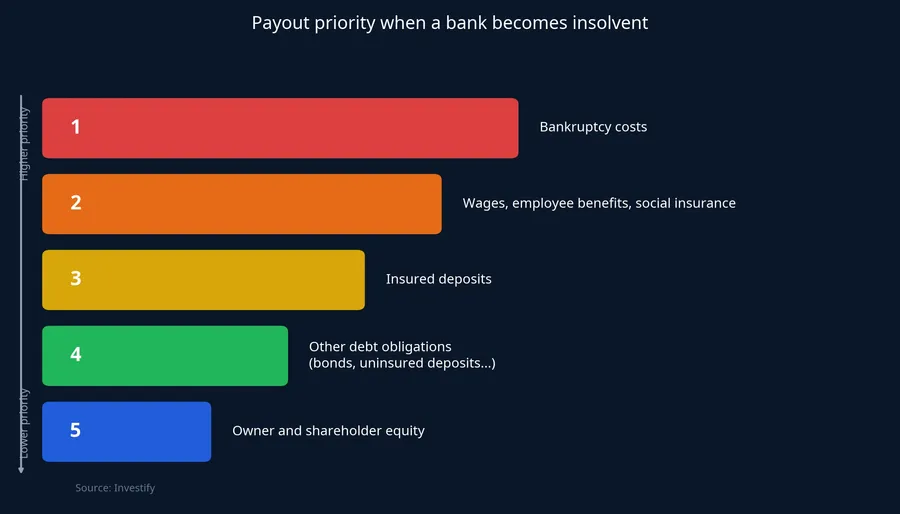
The gap widens further at the last line of defense. Starting July 13, 2026, Vietnam's deposit insurance payout cap rose to VND 350 million per person per institution, covering both principal and interest, under Circular 05/2026 issued by the State Bank of Vietnam.Deposit Insurance of Vietnam The old cap was VND 125 million. But that protection only applies to deposits denominated in Vietnamese dong. Bonds fall outside deposit insurance entirely, including bonds issued by the very bank that takes your deposits.
To be fair, VietinBank is one of the four largest state-controlled banks in the system, so the odds of it actually becoming insolvent are low. This isn't an article about VietinBank collapsing. It's about whether the extra yield you're being paid actually compensates for standing behind everyone else in line.
"Up to 2.8%" is a ceiling, not a promise
The number quoted most often in coverage is a maximum spread of 2.8 percentage points a year. Read the whole phrase, not just the number. The bond's rate floats: it equals a reference rate plus a spread, where the reference rate is the average 12-month personal savings rate across VietinBank, BIDV, Vietcombank, and Agribank. Both pieces can move. The reference rate drifts with the broader deposit market, and 2.8% is a cap, not a locked-in figure.
The bank's own repayment plan makes that clear. VietinBank assumed a reference rate of 5.9% a year, which produces a bond rate of 8.2% a year for the first five years. Subtract 5.9 from 8.2 and you get a spread of 2.3 percentage points, below the 2.8-point ceiling that dominates the headlines.
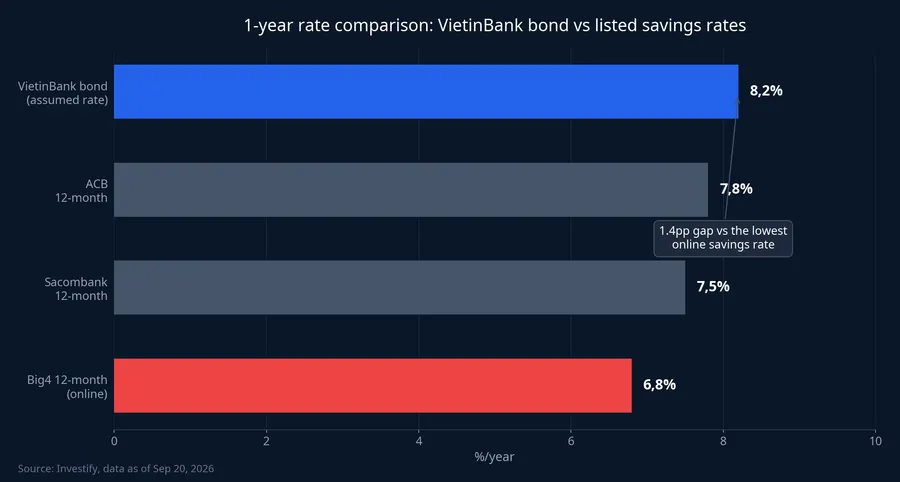
The comparison point also needs resetting. As of online rate sheets from September 20, 2026, all four state-owned banks listed 12-month savings rates at 6.8% a year.Kenh14 Against the bank's assumed 8.2%, that's a gap of roughly 1.4 percentage points. On VND 100 million, that's about VND 1.4 million a year, in exchange for a 6-year term and a subordinated position in the repayment line. Among private banks the comparison tightens further: ACB listed 7.8% for 12 months on the same day. That account is insured, senior to bonds in repayment, and close to what VietinBank is assuming its bond will pay.
The call option belongs to the bank, not to you
The bond runs for six years, but VietinBank holds the right to call it early, exactly one year after issuance. That right belongs to the issuer. You can't demand your money back early. The bank can. And that's not a clause sitting idle on paper: large Vietnamese banks, VietinBank included, have repeatedly called similar Tier 2 bonds early whenever the broader rate environment fell.

The consequence for buyers is concrete. If rates fall, the bank has every incentive to call the high-cost bond and issue a cheaper one in its place. You get your principal back right when the market no longer offers anywhere paying 8% a year. The reverse doesn't happen: if rates rise and your bond becomes less attractive than the going rate, the bank simply holds it to maturity. All the reinvestment risk sits with the buyer.
Six years, and a thin secondary market
The bond will be registered at VSDC and listed on HNX after the offering, so in theory you can sell it. In practice, liquidity in Vietnam's corporate bond market tends to concentrate heavily in a small handful of codes. Large listed bank bonds are among the easier ones to sell, but "easier" here means easier than a real estate developer's private placement, not easier than a stock or a savings account. A savings account withdrawn early forfeits accrued interest; a bond sold early depends entirely on whether a buyer shows up, and at what price.
The broader context explains why supply like this will keep coming. VietinBank's outstanding valuable papers stood at VND 142,990 billion at the end of Q2 2026, down 17.8% from VND 174,030 billion at the end of 2025, with bonds alone accounting for VND 55,721 billion.CafeF Of this VND 16,000 billion round, the bank has earmarked VND 8,000 billion for public-private partnership projects and VND 8,000 billion for real estate. Demand for buffer capital to support medium- and long-term credit growth across the banking sector shows no sign of cooling.
What to check before you commit
The offering still needs a registration certificate from the State Securities Commission, and the official prospectus will be published alongside that step. That's the document worth reading, not the summary headlines. When it comes out, look for four specific clauses: the rate-setting mechanism, to see the actual spread against the 2.8-point ceiling; the early redemption terms, to see exactly when the bank can exercise that right; the payment priority clause, usually buried in the debt obligations section; and the interest deferral clause, if one exists.
Compare those four clauses against the 12-month savings rate you're actually earning right now, not the bank's 5.9% assumption. For money you'll need within a year or two, a 6-year term paired with a thin secondary market simply doesn't fit, and a savings account remains the better home for it. For money that's genuinely long-term, the harder question remains: is the real yield gap — whether it's today's 1.4 points or whatever number the prospectus ultimately shows — enough to compensate for standing behind depositors in the repayment line. That's a calculation each buyer has to run on their own; the flyer at the counter won't run it for you.