
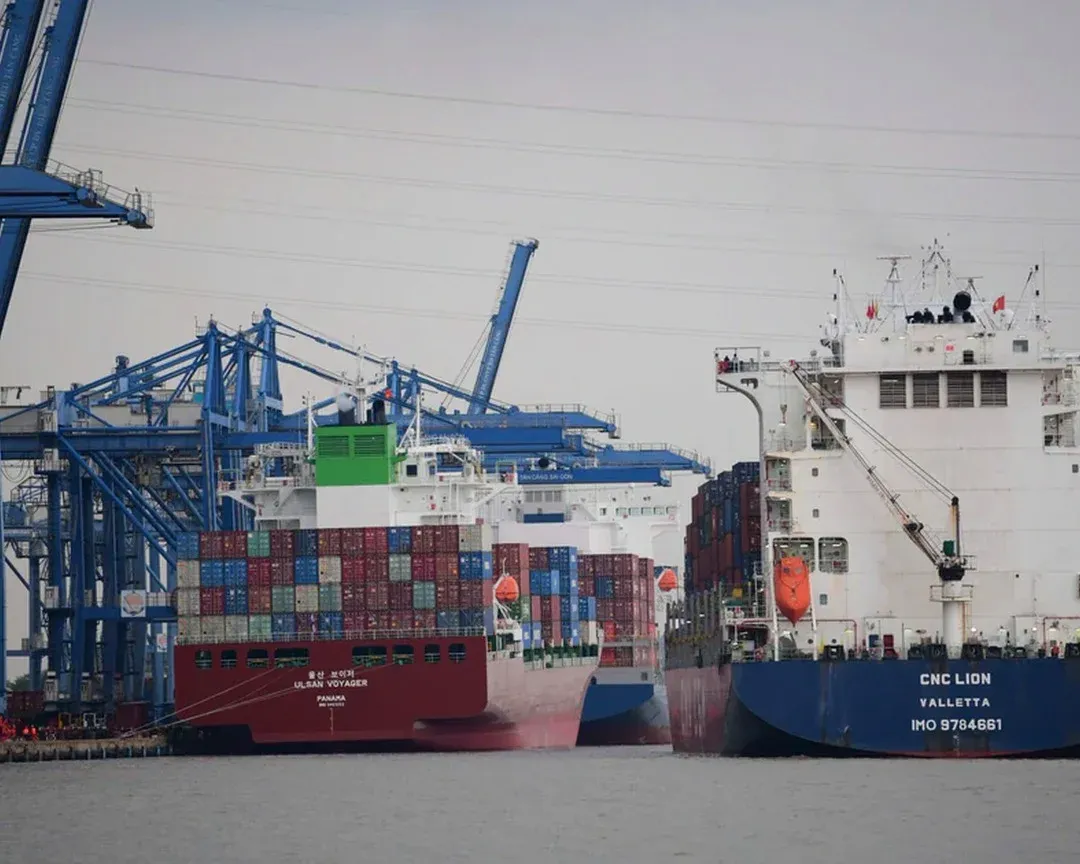

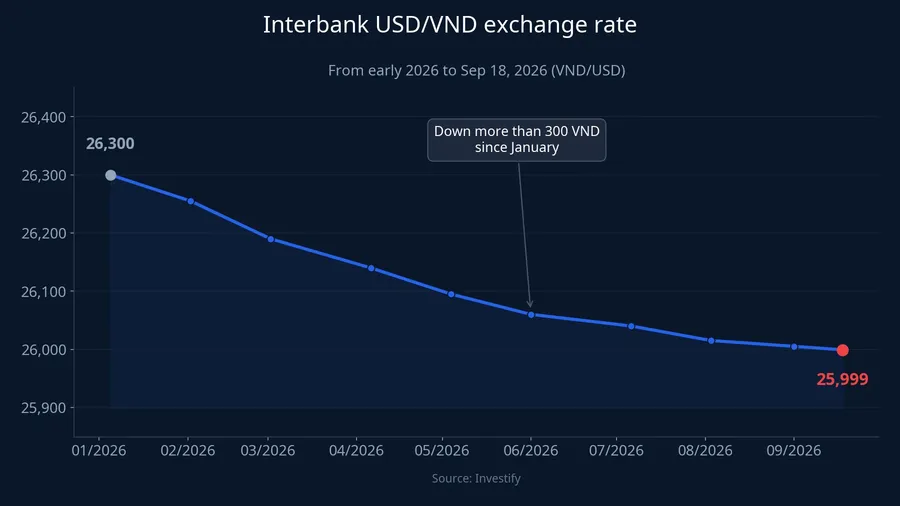
Through September 15, 2026, Vietnam's trade deficit topped $23.5 billion.Báo Đầu tư That is the largest trade shortfall the economy has ever recorded, well past the old record of roughly $18 billion set across the full year of 2008.VnBusiness Over the same window, one US dollar traded for 25,999 VND on the interbank market on September 18, down from around 26,300 at the start of the year. The dong appreciated roughly 1.1% in the very year the country posted its largest-ever trade deficit.
That is the tension worth sitting with. If a record trade deficit were truly draining foreign currency the way most people assume, the exchange rate could not be moving in the opposite direction.
Why the worry makes sense
The concern is not baseless. Vietnam has spent nearly a decade running trade surpluses, and the last time the balance flipped sharply negative was 2008-2011, when the deficit arrived alongside double-digit inflation and repeated currency devaluations. That memory still lingers for veteran investors.
This deficit run is not a one-off month either. The first deficit month was December 2025, at $554 million, and as of the end of August 2026 the balance had not turned positive once since.Tuổi Trẻ Nine straight months is a pattern, not statistical noise.
Three facts that cut against the worry
The first fact is export momentum itself. Through September 15, exports had topped $400 billion, up 23.2% year-on-year, while imports reached $424.35 billion, up 36%.Người Quan Sát Both sides of the ledger are expanding fast, just at different speeds. This deficit is the gap between two rising lines, not one line climbing while the other falls.
The second fact is what Vietnam is actually buying. Per the Ministry of Industry and Trade's five-month data, production inputs accounted for 94.1% of total import value, while consumer goods made up just 5.9%.Người Quan Sát The money is flowing out to buy inputs for production and investment, not to bring in foreign consumer goods.
The third fact is the exchange rate itself. If a $23.5 billion deficit were genuinely draining foreign-currency reserves, the dong would have had to weaken. Instead, realized FDI disbursement over eight months reached $17.25 billion, the highest in five years, on top of remittances and tourism receipts.Doanh Nhân Foreign currency enters the economy through multiple doors, and the trade balance is only one of them.
The familiar reassurance doesn't hold up either
The most common explanation is that Vietnam is importing machinery to build new electronics and semiconductor factories, so today's deficit is tomorrow's export revenue. The customs data doesn't back that story at the scale it's usually told.
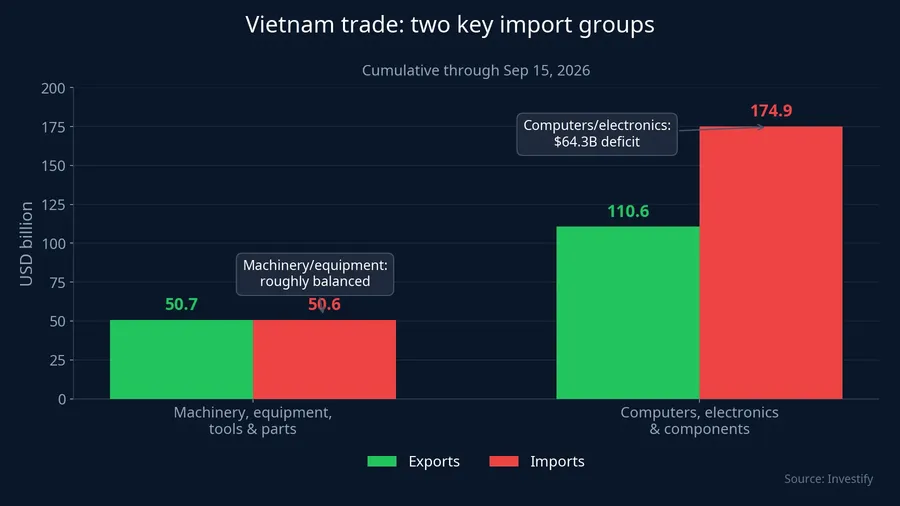
Through September 15, the machinery, equipment, tools, and parts category exported $50.7 billion and imported $50.6 billion, essentially balanced.Báo Đầu tư The economy-wide deficit comes from an entirely different category: computers, electronics, and components. That group imported $174.9 billion and exported $110.6 billion, a $64.3 billion deficit, nearly triple the economy's overall trade gap and about 41% of the country's total import value.Tinnhanhchungkhoan
It's the price of chips, not the volume
A significant part of that increase is price, not volume. Phan Quốc Bửu, Director of the Analysis Center at BIDV Securities (BSC), argues that electronics import value has climbed rapidly even where volume hasn't kept pace, because memory chips and processors have become markedly more expensive.Tuổi Trẻ TrendForce reported that global DRAM industry revenue jumped 59.5% quarter-on-quarter in Q2 2026, to nearly $155 billion, driven mainly by higher contract prices rather than higher unit sales.Tinnhanhchungkhoan

Most of the global memory-chip supply is being absorbed by AI data centers, and Vietnam sits on the side that pays that price rather than the side that sets it. That's the real reason the electronics trade gap has widened even though domestic assembly plants haven't suddenly cut production.

Three competing explanations
The causal story here isn't settled, and different securities firms are leaning in different directions. Vietcombank Securities ties the deficit to domestic demand, pointing to stronger imports of machinery, raw materials, and inputs amid a push in public investment. Rong Viet Securities ties the gap to Vietnamese enterprise capacity, arguing the deficit "also reflects limitations in domestic production and export capability." BIDV Securities leans toward input prices.
The available data best supports the third explanation, with the second as a secondary factor. The DRAM price surge is a measurable number, while the pure machinery-and-equipment category is nearly balanced. That means the "importing machinery to build factories" story only accounts for a small slice of the total figure. That doesn't rule out the other two explanations; it just demotes them to a supporting role.
The number that actually deserves attention
The figure worth watching most closely isn't $23.5 billion — it's how fast the FDI sector's trade surplus is shrinking. Per General Statistics Office data released in early September, the FDI sector still ran an eight-month surplus of $10.13 billion, down from $29.61 billion in the same period a year earlier.Tuổi Trẻ Through September 15, that surplus had narrowed further to just $8.74 billion.Báo Đầu tư Meanwhile, domestic enterprises posted an eight-month deficit of $30.60 billion, up from $15.58 billion a year earlier, and their exports grew just 7.4% versus 26.9% for the FDI sector.
The cleanest way to measure this whole story is the conversion ratio. Over eight months, every additional dollar of electronics imports has come with only 52 cents of additional exports. Include phones and the ratio rises to 63 cents. Combine both categories and the assembly segment ran a $21.85 billion deficit over eight months this year, compared with a $2.06 billion surplus in the same period last year.
If that conversion ratio climbs in coming periods, it means imported components are flowing straight into production lines and back out through the ports, and the deficit should narrow on its own. If it keeps falling, it means Vietnam is paying more for the same volume of assembled goods, and the value retained domestically is thinning out.
What to watch next
Concluding a working session with the Vietnam Electronics Industries Association, Standing Deputy Prime Minister Phạm Gia Túc instructed the Ministry of Industry and Trade to clarify the state of electronics exports, imports, and the trade deficit, with the review due by the end of September 2026, and to meet directly with companies showing the widest gap between import and export value.Tinnhanhchungkhoan A separate task is to review the list of priority supporting industries for the electronics sector, due by October 2026.
For investors, the useful framework right now is to separate two questions. The currency-risk question already has a tentative answer: FDI inflows, remittances, and tourism are covering the gap, and the foreign-exchange market hasn't shown signs of strain. The growth-quality question remains open, and it will be answered by how much value Vietnam retains from every dollar of exports in the reporting periods ahead.
The clearest beneficiaries of this cycle are domestic firms that have managed to plug into foreign-invested supply chains: electronic components, precision engineering, industrial packaging, and port logistics. The group under more pressure is pure assembly operations, where input costs are rising faster than selling prices.
The $23.5 billion figure doesn't measure the health of Vietnam's exports. It measures the price of memory chips worldwide and the pace of FDI sector expansion. Both of those can reverse, but not necessarily on the same schedule as the trade balance. September's trade data and the Ministry of Industry and Trade's review, due later this month, will be the nearest checkpoints for the assembly sector's conversion ratio.