
In the first eight months of 2026, Vietnamese investors opened more than 2 million new brokerage accounts.Nhân Dân Most of that money went into self-directed individual accounts, not through professional funds. That is exactly what the Ministry of Finance wants to change, and the gap between the target and the current reality is wider than most people assume.
A 6x target starting from 0.8% of GDP
On September 12, 2025, Vietnam's Ministry of Finance approved a restructuring plan for investors and the securities fund industry under Decision 3168/QĐ-BTC, targeting 500 funds, 2.5 million fund-certificate holders, and total fund NAV equal to 5% of GDP by 2030. That target was later reaffirmed at the government level under Decision 1413/QĐ-TTg on July 27, 2026.
The starting point shows just how steep that climb is. With 2025 GDP at roughly VND 12.85 quadrillion, securities fund NAV today is equivalent to about 0.8% of GDP.Tin Nhanh Chứng Khoán Getting from 0.8% to 5% means the fund industry has to grow more than sixfold in four years, even if the economy itself stays flat. For comparison, HOSE market capitalization had already passed 72% of GDP by the end of 2025.VnEconomy The market itself is already large; the layer of professional funds standing between household savings and that market is still thin.
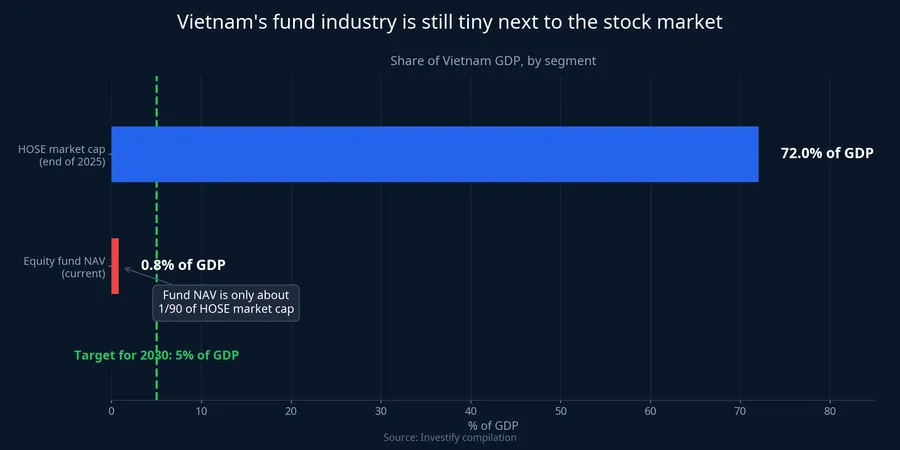
This gap is not unique to Vietnam. By total assets under management, Thailand sits above 31% of GDP and Malaysia above 56%, while Vietnam is around 6%.Thời báo Tài chính Việt Nam Note that the two figures measure different things: the 6% AUM figure covers the whole industry, including institutional mandates, while the 0.8% figure is specifically securities fund NAV.
Three years of results say the opposite
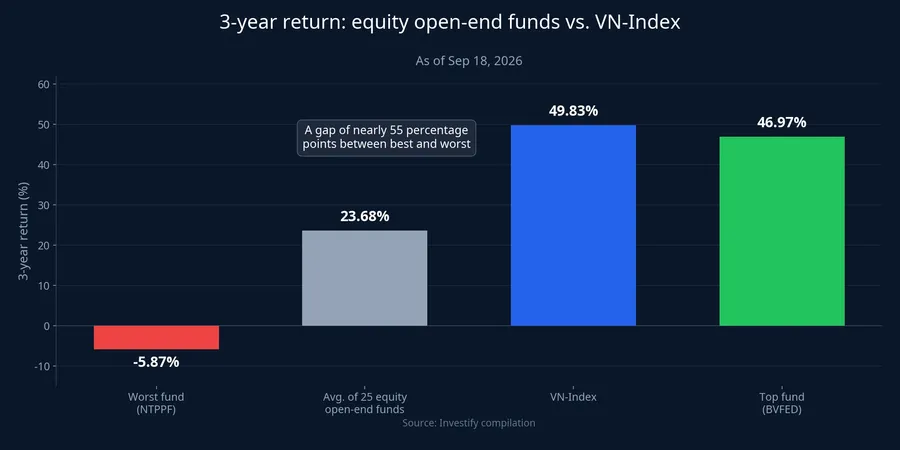
This is where the story splits from the policy pitch. Of 38 active equity open-end funds, 25 have a three-year track record long enough to compare. As of the September 18, 2026 session, not one of those 25 funds kept pace with the VN-Index: the group's average three-year return was 23.68%, versus 49.83% for the index.
Shorter windows tell the same story. Over one year, 34 funds averaged a negative 9.08% return while the VN-Index gained 9.04%. Over two years, 28 funds averaged 12.14% against the index's 43.54%. Only when the window stretches further does the picture change: over five years, 5 of the 14 funds old enough to qualify did beat the VN-Index, though the group average (27.65%) still trailed the index (34.23%) by about 6.6 percentage points. If stock-picking skill exists among fund managers, it only starts to show up over long cycles, not in a year or two.
This year has been harder still. Per FiinTrade data, 56 of 88 equity funds, or 64%, posted negative returns in the first half of 2026, nearly double the 35% rate in the same period of 2025.VnEconomy
Picking stocks yourself is no easier
Stop the story here and the obvious conclusion is "better to just pick stocks yourself." The numbers don't back that up either. In 2025, the VN-Index rose 40.87%, but according to Dragon Capital, only about 17% of stocks outperformed the index, the lowest rate in more than 25 years of market history, while over 46% of stocks posted negative returns.VnEconomy That year's rally was concentrated in a narrow group of large-cap names, so an investor picking a handful of stocks at random had a much higher chance of losing to the index than beating it.
In other words, both paths lost to the index over the past three years, just in different ways. That difference, not the question of "which wins," is what investors actually need to weigh.
Three criteria for weighing the two paths
Baseline cost. The average management fee across the 38 equity open-end funds is 1.58% a year, ranging from a low of 1.0% to a high of 1.95%. That fee is charged regardless of whether the fund makes or loses money. Self-directed traders skip the management fee, but pay a transaction fee on every trade, margin interest if they use leverage, and the time cost of watching the market daily.
Dispersion of outcomes. Choosing a fund is still a decision, not a way to avoid one. Among the 25 funds with three years of history, the best performer returned 46.97% while the worst returned negative 5.87%, a gap of more than 52 percentage points. That range is far narrower than the dispersion of an individual portfolio concentrated in a handful of stocks, but it is still wide enough that picking the wrong fund is a real risk.
Barrier to entry. Purchase fees are close to zero at 34 of the 38 funds. Recurring investment programs typically start at a minimum of VND 100,000 per contribution, with some funds accepting as little as VND 10,000. Capital is no longer the barrier. The more relevant cost is the early-redemption fee, commonly 1.5-2.0% and as high as 3.0% at some funds for short holding periods, which then tapers to zero the longer an investor stays in.
One observation ties all three criteria together: the fund with the lowest management fee in the group, BVFED from Bảo Việt Fund at 1.0% a year, is also the three-year return leader at 46.97%. That is a single case, not enough to prove low fees cause high returns. BVFED's result could come from its stock selection, its allocation timing, or simply the low fee reducing the drag on compounding. But when the whole group is losing to the index, every percentage point of fee is a certain deduction, while the payoff for paying it is not.
Real money flows are moving against the target
While the plan calls for sixfold growth, investors have been pulling money out of funds. More than VND 20 trillion was net-withdrawn from investment funds in the first half of 2026.Báo Đầu tư That withdrawal streak did break: in July 2026, equity open-end funds took in a net VND 884 billion, reversing two straight months of outflows.Thời báo Tài chính Việt Nam
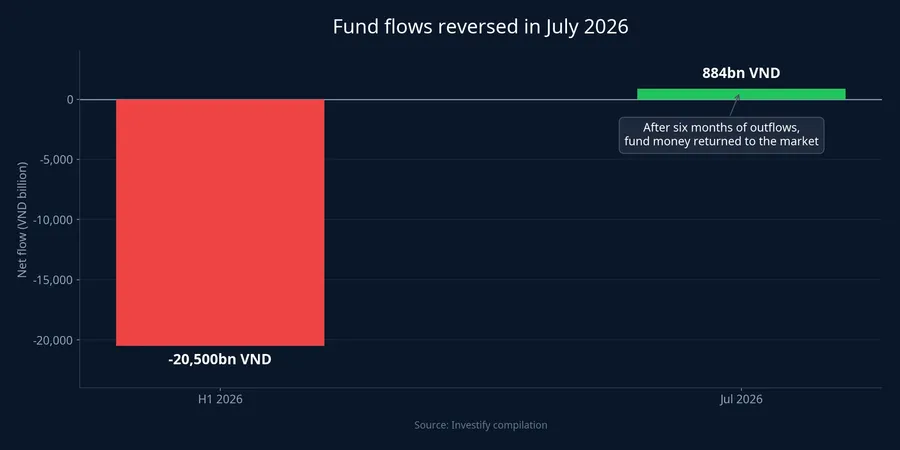
One month isn't a trend, but it points to something important: money is flowing into funds based on recent performance, not on policy targets. As long as the three-year track record looks like it does now, the 5% of GDP target remains a number on paper.
How to weigh this for your own money
For investors who don't track the market daily, the common standard is to separate what you're actually paying for: index-tracking exposure and active management. Index-tracking products deliver near-index results at low cost. Active open-end funds charge an extra 1.58% a year on average, and over the past three years that extra fee has not bought better-than-index results at any of the 25 funds. What it does buy is discipline and lower dispersion: the worst three-year result among the group was negative 5.87%, while an individual portfolio concentrated in a handful of stocks can do far worse.
For investors picking their own stocks, the most honest test is to measure portfolio returns against the VN-Index over the same period, not against each stock's cost basis. The VN-Index closed the September 21 session at 1,799.67 points, down 0.88%, a free and always-available benchmark for fund investors and self-directed traders alike.
As for the 5% of GDP target for 2030, the signal worth watching in the coming months isn't how many new funds get licensed, it's net inflows into equity funds. If July's inflow streak extends through the fourth quarter, that would be evidence investors are starting to trust the fund channel. If outflows resume, the policy target and actual market behavior will keep moving in opposite directions.