


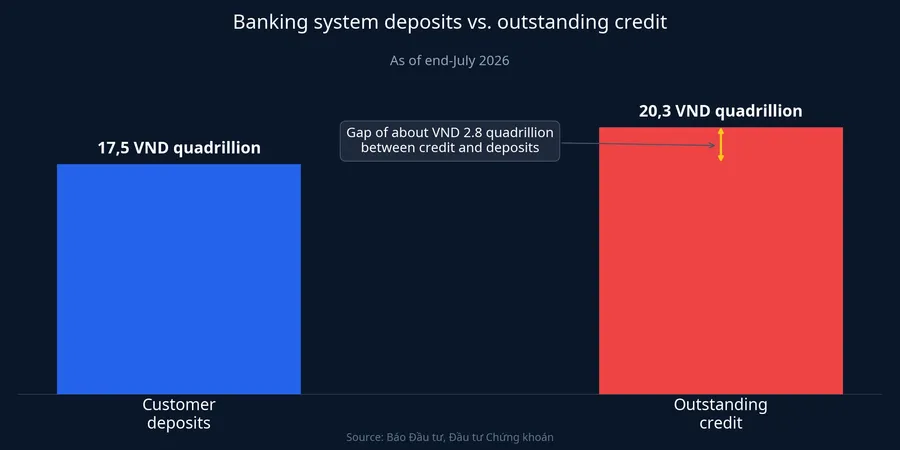
By the end of July 2026, deposits from households and businesses across Vietnam's credit institutions reached VND 17.46 quadrillion, an all-time high.Báo Đầu tư Set against outstanding credit of VND 20.26 quadrillion at the same point, for every VND 100 banks raised in deposits, roughly VND 116 had already been lent out to the economy.Báo Đầu tư The nearly VND 2.8 quadrillion gap does not appear out of nowhere, and the more troubling question is not where the money came from, but why old money has not cycled back yet.
The gap between two flows
In the first seven months of 2026, deposits grew by VND 945 trillion, or 5.72% from end-2025, while banks pumped out nearly VND 1.67 quadrillion in credit.Tinnhanhchungkhoan That gap of over VND 720 trillion forces banks to buy funding elsewhere, mainly by issuing valuable papers such as certificates of deposit and bank bonds. Outstanding valuable papers at 26 listed banks reached VND 1.96 quadrillion by the end of Q2 2026, up 23.6% year-on-year, three times the growth rate of customer deposits, and this is the most expensive funding source in the mix.Thời báo Tài chính Việt Nam The share of customer deposits in listed banks' total funding fell from 64.6% to 59.8% over the past six quarters, while interbank funding rose from 13.4% to 16.5%. The more banks lean on expensive funding, the harder it is to bring down their cost of capital.Thời báo Tài chính Việt Nam
There is a second mismatch underneath: household deposits climbed 8.56% since the start of the year to VND 11.22 quadrillion, while corporate deposits grew just 0.98% and actually fell by about VND 130.7 trillion in July alone, as businesses withdrew cash for production and operations.Báo Đầu tư Corporate deposits are the cheapest funding banks have; the system is losing that cheap source while having to buy more of the expensive kind.
What the numbers don't spell out: lent capital that hasn't come back
Those two layers explain most of the funding squeeze, but they miss the hardest part to untangle: banks don't just need fresh money coming in, they need old money coming back to fund the next lending cycle. Among 27 listed banks, bad debt at the end of Q2 2026 stood at VND 310 trillion, up VND 43 trillion year-on-year, even as the headline bad debt ratio held at 2.01%, down slightly from a year earlier.Người Quan Sát The two directions are not actually contradictory: outstanding loans are growing faster than bad debt, so the ratio looks reassuring while the absolute figure does not.
The real risk sits in a less-discussed line item. As of June 30, 2026, accrued interest and fees receivable at 27 listed banks reached VND 230.745 trillion, up 36.1% year-on-year, while outstanding loans grew only 17.8%.Người Quan Sát This is interest already booked as income that customers have not yet paid, on loans still classified as Group 1. The ratio of accrued interest to outstanding loans rose from 1.30% to 1.50%, the highest in six half-year periods, equal to 28.9% of the industry's trailing 12-month operating income. TCBS Research notes this does not mean the entire balance will have to be reversed out of income, since loan-term structure and grace periods play a role that the disclosed figures cannot isolate. But when a loan is reclassified into a worse group, the bank must reverse the booked interest and set aside provisions in the same period.
The accompanying signal is no more comforting. Group 2 loans, the "loans requiring attention" category, have risen for two straight quarters, from 1.17% at end-2025 to 1.38% at end-Q2 2026, and TCBS Research says that increase could migrate into bad debt within one to two quarters if the reclassification pace holds.Người Quan Sát Add it up, and the system is carrying over VND 310 trillion locked in bad loans and more than VND 230 trillion in interest that exists only on paper. That is capital that left the vault but hasn't come back, and no liquidity injection can pull it back in.

Why the State Bank chose to drain, not inject
In the week of September 14-18, the State Bank of Vietnam net-drained more than VND 62.543 trillion through open market operations, rather than injecting more.Thời báo Tài chính Việt Nam The overnight rate fell to 3.2%, while the one-month rate stayed at 6.0%, and that curve makes one thing clear: the system is not short on cash, only on term funding.Thời báo Tài chính Việt Nam
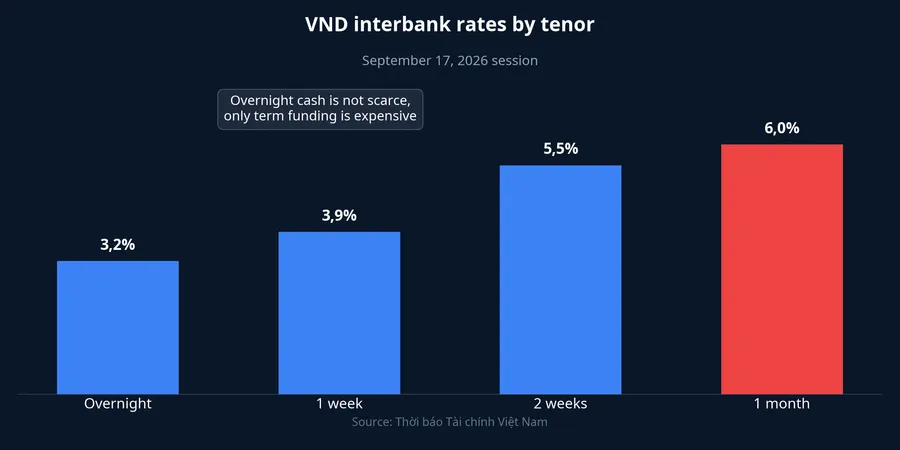
Pumping more liquidity through open market operations only creates money that lasts days to weeks, while banks need funding for medium- and long-term loans. A heavier injection would also pressure the exchange rate as the dollar strengthens, and risks channeling more credit into loans that are already turning sour. That is why the tool chosen targets the debt locking up capital, not short-term liquidity.
Decree 359: a real tool, not a magic fix
On September 17, 2026, Deputy Prime Minister Nguyễn Văn Thắng, on behalf of the Government, signed Decree No. 359/2026/NĐ-CP establishing the Vietnam Asset Management Company (VAMC), with charter capital of VND 5 trillion, effective from November 6, 2026.Báo Chính phủ The period between now and then is for building the organization and internal rules, not for buying debt yet.LuatVietnam
Placed next to VND 310 trillion in bad debt, VND 5 trillion in charter capital looks tiny, and it would be, if the company used cash to buy debt outright. The core mechanism is not cash: the company can buy bad debt at market value or with special bonds carrying a maximum five-year term and a 0% coupon, and those bonds can then be used to borrow refinancing from the State Bank.Bnews A bad loan leaves the bank's balance sheet and turns into paper that can be taken to the State Bank for funding. Banks get capital back to lend for another round, and liquidity gets injected at the exact point it's needed instead of flooding the whole market.

But look closely at the limits and this is no magic fix. Special bonds don't erase the loss, they defer it: the selling bank still has to provision against the bond itself on a set schedule, and if the company can't recover the debt, it lands back on the bank's books when the bond matures. A 0% coupon also means the selling bank bears an opportunity cost for the life of the bond, turning an income-generating asset into one that generates nothing, a tradeoff worth weighing rather than a gift. How fast this actually works also depends on something outside the decree's reach: the liquidity of collateral, most of which is real estate. As long as the transfer market stays slow, a debt that has changed hands still sits idle.
Two other explanations, and why they fall short
Bad debt and unpaid interest aren't the only explanation. Term mismatch between deposits and lending holds some truth too, and the State Bank raised the share of State Treasury deposits counted in the LDR formula to 50% starting August 1, 2026, precisely to ease that pressure. Credit growth itself is also running fast, up 8.98% over seven months, fast enough to strain funding regardless of asset quality.
But the data doesn't point most strongly to either explanation. If this were purely about term mismatch or growth pace, funding costs would fall as soon as system-wide liquidity turned ample. In reality, the overnight rate has dropped to 3.2% while the one-month rate holds at 6%, and banks are still ramping up issuance of pricier valuable papers. That points more toward capital trapped in assets that aren't cycling back, and the Government's choice to issue a debt-resolution decree rather than loosen monetary policy fits that same reading.
Three dates to watch
The plan for roughly 15% credit growth in 2026 translates to about VND 2.79 quadrillion of fresh credit for the year.VnEconomy The first seven months already used nearly VND 1.67 quadrillion, leaving about VND 1.1 quadrillion for the last five months, and if deposit growth doesn't keep pace, the gap still has to be bought with expensive funding. Three dates are worth watching: mid-October, when August deposit data is released, especially whether corporate deposits resume growth after July's VND 130.7 trillion drop; late October, when Q3 bank earnings land, with the accrued-interest-to-loans ratio worth checking against Q2's 1.50%; and November 6, when Decree 359 takes effect, the point from which the actual scale of debt purchases can finally be tracked.
Bad debt and unpaid interest are the leading reason a record-setting deposit base still comes with a funding squeeze, more so than term mismatch or the pace of credit growth. Decree 359 opens a real channel for resolving it, but it buys time rather than erasing the loss, and its speed depends on real estate liquidity, something no policymaker controls directly. For savers, the read is simpler: as long as credit keeps outrunning deposit growth and valuable-paper issuance keeps growing three times faster than deposits, deposit rates are unlikely to fall much in the coming quarters.