
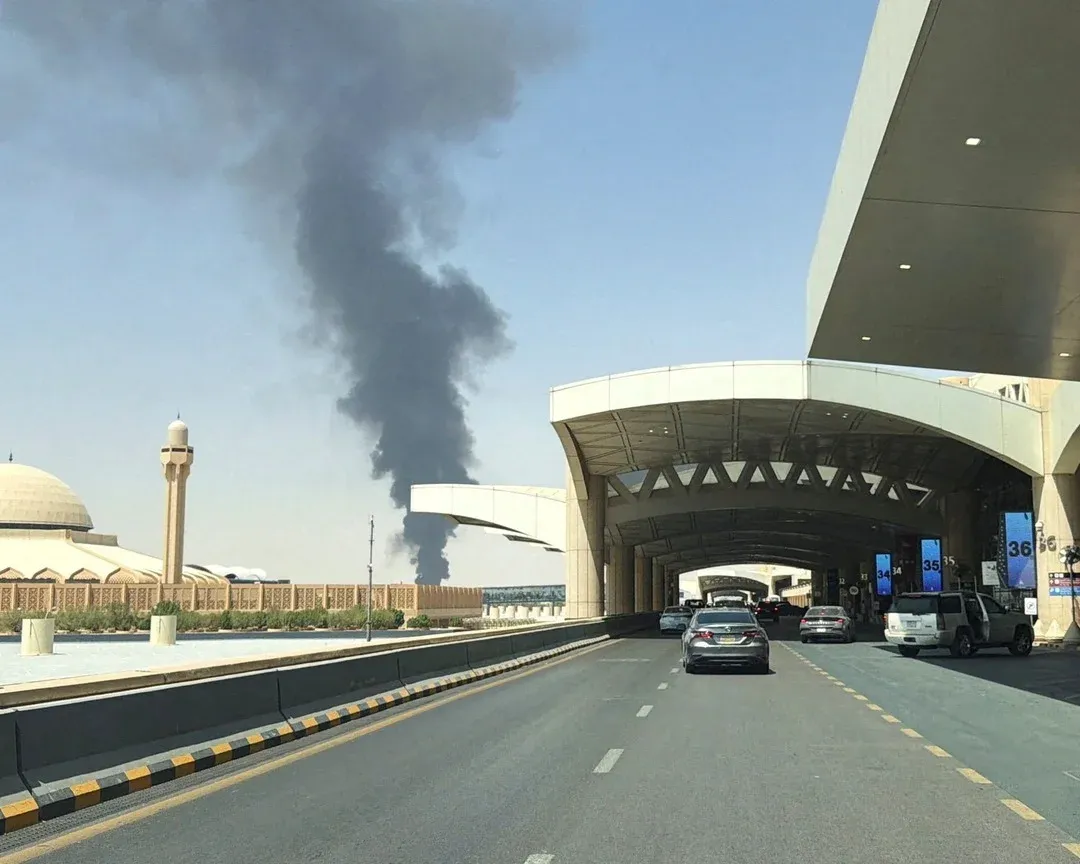

On the morning of September 19, air-raid sirens sounded in Riyadh as the Saudi-led coalition intercepted a ballistic missile aimed at the capital, the first time Riyadh itself had been targeted since fighting with Houthi forces escalated.Al Jazeera Residents near King Khalid International Airport watched black smoke rise into the sky as flights were delayed and cancelled, though officials reported no casualties or infrastructure damage.France 24
For anyone holding oil and gas stocks, what didn't happen matters just as much as what did: no production or refining facility was hit in the September 19 strike. The real supply shock had already happened eight days earlier, and it left a trail of measurable data.
The damage that was already priced in by September 11
On September 11, Saudi Arabia's 1,200-km East-West Pipeline, the route that bypasses the Strait of Hormuz by carrying crude from the Eastern fields to the Red Sea port of Yanbu, was hit by drones. Three pumping stations were damaged; Aramco aimed to restore about half of capacity within days, while full restoration was estimated to take roughly six weeks.Shafaq News The fallout came immediately: Aramco told European refiners they would receive no crude cargoes in October, cancelling their entire long-term contract allocation.Middle East Monitor This is a multi-week production shortfall, a fundamentally different kind of event from a missile intercepted in a single day.
Oil prices had already moved before the news broke
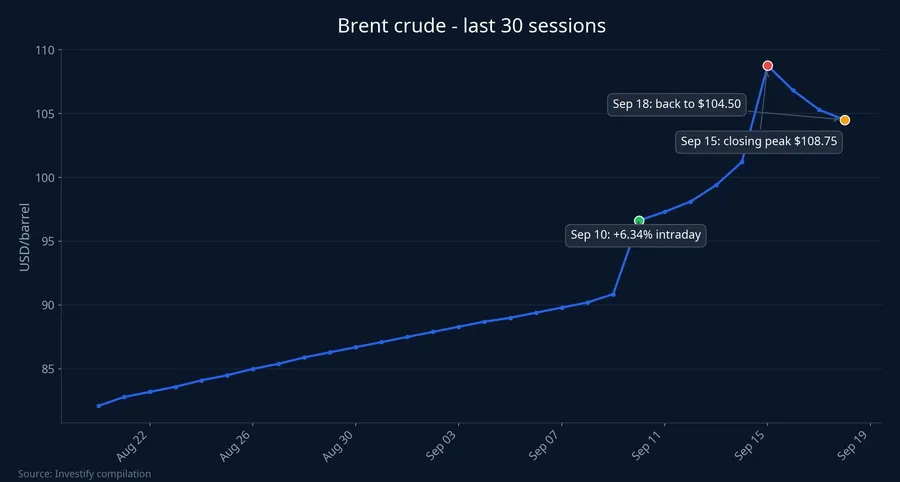
Brent opened September at $94.65 a barrel, jumped 6.34% intraday on September 10, then closed the month's high at $108.75 on September 15. What stands out is the three sessions that followed: down 2.69% on September 16, down 0.95% on September 17, and down another 0.30% on September 18 to close the week at $104.50, even as tensions showed no sign of easing. Zoomed out, Brent is still up 15.5% from $90.49 at the end of August and up 72% from the start of 2026, but most of that gain had already formed before September 19. The Riyadh strike fell on a Saturday, when oil markets were closed, so Monday's September 21 session will be the first time the market actually prices in that event.
Vietnam's oil and gas stocks have stopped moving together
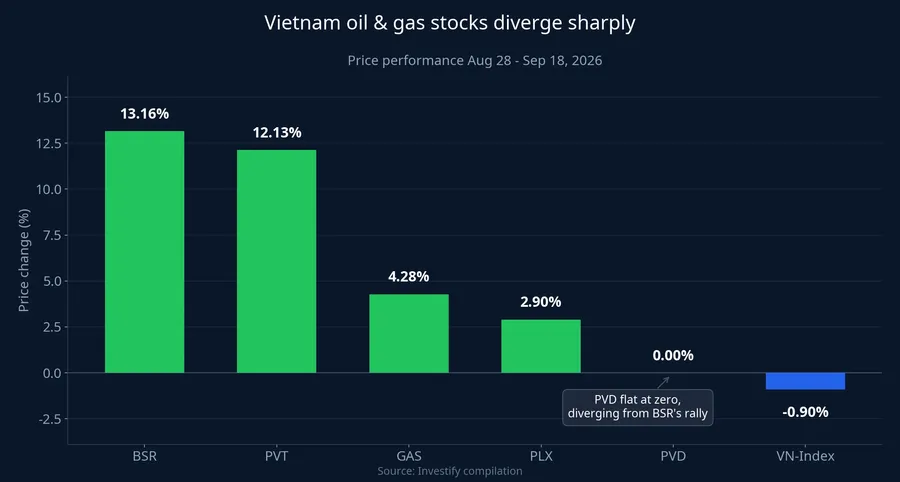
This is where domestic investors are most likely to misread the situation. From August 28 to September 18, while the VN-Index fell 0.90%, six major oil and gas stocks followed six different paths: BSR (refining) rose 13.16% to VND 30,100, PVT (crude shipping) rose 12.13% to VND 22,650, GAS gained 4.28%, PLX gained 2.90%, while PVD closed at VND 19,150 on September 18, exactly matching its August 28 close, unchanged to the dong over three weeks.
One other factor deserves acknowledgment: the week of September 14-18 was also when index funds rebalanced ahead of the FTSE upgrade taking effect, so part of the group's rise came from broad fund flows rather than oil prices alone. But the more-than-13-point gap between BSR and PVD over the same three weeks can't be explained by fund flows. It comes down to the fact that these two companies' profits flow through completely different channels.
Despite the rally, all 11 oil and gas stocks across Vietnam's three exchanges are still more than 20% below their previous highs as of September 16, meaning oil prices are recovering faster than the sector's share prices.Vietstock
Why BSR and PVT led while PVD sat out
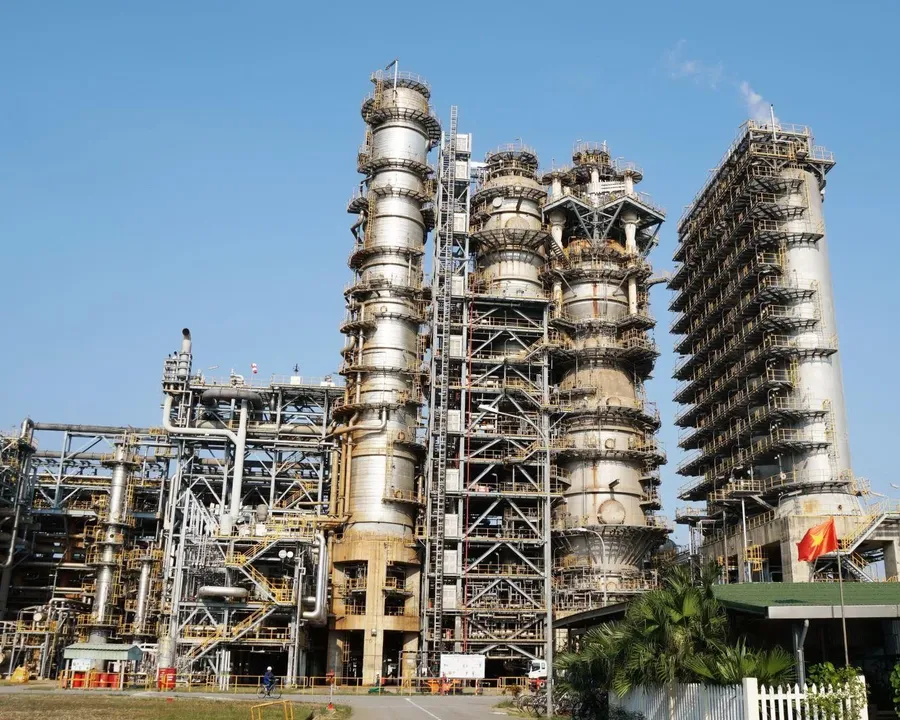
For BSR, the variable that decides margin is the spread between refined product prices and crude input costs, especially on diesel, not the crude price itself. BSR's gross margin jumped to 20.7% in Q1 2026 before easing to 15.0% in Q2, and a given quarter's margin typically reflects the price environment of the one or two quarters before it.

For PVT, the transmission channel is charter rates. In the first half of the year, PVT posted net revenue of VND 9,892 billion, up 39% year-over-year, driven by re-signing contracts at higher-than-expected rates.Vietstock Q2 net margin hit 12.7%, the highest in eight quarters. Charter rates only rise sustainably when oil stays elevated long enough to extend the leasing cycle, so PVT benefits more slowly than BSR but is also less prone to reversing quickly.
PLX sits in the middle and faces two-way exposure, since domestic retail prices adjust on a periodic cycle, meaning input costs rise first and selling prices catch up later. PLX lost VND 662 billion in Q1 2026, right as oil prices were climbing fast, then recovered to net income of VND 3,052 billion in Q2. The most recent pricing period, on August 20, pushed 0.05S-II diesel to VND 28,540 per liter. PVD and PVS, by contrast, sit almost entirely outside this story, since their profits are tied to drilling-rig contracts and engineering projects signed months in advance. PVS also fell partly because its shares traded ex-rights ahead of a 20% share issuance on September 14.
Two scenarios for the week of September 21-25
The first scenario is continued supply tightening: the pipeline fails to return to full capacity before mid-October, Aramco extends its halt on European deliveries into November, or a future strike actually hits its target instead of being intercepted. In that case, money tends to flow toward margin-driven names like BSR and PVT rather than companies exposed directly to the crude price.
The second scenario is de-escalation: the pipeline restarts partially ahead of schedule, further strikes keep getting intercepted without infrastructure damage, or signs of negotiation emerge over Hormuz shipping. In that case, inventory flips from asset to liability. BSR's inventory swelled to VND 21,574 billion in Q1 2026 (20.2% of total assets) before falling to VND 14,626 billion in Q2, while PLX's went from VND 29,754 billion (28.1%) to VND 20,076 billion. Buying crude high and selling once prices have pulled back is the scenario that squeezes margins one to two quarters later; the same inventory that's an advantage when prices rise becomes a burden when they fall. PVT is less exposed to this branch since most of its revenue already sits in signed charter contracts, while GAS feels an indirect effect through gas and gas-product export prices, with Q2 gross margin at 18.0%, the highest in eight quarters.
What to watch
September 21 will be the first session in which oil markets actually price the Riyadh attack, since it landed over the weekend while markets were closed. If Brent opens higher and gives back most of the move within a session or two, the market is reading the attack as a psychological event rather than a supply event. If prices hold above $104 alongside fresh bad news on the pipeline, the supply-squeeze scenario is taking clearer shape. The single most useful signal, then, isn't the Brent price itself but the pace of pipeline repairs and the diesel-crude spread, the variable that decides BSR's margin far more than the headline oil price does. Vietnam's next fuel pricing cycle will show how much of that actually passes through to retail prices and distribution margins.
A longer, slower layer of context is forming in parallel: the amended Petroleum Law, passed by the National Assembly on August 23 and taking effect March 1, 2027, expands PetroVietnam's decision-making authority and adds incentives for small and marginal fields.Vietstock This layer plays out over years, not weeks, and shouldn't be mixed into short-term decisions for the week ahead.
The right frame for the coming week, then, isn't whether oil goes up or down, but how to split the sector by profit channel: refining-spread and charter-rate names are most exposed to an escalation scenario, drilling-services names are close to neutral either way, and distribution faces two-way exposure with a lag tied to the pricing cycle. Q3 earnings, once reported, will be where it becomes clear which group actually benefited from the current price environment.