
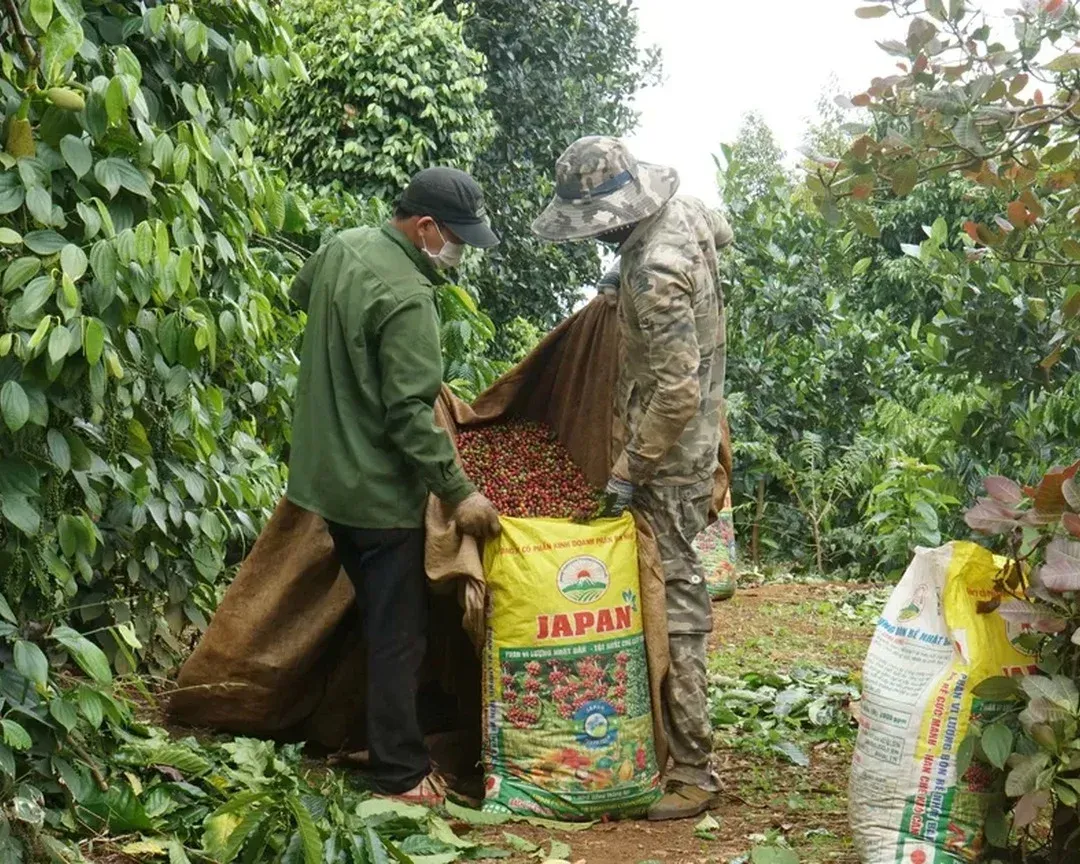

Over the weekend, commodity wires flagged what looked like a paradox: world coffee ticked up on Friday's session while Vietnam's domestic buying price kept falling. Per data published on September 20, domestic coffee traded between VND 93,000 and VND 93,800/kg, down VND 1,500-1,700/kg from the previous weekend; Đắk Lắk and Gia Lai both lost VND 1,600/kg, settling at VND 93,600/kg.VTV
That paradox is real, but only for a single session. Widen the window to a full week and the two markets actually move in the same direction, with the world market falling harder.
From late-August peak to mid-September trough
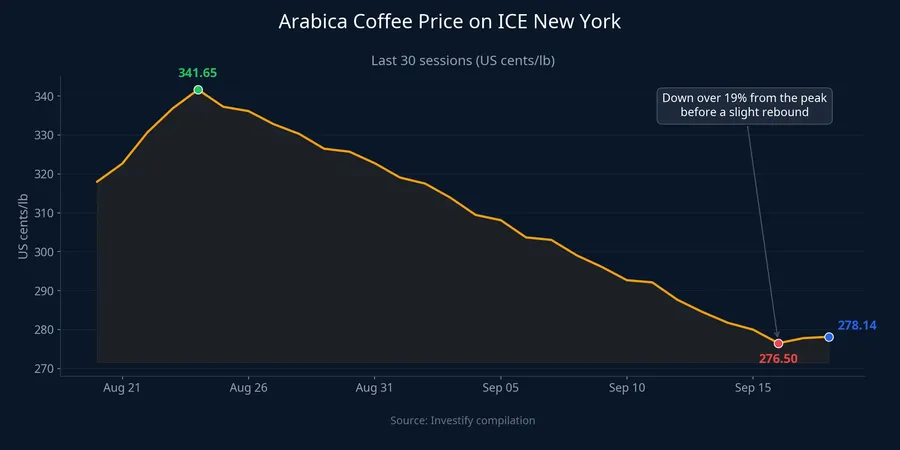
The story starts on August 24, when Arabica on ICE New York closed at 341.65 US cents/lb, the high for the month. From that peak, prices slid almost without pause: down to 311.50 cents on August 31, breaking below 300 cents on September 2 with a 3.67% single-day drop, then settling at 285.70 cents by September 11.
The force behind this slide came from supply, not financial flows. Brazil's coffee exporters association (Cecafe) reported August export data showing the country shipped 3.82 million bags of green coffee, up 31.7% year-on-year and a new record; robusta alone jumped 53.6% to 953,592 bags, exactly the variety Vietnam's coffee sector depends on.ADM/Cecafe
At the same time, the International Coffee Organization (ICO) issued its first supply-demand balance for the 2025-2026 crop year: global output at 183.6 million bags, up 4.4%, against consumption of just 180.6 million bags, down 0.8%. The market now shows a 3-million-bag surplus after four straight years of deficit.Báo Thế giới & Việt Nam That's a structural reversal for the whole industry, not a one-day headline.
Mid-September: inventories turn a corner
The second key marker fell on September 11, when certified Arabica stocks on ICE dropped to 217,932 bags, the lowest level in 27 years.Báo Thế giới & Việt Nam Thin inventory usually props up price. Not this time, because traders already knew what was coming: nearly 65,000 bags of Arabica were awaiting grading, and dealers expected to add at least another 300,000 bags to ICE warehouses within months. Markets price what's coming, not what's currently on hand.
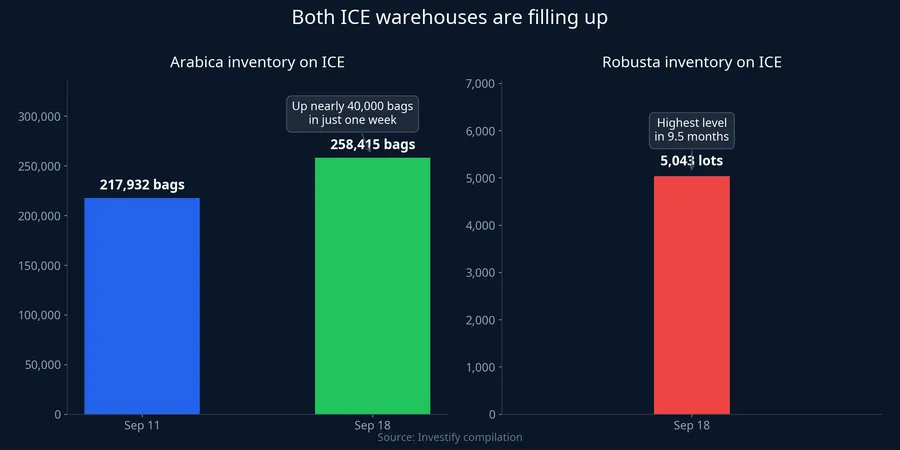
By September 18, Arabica stocks had risen another 10,528 bags to 258,415, a 1.5-month high. On the robusta side, ICE inventory climbed to 5,043 lots, a 9.5-month peak.VTV Both warehouses are filling up right as Vietnam heads into its own new harvest.
Friday's bounce: an FX move, not a demand signal
On September 17, Arabica hit a monthly low of 276.50 US cents/lb, then recovered to 278.14 cents on September 18, up 0.59%. On the London exchange, robusta contracts for September and November 2026 both edged up USD 5/tonne, or 0.15%, to USD 3,366 and USD 3,396/tonne respectively.
Analysts attributed this to the US dollar cooling off from a 7-week high, which prompted speculative funds to unwind some of their short positions in the futures market. That's position-closing behavior, not a signal that consumer demand is returning.
More importantly: robusta's USD 5/tonne gain translates to roughly VND 130/kg at the September 18 exchange rate of VND 25,999/USD. Even if the world's entire Friday bounce passed straight through to Vietnam, it would be worth only VND 130 per kilogram.
The full week: domestic prices fell less than global ones
This is where the observation window determines the conclusion. On September 14, London robusta's November 2026 contract closed at USD 3,535/tonne; by September 18, that same contract stood at USD 3,396/tonne: a loss of USD 139/tonne in one week, equivalent to 3.93%. Converted at the prevailing exchange rate, that's roughly VND 3,600/kg.
Over those same seven days, the Đắk Lắk farm-gate price went from VND 95,400/kg on September 15 to VND 93,600/kg, a loss of VND 1,800/kg, or 1.9%. Arabica told the same story: New York's December contract fell from 290.50 US cents (Sep 14) to 278.14 cents (Sep 18), down 4.25%.
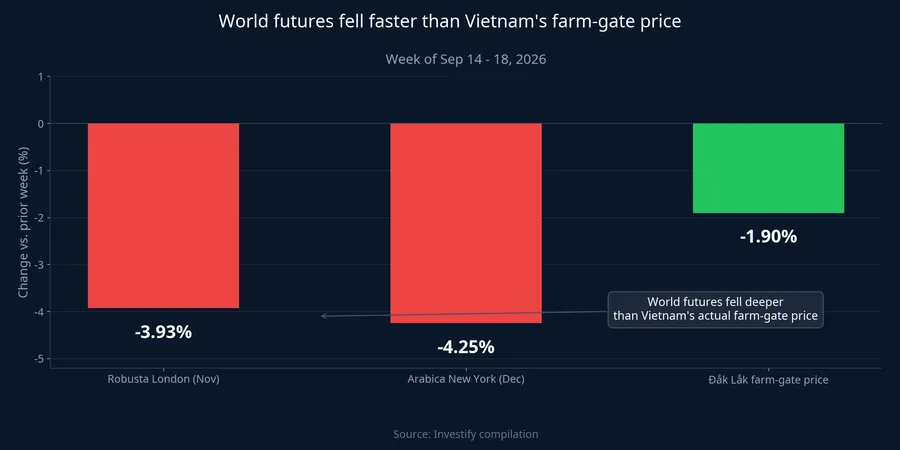
In other words, Tây Nguyên's farm-gate price fell less than half as much as the robusta contract that Vietnamese coffee actually references. Note this compares two rates of change within the same week, not price levels. Real coffee in Vietnam always trades at its own spread to the London futures benchmark.
Why the gap exists
Three explanations each have some basis, and the evidence favors the first two.
First is liquidity. Traders reported that Vietnamese robusta prices ticked up the week before with almost no actual trading behind the move.Báo Thế giới & Việt Nam A thinly-traded spot market adjusts slower than a futures market where orders clear by the second.
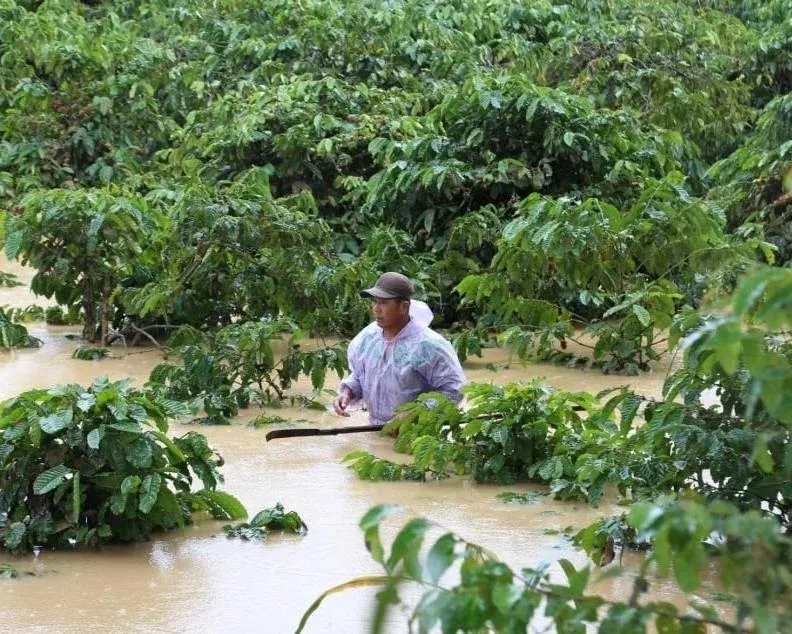
Second is weather. Forecasts of heavy rain across the Central Highlands raised concerns about crop damage, and that worry has kept sellers holding out for a better price. On September 20, domestic prices held flat at an average of VND 93,700/kg, ending the earlier losing streak.Báo Văn Hóa
Third, and the weakest explanation, is the exchange rate. USD/VND moved from 25,925.50 on September 14 to 25,999 on September 18, up 0.28%. That is enough to offset only a sliver of the roughly 2-percentage-point gap between the two markets, not nearly the whole story.
Three signals to watch next week
For domestic commodity investors, robusta is tradable on the Vietnam Commodity Exchange (MXV), so moves on the London exchange feed directly into both growers and futures position holders.
The signal worth watching most closely is the London robusta contract. Traders have shifted most activity to the January 2027 contract, meaning the market is now pricing the new crop rather than the old one.Báo Thế giới & Việt Nam The January contract at USD 3,515/tonne on September 14 is the benchmark to track against.
The second signal is robusta inventory on ICE, currently at 5,043 lots. If that number keeps climbing, the cushion supporting domestic prices will keep thinning, since buyers have fewer reasons to pay above the futures price.
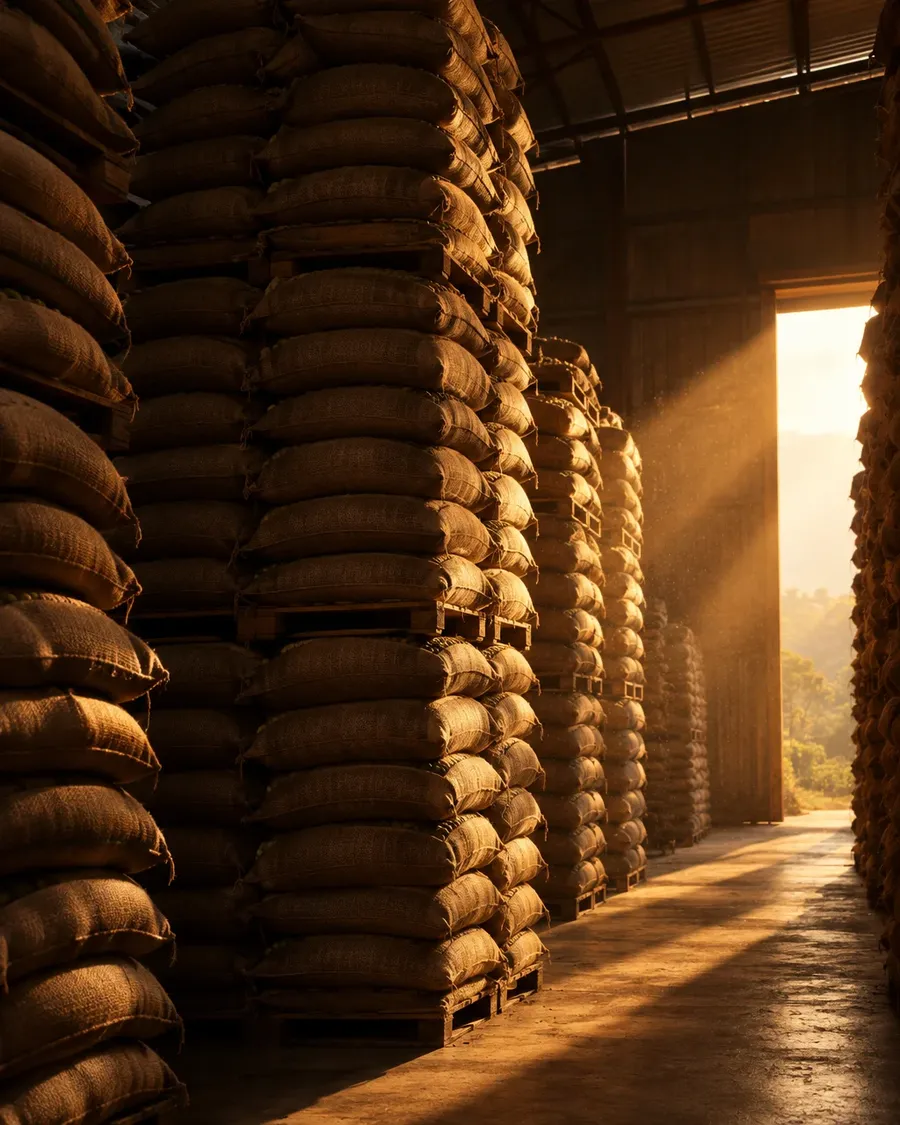
The third signal is rainfall and harvest progress in the Central Highlands. Vicofa says the new crop starts reaching the market in November. As the 2026-2027 harvest arrives while both ICE warehouses are already filling up, the two factors currently propping up domestic prices — thin liquidity and weather anxiety — are likely to weaken at the same time.
The straightforward conclusion: Vietnam's domestic coffee price did not move against the world last week. It moved with it, just one beat behind, and that lag comes from the nature of a thinly-traded physical market, not from any durable support. That cushion won't disappear overnight, but it should narrow as the new crop starts reaching the market in November and both ICE warehouses keep filling. ICE inventory reports and the January 2027 futures contract over the coming weeks will be the clearest test of how much longer that cushion holds.