
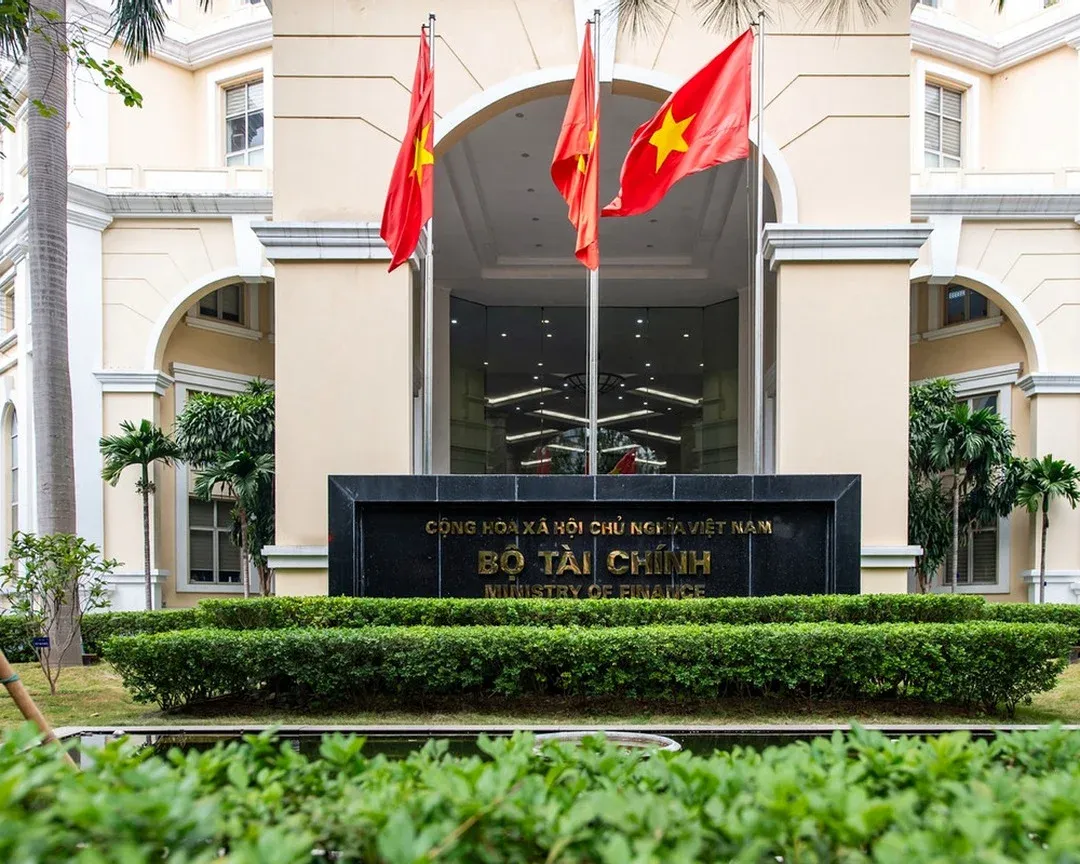

On September 19, Vietnam's Ministry of Finance said it is preparing, together with the State Bank of Vietnam and other agencies, to hold a round of meetings with international investors, and stated explicitly that the roadshow is not tied to any offering or issuance of international bonds.Nhân Dân The statement came exactly a week after domestic markets were buzzing about a very different possibility: Vietnam preparing to borrow $1 billion in the international bond market for the first time since 2014. Two stories, seven days apart, are being merged into one by a lot of readers.
Two sources, two different stories
Reuters' September 15 report did not say Vietnam will issue bonds. It described an internal deliberation: the Ministry of Finance working with investment banks on a possible USD-denominated government bond, sized up to $1 billion, with no final decision made.Vietstock One foreign investment bank proposed a 10-year, $1 billion structure. Another international lender floated $500 million to $1 billion, same tenor, at a proposed coupon of roughly 7% per year. The source of that report was investment-banking circles, not a statement from a regulator.
The Ministry of Finance, by contrast, describes the upcoming roadshow as an annual program to promote and update global financial institutions and investment funds on Vietnam's socioeconomic situation, fiscal and monetary policy, and public debt management direction. The size, tenor, and timing of any issuance, if one happens, will be decided later by the government, based on domestic development financing needs and both domestic and international capital market conditions.VietnamPlus
The gap between the two sources isn't about who's right, it's about two different layers of information: Reuters described a proposal still under internal evaluation, while the Ministry described the nature of an upcoming public event. Notably, the September 19 statement doesn't rule out issuance down the road either. The Ministry didn't deny having considered the option; it simply drew a line that this particular roadshow is purely promotional. The question of whether Vietnam will borrow abroad remains open; it just isn't being answered this month.

The under-covered part: a push for a rating upgrade
The detail that got the least attention in the September 19 announcement actually carries more long-term weight than whether a bond gets sold: as part of the roadshow, the Ministry of Finance plans to meet with international credit rating agencies as part of a plan to improve the sovereign rating, aiming to lift Vietnam to investment grade.Tin nhanh Chứng khoán That's worth watching more than the size of any single bond deal, because it determines the country's cost of capital for years, not just for one issuance.
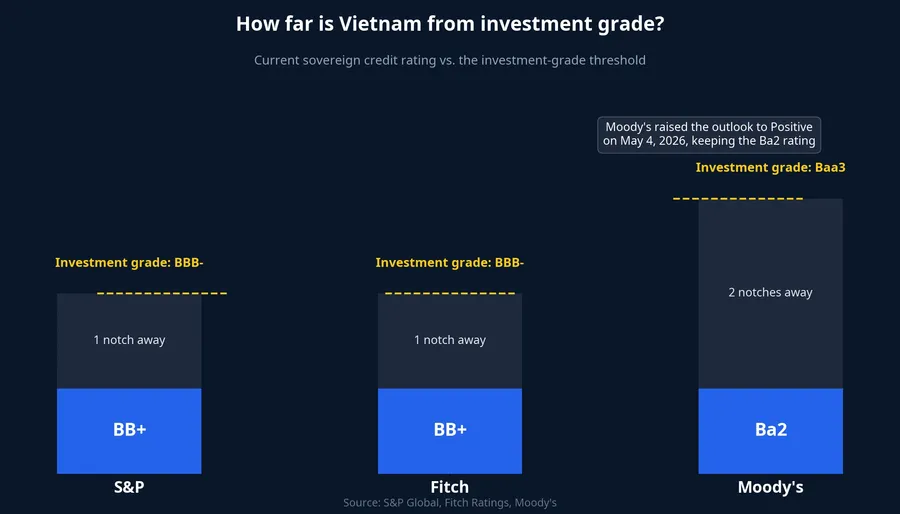
Vietnam currently sits just below investment grade. S&P and Fitch both rate the sovereign at BB+, exactly one notch below BBB-. Moody's rates it Ba2, two notches below Baa3, and on May 4, 2026 raised the outlook from Stable to Positive while keeping the rating unchanged.Tuổi Trẻ Earlier, on January 22, 2026, Fitch upgraded Vietnam's senior secured long-term debt instrument rating from BB+ to BBB-, the first time any Vietnamese debt instrument touched investment grade.Báo Chính phủ The unsecured foreign-currency rating — the general sovereign rating — remains at BB+.
The obstacles these agencies themselves have flagged are equally clear. Fitch has noted that Vietnam's bank credit has swelled to around 155% of GDP, roughly three times the average for peer-rated countries, alongside thin foreign reserves and data transparency requirements.Người Quan Sát These are issues that take time to fix, not something resolved in a single investor-meeting trip.
The real variable is cost of capital, and it's pricier than 2014
Line up the numbers and it's clear why timing matters so much here. In 2014, Vietnam successfully issued $1 billion of 10-year bonds at a 4.8% coupon, below the initially guided 5.125% and well below the two prior rounds at 6.875% in 2005 and 6.755% in 2010.VnEconomy Order books back then topped $10.6 billion from 437 international investors, more than 10 times the amount on offer.
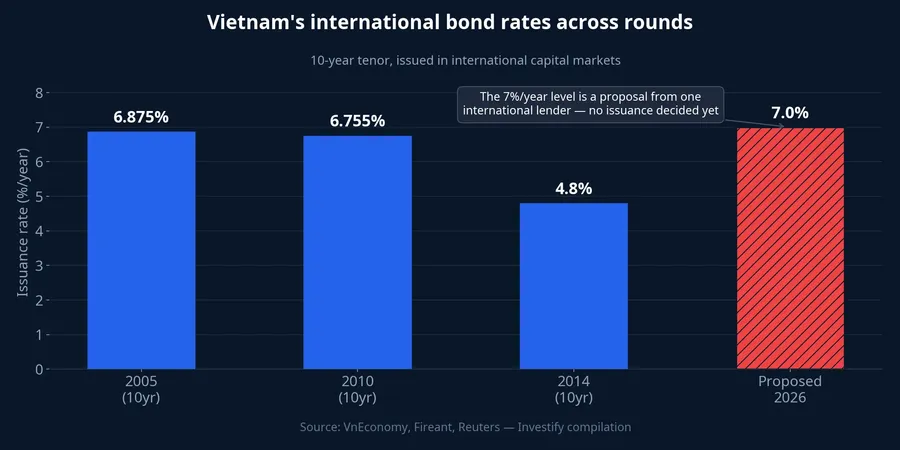
The roughly 7%-a-year rate one international lender is reportedly proposing this time, if it becomes the actual issuance price, would push Vietnam's international borrowing cost back into the expensive territory of the 2005 and 2010 rounds, wiping out the cheap financing achieved in 2014. That could happen even though the economy is now far larger than 12 years ago and public debt has fallen to around 37% of GDP.Fireant The paradox stems from three compounding pressures: the global USD rate cycle sitting at elevated levels, a risk premium tied to the BB+ rating that hasn't narrowed, and domestic funding costs also rising: the average yield on 10-year domestic government bonds is running around 4.2% this year, up from 3.1% last year.Fireant
It's worth being careful not to pin the entire gap on the credit rating alone. A sovereign bond's issuance rate also depends on the prevailing USD rate environment on the exact pricing date, on tenor, and on investor appetite for emerging markets at that moment. Of those factors, the rating is the one piece Vietnam can actively change through domestic policy; the rest sit outside any borrower country's control.
For individual investors, this isn't actionable news yet
USD-denominated government bonds sold in international markets are the playing field of financial institutions, global bond funds, and investment banks; individual investors cannot buy them directly. The retail channel for exposure to sovereign debt remains domestic government bonds, traded through the Hanoi Stock Exchange's dedicated platform or purchased through banks, typically in VND 1 million denominations.
Where the September 19 announcement actually adds value for a personal portfolio is in correcting a false expectation. A $1 billion USD issuance, equivalent to roughly VND 26,000 billion at the September 18 exchange rate of VND 25,999 per dollar, isn't large enough to move the exchange rate or domestic interest rate levels even if it happens, and it hasn't been decided yet. Jumping from a rumored deal size to expectations about currency pressure, or to expectations about domestic deposit rates, is a leap the evidence doesn't support.

The variable to watch is the rating, not the rumor's size
The more useful framework for the coming months is the outcome of Vietnam's engagement with S&P, Fitch, and Moody's, not the size of a bond deal that hasn't been finalized. If S&P or Fitch upgrades Vietnam from BB+ to BBB- following this round of meetings, the country risk premium narrows and a USD issuance becomes more cost-effective, while the cost of capital for listed companies broadly would have grounds to fall too. If the rating stays at BB+, USD borrowing remains meaningfully more expensive than borrowing at home, and the government has ample reason to keep waiting rather than lock in a rate near 7%.
The banking-credit and data-transparency concerns Fitch has previously raised don't disappear just because there's an investor roadshow, and they remain the basis on which rating agencies will make their decisions. But they don't reverse the direction of travel: Vietnam's upgrade trajectory over the past two years is still pointing the right way, it's just not yet enough for all three agencies to jointly recognize Vietnam at investment grade.
The next announcement worth reading, then, is the outcome of the Ministry of Finance's meetings with the rating agencies during this roadshow — not another headline about bond deal size.