


The State Bank of Vietnam (SBV) just released deposit data through the end of July 2026: household deposits at credit institutions reached over VND 11.2 quadrillion, up VND 151.661 trillion from June and up 8.56% from the end of 2025.Dân trí That's the highest level on record. Just over a year ago, this figure hadn't even crossed VND 10 quadrillion.
The number landed the same week Vietnam was officially upgraded to emerging-market status by FTSE Russell, which makes it tempting to read as a simple story: Vietnamese savers are risk-averse and pulling money into banks. Look closer at the data, though, and the picture is more complicated. This piece is here to help you read that VND 11.2 quadrillion figure correctly, and more usefully, give you a clear framework for choosing between a savings account and an investment fund.
Part of the increase may not be fresh savings
In the same July release, corporate deposits fell by more than VND 130.695 trillion from the prior month, down to just over VND 6.24 quadrillion.Dân trí The two numbers are close: households added VND 151.661 trillion, businesses withdrew VND 130.695 trillion.
Here's the simple way to think about it: there's no evidence these are the same flow of money, but you also shouldn't assume the entire household increase is brand-new savings. When a company pays salaries, dividends, or settles a contract, money moves from a corporate account to a personal one. The total amount of money in the system doesn't change, but the personal-deposit balance still ticks up on paper. The cautious read is to treat VND 11.2 quadrillion as a base that keeps thickening over time, not as proof of a rush out of riskier assets.
Vietnamese savers aren't abandoning stocks either
If money were truly turning its back on the stock market, new account openings should be slowing down. The opposite is true. By the end of August 2026, the total number of domestic brokerage accounts had climbed to nearly 13.9 million, with over 2 million new accounts opened in the first eight months of the year alone.Fili August alone saw nearly 230,000 new individual accounts, and the pace has held steady at 200,000-270,000 a month, even through March and July, two months of sharp market pullbacks.Thời báo Tài chính Việt Nam

Two records are coexisting side by side. Vietnamese savers are putting more into deposits and opening more brokerage accounts at the same time. The more useful question isn't "which side should I pick," but what each channel actually demands from the person putting money in.
Yardstick one: real return after inflation
Average CPI for the first eight months of 2026 rose 4.45% year-on-year, just below the full-year control target of 4.5%.Thời báo Tài chính Việt Nam That's the benchmark for converting any nominal yield into real value, because the headline rate printed on a bank's rate sheet isn't the number that ends up in your pocket.
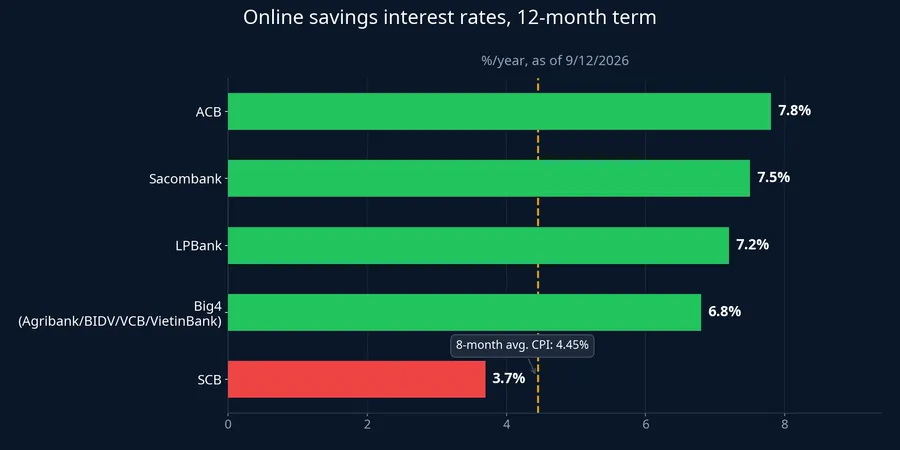
The Big Four state-owned banks — Agribank, BIDV, Vietcombank and VietinBank — all list 6.8%/year for a 12-month term, while ACB leads the market at 7.8%/year.Dân trí Per a survey of 35 banks on September 12, nine banks listed 7%/year or higher for this term, while the lowest was SCB at 3.7%/year.Soha Against 4.45% inflation, a 12-month depositor at a state-owned bank nets a real return of roughly 2.35 percentage points; at ACB, about 3.35 points. Depositors at the lowest-paying bank are earning a negative real return: your money is technically losing value even though the passbook shows a positive number.
On the investing side, the picture is far more dispersed. As of September 18, 2026, Vietnam's equity mutual funds are down 6.11% on average year-to-date, with 30 of 34 funds in the red; bond funds are the opposite, up 3.99% on average with 22 of 23 funds in positive territory. The VN-Index closed the September 18 session at 1,815.66 points, up just 1.75% from the end of 2025. One caveat: the savings rate is a full 12-month payout, while fund performance reflects only about nine months so far, so this is a directional comparison, not a direct subtraction.
Yardstick two: the cost of choosing wrong
This is the point new investors most often miss. Both channels force you to make a choice, but the consequences of choosing wrong differ sharply in both magnitude and how soon you find out.
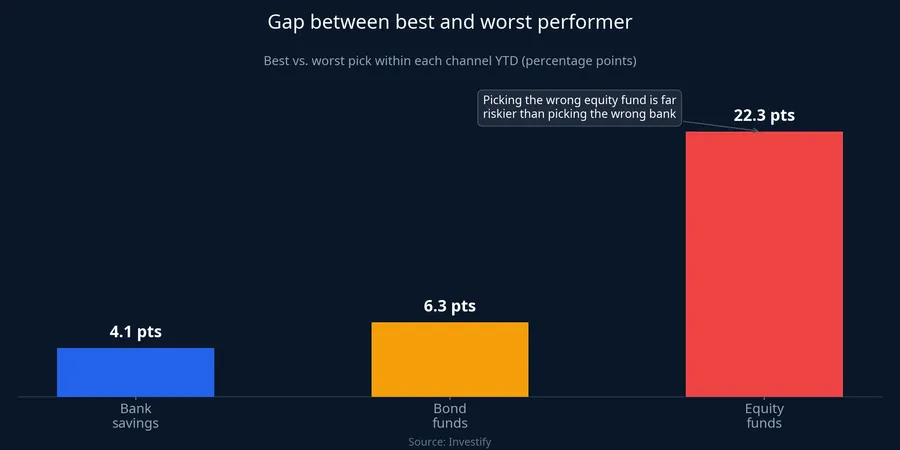
In savings, the gap between the highest-paying bank (ACB, 7.8%) and the lowest (SCB, 3.7%) at the same 12-month term is 4.1 percentage points, equivalent to VND 7.8 million in interest versus VND 3.7 million on a VND 100 million deposit over a year. You know that number the moment you sign the deposit slip, no waiting required.
Among equity funds, the best performer is up 2.27% year-to-date while the worst is down 20.04%, a gap of over 22 percentage points, and you only find out which group you landed in after time has already passed. Bond funds sit between the two extremes: the best is up 5.62%, the worst down 0.64%, a gap of just over 6 points.
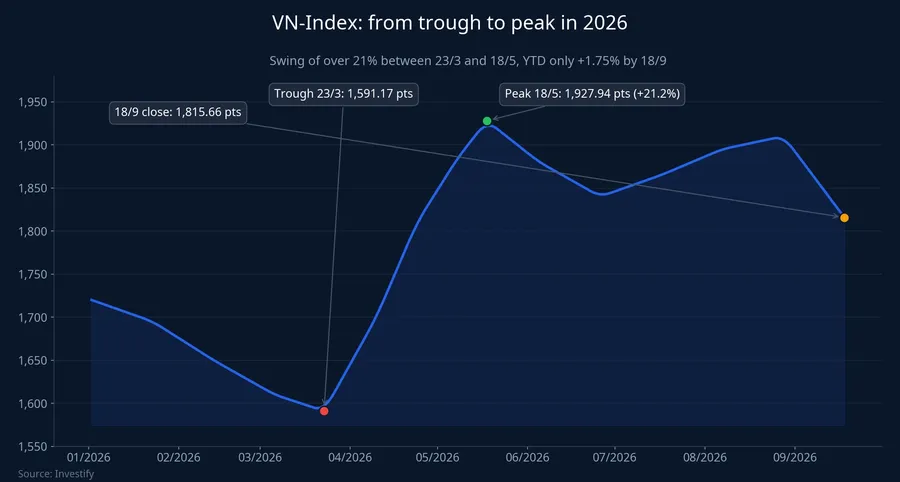
The VN-Index this year illustrates this well. The index is up just 1.75% year-to-date, but it swung from a trough of 1,591.17 points on March 23 to a peak of 1,927.94 points on May 18, a swing of over 21%. The index has essentially gone nowhere for the year while most equity funds are still underwater, which tells you most of the outcome came from picking the right stock and the right timing, not from the broad market trend.
Why money is still flowing into banks
At least three factors are contributing here, and you shouldn't reduce it to a single cause. First is the rate environment: the run-up in deposit rates began in late 2025, only cooling from early April after the SBV directed rates lower, but today's 6.8-7.8%/year range still sits meaningfully above inflation. Second is the actual track record of the competing channels this year: with most equity funds in the red and the index trading sideways in a wide range, a known 6.8% return becomes more attractive than usual. Third is the technical factor noted earlier: part of the household increase may reflect money shifting from corporate to personal accounts rather than genuinely new savings behavior.
A framework for allocating your money
For new investors, the more useful framework starts with the time horizon of the money, not your return expectations. Put simply, ask yourself: how long can this money sit untouched?
Money you'll need within 12 months should default to a matching-term savings deposit. The variable most worth optimizing is picking the right bank, since a 4.1-point gap at the same term isn't trivial, and online channels typically pay more than in-branch deposits. Money you can leave alone for several years is the reasonable candidate for chasing a yield above savings rates, on the condition that you can stomach two-way volatility like the VN-Index's 21% swing this year.

One thing to watch for: beyond the published rate sheets, some private banks are offering 8.5-9.2%/year for 6-12 month terms through private negotiated deals, with terms depending on the amount, tenor, and each customer's negotiating position.Dân trí If you're offered a rate like this, ask for the rate and terms written explicitly into the deposit contract. Don't rely on a verbal promise.
What to watch next
The next data release will give a clearer read. The SBV typically publishes deposit data with about a two-month lag, so August 2026 figures should land in mid-October. Comparing that month's growth against July's VND 151.661 trillion will show whether current interest rates still have enough pull to hold onto money.
A sharp slowdown in growth, arriving just as foreign capital begins flowing in under the upgrade timeline, would be the first sign that domestic risk appetite is shifting. If deposits keep growing at the same steady pace as the past seven months, the "two records coexisting" picture will likely persist for a while longer.