

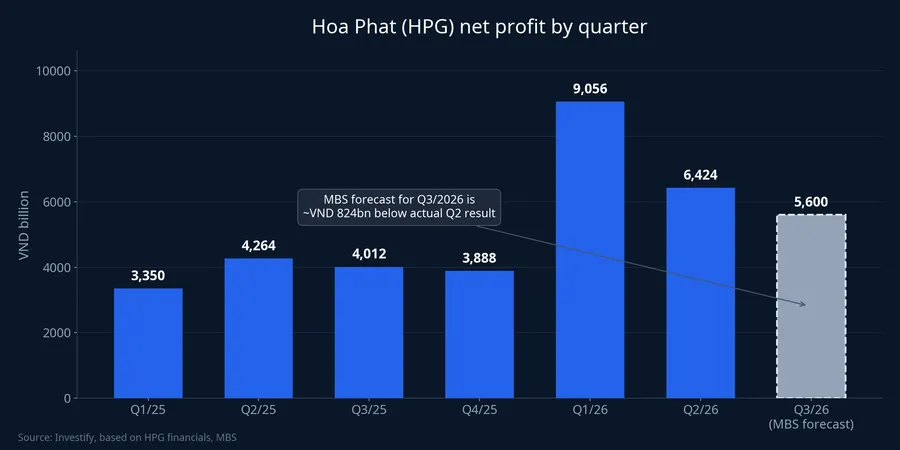
On September 19, 2026, MBS Securities forecast Hoa Phat Group's (HPG) net profit for Q3/2026 at VND 5,600 billion, up 40% year-on-year, alongside projected revenue of VND 55,300 billion, up 50%.Người Quan Sát Most investors reading this headline will stop at the 40% growth rate. But set against the immediately preceding quarter, the picture flips: Hoa Phat posted VND 6,424.5 billion in net profit in Q2/2026, up 51% year-on-year.Vietstock In other words, the latest Q3 forecast sits roughly VND 824 billion below the actual Q2 result.
This isn't a data contradiction: it's two different measurements pointing at the same number. With close to 300,000 shareholders currently holding HPG, as disclosed by Tran Dinh Long, Chairman of Hoa Phat Group's Board of Directors, at the company's annual general meeting,CafeF how you read this figure carries weight for a meaningful share of retail portfolios.
The first half was a genuinely strong cycle
There's little to doubt about Hoa Phat's operating health in the first six months of 2026. Revenue reached VND 108,870 billion, up 47%, with net profit of VND 15,480 billion, up 103% year-on-year. That pace completed roughly 70% of the full-year profit target (VND 22,000 billion) in just two quarters.Tin Nhanh Chứng Khoán Q1/2026 alone delivered VND 9,055.9 billion in net profit, nearly 2.7 times the year-earlier figure.CafeF
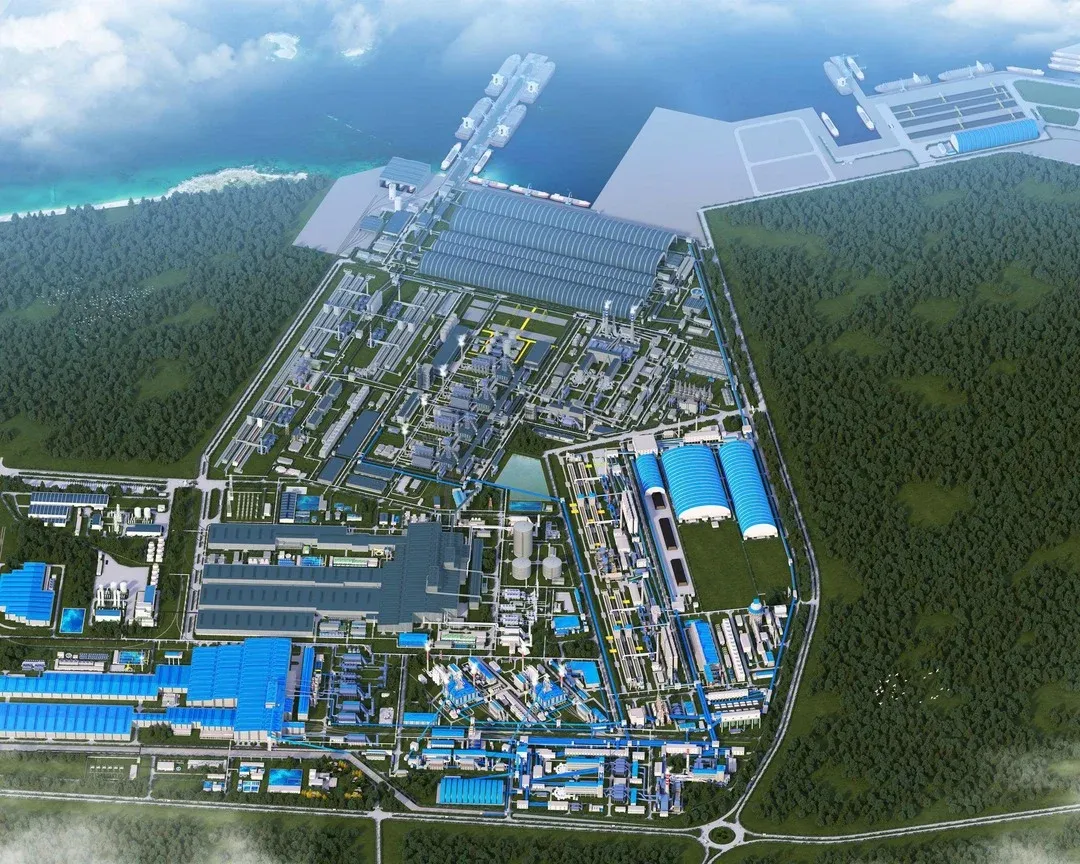
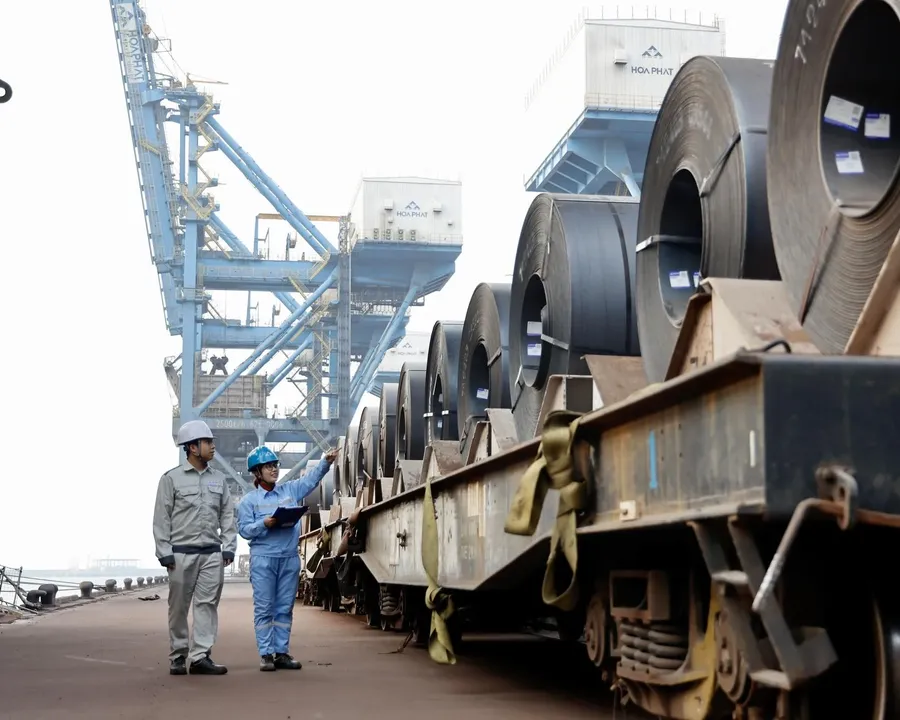
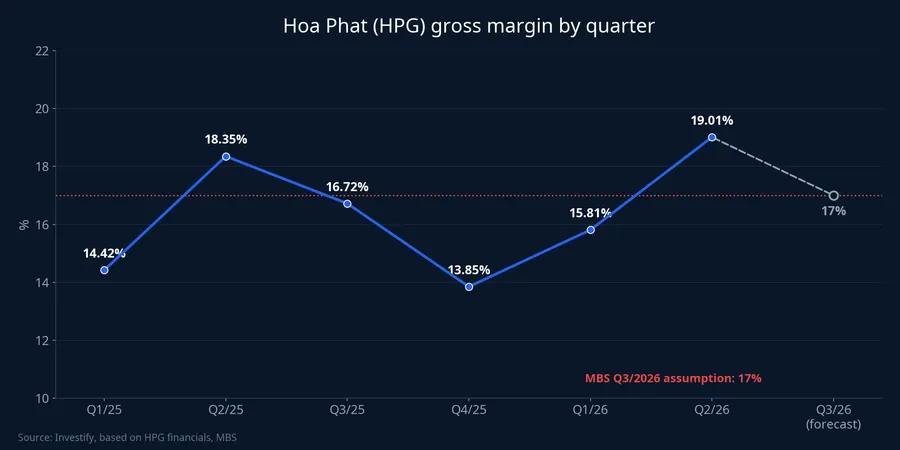
The gross margin trend explains the engine behind this cycle more clearly than the headline numbers. Q2/2026 gross margin hit 19.01%, the highest point in the data series since early 2025, compared with 14.42% in Q1/2025 and 13.85% in Q4/2025. The main driver is hot-rolled coil (HRC): Hoa Phat's HRC sales volume in Q2/2026 reached about 1.9 million tonnes, up 64% year-on-year, lifting domestic HRC market share to 63.7% from 62.3% in Q1. The Dung Quat 2 complex, a VND 85,000 billion investment, is contributing a full 12 months for the first time, pushing total crude steel capacity to roughly 14.5 million tonnes per year. Hoa Phat is targeting close to 15 million tonnes of steel sales in 2026, up about 40% from the prior year.Fili
Two tailwinds with different shelf lives
The notable part of this first-half picture is that the two tailwinds MBS cites don't share the same nature, and investors need to separate them before extrapolating into later quarters.
The tariff shield has an expiration date written into it. Vietnam's Ministry of Industry and Trade issued a decision imposing anti-dumping duties on certain HRC products from China at rates of 23.1% to 27.83%, effective for five years from July 6, 2025.Người Quan Sát After wide-gauge coils above 1,880mm were imported to circumvent this barrier, regulators followed up with a provisional anti-circumvention duty of 27.83% starting April 17, 2026.Người Quan Sát The effect shows clearly in volumes: domestic HRC output in H1/2026 reached about 5.397 million tonnes, up 41.9% year-on-year.
The key point to remember is that this measure is a policy decision, not a market outcome. The official duty expires in July 2030 unless renewed after review, while the anti-circumvention duty currently remains provisional. The margin gain coming from this tariff wall is therefore the kind that can be withdrawn by a single administrative document, not a durable competitive advantage the company built itself.
Domestic demand is more durable, but uneven. The 2026 public investment plan calls for roughly VND 1.1 quadrillion, up 22% from the prior year, covering major projects like the North-South Expressway phase 2 and Long Thanh Airport. Disbursement, however, is running behind the plan's scale: cumulative disbursement through end-June 2026 reached only VND 299,501 billion, or 29.2% of plan, rising to just 41.9% by end-July. The undisbursed portion means infrastructure demand is still backloaded into the second half of the year, which supports the Q3 and Q4 forecasts.
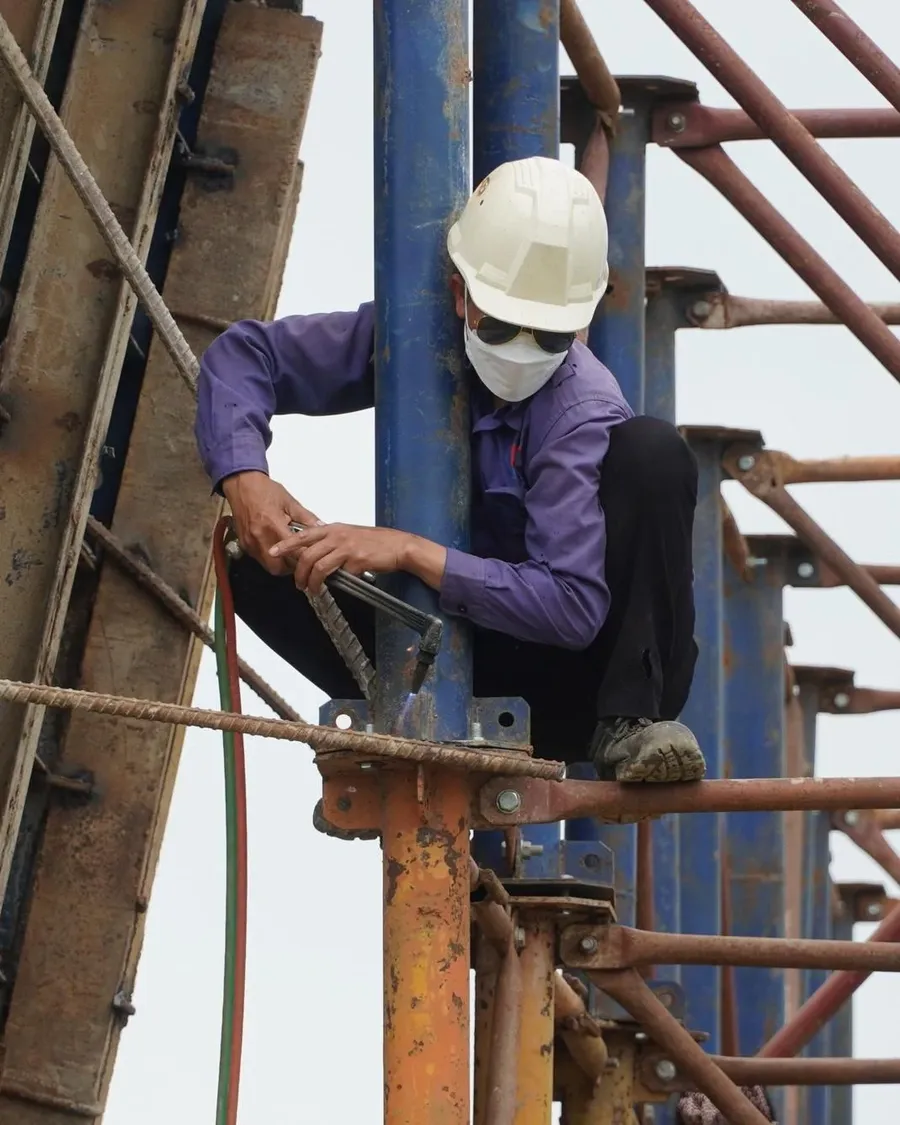
On the flip side, the traditional construction-steel segment moves unevenly month to month. In May 2026, Hoa Phat sold just 429,000 tonnes of construction steel, down 19% year-on-year, as buyers delayed restocking while waiting for prices to fall.Người Quan Sát Residential real estate demand is also being held back by interest rates: home mortgage rates commonly run 12-14% per year, with floating rates after the promotional period reaching 15-16%.Markettimes
Why MBS forecasts below Q2
Analysts themselves don't agree on this number. BSC forecasts Hoa Phat's Q3/2026 profit at about VND 6,500 billion, nearly VND 900 billion above MBS, arguing that sales volume will rise 5-8% quarter-on-quarter and lower input costs will support margins.Người Quan Sát
The gap between the two forecasts comes down to a single variable: gross margin. MBS assumes a Q3 gross margin of about 17%, cooling from the 19.01% just reached in Q2. BSC assumes iron ore and coking coal costs fall enough to hold margins higher. At the same production volume, a two-percentage-point gap in gross margin on VND 55,000 billion of revenue produces a gap of more than VND 1,000 billion in profit. That gap nearly explains the difference between the two forecasts on its own.
A second, less-discussed variable is interest expense. The Dung Quat 2 complex carries a heavy debt load, and its depreciation and interest costs are eating into profit during the early operating phase. Vietcap estimates the complex's standalone pre-tax profit at only about VND 773 billion per year, equivalent to a pre-tax margin of roughly 7%. New volume is pulling revenue up faster than it's pulling profit up, which is why a VND 85,000 billion investment hasn't immediately translated into proportionate profit.
The market is pricing the cycle, not the quarter
This is the clearest paradox in HPG this year. First-half profit more than doubled, yet the stock closed the September 18, 2026 session at VND 21,450, down 8.99% from the end-2025 reference price and down 17.58% from a year earlier.
The most reasonable explanation for this gap is that the market is pricing steel stocks by where they sit in the cycle, not by the quarter just reported. With gross margin already at 19.01%, the question investors are asking has shifted from "how much did last quarter earn" to "how long can this margin hold." Two other explanations are also worth weighing: this year's capital flows have favored banks and real estate on the market-upgrade narrative, and global steel prices remain under pressure from Chinese oversupply flowing into export markets. The evidence isn't sufficient to say which factor dominates, but book-value valuation partly supports the cycle-based reading: HPG's P/B sits at 1.26x, only about 16% above its 5-year average, meaning the share price isn't anchored to expectations of a breakout in growth.
The number to watch in the Q3 report
Hoa Phat's Q3/2026 financial report is expected in late October. The decisive figure won't be the net profit line: it will be the gross margin ratio, set against Q2's 19.01%.
If gross margin holds above 18%, the tariff wall plus domestic demand are still strong enough to sustain price levels, and MBS's VND 5,600 billion forecast will turn out to be the more conservative scenario. If gross margin slips back to the 16-17% range, input costs and pricing pressure are eating into the advantage, and Dung Quat 2's volume growth is mainly thickening revenue rather than profit. For a cyclical stock like HPG, margin is always the leading indicator — the profit line reported afterward only confirms what margin already signaled.