


On September 15, 2026, the State Securities Commission's inspectorate fined Phu Quoc Civil Construction Company Limited VND 350 million for offering bonds before meeting the legal conditions.Thời báo Tài chính Việt Nam It was the largest penalty in a batch covering 10 companies for a combined VND 1.33 billion, eight of them bond-related.Vietstock The basis for the fine was Phu Quoc's debt-to-equity ratio of 7.07x, well above the 5x regulatory cap. That number is accurate, and the penalty stands. But read the audited financial statements closely, and nearly 40% of that debt turns out to be customer deposits for future home purchases, not bank loans or interest-bearing bonds.
The same week, two other bond filings appeared on the Hanoi Stock Exchange's disclosure board: Viconship completed a VND 500 billion issue, while CII announced plans to redeem two bond lots early in October. The three filings have no causal link to one another. But each one contains a figure that reads very differently once you open up what sits beneath the headline number. That pattern is worth more than the fine itself.
A 7.07x Debt Ratio That Lumps Together Very Different Things
The legal basis for the fine is point c1, clause 3, Article 128 of the 2020 Law on Enterprises, amended in 2025 and effective from July 1, 2025.Báo Đầu tư The rule requires non-public companies issuing private bonds to keep total liabilities, including the planned bond issue, under five times equity as reported in the prior year's audited financial statements.
For Phu Quoc, the audited 2025 financials show total liabilities of VND 28,458.8 billion against equity of VND 4,235.8 billion. Add the planned VND 1,500 billion bond issue and the ratio climbs to 7.07x, well past the 5x cap. But underneath that VND 28,458.8 billion headline sits a notable component: more than VND 11,600 billion is short-term customer advance payments, roughly 38% of total liabilities.CafeBiz That's money buyers put down to secure the right to purchase a project unit, not an interest-bearing loan.
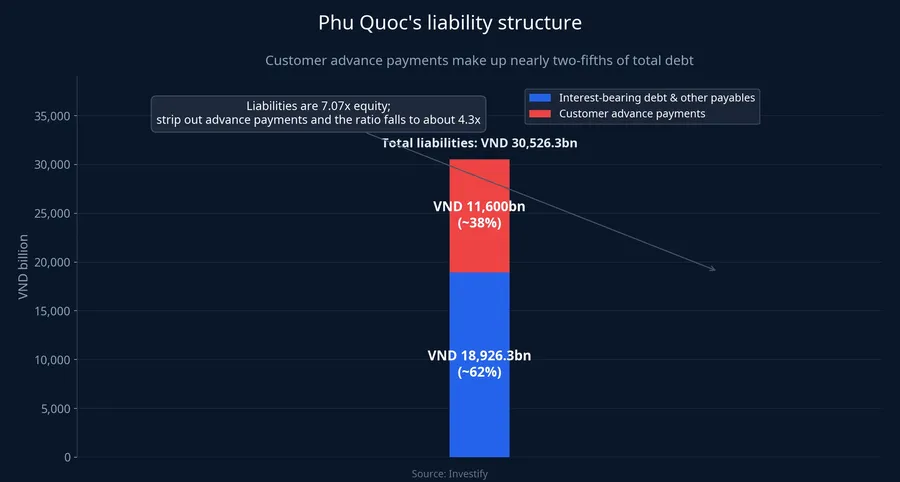
Strip out the advance payments and the debt-to-equity ratio drops to roughly 4.3x, back under the cap. That doesn't make the fine wrong: the law counts total liabilities, so 7.07x remains a genuine breach. But the lesson for bond buyers cuts against intuition. A high headline ratio isn't necessarily all interest-bearing debt, and a low ratio isn't automatically safe if most of it consists of bank loans and bonds that require regular interest payments. The two kinds of obligation carry entirely different cash-flow pressure: one only requires delivering a finished unit on schedule, the other demands cash on a fixed date, every time.

Collateral: "Secured" Doesn't Say How Much Is Secured
On September 16, 2026, Viconship announced it had completed issuance of the VSCL12601 bond lot worth VND 500 billion, at a fixed 11% annual coupon and a 36-month term.MarketTimes The collateral is Viconship's entire capital stake in Green Port Services Company Limited, with a par value of VND 110 billion.Vietstock
Put the two numbers side by side: VND 110 billion in par-value collateral backing a VND 500 billion bond, a book-value coverage ratio of only about 22%. At a glance, a "secured" bond sounds safer than one with no collateral at all. But the word "secured" doesn't tell you what fraction of the loan is actually covered.
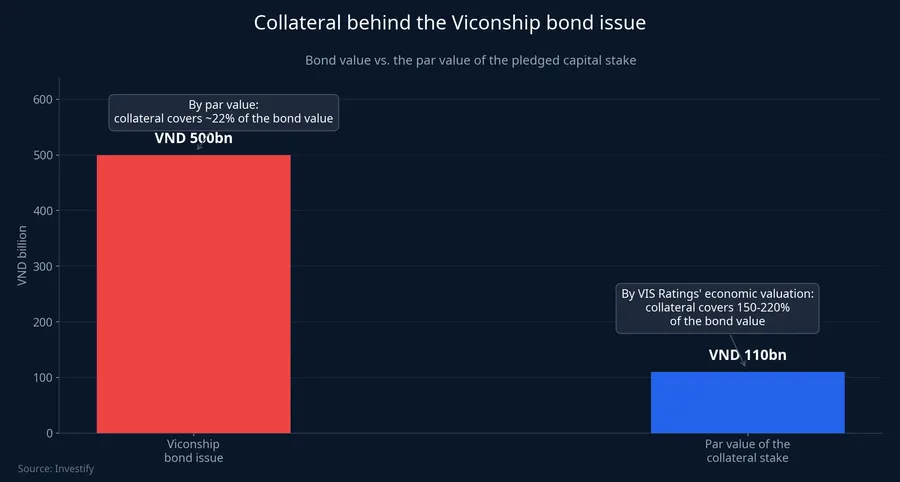
VIS Ratings, meanwhile, rated the bond lot A with a stable outlook and put coverage at 150-220%. The two figures diverge sharply because they measure different things: one is the par value recorded on a business registration certificate, the other is the rating agency's economic valuation of the port company. Green Port's economic valuation has not been made public, so the 150-220% figure is a third party's estimate, not something a buyer can independently verify.
The parent company's leverage backdrop matters too. As of end-June 2026, Viconship's total borrowings and finance lease liabilities stood at VND 6,503.5 billion, equal to 89.6% of equity, while interest expense in Q2 2026 alone reached VND 144 billion. The issue's stated purpose is debt restructuring, and the 11% coupon is the market's price for that risk package, not an arbitrary figure.
Early Redemption: A Positive Signal That Needs Scale for Context
On September 18, CII's board approved two resolutions on early bond redemption. The company plans to redeem 302 bonds under code CII12402, worth VND 30.2 billion at par, settling October 19, 2026, and 45 bonds under CII12403, worth VND 4.5 billion, settling October 26, 2026.CafeF Both lots were issued in October 2024 with a three-year term, so the redemption comes roughly a year ahead of maturity, funded from legitimate operating cash flow.DNSE
The total redemption value is VND 34.7 billion, a figure that sounds encouraging until you place it against the company's own debt scale. As of June 30, 2026, CII's total liabilities exceeded VND 30,518 billion, with borrowings and finance lease liabilities of more than VND 24,534 billion, or 80.4% of the total. First-half 2026 net profit fell 48.1% year-on-year to just over VND 96 billion.
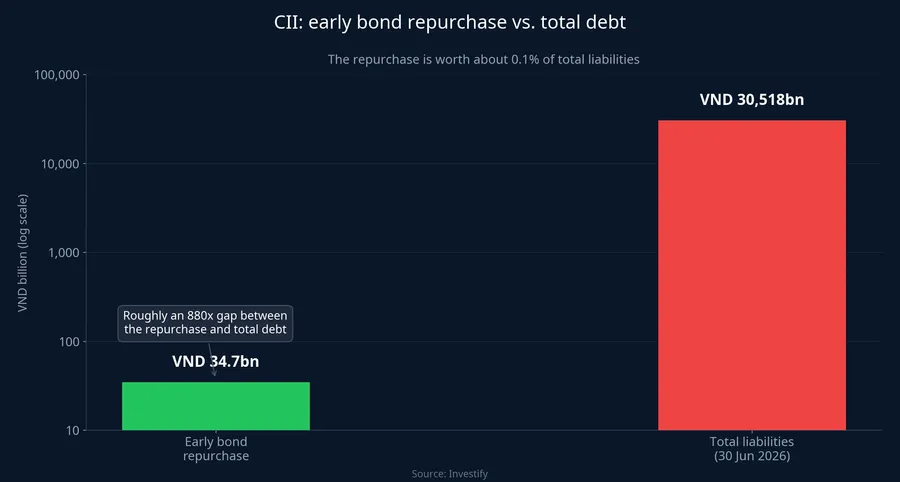
So how should early redemption be read? There are at least three equally reasonable interpretations, and bond buyers should weigh all three rather than picking whichever sounds most comforting. The optimistic read: the company has cash flow and is proactively cutting bond obligations. The technical read: this could be the outcome of negotiations with bondholders, or a way to save on interest costs now that fresh funding is cheaper. The cautious read: at VND 34.7 billion, the redemption is roughly one-thousandth of total liabilities, proving good faith on one specific lot but not a reduction in overall leverage pressure. These three readings don't rule each other out, and the available data isn't enough to settle on just one.
A Reading Framework for Bond Disclosures
Together, these three filings form a reading framework for any corporate bond disclosure. When checking the debt-to-equity ratio, read the debt-structure notes and separate interest-bearing debt from trade payables and customer advances. The two carry entirely different cash-flow pressure. When checking the collateral line, look for the coverage ratio and its valuation basis, since par value and economic valuation can produce very different results for the same asset. When checking a company's early-redemption history, weigh the redeemed amount against its total outstanding bond debt rather than reading the action in isolation.
What the disclosure itself never states is that the reader has to run all three comparisons alone. No rule requires an issuer to spell out that 38% of its debt is customer deposits, or to disclose collateral coverage by economic value rather than par value. That gap is exactly what individual bond buyers have to fill through closer reading, not by trusting a single aggregate figure.
The next checkpoint for this framework falls on October 19, 2026, when CII is scheduled to settle its first redemption tranche. If the redemption is completed on schedule and in full, that's a sign the company's cash flow is running to plan. If the settlement date slips or the volume shrinks, September's resolution will have amounted to nothing more than an unexecuted plan.