


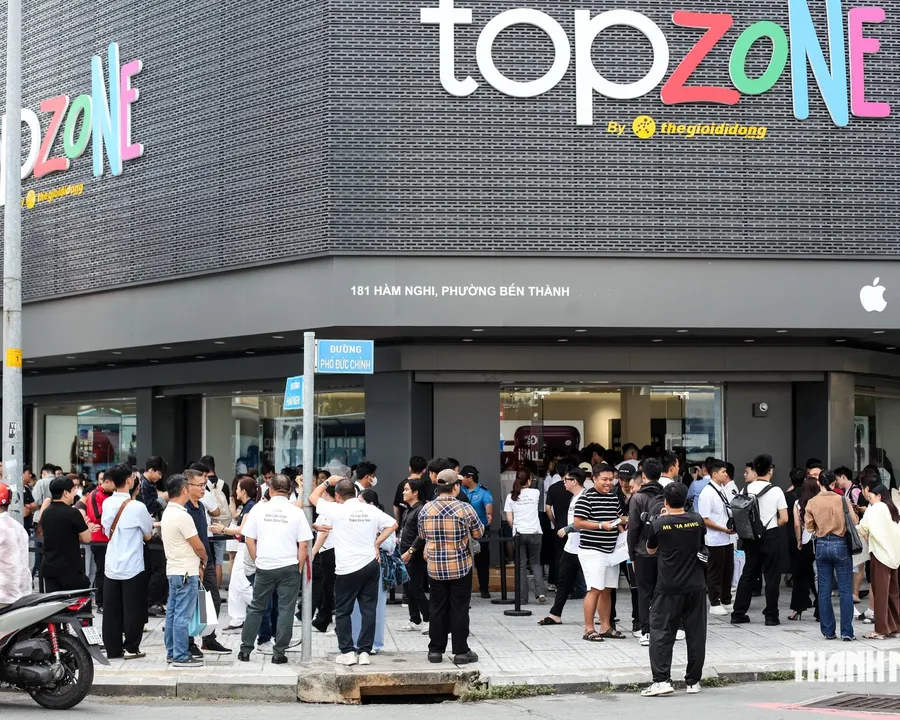
On September 18, 2026, the iPhone 18 Pro Max launched in Vietnam.Tao247 As happens every year, the previous generation dropped in price overnight: the iPhone 17 Pro Max 256GB is now listed from VND 34,590,000 at FPT ShopFPT Shop and from VND 34,599,000 at CellphoneSCellphoneS, while Apple's official price for that configuration is still VND 37,990,000.Apple
Here's the simple way to think about it: if you're holding roughly VND 35 million in spare cash, today's question is concrete. Bring the phone home, or park that money somewhere else for the next 12 months? This piece lines up four choices side by side, using one yardstick: how much money is left after a year.
The phone has already lived through year one, and the depreciation is measured, not guessed
The lucky part of this comparison is that the iPhone 17 Pro Max isn't a new product. It launched in September 2025, so its entire first-year price slide has already played out and can be measured rather than forecast. On the official second-hand market, the 256GB model is now listed around VND 28-30 million for like-new condition and VND 25-27 million for used units.Chợ Tốt
Against the original retail price of VND 37.99 million, the first year alone erased roughly VND 10-13 million, or 26-34% of value. That's just the asking price from a seller; what a shop actually pays when buying the phone back is lower still. The phone bought today enters its second year, and the depreciation curve is usually gentler than year one, though it still points the same direction. In exchange, you get 12 months of real use, which is value, not a pure loss. The real question is simply how the price of those 12 months stacks up against what VND 35 million could do elsewhere.
Savings deposits: the gap between banks is smaller than most people assume
A survey of 29 banks on September 19, 2026 found the average 12-month online savings rate at 6.15% per year. LPBank led at 7.15%, followed by BacABank at 7.10% and SaigonBank at 7.00%. Large state-owned banks like Vietcombank and VietinBank held around 5.90%.
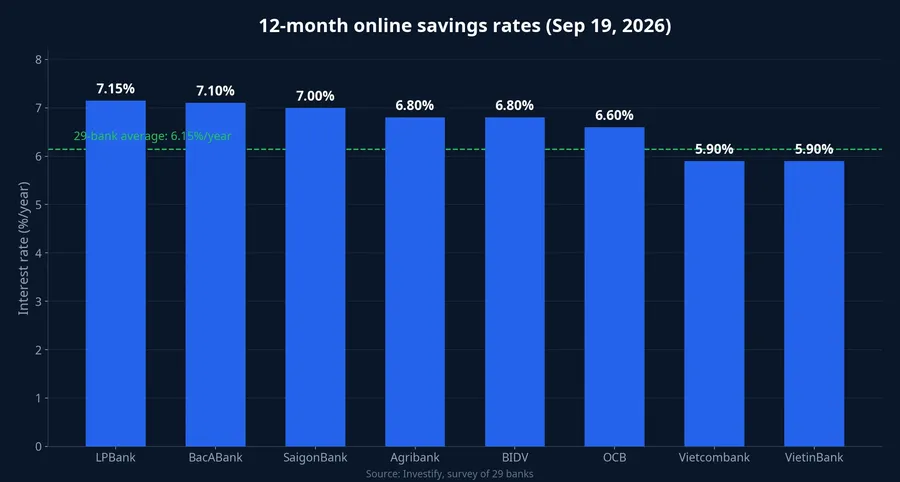
Converted into cash on a VND 35 million, 12-month deposit: the 6.15% average yields VND 2,152,500 in interest, the market-leading 7.15% yields VND 2,502,500, and the 5.90% rate at large state banks yields only VND 2,065,000. The gap between the highest and lowest payers is VND 437,500 for the whole year. That's smaller than most savers imagine.
A more worthwhile gap sits somewhere easier to grab: Agribank and BIDV pay 6.80% online versus 5.90% at the counter, a difference of VND 315,000 that comes down purely to whether you tap your phone or wait in line. Stretching the term barely helps either: the average 24-month rate is just 5.71%, lower than the 12-month rate, because the savings-rate curve has gone quite flat in the mid-term bucket.
Gold: you lose money before the price even moves
On September 19, 2026, SJC gold bars were quoted at VND 144,600,000/tael to buy and VND 147,600,000/tael to sell, or VND 14.46 million and VND 14.76 million per chỉ. Buying with VND 35 million at the sell price gets you 2.37 chỉ. If you changed your mind and sold it back that same afternoon at the buy price, that gold would convert to just VND 34,288,618.
Put simply: you'd lose VND 711,382 in a matter of hours, with the gold price unchanged. That's exactly one-third of the entire year's interest a VND 35 million savings deposit earns at the average rate. It comes from the roughly 2.07% buy-sell spread, a perfectly normal margin rather than an unusual one, and it's always sitting there waiting for anyone who walks in.

Over 12 months, gold has genuinely outperformed savings: the SJC sell price rose 11.82%, from VND 132 million to VND 147.6 million per tael. But that figure depends almost entirely on when you stepped in. Over the past year, gold moved through a wide swing: it peaked at VND 187 million per tael in February 2026, corrected sharply to VND 141.9 million in July, then recovered to VND 147.6 million today.
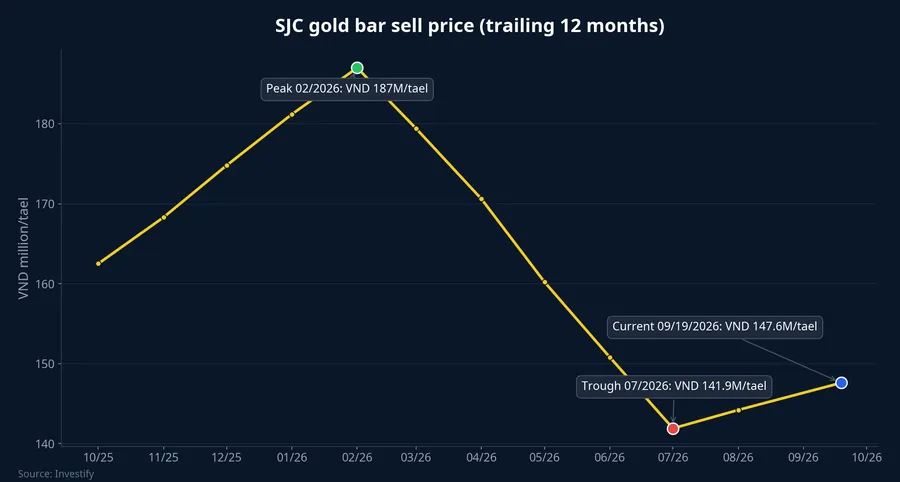
Someone who bought right at the February peak and sold today at the buy price would keep only 77.3% of their money, a 22.67% loss. Someone who bought in July is up 1.9%. Same asset, same year, and the two outcomes sit nearly 25 percentage points apart purely because of timing. The most important thing for anyone holding VND 35 million: gold pays no interest. The entire outcome hinges on price movement, and nobody knows that in advance.
Fixed-rate bonds: genuinely higher yield, but a narrow door for VND 35 million
The "fixed-rate" products that investment platforms distribute are, in substance, repackaged corporate bonds, not bank deposits. This distinction shapes everything that follows.
On yield, listed bond data as of September 18, 2026 shows the fixed-coupon group averaging 6.72% per year for private placements and 6.82% for public offerings. On VND 35 million, the 6.82% rate yields VND 2,387,000 in interest, about VND 234,500 more than the average savings deposit. That extra return isn't free: government bonds with a 1-year term pay only 3.90% per year, lower than bank deposits, which means the spread corporate bonds carry over that benchmark is compensation for the issuer's credit risk.
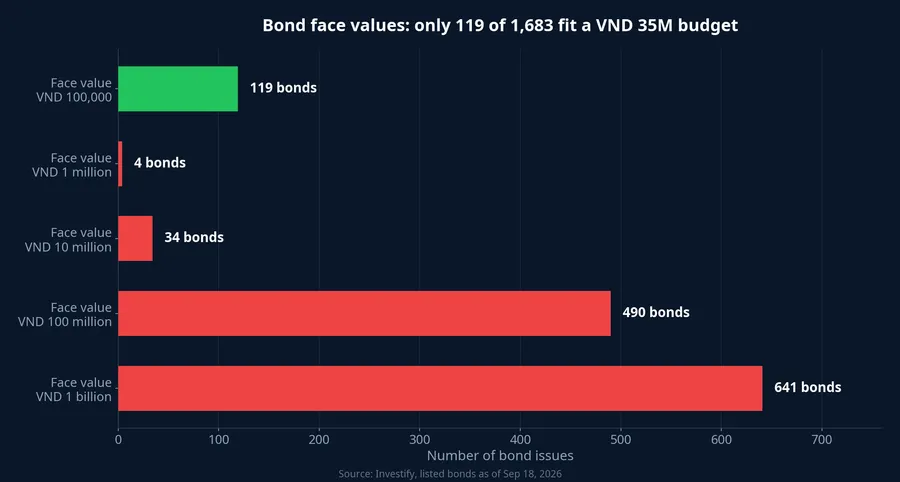
For a VND 35 million allocation specifically, the first obstacle is face value. Among 1,683 listed bond issues surveyed, 641 carry a face value of VND 1 billion and 490 carry VND 100 million; only 119 go as low as VND 100,000. Most of the market is simply out of reach at this amount.
The second obstacle is the protection layer. Bank deposits are insured up to VND 125 million per person per institution, and the principal is always preserved even on early withdrawal; you just drop to the no-term interest rate. Corporate bonds have no equivalent mechanism. Cashing out early means selling on the secondary market or negotiating with the distributor, and the price you get may fall below what you paid if market rates rise or the issuer's credit quality deteriorates.
Four choices, one yardstick
Lined up together, the three money-holding channels — savings, fixed-rate bonds, and gold sold immediately — differ by only about VND 400,000 to 800,000 for the whole year. Meanwhile, the iPhone's first-year depreciation is roughly four to five times larger than the best-performing channel's entire year of interest.
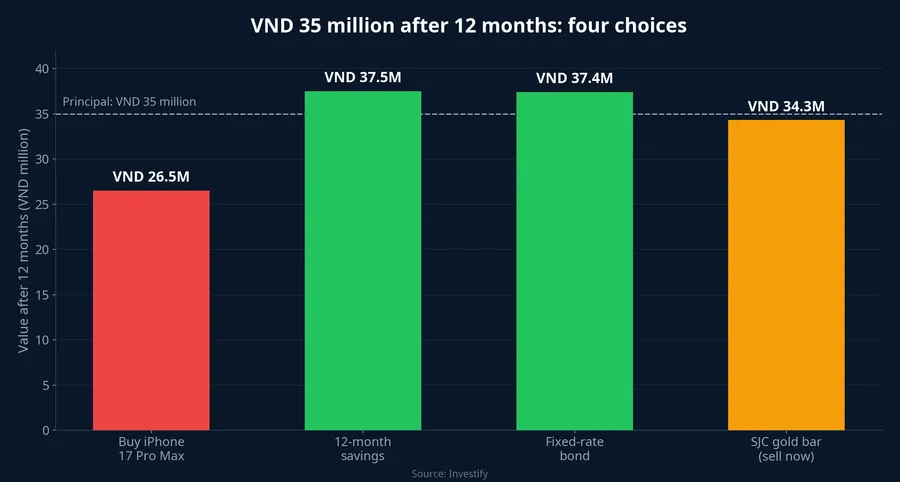
| Choice | VND 35 million after 12 months | Conditions attached |
|---|---|---|
| Buy an iPhone 17 Pro Max | Roughly VND 25-28 million in resale value | In exchange for 12 months of real use |
| 12-month savings deposit | VND 37.07-37.50 million depending on bank | Principal insured up to VND 125 million, withdrawable anytime |
| SJC gold bars | Loses VND 711,382 immediately to the buy-sell spread; everything after that depends purely on price | Pays no interest, outcome depends on entry timing |
| Fixed-rate bonds | VND 37.39-37.98 million, if you can buy in | Most issues require VND 100 million+; no deposit insurance |
A framework for deciding
The two levers in this decision sit a full order of magnitude apart. Choosing to spend or hold decides tens of millions of dong; choosing which channel to hold in — once you've decided to hold — decides only a few hundred thousand. A lot of attention is going toward the smaller lever.
If you've already decided to hold cash for roughly a year, the reasonable default today is a 12-month online savings deposit at the higher end of the market, 7.00-7.15% per year. That's close to the average yield on fixed-rate corporate bonds while keeping full deposit insurance and the right to withdraw anytime. Fixed-rate bonds only become worth considering when you're certain you won't need the money for the full term, can buy an issue with a face value that fits your budget, and are willing to take on the issuer's credit risk. Gold sits in its own category because it pays no interest: it's a long-term allocation, not a place to park money for exactly 12 months.
The number worth watching next quarter is the 12-month deposit rate level. If private banks keep rates above 7% per year, the gap between savings and corporate bonds stays narrow, and the credit-risk premium isn't worth the trade-off. If that level slips below 6.5%, the gap widens again, and the calculation needs to be redone.