


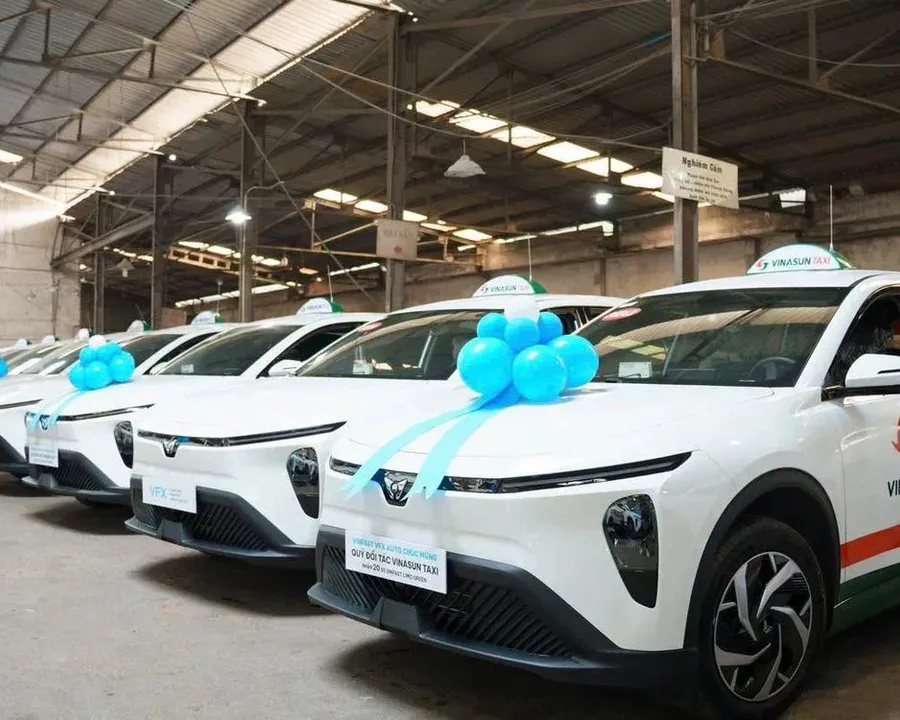
On the morning of September 16, 2026, at the lot of Ánh Dương Vietnam Joint Stock Company, twenty white VinFast Limo Green cars lined up waiting for Vinasun decals, the first electric taxi batch in the company's 22-year history.CafeF A few rows away sat thousands of Toyota hybrids the company had borrowed hundreds of billions of dong from banks to buy, for a reason management spelled out clearly just seventeen months earlier: it did not want to depend on charging stations.
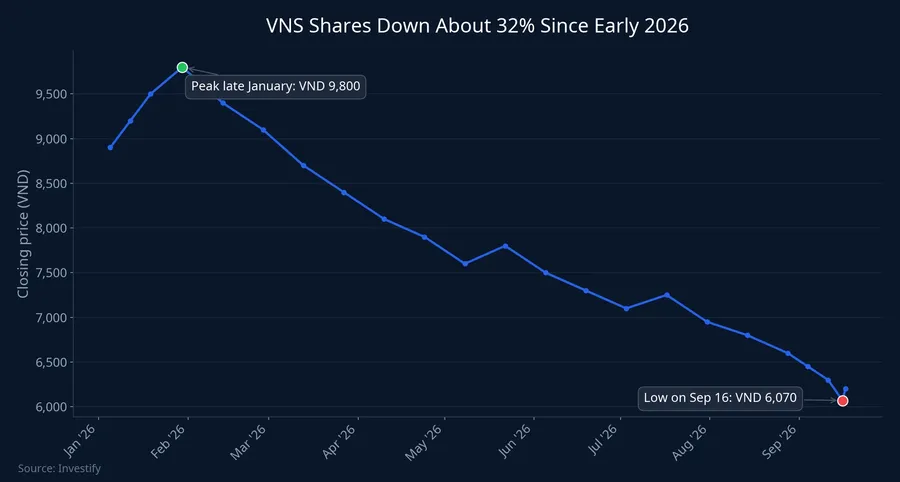
On that same September 16 session, VNS shares closed at VND 6,070, the lowest since the start of the year.Tin Nhanh Chung Khoan The two events fell on the same day but are not causes of each other: the share price had been sliding since March, and the sharpest drop came after the Q2 earnings report released in late July. What the two events share is a company buying itself more time with money its old business model no longer generates enough of.
The case against EVs was once quite solid
In April 2025, as the entire Vietnamese taxi industry rushed into electric vehicles, Vinasun's management publicly explained why it went the other way, and the reasoning was not superficial. Every morning the company has to bring its fleet back to the yard for technical checks, and no charging station at the time could hold 40 to 50 cars at once.Nguoi Lao Dong Hybrids save roughly half the fuel of a pure gasoline car, and drivers lose no time waiting to charge, meaning no lost fares. Management also worried EVs would depreciate faster on resale, while selling off old cars is an important revenue source for the company.
From those arguments, Vinasun poured money into hybrids: 806 cars put into service in 2024, roughly 400 more in 2025, backed by a loan of up to VND 264 billion from Vietcombank over 48 months to buy 550 Toyota hybrids.CafeF The 2026 plan added 310 more hybrids and retired 150 old vehicles, aiming for roughly 2,345 cars in operation by year-end.Nguoi Quan Sat Each decision was reasonable on its own, but all of them were made on top of a revenue base that kept shrinking.
Q2 2026 is when the math showed through
In Q2 2026, Vinasun posted net revenue of VND 194.3 billion, down 10.3% year-on-year.Tin Nhanh Chung Khoan Revenue dropped only about a tenth, but profit flipped direction entirely: from a VND 9.94 billion profit in the same period of 2025 to a net loss of VND 20.1 billion. It was the company's first loss after 17 consecutive profitable quarters, its first since the pandemic period.
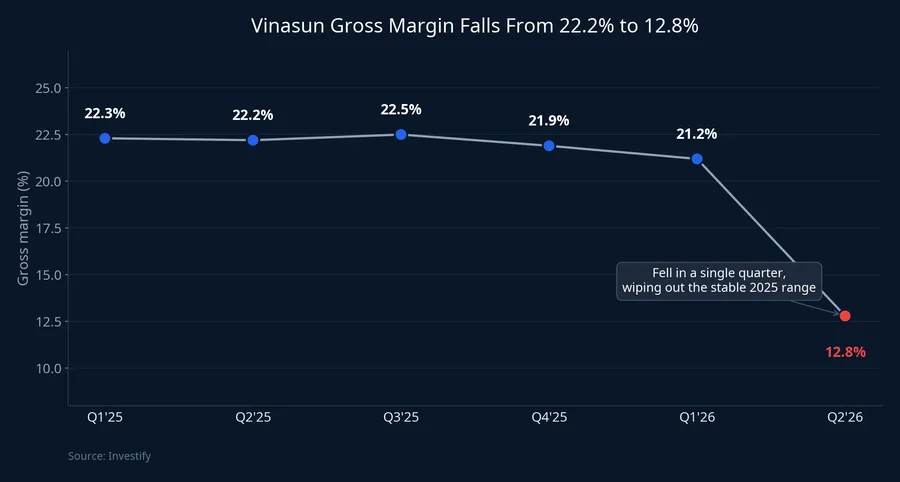
The number worth reading first is gross margin, which fell from 22.2% to just 12.8%, dragging gross profit down 48.3% to VND 24.91 billion. This is where a taxi company's cost structure shows its true shape: revenue tracks the number of fares and can shrink, but fleet depreciation of roughly VND 55 billion a quarter, bank interest, operations payroll, and yard maintenance all run at a steady pace regardless of whether cars are carrying passengers or sitting idle. When revenue fell 10% while cost of goods stayed nearly flat, the entire gap ate straight into the margin.
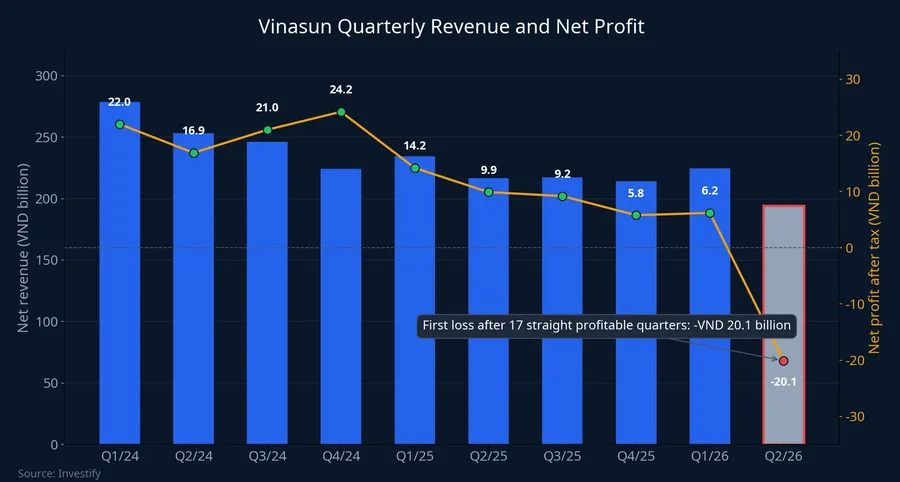
For the first half, Vinasun posted revenue of VND 419.06 billion and a net loss of VND 13.92 billion, versus a VND 24.1 billion profit in the same period a year earlier.Doanh Nhan Phap Luat The full-year profit target is VND 32.68 billion, meaning the remaining two quarters need to earn nearly VND 47 billion just to reach it.
The loss did not come from a single cause. The company attributed the revenue decline partly to maintaining driver support policiesNguoi Quan Sat, while rising oil prices tied to geopolitical tension and an 11% jump in financial costs to nearly VND 9 billion from vehicle-purchase interest also played a role. But the data leans toward structural causes rather than a one-off shock: if fuel were the main driver, gross margin would move with the oil-price cycle and then recover. Instead, it held steady in the 21-22.5% range through all of 2025, then dropped in a single quarter, exactly the one where revenue hit its lowest point in the series. That pattern fits a loss of pricing power and volume better than a pure input-cost shock.
The market is growing, but not for Vinasun
Vietnam's ride-hailing industry keeps growing fast: roughly $1.54 billion in 2025, projected to reach $1.94 billion in 2026, a compound growth rate around 19% a year. Meanwhile, Vinasun's revenue has fallen for 10 consecutive quarters year-on-year. In Q1 2026, Xanh SM held 54.51% of the four-wheel ride-hailing market by gross transaction value, Grab 40.92%, and Be 4.57%.CafeF Vinasun once held 2.44% in Q4 2024 and no longer appears in the market-share tables at all.Nguoi Quan Sat
The company's shrinkage shows most clearly in its fleet and headcount: once above 6,000 cars before 2020, down to 2,167 by the end of 2025; staff down from roughly 17,000 at its 2016 peak to about 1,400 by the end of 2025, a drop of more than 90%.Nguoi Quan Sat Pressure also comes from rivals' capital scale: Xanh SM raised charter capital from VND 25,000 billion at the end of 2025 to VND 54,000 billion after four capital raises in the first half of 2026 alone. Vietnam's taxi industry as a whole is shifting nearly 20,000 vehicles to VinFast EVs, with Mai Linh committing nearly 4,000 cars, Sun Taxi 3,000, and G7 nearly 4,000.Nguoi Quan Sat Set against those numbers, Vinasun's 20 Limo Green cars are a trial step, not yet a transition.
The balance sheet still has cushion, but it's thinning
Vinasun's operating cash flow has stayed positive every quarter, including the loss quarter: Q2 2026 brought in VND 53.5 billion, thanks to VND 55.2 billion in depreciation, a non-cash expense. Shareholders' equity stands at VND 1,106 billion, with a debt-to-equity ratio of about 0.55x, leverage that is not yet in alarming territory. At a market cap of around VND 420 billion, the stock trades at roughly 0.5x book value.
But the cushion is thinning every quarter. Cash stood at just VND 53.4 billion at the end of Q2, the lowest in the observed series and sharply down from VND 209.6 billion a year earlier. The current ratio has fallen to 0.95x, meaning current assets no longer fully cover current liabilities. Net debt to EBITDA jumped from 3.73x in early 2025 to 9.53x, not because debt rose but because earnings before interest, tax, depreciation and amortization collapsed. This is the real bind in the fleet strategy: every new batch of cars requires cash or debt, locking in additional depreciation and interest expense on the income statement for the following four years. If revenue per fare and fare volume both recover, that cost gets absorbed over time. If revenue keeps shrinking, every additional car purchased just makes the fixed-cost base heavier relative to what's left of revenue.
Shareholders are split into two camps
The market has already repriced VNS sharply: shares opened 2026 around VND 9,300, peaked at VND 9,800 in late January, drifted down over three quarters to VND 6,070 on September 16, and closed at VND 6,200 on September 17, a decline of about 32% since the start of the year. After the negative first-half results, HoSE added VNS to its list of stocks ineligible for margin trading, further narrowing demand from leveraged investors.FireAnt
Major shareholders inside the company are moving in opposite directions. Kim Nguu Consulting Co., an entity linked to a board member, has repeatedly registered to divest from April through late August 2026, though many attempts sold only a small fraction of the intended shares due to thin liquidity. In the opposite direction, Le Hai Doan, a Board Member at Ánh Dương Vietnam Joint Stock Company (Vinasun), bought more than 909,000 additional shares in May 2026, raising his stake from 13.55% to 14.89%; he and related parties now hold more than 17.8 million shares, equivalent to 26.29% of charter capital.StockBiz This split shows that even the people closest to the books are reading two different futures for the same company.
Two reading habits for investors
The Vinasun story is not one about a management team making bad decisions. The hybrid case in 2025 was solid at the time, and adding EVs this year is a reasonable adjustment now that charging infrastructure has changed. The problem runs deeper: when a business model gets displaced by another with a superior cost structure and capital scale, every defensive investment only buys time. It does not reverse the decline.
For investors weighing shares of traditional incumbents in industries being displaced, two reading habits are worth taking from this case. First, read gross margin before the profit line: profit can be propped up temporarily by asset sales or financial income, while gross margin reflects directly whether a company still holds pricing power with its customers. Second, put the growth rate of fixed assets next to the growth rate of revenue: Vinasun's net fixed assets stood at VND 1,424.8 billion at the end of Q2 2026, higher than a year earlier, while revenue in the same period fell. Two lines moving in opposite directions like that signal fixed costs piling up on top of a shrinking revenue base.
The nearest checkpoint falls at the end of October, when the Q3 2026 earnings report comes out. A gross margin back in the 20% range would signal the new fleet is starting to pay back its operating efficiency. If the figure still hovers around Q2's 12.8%, most of the fleet investment is adding to the fixed-cost burden rather than easing it.