
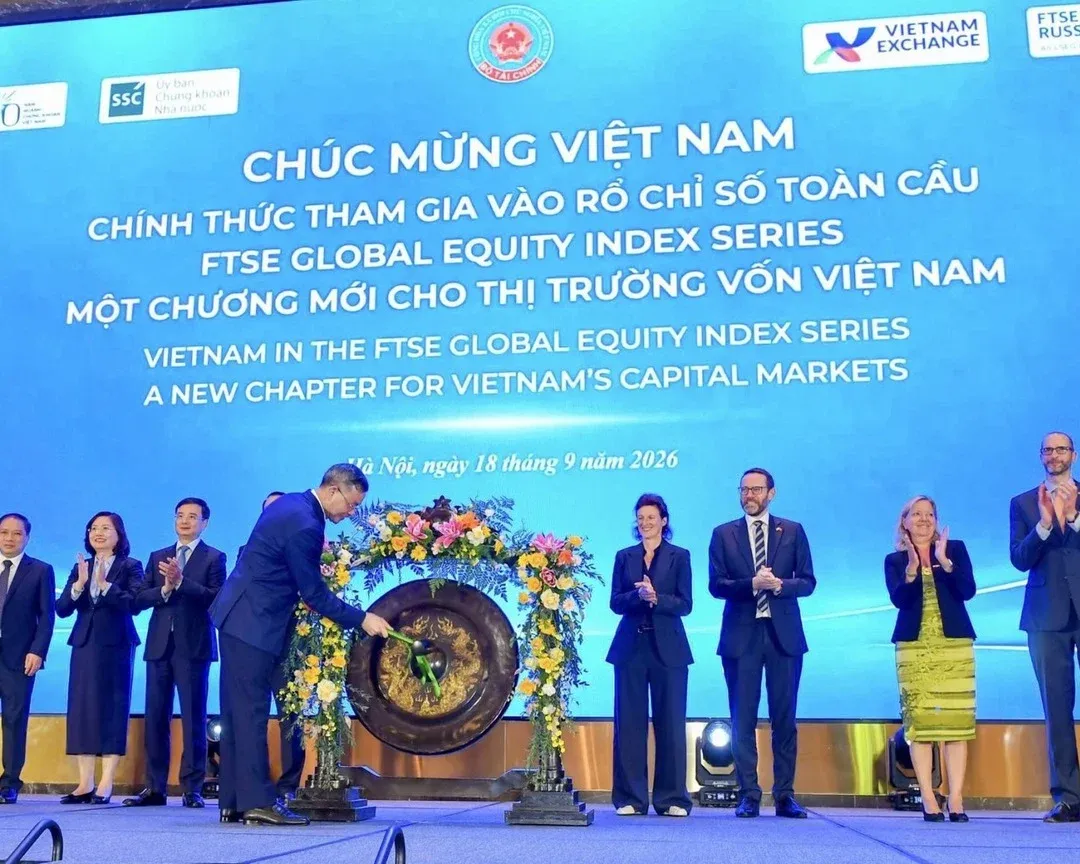

On the evening of September 18, 2026, the gong sounded at a conference jointly hosted by the Ministry of Finance, the State Securities Commission and FTSE Russell, marking Vietnam's stocks officially entering the secondary emerging market basket after years in frontier status.VnEconomy On investor forums, the story is already being told in a familiar shorthand: the gong rings, foreign money pours in, prices pop.
The bigger picture shows that's only half true. Vietnam's upgrade is real: 117 stocks appear in the FTSE GEIS index system for the first time, including 27 large, mid and small-cap names plus 90 micro-cap names.VnBusiness Brokerages estimate the passive capital that index-tracking funds must deploy at roughly $1.5 billion.Tap Chi Cong Thuong But the gap between the popular narrative and reality isn't about the size of the flow. It's about the timeline.
The real effective date is Monday, and phase one opens just 10%
Tonight's gong is ceremonial. The actual effective date is Monday, September 21, 2026, when Vietnamese stocks formally appear in FTSE's indices.Dan Tri More importantly, Vietnam isn't being added to the basket in one move. FTSE Russell splits the process into four phases running through September 2027, on a rising cumulative weight schedule.Thoi Bao Tai Chinh Viet Nam
Phase 1 in September 2026 applies a 10% weight. Phase 2 in March 2027 adds another 20%, bringing the cumulative total to 30%. Phase 3 in June 2027 adds 35% more, reaching 65%. Phase 4 in September 2027 adds the final 35%, completing 100%.
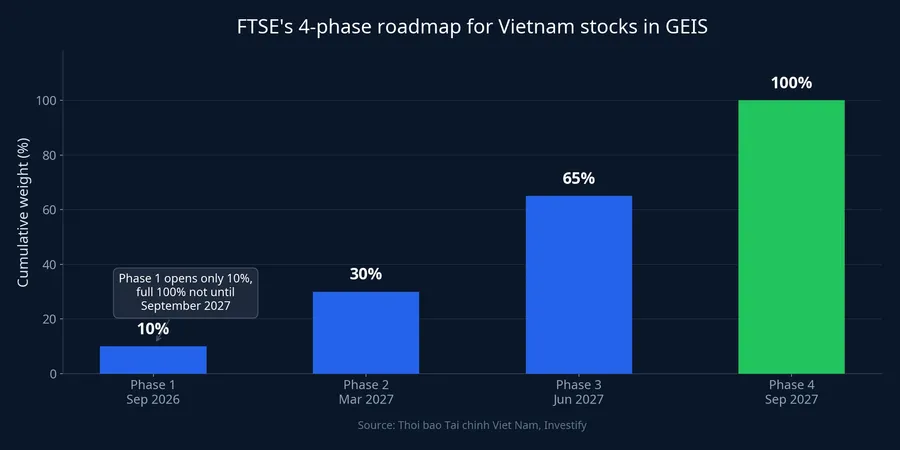
FTSE Russell has said the phased approach is designed to limit market disruption and ensure liquidity can absorb the flow. In practice, as of Monday morning, Vietnam's market has only opened one-tenth of the capital door that the $1.5 billion figure represents. Vietnam's full weight in the FTSE Emerging All Cap index has been set at approximately 0.488%, and that level won't be reached until September next year.VietnamFinance
Sellers exit all at once, buyers arrive in four installments
This is the least-discussed detail, and it's the one that will shape how investors feel over the coming weeks. When a market gets upgraded, it leaves the frontier basket and enters the emerging one, but these two moves don't happen on the same clock.
Per the September 2026 review, 126 Vietnamese stocks exit all FTSE Frontier indices immediately after the September 18 session closes.Vietstock Funds tracking the frontier basket are forced to sell out completely in one go, since Vietnam no longer falls within their investment scope. On the other side, funds tracking the emerging basket buy only 10% in the first phase.

ACBS estimates the 27 large, mid and small-cap stocks receive around $216 million, equivalent to VND 5,588 billion, in the first allocation.VietnamFinance SSI Research puts the first week of deployment at a similar figure, roughly $240.5 million in net buying.Tin Nhanh Chung Khoan One side sells 100% in a single session. The other buys 10% and then waits six months for the next tranche. That mismatch in pacing is why net foreign inflows around the effective date tend to run much thinner than the headline total the market keeps citing.
The money already arrived, and the index still fell
Most of the first-phase flow didn't wait until Monday. Index-tracking funds typically rebalance their portfolios in the sessions closest to the effective date, which means the week of September 14-18 was the real reshuffling week. The September 18 session data makes that clear: foreign investors bought a net VND 1,218 billion across the whole market.Tin Nhanh Chung Khoan Within the 27 stocks in the FTSE All-Cap basket alone, 21 names saw net buying worth VND 1,717 billion.VietnamPlus
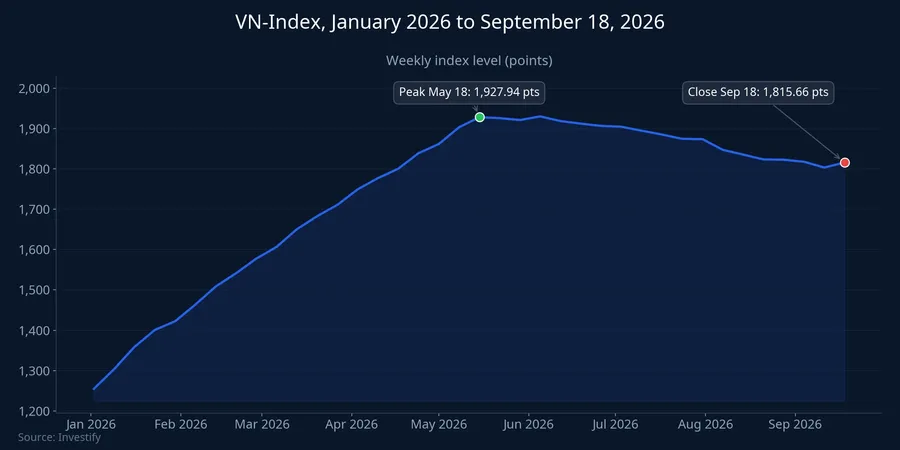
That same session, the VN-Index closed down 7.11 points, or 0.39%, at 1,815.66. Trading volume topped 881 million shares, notably higher than the 715 million shares of the prior session. A single down session can't be pinned on one cause: bank stocks dragged the index lower, some domestic profit-taking followed a three-session rally, and the market was still absorbing the Fed's rate hike from the early hours of September 17. The available evidence isn't enough to cleanly separate how much each factor contributed. What's worth keeping is simpler: more than VND 1,200 billion in foreign capital flowed in on the exact session the index fell. Net buying and index direction are two different things, even during the year's biggest rebalancing session.
Four markets that went first already answered this question
If one session isn't enough to draw a conclusion, look at markets that have already gone through this exact process. The trajectories around the effective date for Kuwait, Saudi Arabia, Qatar and the UAE show a fairly consistent pattern.Tuoi Tre
Kuwait rose 13.19% ahead of its effective date, but was up just 3.84% six months later, and down 15.3% after a full year. Saudi Arabia rose 10.158% ahead of its effective date, then sat nearly flat, up just 1.15%, a year later. Qatar fell 8.98% ahead of its effective date and dropped a further 20.34% over the following year. The UAE fell 23.28% ahead of its effective date, rebounded to +3.4% after six months, then fell back 14.97% after a full year.
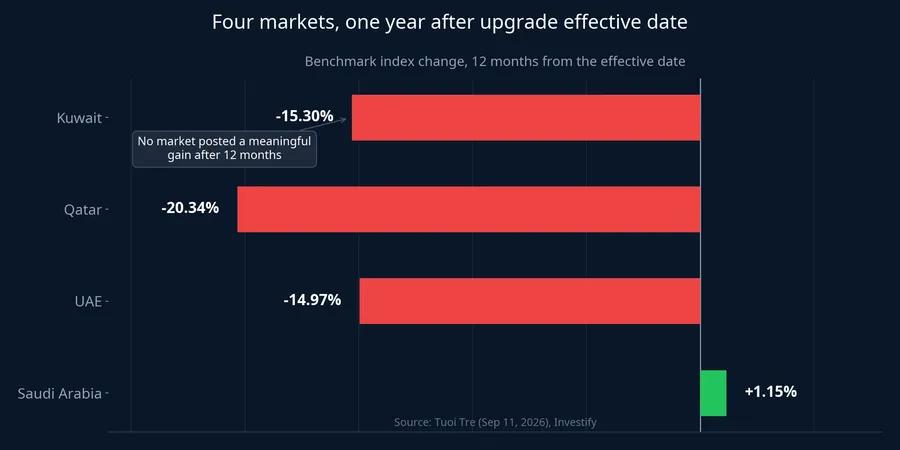
Four markets, four different macro backdrops, and none of them posted a meaningful gain in the twelve months after the effective date. The rally in an upgrade story mostly happens beforehand, during the anticipation phase, not after. The other half of the pattern deserves equal airtime: over three years, most of these markets returned somewhere between 20% and 50%, with Kuwait up 14.8% after two years and 44.84% after three. An upgrade functions as a medium-term driver, not a one-session pop.
What actually changes starting Monday
Looking back at Vietnam's own market this year sharpens the picture. The VN-Index closed 2025 at 1,784.49 points and now sits at 1,815.66, up just 1.75% after nearly nine months. The index peaked at 1,927.94 points on May 18 and currently sits 5.8% below that peak. The upgrade narrative has run all year, but the index hasn't moved in a straight line upward.
The more accurate picture is this: the FTSE upgrade changes who is allowed to buy Vietnamese stocks, not what those stocks are worth right away. Starting Monday, Vietnam sits within the default investment universe of global emerging-market funds, including active managers who have far more flexibility than passive index funds. That's a structural change, and it's durable, but it plays out over months and quarters, not sessions.
For individual investors weighing this story, the sensible framework is to treat the upgrade as a twelve-month process and use the review dates as checkpoints rather than the first Monday of trading. The nearest checkpoint that will offer an answer is the March 2027 review, when the cumulative weight steps up from 10% to 30%. The actual passive capital received in that round, measured against today's estimate, will show whether foreign inflows are tracking the schedule or falling behind it.
Over the coming week, the figure worth watching isn't the VN-Index level. It's the cumulative net foreign buying for the week, measured against the roughly $240 million brokerages estimate for the first deployment tranche. If the cumulative figure comes in above that estimate, it signals active capital is arriving alongside the passive funds. If it comes in well below, selling pressure from exiting frontier funds is still offsetting most of the new buying.