


On September 15, 2026, the State Securities Commission's Inspectorate issued an administrative fine of VND 350 million against Phu Quoc Civil Construction Co., Ltd. for offering bonds while its liabilities-to-equity ratio stood at 7.07x, above the 5x legal cap.Cafebiz It is the first issuer fined for this specific violation, not the first issuer whose leverage has ever crossed the cap.
What matters more than the fine itself is timing. The VND 1,500 billion bond tranche had already been fully placed, with proceeds landing in the company's account back in late March, while the penalty only arrived in mid-September. That nearly six-month gap is not a regulatory oversight. It is a structural feature of how Vietnam's private placement bond market operates, and retail investors need to understand it before they put money down, not after reading a headline about a fine.

Sold first, fined six months later
On March 30, 2026, the Hanoi Stock Exchange's (HNX) corporate bond information portal received the pre-offering disclosure for tranche PKC12601, valued at VND 1,500 billion, with an expected issuance date of March 31, 2026.Cafebiz The tranche was sold and remains outstanding today.
The company's H1 2026 financial statements record VND 1,479 billion in outstanding bonds. For tranche PKC12601 specifically, the company repaid VND 21 billion in principal and more than VND 15.8 billion in interest during the first half of the year, at a 10.5% annual coupon.Cafebiz In other words, the cash had already flowed to the issuer, and some of it had already flowed back to bondholders as interest, before the penalty ever existed. Who carried the risk during that nearly six-month window? The people who bought the bonds, not the regulator and not the issuer.

What the 5x cap actually measures
The condition that was violated sits in the amended 2025 Enterprise Law, effective July 1, 2025. The Inspectorate's decision quotes the exact wording: an issuer must have "total liabilities (including the value of the planned bond issuance) not exceeding 5 times its equity, per the audited financial statements of the year immediately preceding the issuance year."Cafebiz
That single sentence embeds three notable technical choices. The numerator is total liabilities, not just interest-bearing debt, so an issuer with almost no bank loans can still breach the cap if it has collected large customer advance payments. The rule also adds the value of the planned bond tranche itself into the numerator, meaning it measures leverage after the new debt is taken on, exactly the position bondholders will be stepping into. And the denominator is locked to audited full-year financials: Decree 200/2026/ND-CP, issued June 5, 2026, eliminated the earlier option to use unaudited semi-annual or quarterly reports.Nhan Dan Issuers can no longer cherry-pick their most flattering reporting period.
For Phu Quoc, the math is entirely public. The audited 2025 financial statements recorded total liabilities of VND 28,458.8 billion and equity of VND 4,235.8 billion. Add the VND 1,500 billion planned bond issuance to the numerator, divide by equity, and the result is 7.07x.
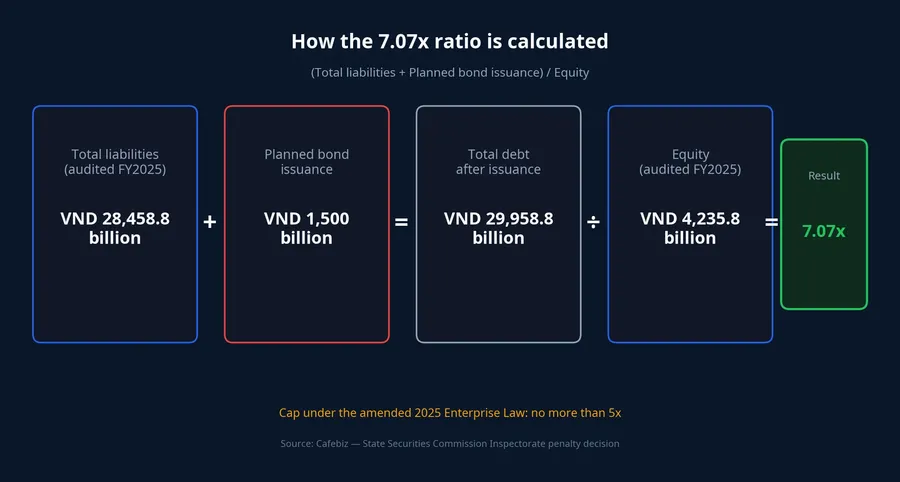
The 7.07x figure and what the debt is actually made of
By June 30, 2026, the picture had improved somewhat: equity rose to VND 4,331 billion, up more than 10% year-on-year, while total liabilities fell to under VND 30,500 billion.Cafebiz The debt-to-equity ratio still sits above 7x, but the composition of that debt is not uniform, and that's where the story gets more complicated than a single number.
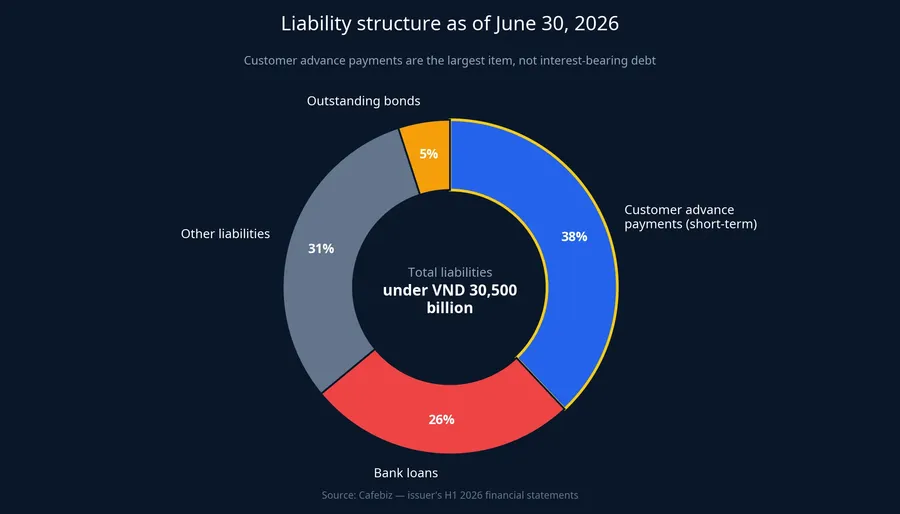
Short-term customer advance payments account for more than VND 11,600 billion, roughly 38% of total liabilities and the single largest line item. Strip that out, and the ratio drops to around 4.4x, below the cap. Bank loans total VND 7,836 billion.Cafebiz
The issuer-friendly reading has real economic logic: customer prepayments aren't interest-bearing loans, they're an obligation to deliver a product, with no maturity date forcing a cash payout. But the opposite reading holds up just as well. If a project fails to deliver on its commitments, that delivery obligation converts into a refund obligation, and refunds owed to thousands of buyers are typically settled ahead of bondholder claims. With H1 net profit of just VND 95.4 billion, down 64% year-on-year, the company's ability to deliver on its commitments is a real variable worth watching, not a safe assumption.Cafebiz
Lawmakers deliberately chose a blunt yardstick here. The 5x cap doesn't distinguish good debt from bad debt, or interest-bearing debt from interest-free debt. In exchange, it produces a number every investor can calculate the same way, with nothing to argue about.
Ex-post enforcement means the money moves first, penalties come later
Private placement bonds don't require case-by-case approval from the State Securities Commission. Issuers self-disclose on the HNX portal before an offering and take responsibility for confirming they meet the conditions; the regulator only checks afterward. The Phu Quoc timeline is a direct product of that design: disclosure on March 30, issuance on March 31, penalty on September 15.
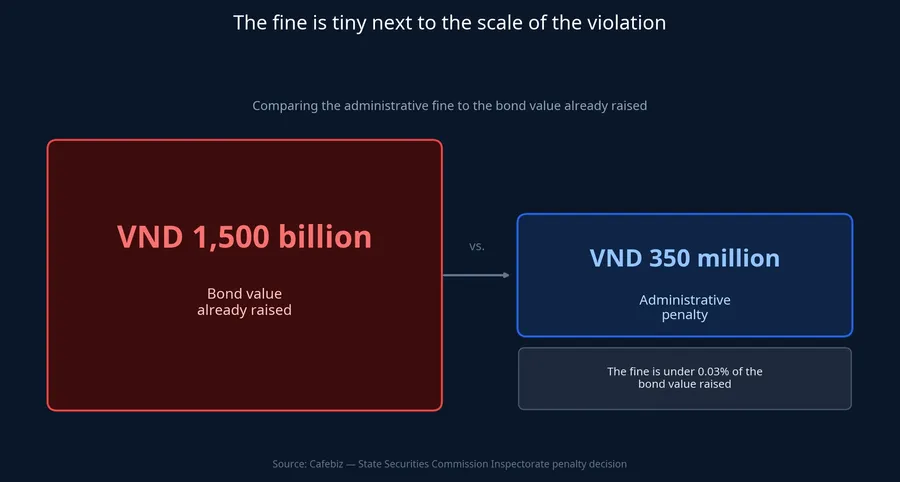
Coverage of the case only reports the monetary fine, with no remediation measures mentioned for the VND 1,500 billion tranche still outstanding. The VND 350 million penalty amounts to under 0.03% of the value raised, far too small to function as a real deterrent.
On September 14 and 15, the Inspectorate issued 10 penalty decisions totaling nearly VND 1.33 billion, with 8 of them bond-related and totaling VND 990 million.Vietstock Seven issuers were each fined VND 92.5 million for late or missing disclosures, financial reports, use-of-proceeds reports, or principal-and-interest payment reports.Vietstock Most of the enforcement to date has targeted paperwork failures, while issuers' actual financial conditions had never been touched. Phu Quoc is the first case where that line was crossed.
Who the 5x cap doesn't touch, and where to check it yourself
The 5x cap does not apply to state-owned enterprises, credit institutions, insurance companies, or issuers raising bonds specifically to fund real estate projects.Nhan Dan That last exemption matters most for retail investors: real estate bonds are the group most commonly pitched with high-yield offers, and they're also the group exempted from the exact cap just used to hand out a penalty. A tranche that doesn't breach the 5x cap could mean genuinely low leverage, or it could simply mean the issuer falls outside the cap's scope. Those are two very different risk profiles.
HNX's corporate bond portal centralizes issuer disclosures: financial statements, use-of-proceeds reports, principal-and-interest payment status, and collateral information. For any private placement bond being pitched, the check starts with the same formula the Inspectorate used: divide total liabilities by equity from the most recent audited annual financials, then add the planned issuance to the numerator. From there, look at what the debt is actually made of, how much is interest-bearing versus customer prepayments, and confirm whether the issuer falls into an exempted category. The pre-offering disclosure document itself is self-prepared by the issuer and has not been reviewed by anyone before the money is raised.
The division works before you buy, not after you read about a fine
The Phu Quoc case isn't a story about a bad actor caught red-handed. It's a demonstration of how a market built on ex-post enforcement actually works: issuers self-disclose, take on their own responsibility, and the regulator can only penalize after the money has already changed hands. The 5x cap is a blunt but necessary supervisory tool, and the nearly six-month gap between when the cash arrived and when the penalty landed is the cost this market design imposes on bondholders.
VND 350 million does nothing to protect whoever bought into that VND 1,500 billion tranche. The debt-to-equity division, on the other hand, is entirely doable before buying, and takes only a few minutes with financial statements that are already public on HNX. Worth watching next: whether the Commission expands its review of the 5x cap to other outstanding issuances, and whether the real estate bond exemption gets tightened in upcoming implementing guidance.