

On the morning of September 17, at a conference titled "Listing Roadmap for FDI Enterprises in Vietnam," Thomas Nguyen, Head of Investment Banking and Institutional Client Coverage at SSI Securities Corporation (SSI), floated a striking figure: roughly $10 billion could flow into Vietnamese equities over the next 12 months.CafeF
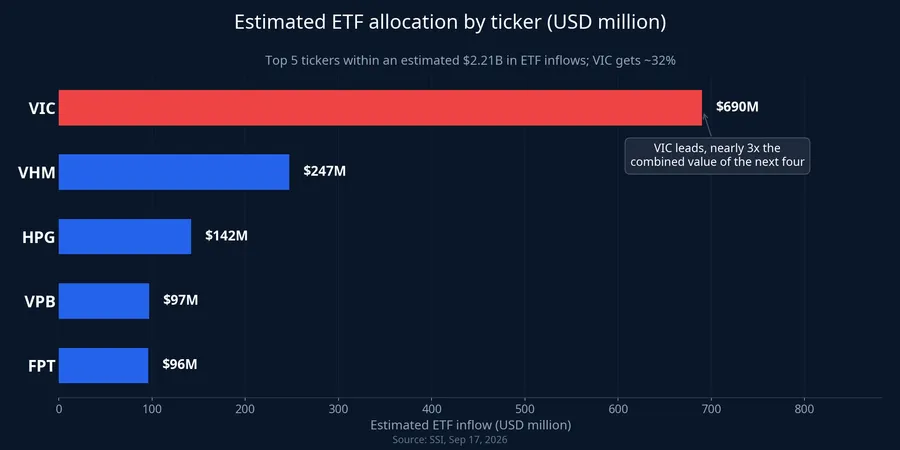
The breakdown that came with it is the part worth reading closely. Of the roughly $2.21 billion in new ETF capital SSI estimates will flow into Vietnamese stocks, VIC alone is projected to receive around $690 million, or 32%.CafeF Behind it come VHM at roughly $247 million, HPG at roughly $142 million, VPB at roughly $97 million, and FPT at roughly $96 million. The top five names absorb more than half the total.
None of those funds are reading Vingroup's financial statements before hitting buy. The real story is a multiplication problem: country weight times free-float-adjusted market cap.
Index money is split by formula, not opinion
Index funds and passive ETFs promise their investors one thing: tracking the benchmark. Every dollar that flows into the fund gets divided among stocks exactly in proportion to each stock's weight in the basket. Thomas Nguyen put it bluntly: "If VIC accounts for 19% of the index, then 19% of the money goes there. It doesn't matter whether you drive a VinFast or think the company is good or bad; the capital still flows in."CafeF
The first layer of the multiplication is country weight. After the August 2026 review, Vietnam's weight in the FTSE Emerging All Cap Index rose to roughly 0.49-0.50%.CafeF In other words, every $1 billion in assets tracking that index sends only about $4.9-5 million into Vietnam. $2.21 billion sounds like a lot, but it's a thin slice cut from a far larger pool of capital outside the country.
Market cap multiplied by free float
The second layer is what decides the pecking order. The index doesn't weight stocks by total listed market cap: it weights them by free-float-adjusted market cap, meaning the portion of shares actually available to trade after subtracting what large shareholders and the state hold.
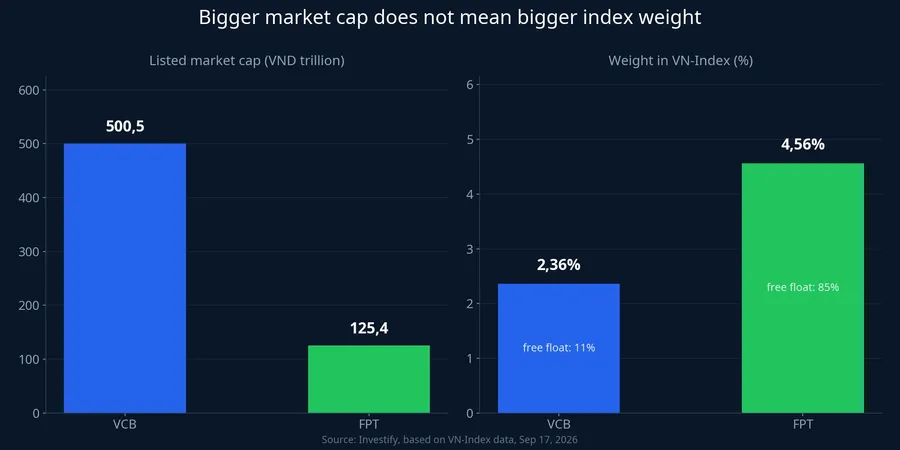
Vietnam's own VN-Index basket illustrates the weight of this variable clearly. VCB has the largest listed market cap in the basket, around VND 500.5 trillion, but its free float is just 11%, so its actual index weight is only 2.36%. FPT's market cap is VND 125.4 trillion, more than four times smaller, but its free float runs to 85%, giving it a weight of 4.56%. A company several times larger still ends up with half the weight.
The same logic drives the basket's concentration: the top 15 names account for 57.40% of the entire VN-Index, while more than 360 remaining stocks split under 43%. When money flows by weight, most of it stops at the top.
Why VIC comes out on top
VIC checks three boxes at once. First is scale: market cap of over VND 1.86 quadrillion as of the morning of September 17, among the largest on the exchange. Even a fraction counted as free float is still large relative to the rest of Vietnam's basket.
Second is ownership structure. Major shareholders hold roughly 70.86% of VIC's charter capital, equivalent to more than 5.35 billion shares locked outside the market, leaving the genuinely tradable float much thinner than the company's size suggests.
Third is foreign ownership room. Foreign ownership at VIC currently sits at just around 3.05%, leaving roughly 44.9% of charter capital still available. For banks, the foreign room is usually the bottleneck that chokes off index inflows. For VIC, it isn't.
Liquidity is where the math meets reality
Those three conditions explain the weighting, not the speed. The roughly $690 million works out to about VND 18,078 billion, while VIC's 20-session average matched trading value is only around VND 1,377.6 billion per session. If a single fund tried to absorb the stock's entire liquidity — a scenario no fund actually attempts — it would still take about 13 consecutive sessions to buy it all. In practice, passive funds only take a small slice of each session's trading value to avoid pushing up the price themselves, so disbursement stretches over weeks.
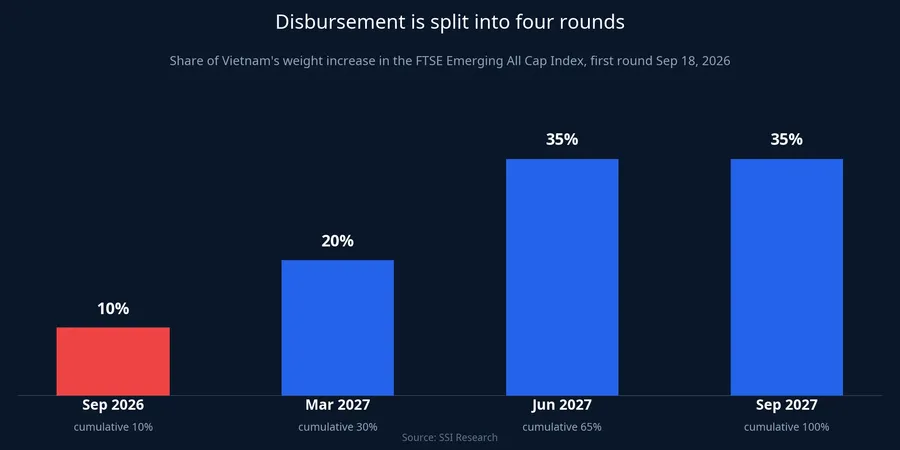
The timeline is also broken into stages: four disbursement rounds at 10% in September 2026, 20% in March 2027, 35% in June 2027, and 35% in September 2027.VietnamPlus The first round lands on September 18, 2026, with estimated net buying of around $240.49 million across 27 stocks, ahead of the new indices officially taking effect on September 21, 2026.VietnamPlus
Entering the basket doesn't mean immediate net buying. In that very first disbursement week, VIC was, by SSI's estimate, the stock with the heaviest net selling, around $28.06 million, as several foreign funds trimmed their positions at the same time, overwhelming the new buying.VietnamPlus The index mechanism decides where the money eventually goes, not which way the price moves this particular week.
How the $10 billion figure stacks up
The $10 billion figure and the $2.21 billion figure don't carry the same level of confidence, and this is exactly where investors tend to conflate the two. The part with a clear calculation basis is passive flow: roughly $2.21 billion under a scenario where Vietnam's weight stays around 0.49%. If Vietnam's weight gets raised gradually across upcoming review cycles, the optimistic scenario pushes total inflows to roughly $4.453 billion.VietnamPlus Whether that weight actually rises accounts for a swing of more than $2 billion on its own.
The rest, from roughly $4.4 billion up to $10 billion, is active capital. Thomas Nguyen made clear that $2.21 billion is only the passive portion, and he believes that figure is overly conservative based on experience in other markets.CafeF But active capital doesn't follow any formula: it depends on global investor sentiment, valuation levels, corporate earnings outlook, and global interest rates. The $3 billion figure attributed specifically to Vanguard funds is an expectation, not a commitment.CafeF A reasonable read: $2.21 billion is the floor, $10 billion is the ceiling of an optimistic scenario.
The consequence: a more concentrated market
The good news is that capital is coming. The less welcome news is that concentration will keep rising. The Vingroup group already made up roughly 19% of the VN-Index as of end-July 2026, and new index-tracking flows will buy in exactly that proportion.CafeF
This isn't unique to Vietnam. SK Hynix and Samsung together make up roughly 52% of South Korea's KOSPI, TSMC alone accounts for 42% of Taiwan's index, the five largest stocks make up 41% of the Nikkei 225, and the Magnificent Seven account for roughly 34% of the S&P 500.CafeF In Vietnam, foreign investors' share of trading value has also climbed from 7.4% in 2021 to 13.2% in the first seven months of 2026.CafeF For individual investors, the consequence is concrete: an index-tracking portfolio will increasingly look the same at the top, and the movement of a handful of large stocks will drive most of the result.
Where individual investors stand
No retail investor can buy at exactly the weights foreign funds are buying at. But the same mechanism is how domestic index funds operate: ETFs tracking VN30, VNDIAMOND, or VNFIN LEAD also allocate capital by basket weight, typically charging management fees around 0.6-0.8% a year. Actively managed open-end funds go the opposite direction, letting managers deviate from the basket in exchange for higher fees, commonly 1.30-1.95% a year, with minimum periodic investment amounts as low as VND 10,000-100,000.
The framework for choosing is fairly clear. If the goal is to track index flows, a low-fee passive fund achieves that, on the condition of accepting the basket's concentration as-is. If the goal is having someone adjust when the basket skews too heavily toward one group, an active fund fits better, and the fee difference is the price of that flexibility.
One note on expectations: year-to-date performance for most domestic ETFs tracking VN30 remains negative by around 3%, even though the market-upgrade story has been discussed for months. The market has already priced in part of it, and the capital inflow is being split across four rounds stretching to September 2027.
Conclusion
The $2.21 billion in passive ETF capital rests on a clear calculation basis: country weight multiplied by free-float-adjusted market cap. VIC captures the largest share of it because it checks the boxes on scale, ownership structure, and foreign room. The portion above that, up to $10 billion, remains an expectation tied to active capital, with no mechanism guaranteeing it materializes.
The nearest checkpoint is the March 2027 review. There's only one number worth watching: Vietnam's weight in the FTSE Emerging All Cap Index. If it climbs above the current 0.49-0.50%, the case for a larger capital scenario gets stronger. If it holds flat, anything above $2.21 billion remains just an expectation.