


In the first half of 2026, outstanding real estate credit across Vietnam's banking system reached VND 5.146 quadrillion, up 8.3% from the end of 2025 and equal to roughly 25.5% of total system-wide credit.1thegioi.vn Set next to the 36.24% growth rate for all of 2025, that figure is easy to compress into a tidy conclusion: real estate credit has been tightened, and banks are running out of room to lend.
That reading isn't entirely wrong. At the end of 2025, the State Bank of Vietnam (SBV) issued Document 11686/NHNN-CSTT, setting a hard rule for 2026: each credit institution's real estate credit growth cannot exceed its own overall credit growth rate.1thegioi.vn That rule is still in force, and actual growth has indeed slowed markedly from last year. But the 8.3% headline and the actual constraint governing bank lending behavior are not the same thing.
Two different measurements, one published number
The 8.3% figure is an aggregate statistic. It sums every dong of real estate credit banks have extended, including social housing, industrial zones, and resorts. But the number each bank must actually watch to stay compliant with Document 11686 is something else: real estate credit minus the categories the SBV has explicitly excluded from the controlled basket. That second measurement is what really determines how much more a bank can lend into real estate, and it has been narrowed twice in just nine months.
On May 29, 2026, Document 4551/NHNN-CSTT, sent to 25 credit institutions, allowed banks to exclude incremental lending to social housing, industrial zones, and export-processing zones from the controlled basket.1thegioi.vn Then on September 16, 2026, Document 8509/NHNN-CSTT opened another exclusion: through the end of 2026, banks no longer need to count incremental lending to restaurants, hotels, and eco-tourism or resort projects in that basket.Vietstock The accompanying list covers 25 banks, including VietinBank, Agribank, BIDV, ACB, Techcombank, Sacombank, SHB, VIB, TPBank, and OCB.Tin nhanh Chứng khoán
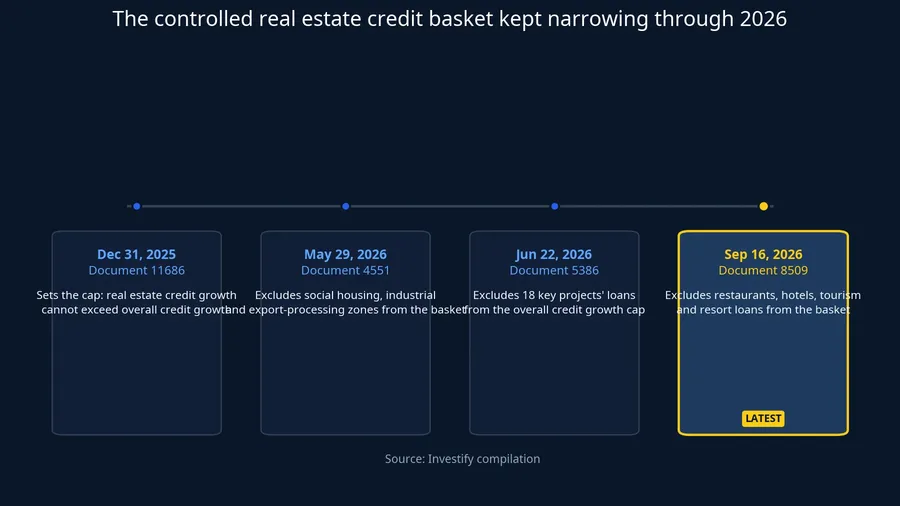
Separately, on June 22, 2026, following requests from Vingroup, Sun Group, and Masterise, a distinct document guided banks to exclude the credit of 18 key projects from the annual credit growth cap, the short-term-funding-for-long-term-lending ratio, and single-borrower credit limits. This mechanism affects the overall credit cap, not the real estate basket, so it shouldn't be counted alongside the exclusions above. Total capital demand for this project group was put at around VND 752 trillion.Người Quan Sát
The evidence is in the segment breakdown
If the controlled basket genuinely had no effect on capital flows, the sub-segments inside real estate credit should be growing at roughly similar rates. End-of-June 2026 data shows the opposite, and the gap between segments is the most notable part of this story.
Credit to industrial and export-processing zones, the segment excluded from the basket since late May, grew 32.38% to over VND 184.1 trillion, nearly four times faster than the sector's 8.3% average.VietnamNet Loans for purchasing land-use rights rose from VND 255.352 trillion at the end of March to VND 314.449 trillion at the end of June, a 23.14% jump in a single quarter.1thegioi.vn Eco-tourism and resort credit, the segment that stayed inside the controlled basket until September 16, fell 4.35% to roughly VND 80.6 trillion.VietnamNet

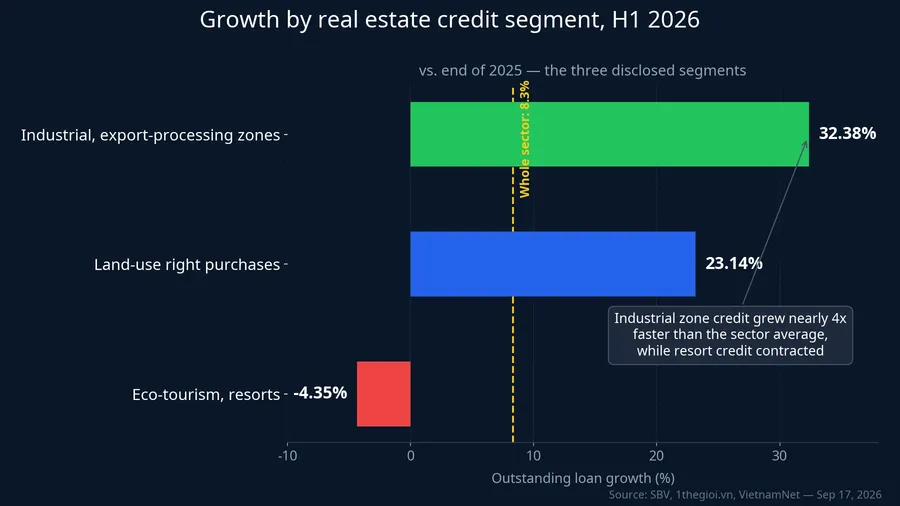
Basket status isn't the only explanation for this gap, and that should be acknowledged. Industrial-zone demand is being lifted by FDI inflows and land-lease demand, while the resort segment already had weak product liquidity and cash-flow generation carried over from before. Those two forces explain part of the divergence between 32.38% and negative 4.35%, but they don't explain why the resort segment specifically, and not some other segment, is the one that just got excluded. Per Markettimes' reporting, when resort lending was counted directly against the real estate credit cap, banks had an incentive to decline those loans to preserve remaining room for residential mortgages.Markettimes The new policy removes exactly that bottleneck, which is why the gap between these two segments runs wider than the two demand-side forces alone can account for.

Not a major spigot opening
Reading this the opposite way is just as easy to get wrong. Loans excluded from the real estate basket still count against the overall credit growth quota the SBV assigns each bank. They only shift where they're counted; they don't come with fresh funding.
KB Securities Vietnam once estimated that Document 4551 alone created only about 1-2% of additional real estate credit headroom system-wide.1thegioi.vn The resort segment is far smaller still: about VND 80.6 trillion, or roughly 1.6% of total real estate credit. The incremental lending now exempted this year is therefore a thin slice of that number, not a major capital spigot opening for the whole sector.
Market reaction on September 17 reflected that modest scale. CEO rose 2.61% to VND 11,800, DXG gained 2.37%, NVL added 1.22%, and VPL rose 0.95%, while the VN-Index gained 0.70%. That's a slightly better showing than the index, not a repricing of resort real estate stocks.
The accompanying risk hasn't gone away either. By the end of June 2026, non-performing real estate loans had risen 10.5% from the end of 2025, faster than credit itself grew, even as the system-wide on-balance-sheet NPL ratio fell from 3.44% to 3.31%.1thegioi.vn Removing a loan from a statistical basket doesn't change the repayment capacity of the project behind it. For investors weighing resort real estate stocks, that distinction matters: the measurement mechanism has loosened, but the underlying asset quality hasn't changed at all.
Which indicator to watch instead
From now through the end of 2026, system-wide real estate credit growth is no longer a reliable gauge of how much lending room individual banks actually have. The scope of the controlled basket has changed twice this year, so reporting periods can no longer be compared directly against each other.
Two replacement indicators will surface in third-quarter financial reports, expected by the end of October. The first is the gap between each bank's overall credit growth rate and its own real estate credit growth rate: the wider that gap, the more room a bank has to lend further under Document 11686's rule. The second is the credit mix by loan purpose, where the incremental growth in restaurant, hotel, and resort lending will become visible now that the reporting barrier has been lifted.
If a fourth exclusion document appears in Q4, that would be a far more meaningful signal than any published growth headline. It would show how tight regulators themselves judge the current controlled basket to be, rather than leaving the market to guess from a single percentage figure.