


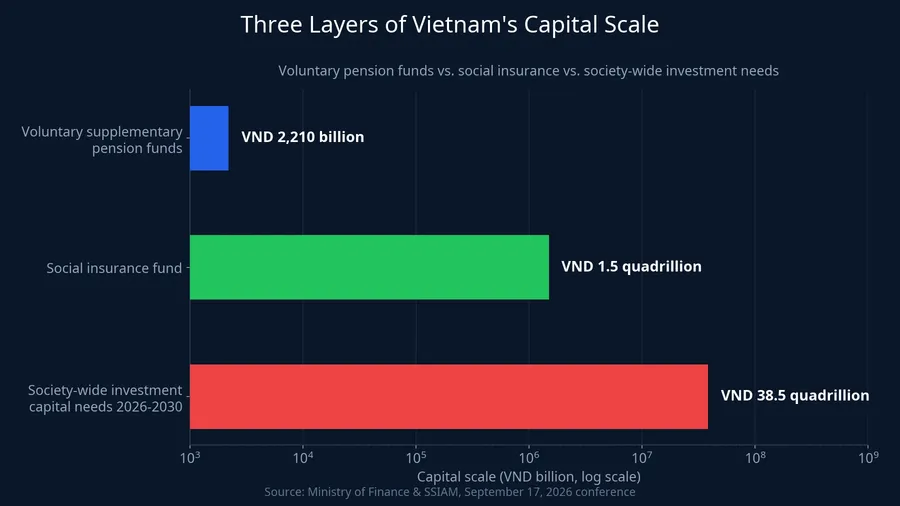
On the afternoon of September 17, 2026, at a conference titled "Unlocking Long-Term Capital: The Role of Pension Funds and Credit Ratings" in Hanoi, SSI Asset Management (SSIAM), alongside S&I Rating and Nice Investors Service, put two figures from the same report side by side. Net assets across all 7 of Vietnam's voluntary supplementary pension funds grew 26x in four years, reaching nearly VND 2,210 billion by the end of 2025.Nguoi Quan Sat Yet measured against Vietnam's society-wide investment capital needs for 2026-2030, roughly VND 38.5 quadrillion, that entire pool amounts to only about 0.006%.Nguoi Quan Sat
The growth rate sounds dramatic, but the root cause of the tiny absolute figure isn't weak demand from savers. It's a structural constraint: the channel only opens through employers, and its expansion depends far more on policy than on individual wallets.
An impressive growth rate, starting from zero
The explanation is in the division. Divide VND 2,210 billion by 26 and the entire industry's size in 2021 was only about VND 85 billion, the very year fund managers began rolling out this product after Decree 88/2016 took effect. A base that close to zero makes any growth rate look spectacular: an average of roughly 126% per year across four years, a figure that reflects how new the industry is more than genuine appetite for the product.
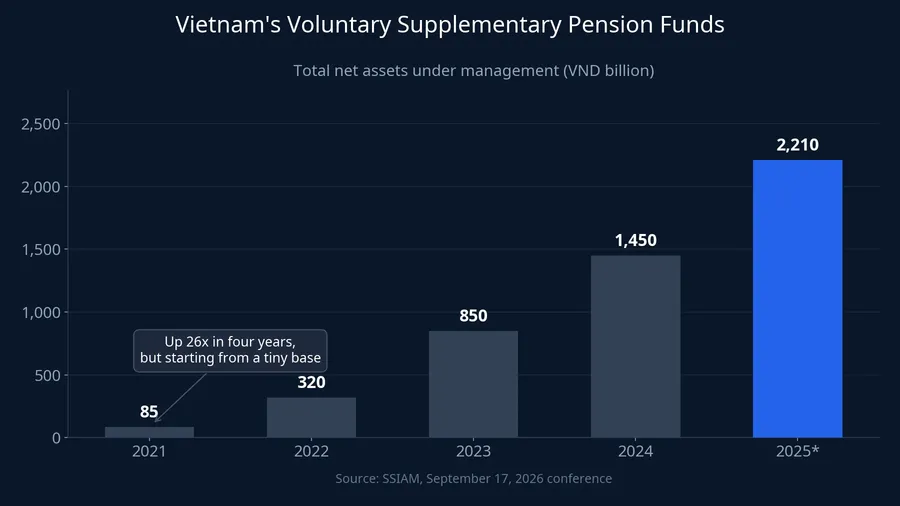
A second division puts the scale in sharper focus than the percentage does. Total participants by the end of 2025 numbered just over 28,500, up 17.1% from the prior year.Nguoi Quan Sat Divide VND 2,210 billion by that headcount and the average account holds roughly VND 77 million. Set that against Vietnam's labor force of 53.8 million people in Q2 2026, per the General Statistics Office, and only about 1 in every 1,900 working people holds this type of account.GSO
Why you can't open one yourself
This is the point individual investors misunderstand most often: voluntary supplementary pension is not a product you open yourself the way you would a savings account or a brokerage account.
Under Decree 85/2026/NĐ-CP on supplementary pension insurance, issued by the government in March 2026 and effective from May 10, 2026, fund managers roll the program out through employers.Chinh Phu Employees and employers already enrolled in mandatory social insurance negotiate contribution levels between themselves, and participation cannot be made a condition of employment.
The consequence is direct: if your employer hasn't set up a program, there's no way for you to join on your own. The channel's expansion therefore depends on how many companies choose to establish programs, not on individual savers' appetite to accumulate. That is the structural reason the 28,500-participant figure hasn't budged into the hundreds of thousands.
One other feature worth knowing: payouts follow the individual account balance at the time of disbursement, on market-based principles, and the state does not guarantee the payout amount. Early withdrawal outside force-majeure cases carries a fee of up to 5%. Investment risk sits with the participant. That's a sharp contrast with bank deposits, which carry deposit insurance.
Placed in context: a system with almost one tier
Speaking at the same conference, Pham Thi Thanh Tam, Deputy Director of the Department of Financial Institutions at the Ministry of Finance, said that by the end of Q1 2026, Vietnam's social insurance funds had reached over VND 1.5 quadrillion, while the broader system of investment and pension funds held roughly VND 835,000 billion in assets under management, equivalent to 6.5% of GDP.CafeF The gap is stark: the voluntary tier's VND 2,210 billion is only about 0.15% the size of the mandatory tier. Vietnam's pension system today is, for practical purposes, nearly single-tier.
Tam cited international benchmarks: total pension fund assets equal roughly 230% of GDP in Australia, about 151% of GDP in the United States, and around 82% of GDP for Singapore's Central Provident Fund.CafeF In those economies, pension funds are major institutional investors in bond and capital markets, holding money with 20-40 year horizons — exactly the lifecycle of an infrastructure project.
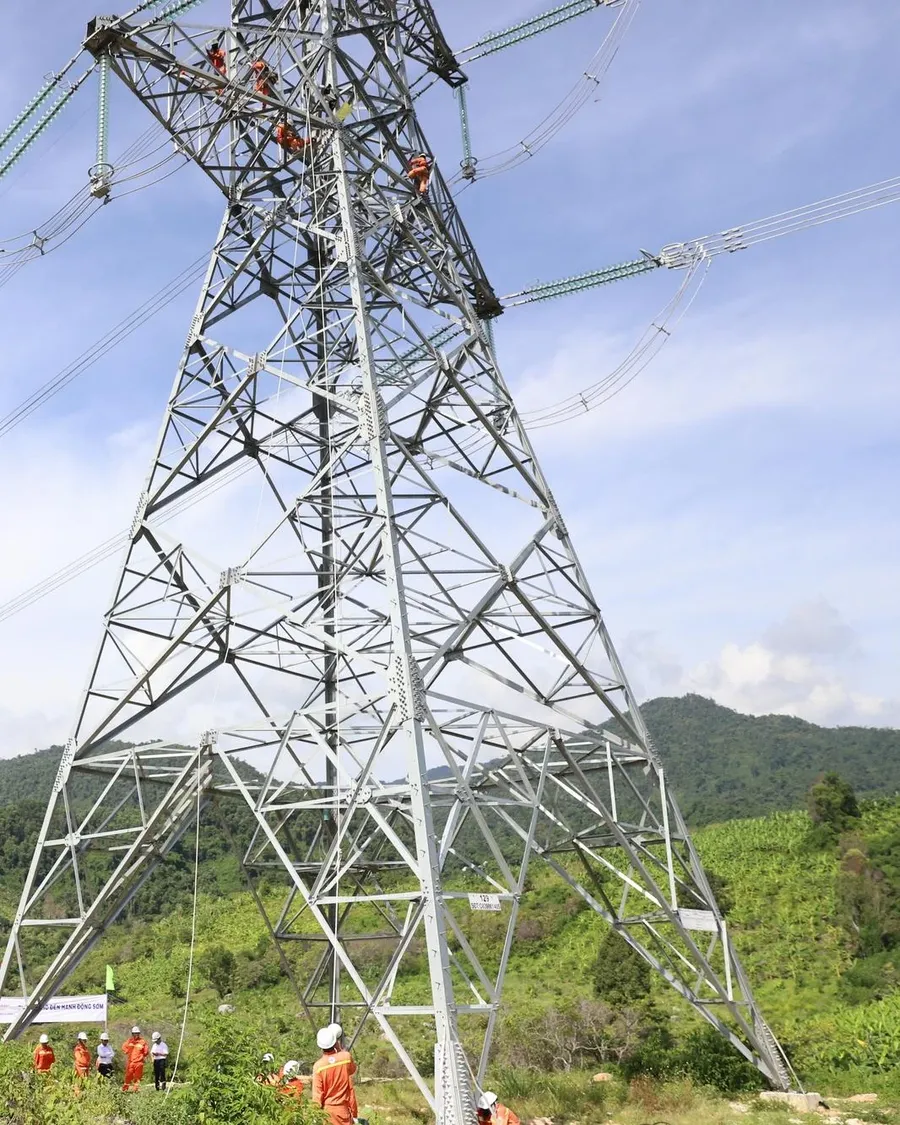
Vietnam's long-term capital needs are already visible in hard numbers. Also at the conference, Nguyen Ngoc Anh, CEO of SSIAM, cited the revised Power Development Plan VIII: for 2026-2030 alone, capital needs for power generation and transmission grids total roughly USD 136.3 billion, new rail lines need about USD 28.5 billion, and urban rail systems in Hanoi and Ho Chi Minh City need over USD 95 billion more.Nguoi Quan Sat
What a 14.5% annual target says about the road ahead
According to Tam, under Decision No. 144/QĐ-TTg, the Prime Minister set a target for total pension fund assets to grow at an average of 14.5% per year over 2026-2030.CafeF The figure is notable precisely because it's modest: far below the 53% growth achieved in 2025 alone, and far below the roughly 126% annual average of the prior four years. The agency setting the target is effectively assuming the low-base effect will fade.
Apply that 14.5% pace directly to the current VND 2,210 billion pool, and by 2030 it would reach roughly VND 4,350 billion. This is only an illustrative calculation, not an official forecast. The target covers total pension fund assets broadly, not the voluntary supplementary tier specifically. But the magnitude is clear enough: even on target, this pool stays in the range of a few thousand billion dong, while capital needs are measured in the quadrillions.
Three factors could break that extrapolation. First, a recent tax policy shift: payouts from the fund are exempt from personal income tax, employers can count contributions of up to VND 5 million per employee per month as deductible expenses starting from the 2025 tax period, and employees get a taxable-income deduction of VND 3 million per person per month starting from the 2026 tax period. Second, if just one large corporate group with tens of thousands of employees sets up a program, industry scale could jump in a single year rather than grow linearly. Third, Decree 85 expands both the eligible investment scope and the pool of participants compared with the earlier Decree 88. What the three factors share: all three act through the employer side, not the individual side.
How individual investors should read this story
For newcomers, three things are worth clarifying before pinning hopes on this channel.
First, voluntary supplementary pension is a supplementary layer: it doesn't replace mandatory social insurance, nor does it replace deposits held for short-term needs. Its liquidity is far lower than either.
Second, the prerequisite for joining is that your employer has already set up a program. The practical question to raise with HR is whether the company has a supplementary pension program and, if so, how much the company contributes each month. The employer's contribution is what actually differentiates this from self-directed saving.
Third, for the large majority of workers who can't access this channel yet, long-term savings still have to flow through channels open to individuals: term deposits, open-end fund certificates, and fixed-income products that pay periodic interest. The biggest difference between pension funds and these channels isn't expected yield: it's the tax incentive plus the discipline of an account that's hard to withdraw from early.
The signal worth watching over the next 12 months isn't asset size, since that figure will keep posting large percentage gains regardless of what happens, simply because the base remains so low. The real signal is participant growth: if the new tax policy actually works, account numbers should grow well past the 17.1% pace of 2025. If growth stays around that level, the channel is expanding mainly on additional contributions from people already enrolled, not yet breaking out beyond a handful of large employers.