
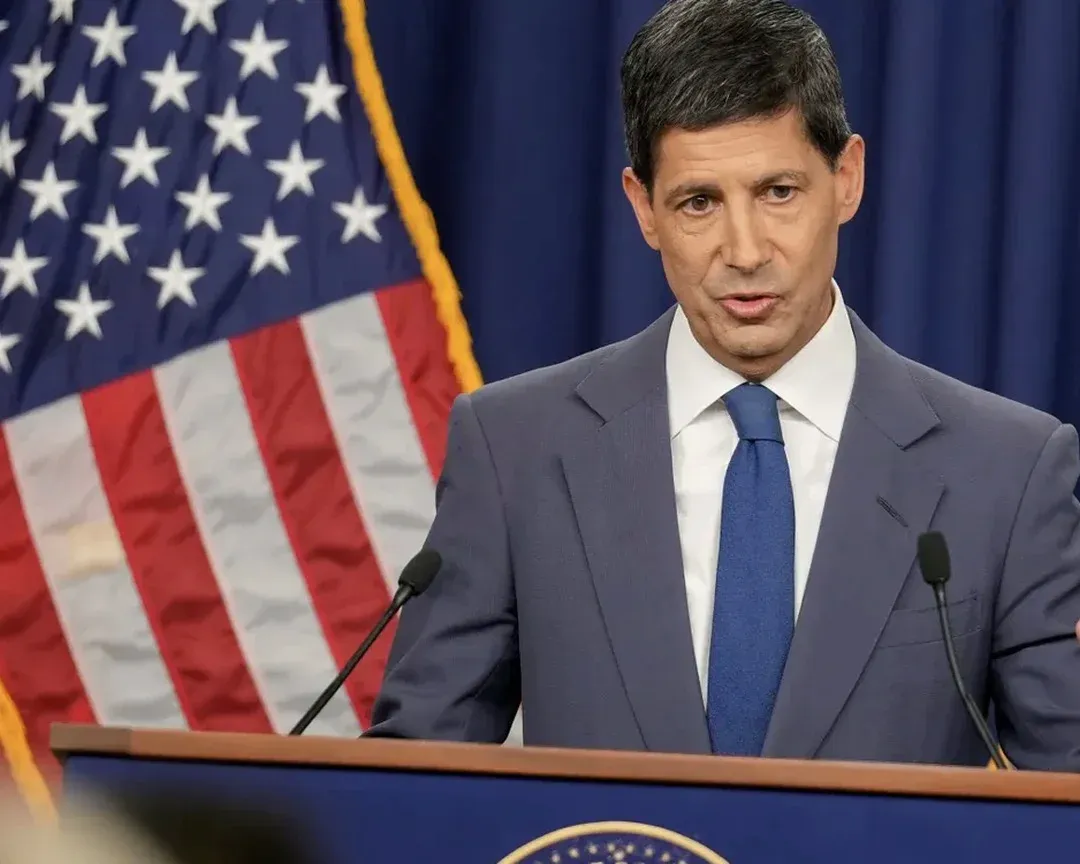

Early on September 17 Vietnam time, the Federal Open Market Committee (FOMC) wrapped up its September 16 meeting by raising the benchmark rate by 25 basis points, lifting the target range to 3.75-4% on a unanimous 12-0 vote.CafeF This is the Fed's first rate hike since July 2023, following three cuts in late 2025 and a string of pauses this year.
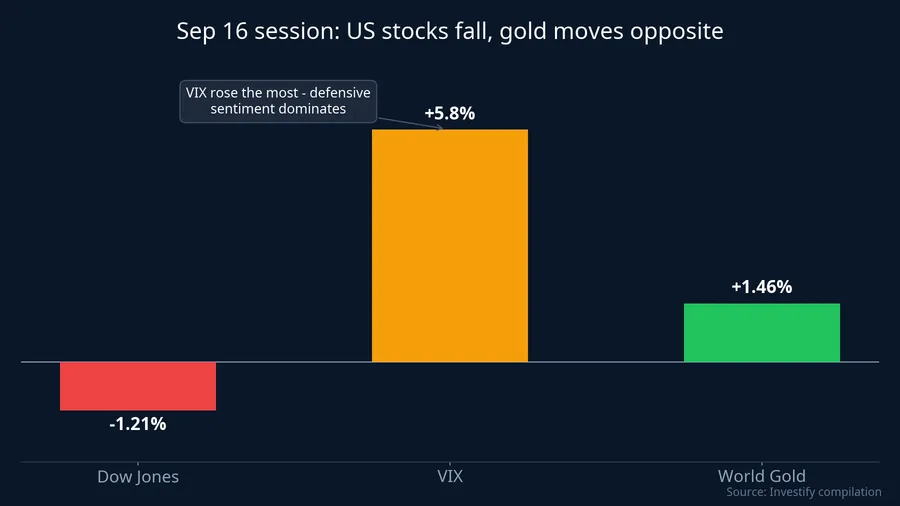
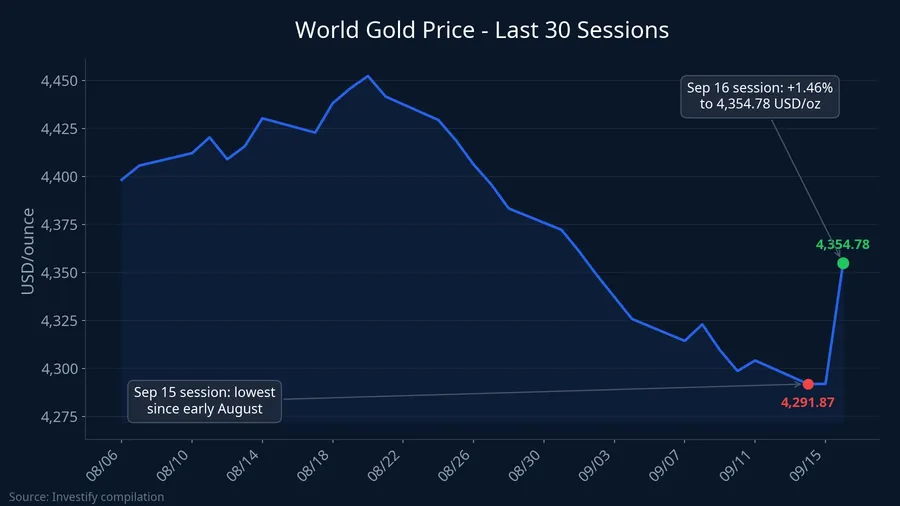
Conventional wisdom says gold should fall when rates rise. Gold pays no yield, so when deposits and bonds pay more, the opportunity cost of holding it goes up. But the September 16 session in the US broke that rule: world gold prices rose 1.46% to USD 4,354.78/oz while US stocks fell. This was not a random anomaly. It was the market repricing the entire forecast package that came bundled with the decision.
The Decision Was Priced In, the Message Was Not
Going into the meeting, markets had already priced a probability above 90% that the Fed would hike, so the decision itself carried little surprise. The forecasts released alongside it were what forced a recalculation. Among the 18 officials submitting projections, 16 see at least one more hike this year, 4 leave the door open for two more, and only 2 consider September's move sufficient.CafeF The majority inside the Fed still leans toward further tightening.
More consequential for gold is the inflation outlook. The Fed raised its headline PCE forecast for this year to 3.7% and core PCE to 3.4%, both 0.1 percentage point higher than the June projection, and does not expect inflation to return to the 2% target until 2029. The unemployment forecast sits at 4.1%, 0.2 percentage point lower than in June, suggesting the labor market is sturdy enough for the Fed to focus its firepower on inflation.
Fed Chairman and FOMC Chair Kevin Warsh kept a hawkish tone at the press conference. He said inflation is too high and has been too high for too long, adding that summer inflation data has not shown meaningful improvement in the underlying trend.CNBC
Stocks Fell, Yields Retook 5%, Gold Went the Other Way
Asset reactions in the same September 16 session split cleanly in two directions. The Dow Jones dropped 631.21 points, or 1.21%, closing at 51,461.90. The S&P 500 fell 0.45%, while the Nasdaq was nearly flat. The VIX volatility index jumped 5.8% to 17.71, reflecting a dominant defensive mood.CNBC All three stock indexes were still rising before the decision was announced, meaning the sell-off came after markets digested Warsh's hawkish message rather than reacting to the rate figure alone. In the bond market, the 10-year US Treasury yield retook the 5% mark, trading around 5.008%, the highest level since 2007.CNBC
Gold moved in the opposite direction entirely. In the September 15 session, world gold prices closed at USD 4,292.30/oz, the lowest level since early August after three straight weeks of declines. By September 16, the price jumped to USD 4,354.78/oz, up USD 62.48 in a single session.
Gold Tracks the Real Rate, Not the Nominal Rate
The mechanism behind this apparent paradox is fairly simple once you isolate the right variable. Gold's opportunity cost is not measured by the nominal interest rate but by the real rate, the portion left over after subtracting inflation. The Fed raised the nominal rate by 0.25 percentage point, but at the same time lifted its own inflation forecast and pushed the timeline for hitting the 2% target all the way to 2029. Both figures rose by roughly similar margins, so the real rate barely budged, and gold lost none of its appeal relative to before the meeting.
The origin of this inflation episode is worth examining too. Central banks typically don't react strongly to supply shocks, but the prolonged conflict with Iran has kept oil prices elevated longer than expected, with Brent crude closing the September 16 session at USD 107.47/barrel. Higher rates can slow consumer demand, but they cannot pull a single barrel of oil back into the market. For investors, an economy facing both tighter money and expensive energy is exactly the environment where gold tends to get chosen as a haven. US 30-year fixed mortgage rates have also climbed to 7.19%, up roughly 0.38 percentage point since the Jackson Hole conference in late August.CafeF

Two Other Readings of the Same Gold Move
The causal story here is not fully settled. The first alternative reading is risk-off flows: US stocks fell and the VIX rose 5.8% in the same session, so some money exiting equities may have flowed into gold as a short-term haven. The second reading is technical mean reversion: gold had fallen for three straight weeks and hit its lowest level since early August, so the bounce after the official announcement carries the shape of "sell the rumor, buy the news."
Available data cannot fully separate these explanations within a single session. What the data does show more clearly is that the 10-year yield retook 5% while gold still held its gains through the close. If the rally were driven purely by short-term risk aversion, a yield level that high would typically be enough to pull gold back down within the same session. Gold's resilience suggests the real-rate mechanism is likely the primary support, though not the only explanation.
Where SJC Gold Stands Against the World Price
SJC gold bars closed on September 16 at VND 143.5 million/tael buy and VND 146.5 million/tael sell, up 0.83% from the prior session, quoted before the Fed's decision was announced. SJC 99.99% rings sold at VND 145 million/tael. The USD/VND exchange rate stood at 25,986; converting the world gold price of USD 4,354.78/oz at that rate works out to roughly VND 136.4 million/tael.
The gap between SJC's sell price and the converted world price is therefore about VND 10.1 million/tael, or 7.4%. For rings, the gap is VND 8.6 million/tael, or 6.3%. That gap has narrowed from 8.7% on September 10, mainly because the world price rose faster than the domestic price, not because the domestic price fell.
Beyond the gap with world prices, there's a second cost buyers pay the moment they hand over cash: SJC's buy-sell spread currently sits at VND 3 million/tael, or roughly 2.05% of the buy price. Buy at the sell price and sell back at the buy price, and buyers lose that amount before the market has even had a chance to move. The best 12-month deposit rate available on September 16 reached 7.15% per year, meaning the 7.4% premium SJC buyers pay over the converted world price is equivalent to more than a year of interest at the market's best deposit rate.
What to Watch in Today's Session
The most important number for domestic investors on September 17 is not the SJC price on the board but the gap between that price and the converted world price. World prices jumped 1.46% overnight, while SJC has yet to catch up. If SJC rises slower than world prices, the gap keeps narrowing from 7.4%. If SJC rises faster, the gap widens again, meaning the extra move comes from domestic sentiment rather than the global market.
The second channel to watch is the exchange rate. A US 10-year yield at 5%, combined with guidance for one more hike this year, tends to keep the dollar elevated. USD/VND is currently flat and still below its level from a month ago, so pass-through pressure on domestic gold prices and foreign capital flows has not clearly emerged yet. The figures worth tracking side by side in coming sessions are the closing exchange rate and net foreign buying/selling on the HOSE exchange.
The overall picture shows gold being supported by a real interest rate that has barely moved, not by any easing from the Fed. If US inflation genuinely cools in the coming months, as some more optimistic forecasts expect, the gap between nominal rates and inflation would widen again, and that is the scenario that could put real pressure on gold.