
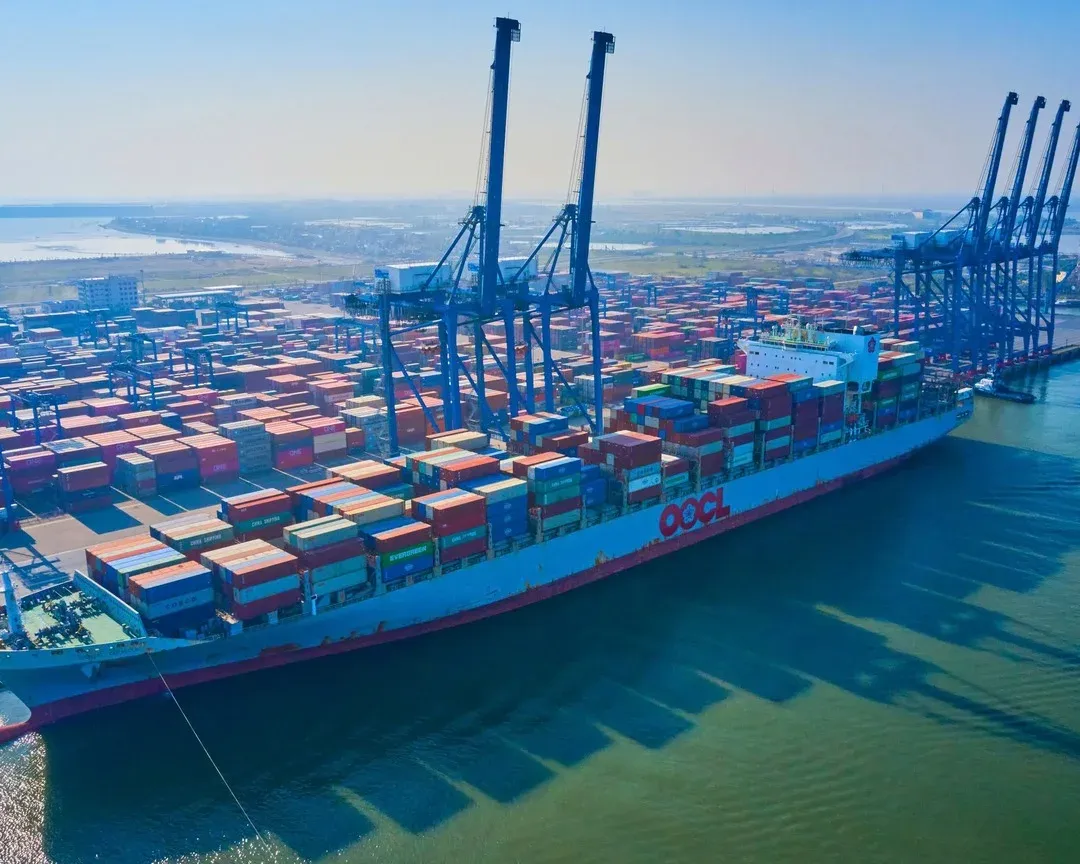

Viconship (VSC) just completed a private bond placement worth VND 500 billion, ticker VSCL12601, fixed at 11% a year for a 36-month term.MarketTimes The bond was issued on August 26, 2026 and matures August 26, 2029. Collateral is Viconship's entire capital contribution in Green Port (Công ty TNHH MTV Dịch vụ Cảng Xanh), with a par value of VND 110 billion.Vietstock
For a new investor, the 11% figure is what jumps out first, since it's nearly double the savings rate. That's also the easiest place to compare wrong. Nobody pays extra interest out of generosity. The gap between 11% and 6.3% is always the price of some risk, and the right question isn't "is that rate tempting" but "where exactly does that risk sit, and how big is it."
Three fixed rates running side by side
Vietnam's 12-month savings rate, as of September 16, 2026, sits at a median of 6.3% a year online and 5.9% at the counter, based on a survey of 29 banks.
The next tier should logically pay more than savings, but reality runs the other way. Recent large bank bond issues actually pay less than a savings account: MBBank's MBB12508 at 5.00% for 36 months, ACB's ACB12507 at 4.95% for 24 months, and Techcombank's TCB12405 at 4.60% for 36 months, each sized at VND 5,000 billion. Across all 998 bonds outstanding from 26 banks, the median coupon is 6.26%, roughly in line with the 12-month savings benchmark.
Those two figures need the right frame. The 6.26% median blends old and new issues together, while 6.3% is today's posted savings rate. But the newest batch of bank bonds issued in 2025-2026, paying just 4.5-5.4%, already makes the point: buyers of bank bonds right now are not being compensated at all for taking on credit risk versus a depositor.
The top tier belongs to real estate. Among 102 bonds from 14 real estate issuers outstanding, the fixed-rate group has a median of 12.00%, while the floating-rate group medians 8.85%. Vinhomes has VHM12501 and VHM12502, both fixed at 11.00%, plus VHM12410 at 12.00%; Vingroup has VIC12502 fixed at 12.00%.
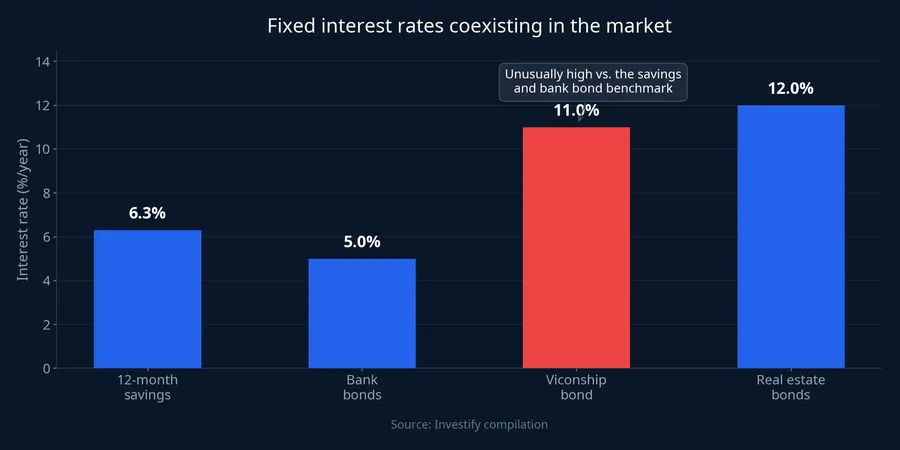
Viconship's 11% lands squarely in real estate's rate band, despite being a port operator. What exactly is that 4.7-percentage-point premium over savings paying for? That question deserves unpacking, not a skim.
Test one: what the money is actually for
Viconship disclosed that the full VND 500 billion raised will go toward restructuring existing debt, not expanding operating capacity.Người Quan Sát This is one link in a bigger plan: management expects to raise roughly VND 1,880 billion in equity and VND 2,000 billion more in bonds with 3-5 year terms during 2026, aimed at restructuring about VND 1,900 billion of margin loans and bank debt.
This is the point investors overlook most: a loan used to roll over debt and a loan used to expand carry entirely different risk profiles. The first depends on whether the company can keep raising the next round, which is to say it depends on market confidence rather than a new cash-generating asset. The second does the opposite, creating real cash flow. Viconship's disclosure already states plainly which type this is, and that's the first signal worth registering before even looking at the rate.
Test two: where the repayment cash flow comes from
As of June 30, 2026, Viconship's total assets stood at VND 14,853.7 billion, with equity of VND 7,260.8 billion. What's worth reading isn't the asset base, but how fast debt has been ballooning: short-term borrowings of VND 2,498.5 billion, long-term borrowings of VND 4,005 billion, total interest-bearing debt of roughly VND 6,503.5 billion, up about VND 1,130 billion from the start of the year. The debt-to-equity ratio climbed to approximately 89.6% by the end of June 2026, up from about 38% in early 2025.Tinnhanhchungkhoan
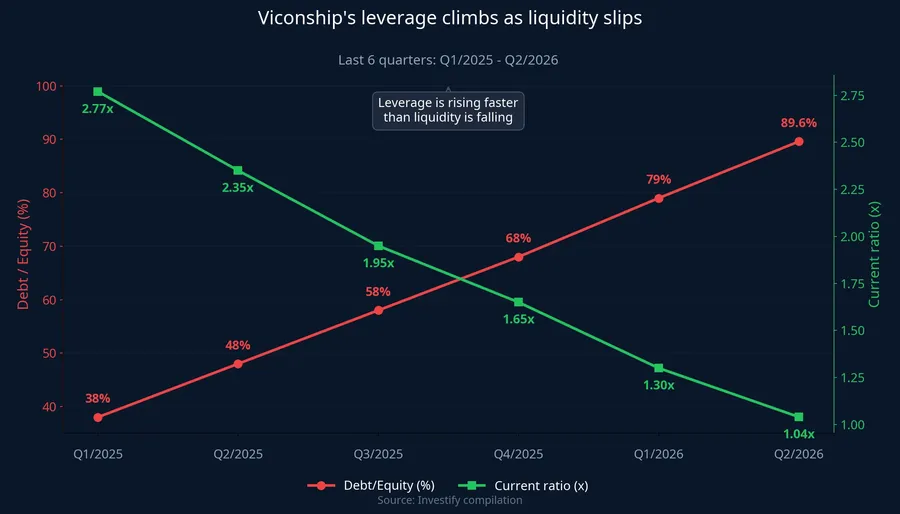
Alongside that, the current ratio shrank from 2.77x in Q1 2025 to 1.04x in Q2 2026. In plain terms, short-term assets now barely cover short-term obligations, with none of the cushion the company had before. Interest expense in Q2 2026 alone ran about VND 144 billion, nearly triple the same quarter a year earlier and equal to roughly half that quarter's pre-tax profit.Người Quan Sát
Six-month net revenue reached VND 1,721.8 billion, up 15.6% year on year, with a 41.1% gross margin. Read in isolation, those numbers look strong. But net profit attributable to parent-company shareholders was just VND 199.1 billion, essentially flat against VND 196.9 billion in the first half of 2025: revenue grew, but interest expense ate up nearly all of the incremental gain.
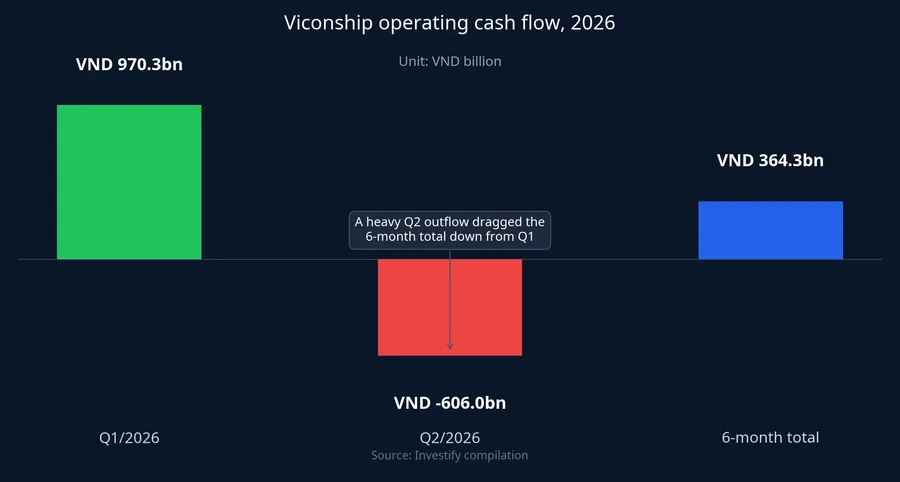
Operating cash flow swung sharply between the two most recent quarters: positive VND 970.3 billion in Q1, then negative VND 606 billion in Q2, leaving a six-month total of positive VND 364.3 billion. Over the same period, capital expenditure hit VND 1,324.1 billion, with the gap plugged by VND 2,445.7 billion in new borrowing. The 11% rate, then, isn't an unusually generous coupon. It reflects the actual cost of capital the market is demanding from a company with fast-rising leverage and thinning liquidity.
Test three: what the collateral is, and how it's valued
This is where the Viconship bond diverges most clearly from most real estate bonds paying similar rates. The collateral here is an equity stake in an unlisted subsidiary, not a plot of land with a land-use certificate.

What the disclosure doesn't spell out: the VND 110 billion figure quoted is Green Port's par value, i.e. its charter capital, not the result of a fresh valuation. An operating port in Hai Phong could easily be worth several multiples of its nominal charter capital, and Green Port is one of two ports Viconship directly operates, meaning it's a core operating asset rather than an empty shell entity. So the 110-to-500 ratio should not be read as the real collateral coverage. It's the single most misleading figure in the whole offering document.
What deserves attention instead is the legal framework behind that number. Decree 200/2026/NĐ-CP, effective since June 5, 2026, requires that collateral or payment guarantees be sufficient to cover the full bond principal, while banning issuers from pledging their own shares, stock, bonds, or capital contributions as collateral for their own bonds.Government Portal A stake in Green Port doesn't fall under that ban, since it's a separate legal entity from the issuer. Procedurally, this bond breaks no rule.
But compliant doesn't mean easy to enforce if something goes wrong. The real difference between the two collateral types shows up in the worst-case scenario. With real estate, bondholders are pointed at an asset with a familiar valuation framework based on location and comparable transactions. With an equity stake in an unlisted company, a forced sale faces almost no market: the largest shareholder of FCC managed to sell only 1,000 shares out of nearly 2.1 million registered, after nearly a month of trying.Fili Processing is further tangled in a company's internal procedures for ownership confirmation and transfer registration.
There's one more layer of risk the offering document doesn't record: the trustee mechanism. The Nam Land bond case showed a bank unable to sell pledged collateral because the issuer never handed it over, while the 2024 Law on Credit Institutions had already stripped collateral-management authority from banking licenses.Tinnhanhchungkhoan Put bluntly: having collateral on paper doesn't guarantee recovering the money once a company can no longer pay.
Where individual investors stand
One practical detail worth stating before going further: ordinary retail investors cannot buy non-convertible, non-warrant private bonds like the VSCL12601 tranche. That class is reserved for professional securities investors. Since January 1, 2026, even professional individuals face an additional dual condition: the bond must carry a credit rating and have collateral or a full-principal payment guarantee from a credit institution.Thời báo Tài chính Việt Nam
So the access point for non-professional investors into corporate bonds is public bond offerings, or bond funds. But the reading framework is identical to the Viconship case. Every fixed rate above savings, no matter the channel, is selling the same thing: the borrower's credit risk.
What order to read it in
When you come across a fixed rate above the savings benchmark, a sensible reading order has three layers. First is the spread over savings at the same tenor, measured in percentage points, to gauge how the market is pricing the risk. Next is the stated use of proceeds in the offering document, distinguishing refinancing from expansion. Last is the type of collateral and how it's valued, distinguishing book value from a fresh appraisal, and distinguishing an asset with a clear resale market from one that has almost none.
For Viconship specifically, the next signal worth watching is Q3 operating cash flow, due out at the end of October. If cash flow turns positive again and covers interest expense, the debt-extension strategy is genuinely working. If cash flow stays negative while borrowing keeps rising, this 36-month bond has only bought time, not fixed the underlying leverage problem. In that case, the 4.7-percentage-point premium will look even less like a bargain.