

On the morning of September 16, VietinBank put 6,940,023 shares of Hai Phong Port (UPCoM: PHP) up for auction through the Hanoi Stock Exchange at a floor price of VND 40,048, more than 10% below the market price.VietnamFinance On the surface, this looks exactly like the kind of deal retail investors call a bargain: buy below market, a business that's performing well, the kind of offer that should get fought over.
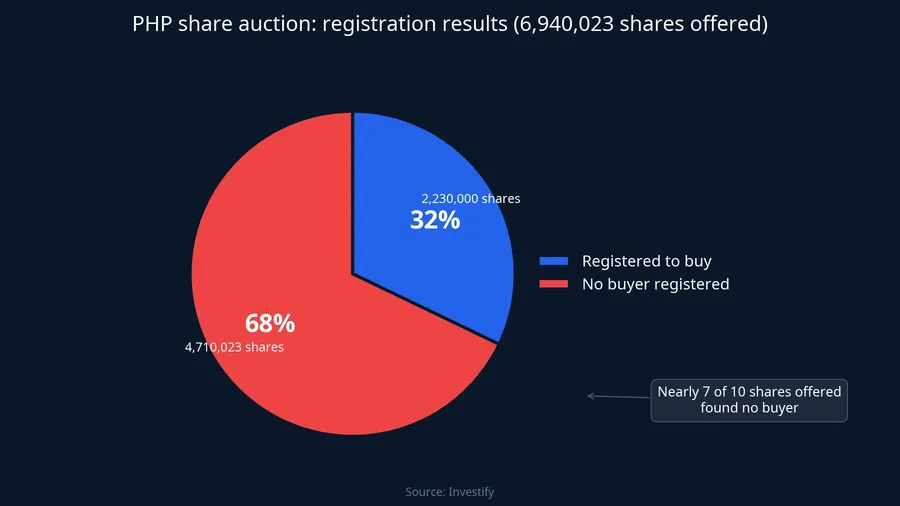
The opposite happened. Registration results published by HNX show only 15 investors participated, with total registered demand of just over 2.23 million shares, about 32% of the offering.VietnamFinance The remaining 4.7 million-plus shares, 68% of the block, drew zero registered buyers. The minimum amount VietinBank could recoup dropped to roughly VND 89 billion, a shortfall of more than two-thirds against the original plan of nearly VND 278 billion.VietnamFinance The real question isn't "why did PHP flop," but: what was that 13% discount many retail investors read as proof of a bargain actually paying for?
The "cheaper than market" formula isn't wrong, it's incomplete
For PHP, the "cheap" half of the equation checks out. On August 27, the day the registration book opened, PHP closed at VND 46,200, putting the floor price 13.3% lower. By September 9, when the book closed, PHP had eased to VND 45,800, still a 12.6% gap.
The underlying business gives no reason for concern either, at least in the short term. In the second quarter of 2026, Hai Phong Port posted net revenue of VND 950 billion, up 44% year-on-year, with after-tax profit of VND 486 billion, up 110%, and a gross margin around 55%, the highest quarterly profit in the company's history.VietnamFinance Debt-to-equity sits at just 0.44x, a healthy balance sheet by any measure. A company posting record profits, shares offered below market, and yet two-thirds of the block went unsold. This is exactly where the "cheap = bargain = sold out" formula breaks, and the cause has nothing to do with business quality.
The real risk was sitting where the price ticker never shows it
PHP shares trade in a very thin market. Over the last 120 sessions, the stock has averaged roughly 149,100 shares traded per day, about VND 5.9 billion. The cause traces back to the ownership structure: Vietnam Maritime Corporation (VIMC) holds nearly 92.6% of the company, leaving only around 10% of shares freely tradable.VietnamFinance Put the offered block next to that liquidity figure and the math becomes obvious: the 6.94 million-share block is equal to roughly 46 average trading sessions, and even the registered portion, 2.23 million shares, equals about 15 sessions.
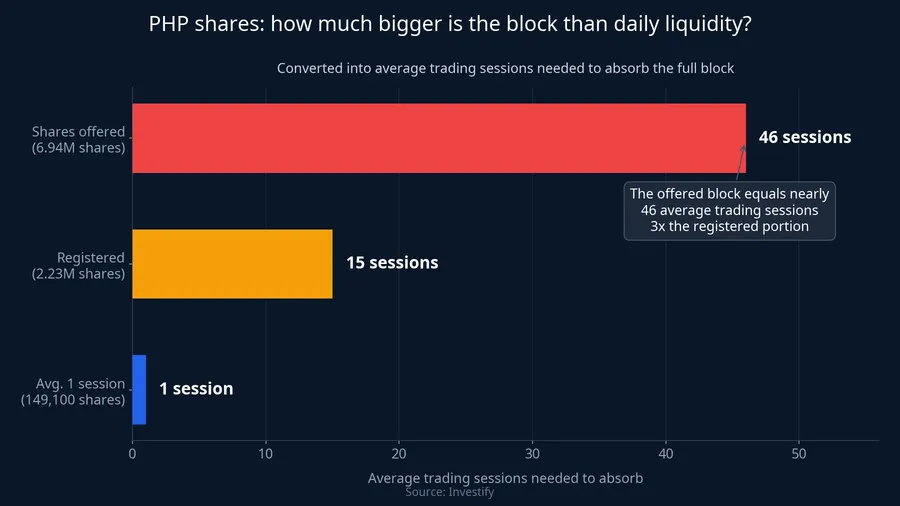
What the auction notice doesn't say, but the math makes clear, is that buyers of this block weren't purchasing a 13% discount. They were buying a position that would take dozens of sessions to unwind, or force a steep markdown to exit faster, a quantifiable cost, and institutional investors likely priced it at more than 13%.
The market measured that cost itself, two days before the auction
No guesswork needed here, the market already answered with real data. On September 14, two days before the auction, PHP traded 738,700 shares, nearly five times its 120-session average, and the price dropped 7.84% to VND 42,300. A single sell-off session at five times normal volume wiped out more than half the discount the floor price offered.
For anyone holding the full 6.94 million-share block, that initial discount clearly wouldn't cover the cost of exiting if a similar sell-off repeated at larger scale. There's another layer of risk few notice: the benchmark price itself was built on thin liquidity, just a few billion dong traded daily across roughly 10% of tradable shares. A discount measured against a price like that isn't proof of value. Institutional investors looking at a 6.94 million-share block price it based on how fast that specific block can be sold, not on the quotes from orders of a few tens of thousands of shares a day.
By the close of trading on September 16, PHP settled at VND 42,700, essentially flat. Against the VND 40,048 floor price, the discount had shrunk to just 6.2%, less than half the 13.3% gap on registration-opening day. Investors who put down deposits back in late August watched their paper gain shrink over nearly three weeks of waiting for the auction.
Two other explanations, but not enough evidence yet
Thin liquidity isn't the only possible explanation. At least two others deserve consideration.
The first is valuation: at around VND 43,200 on September 15, PHP traded at a P/E of roughly 29.8x and P/B of 1.77x, while ROE for the second quarter of 2026 was just 6.8%. A capital-intensive port operator with single-digit returns trading near 30 times earnings is a valuation that already bakes in considerable optimism; institutional investors may simply disagree with the current price level. The second is the cost of participation: auctions through the exchange require depositing funds during the registration window and waiting until the auction date. For PHP, that gap from August 27 to September 16 meant nearly three weeks of capital sitting idle, versus instant execution buying directly on UPCoM.
The available data leans toward the liquidity explanation, since it's the only one the market measured directly, through the real September 14 trading session. The other two are logically sound but lack the granular data to verify how much each one actually contributed.
This isn't the first time VietinBank has hit this wall
The broader context at VietinBank reinforces this reading. The bank is simultaneously divesting from Saigon Port (HOSE: SGP), holding over 19.3 million shares, equivalent to 8.93% of the company. In late 2025, an auction for the SGP block had to be cancelled because no investors registered to participate; the bank has since shifted multiple times to selling through open-market matching but has yet to complete the divestment.VietnamFinance On September 16, SGP traded just 30,900 shares. Two port stocks, sold at different times, running into the same problem: how thin the market is where the shares are listed.

Investors can consider: two numbers before registering
For similar divestment auctions going forward, the pre-registration math needs only two figures.
The first: divide the number of shares you intend to buy by the stock's 20-session average trading volume. If that ratio runs past a few sessions, the discount on offer is paying for liquidity risk, not for an underpriced business. The second: look at the price range during the most recent high-volume session, like PHP's September 14, since that's the real cost of needing to sell fast, and it's often far larger than the discount visible on paper at registration time.
The bottom line: a discount is a cost, not a free profit
The accurate picture of the PHP auction is this: in divestment auctions for thinly traded stocks, the discount against the floor price isn't money already sitting on the table. It's compensation for the cost of exiting later, and as PHP's registration results show, that compensation likely still wasn't enough to draw in most institutional capital.
Valuation risk and the cost of tying up capital in an auction remain worth watching, but there isn't enough evidence yet to displace liquidity as the primary explanation. VietinBank still holds more than 4.7 million unsold PHP shares and an unresolved SGP block. However the bank chooses to sell the rest, another auction or a full shift to open-market matching, will be the clearest signal yet of what price the seller is willing to accept for a market too thin to absorb large blocks.