

Early morning of September 16 in Vietnam, as the September 15 US trading session closed, a number the global financial market had waited two years for finally showed up: the 10-year US Treasury yield touched 5%, specifically 5.003%, the highest level since 2007.VTV The 30-year climbed to 5.37%, while the 2-year sat at 4.68%.BBW
This isn't the first time yields have come close to this level. Back in October 2023, the number also approached 5% before pulling back quickly. But this time it's different in one structural way, and that difference is what will actually determine the cost of Vietnam's dollar borrowing. Just as this global benchmark hits a 19-year high, Vietnam's Ministry of Finance is in talks with investment banks over a 10-year US dollar-denominated government bond.VietnamFinance
Three forces pushed yields up, but not equally
There's no single cause behind this move past the psychological threshold. Money is reacting to three forces at once, and their weights differ quite a bit.
The clearest force is oil. Brent closed the September 15 session at $105.91 a barrel, up roughly 8% in just a week, after tanker traffic through the Strait of Hormuz dropped from 10 vessels to 4 in a single day, according to Kpler data.FireAnt Higher energy prices push up inflation expectations, and when expected inflation rises, nominal yields have to rise with it. The co-movement right now is unusually strong: the one-month correlation between WTI crude and the 10-year yield has climbed to 0.96 according to BMO Capital Markets, the highest since June 2019.Fili
The second force is policy expectation. The Federal Open Market Committee meets on September 15-16, and markets are pricing in roughly a 93% chance the Fed raises rates by another 25 basis points to the 3.75-4.00% range, according to CME's FedWatch tool.Kiplinger This would be the first rate hike under Fed Chair Kevin Warsh, who took office in May 2026.VnExpress
The third force gets less attention but is more durable than the other two: demand for Treasuries is weakening while the US government's borrowing needs remain enormous. Federal debt sits around $40 trillion, forcing the US Treasury to expand long-bond buybacks to cushion the selloff.FireAnt
All three forces are real, but the evidence leans most heavily toward oil for last week's sharp move. A 0.96 correlation is a rare degree of co-movement not seen in seven years. Fed expectations amplify that move, while supply pressure acts as a longer-term floor, making it unlikely the new yield level retreats quickly no matter what the Fed decides.

An upward-sloping curve, unlike the 2023 inversion
In 2023, the US yield curve was inverted: the 2-year traded above the 10-year. That shape reflected expectations that the Fed would soon cut rates, meaning the high long-term yield back then was seen as temporary. This time it's the opposite. The 2-year sits at 4.68%, about 0.34 percentage points below the 10-year, while the 30-year has jumped to 5.37%, the highest of the three tenors. The curve is now sloping upward the normal way, with a clear positive term premium.
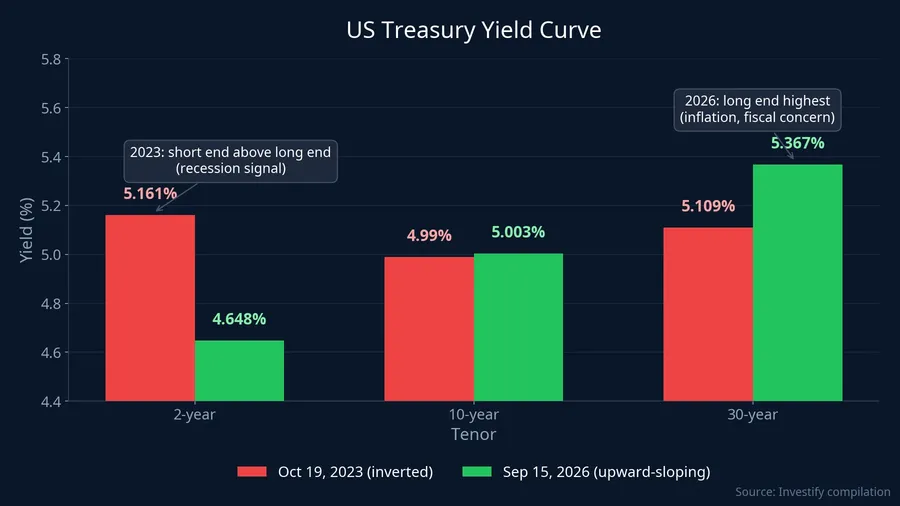
The implication is very concrete for dollar borrowers: this 5% level comes from the long end of the curve, driven by years-long inflation and fiscal-risk concerns, not from short-term policy rates. A Fed decision this week could pull the short end down, but it's unlikely to pull the long end down by the same margin, which is why Vietnam's new dollar borrowing is unlikely to get cheaper quickly no matter what the Fed decides.
The price on offer for Vietnam's dollar borrowing
Among two options put forward by foreign institutions, one lender proposed a 10-year bond sized between $500 million and $1 billion at a rate of roughly 7% a year.Người Quan Sát The Ministry of Finance has not made a final decision, and no formal document approving this issuance exists yet. The legal groundwork is already in place: the 2026 public debt borrowing and repayment plan, approved by the Prime Minister in February, sets a maximum borrowing ceiling of VND 969,796 billion, with international bonds named as one channel.Fili

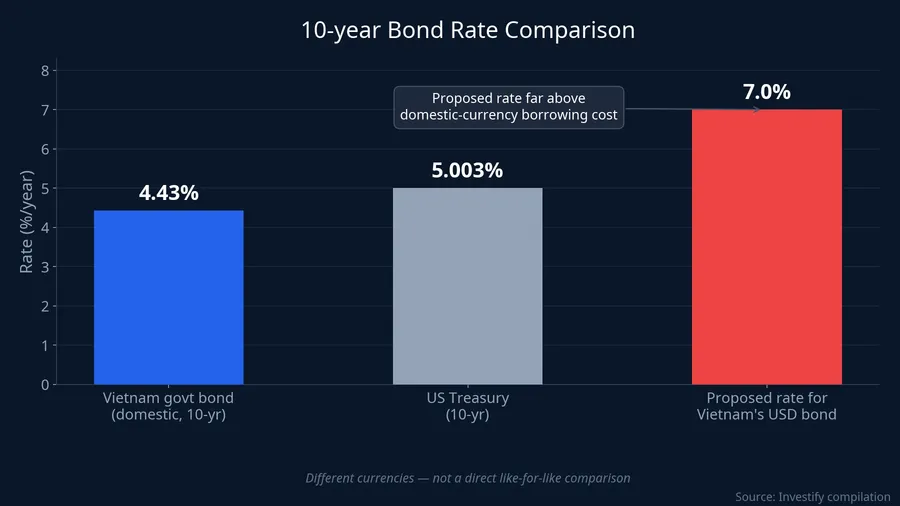
The gap between the US's 5.003% and the roughly 7% rate on offer is exactly the risk premium the market demands for Vietnam. The country's issuer rating currently sits at Ba2 with a Positive outlook from Moody's,Fili and BB+ from both S&P and Fitch, still below investment grade. In January 2026, Fitch did upgrade Vietnam's senior secured long-term debt instruments to BBB-,CafeF but that's a rating for a specific debt instrument, not a sovereign upgrade.
Set against the domestic channel, the picture gets clearer: recent 10-year domestic government bond auctions cleared at 4.43% a year.Thời báo Tài chính Việt Nam These two figures are denominated in different currencies, so they can't be compared directly the way two rates of the same type would be. One is paid in local currency; the other carries exchange-rate risk for a full decade. But for the state budget, the difference in interest cash flows is still a real difference.
Three open paths, each with its own trigger
The first path is to lock in now. The trigger is the FOMC outcome due early morning September 17 Vietnam time. If the Fed hikes exactly 25 basis points as priced in and its dot plot shows no further hikes, the inflation premium stops expanding and 5% has grounds to be seen as a cycle peak. Locking in terms in that window secures financing cost before Q4 Treasury supply floods the market. The price paid is a roughly 7% rate fixed for ten years.
The second path is to wait, triggered by Brent retreating from the $105 range as Hormuz tensions ease, or by Moody's upgrading the sovereign issuer rating. The weakness here is the very curve structure discussed above: the long end is elevated because of years-long fiscal and inflation concerns, so a cooler Fed doesn't guarantee the 10-year yield follows it down. The upgrade path is also a long one: the Ministry of Finance is working with Moody's toward a Baa3 target by 2030, still two notches away.
The third path is shortening the tenor, which sounds the most sensible but saves the least, because the US curve is flat at the short end. Cutting the tenor from 10 years to 2 only pulls the benchmark from 5.003% down to 4.68%, roughly 0.34 percentage points, in exchange for pushing all refinancing risk into just a few years. It also undercuts much of the point of an issuance meant to re-establish a benchmark yield curve for Vietnam internationally.
What retail investors should watch
This story touches domestic portfolios through several channels, not just government borrowing. The closest is the exchange rate: USD/VND stood at 25,925.5 in the September 14 session, down roughly 1.4% since the start of the year, meaning the dong has been strengthening rather than weakening as many forecasts expected earlier this year. High dollar yields are a pull in the opposite direction.
Next is the domestic rate level: government bond yields have crept up from around 4.16% in April to 4.43%, and higher cost of capital typically lowers fair valuations for equities, most visibly among heavily indebted companies. One step further out is foreign capital flows: dollar assets paying above 5% reduce the relative appeal of emerging markets, Vietnam included.
The clearest answer arrives early morning September 17 Vietnam time. The figure worth watching after the Fed's announcement is the 10-year US Treasury yield in the following session, measured against the 5% line, and the 30-year against its current 5.37%. If the long end doesn't come down with the Fed's decision, the premium the market demands on Vietnam's dollar borrowing will stay put regardless of what the Fed decides. That signal matters more than whether the Fed hikes at all.