


Mid-morning on September 16, shares of Vietnam Rubber Group (GVR) traded around VND 32,250, up roughly 4.2% from the reference price, with more than 2.97 million units matched. At the same time, world reference rubber prices had been falling for four straight sessions, and domestic commodity headlines were still running stories about the slide on the Shanghai and Tokyo exchanges.
At first glance, this looks like a paradox. But these two price boards were never designed to move in lockstep session by session.
The session price and the period average selling price are two different numbers
The TOCOM-benchmark reference rubber price peaked at 249.0 US cents/kg in the September 9 session, then retreated over four straight sessions to 235.9 US cents/kg by September 15. From the peak, that is a decline of about 5.3%; versus a week earlier, the price is 2.48% lower.
But zoom out to a longer window and the picture flips. Versus August 17, the price is still 7.32% higher. The average price for September through the 15th sits at roughly 238.4 US cents/kg, which is 10.5% above the July average (215.7) and higher than the June average (225.3) too. In other words, what is happening is a pullback after August's steep rally, not a collapse in the underlying price floor.
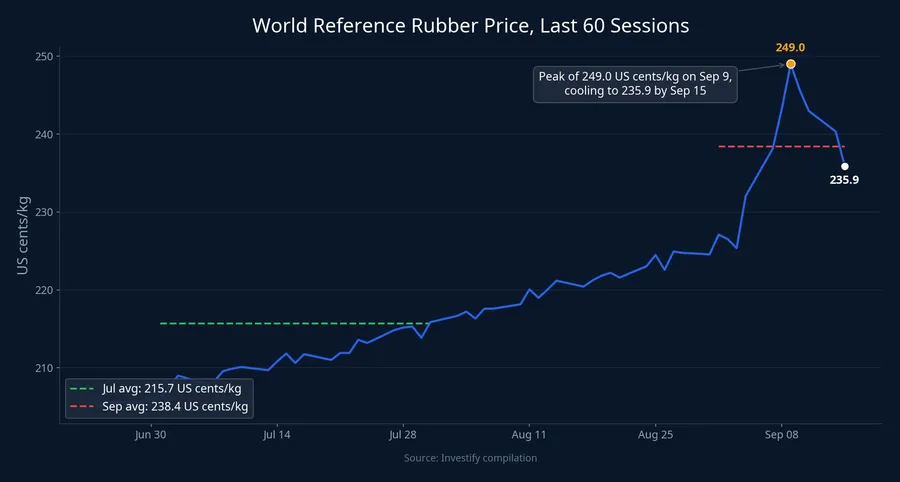
This is the crux for a company like GVR: it books revenue on the average selling price for the full period, based on contracts already signed and shipments already delivered, not on the closing price of a single session on Tokyo's derivatives exchange. Export data makes this clear: in the first 8 months of 2026, Vietnam exported 944,900 tons of rubber for USD 1.88 billion, down 15.4% in volume and 5.1% in value from the same period last year.Người Quan Sát Dividing value by volume, the average export price works out to roughly USD 1,990/ton, about 11.5% higher than the same period last year: selling less but selling at a better price.
GVR is still a rubber company, that has not changed
To avoid the opposite misreading: GVR has not escaped the price of rubber latex. In Q2 2026, more than 80% of the group's net revenue still came from the rubber latex segment, and that share is actually higher than the same period last year, not lower.Elibook
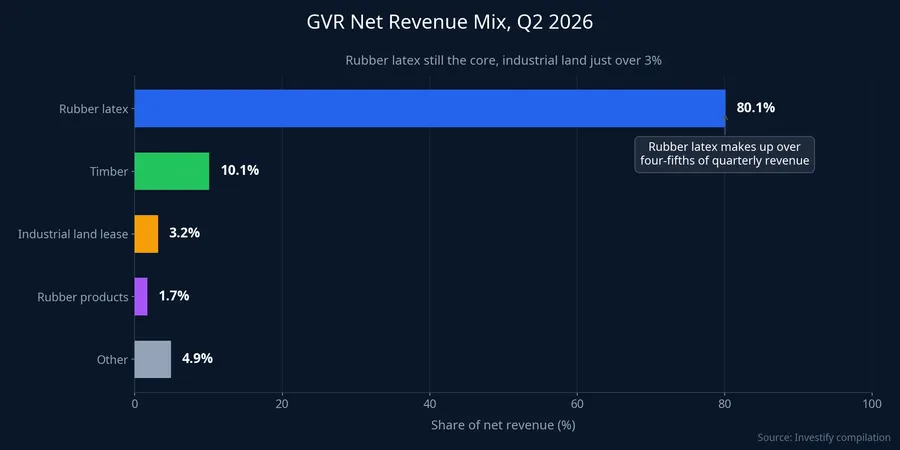
Industrial-park land leasing, the segment most often mentioned when people talk about GVR, is still tiny on the actual financial statements: it accounts for only around 3% of net revenue in the first half of the year, and revenue from this segment fell 27% year-on-year in Q1 2026 because it depends on the timing of individual land handovers.Fireant This is a long-dated option on the land bank, not yet a steady cash flow.
A second profit layer runs on land's calendar, not the price board
The real distinguishing point sits at the profit line, not the revenue line. In Q2 2026, GVR posted net revenue of VND 7,082.6 billion, up 20.2% year-on-year, while pre-tax profit reached VND 2,864.6 billion, up 46.7%. Profit grew twice as fast as revenue, even as the gross margin barely moved, 30.6% versus 30.7% a year earlier.
That gap comes from two lines outside core sales. Q2 financial income reached VND 531.3 billion, up 125.5% year-on-year. Net other income reached VND 1,056.9 billion, up 99.5%. Combined, these two lines made up roughly 55% of the quarter's entire pre-tax profit.
This is where land clearance compensation and rubber-plantation liquidation proceeds get booked when land is converted to another use. These items move on the legal timeline of each project, on each locality's land recovery decisions, on the contract-signing calendar, with no link at all to the price of the December rubber futures contract on Tokyo's exchange. That is exactly why GVR's profit can grow faster than revenue even while the gross margin stays flat.
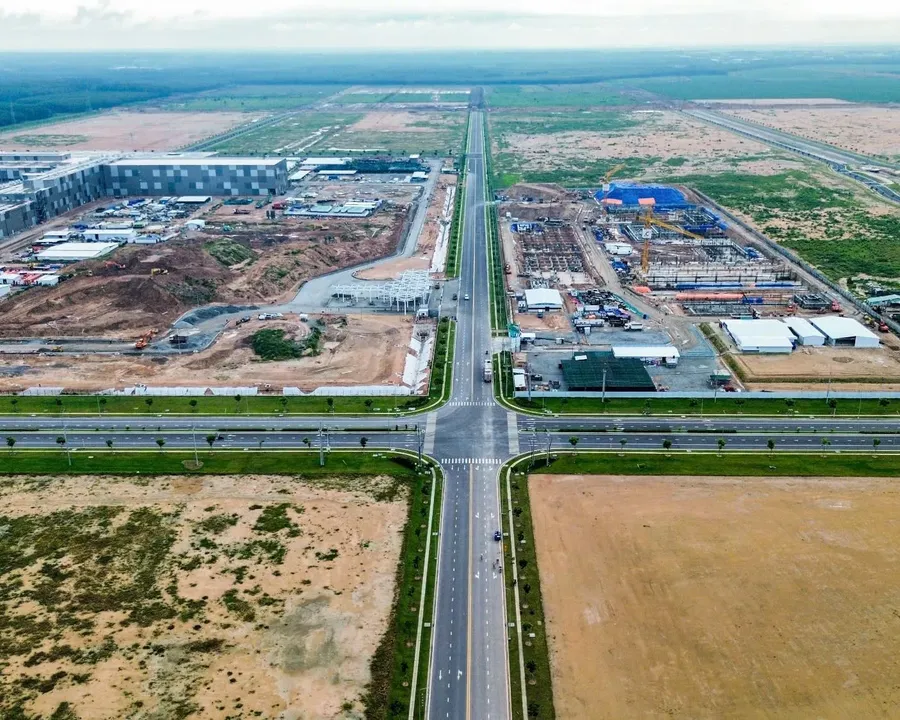
The scale of the land bank explains why the market pays attention to this profit layer. At its annual shareholder meeting on June 17, GVR said it was managing 19 industrial parks covering more than 6,300 hectares, 14 of which are already operating at roughly 90% occupancy.FILI The 2026 plan targets signing 275 new hectares of leasable land. Behind that sits a Southeast Vietnam regional plan that allows tens of thousands of hectares of rubber land to be converted to industrial use through 2030.
The stock runs out of step with the commodity in both directions
Looking at today's session alone, it is tempting to conclude the stock is simply ignoring the commodity price. But the last several sessions show the gap runs in both directions, not just one favoring the stock.
In the September 11 session, the reference rubber price fell 2.10%, while GVR dropped as much as 5.36% on 3.83 million units matched, more than double the average volume. The stock reacted more than twice as hard as the commodity. By September 15, the rubber price was nearly flat, down just 0.04%, while GVR rose 3.34%. Over the last three sessions, the stock has clawed back the entire decline from September 11.
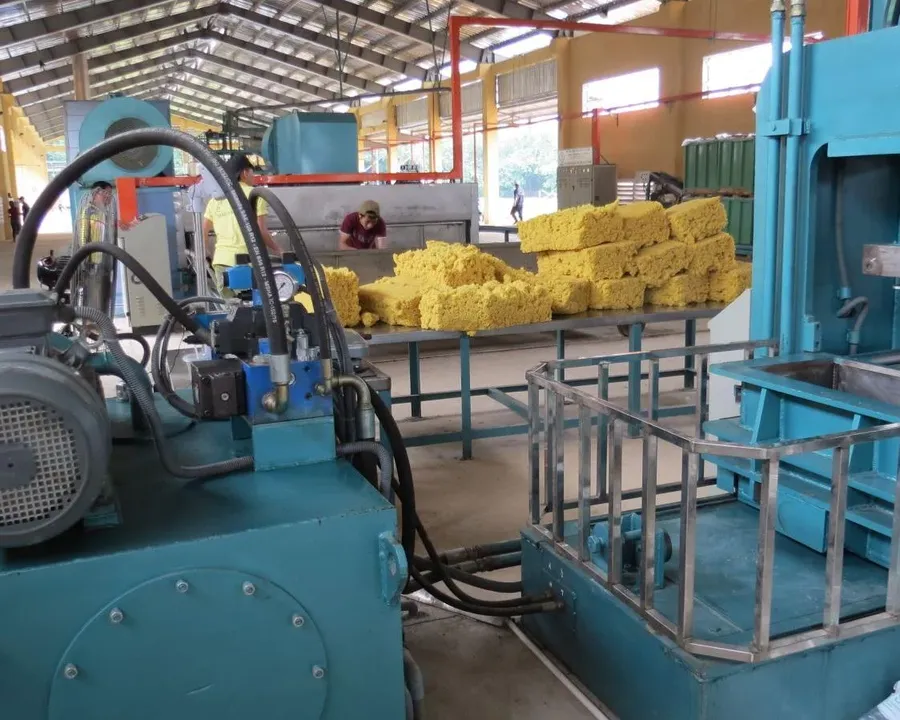
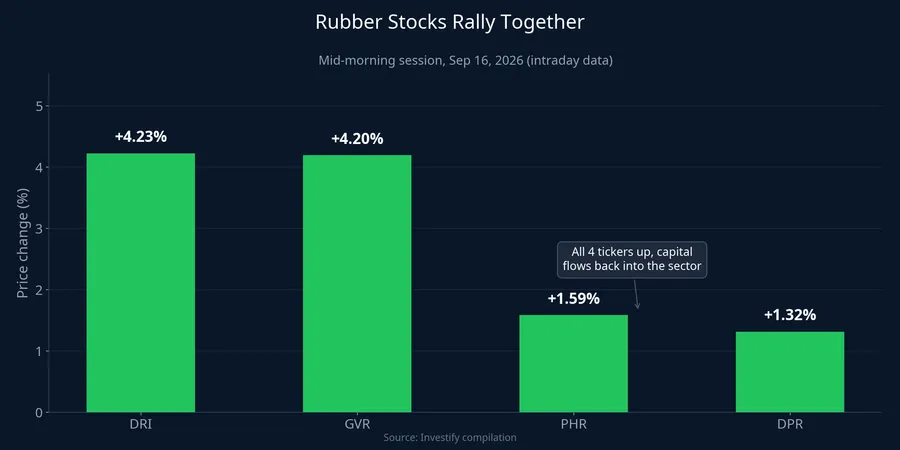
This morning's move is also not a GVR-only story: Phuoc Hoa Rubber rose 1.59%, Dong Phu Rubber rose 1.32%, and Dak Lak Rubber Investment rose 4.23%. The whole group moved up together while no individual company disclosure was released during the session. That is a sign of capital flowing into a sector, not the market reacting to a specific price move on a commodity exchange.
Three alternative explanations to rule out first
There are at least three other explanations for this rally, and the available evidence supports only one of them.
The first is upgrade-driven capital flows. On September 21, FTSE Russell's Vietnam market upgrade takes effect with a 10% initial weighting. But GVR is not on the list of 27 stocks added to the FTSE Global All Cap basket.VnEconomy This explanation is ruled out.
The second is a pure technical rebound following the heavy sell-off on September 11. This factor is real and likely contributed meaningfully, since the gain over the last three sessions is almost exactly equal to that session's decline.
The third is anticipation of land-related legal milestones approaching in Q4. This factor is hard to measure directly within a single session, so it should be read as background sentiment rather than the specific cause of this morning's move.
Putting it together, the best-supported reading is that capital is rotating back into a sector trading at elevated selling prices, following a session of excessive selling. The stock has not decoupled from rubber prices; it is simply reacting more slowly, and then more sharply, than the derivatives price board at certain moments.
What to watch next
Given the current structure, two numbers say more than the session-by-session price board.
First is the monthly average selling price, rather than the daily closing price. As long as the average stays above the Q2 range, there is no reason yet for the rubber segment's margin to compress.
Second is the "other income" line in the Q3 financial statement, expected in late October. If this line continues to contribute more than half of pre-tax profit, GVR's earnings are still leaning on non-recurring, land-linked items. If that line shrinks while profit holds up, it would mean the core business has genuinely started carrying its own weight, arguably the most important signal to watch next quarter.
On valuation, the stock is currently trading above the target prices some securities firms have recently issued: BVSC at VND 31,669 and Vietcap at VND 32,100, while KBSV set a higher target at VND 37,500.Tin nhanh chứng khoán The spread between these targets reflects exactly what this article has described: the land-linked slice of profit is hard to value with a single model, and that is also why GVR's stock moves are hard to read from a commodity price board alone.