

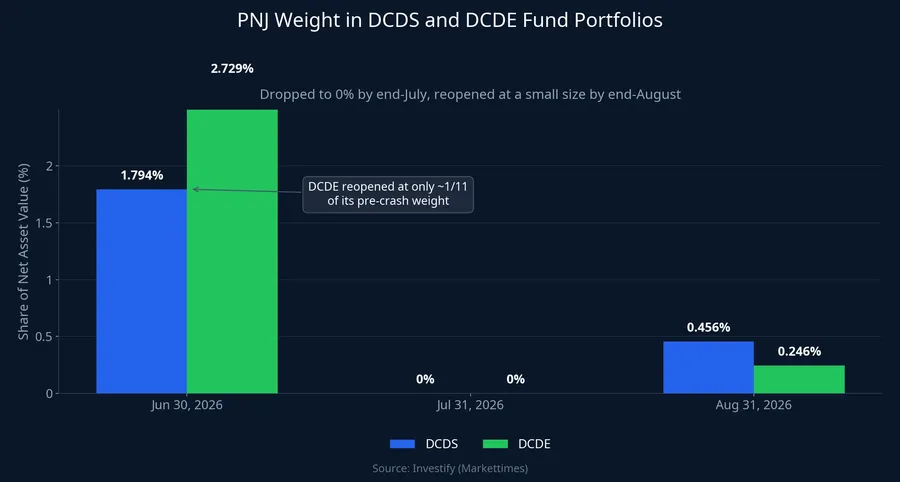
Look at two month-end portfolio reports from the same fund group and it's easy to conclude Dragon Capital changed its mind on PNJ. At the end of July 2026, the DCDS and DCDE funds held zero PNJ shares; by the end of August, the same two funds had bought back 745,100 shares.Markettimes
The risk isn't whether a fund buys or sells. It's that those two numbers are just two snapshots taken at month-end. In the three weeks between them, PNJ lost more than half its value, and almost none of that stretch showed up in any news article retail investors could read in real time.
The crash was real, not a technical adjustment
The first explanation most people reach for when a stock loses half its value in a month is a corporate action: a stock split, bonus shares, or a stock dividend. For PNJ, that theory doesn't hold up. The company did issue a 50% stock bonus in 2026, but the ex-rights date was April 23, 2026, nearly three months before the drop, and from May through September no session's reference price deviated more than 2% from the prior close.
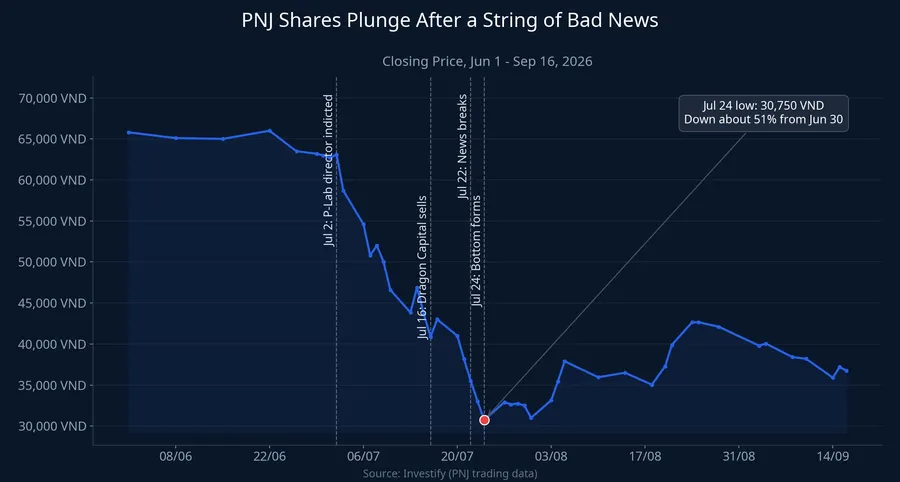
What actually happened was a string of consecutive limit-down sessions. From VND 63,000 on June 30, PNJ hit the floor on July 3, 6, and 7, then kept falling 6.8-6.96% through the second half of July, bottoming at VND 30,750 on July 24, the lowest in 400 sessions. That bottom session traded 41.56 million shares, versus a few hundred thousand to just over a million per session back in June, the signature of a panic-driven crash, not a technical correction.
Where the real risk came from
On July 2, Đặng Ngọc Thảo, the former director of PNJ Gemological Laboratory (P-Lab), a subsidiary of Phu Nhuan Jewelry (PNJ), was arrested and charged in a ring smuggling more than 28,000 diamonds from Hong Kong.Tuổi Trẻ He is accused of erasing the GIA codes engraved on smuggled diamonds, re-engraving P-Lab's own code, and issuing new certification papers.Vietstock P-Lab holds a dominant share of Vietnam's diamond certification market, so the case struck directly at jewelry buyers' trust.

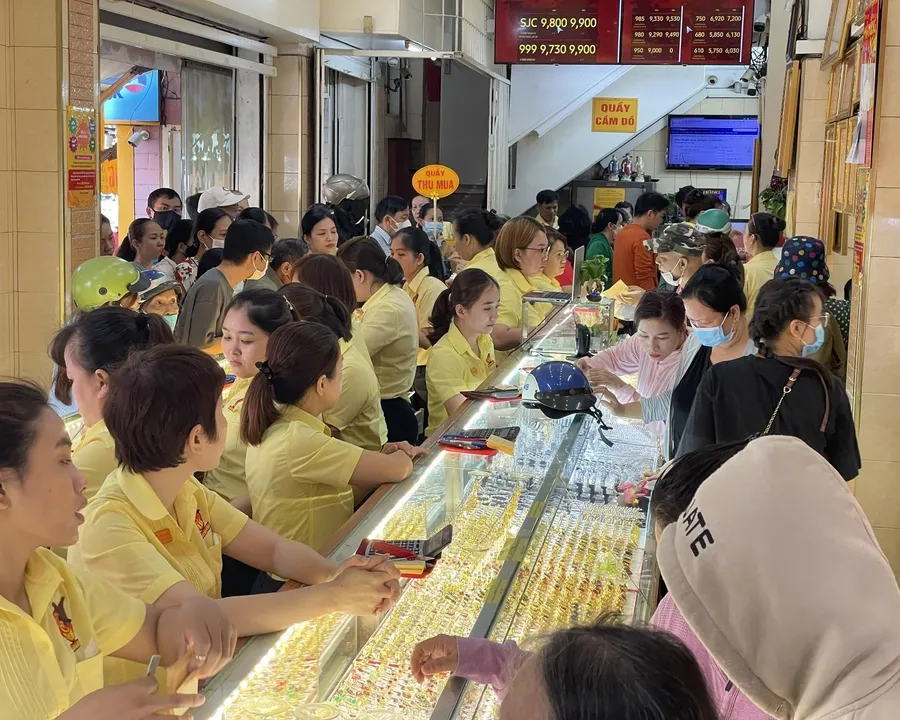
That loss of trust turned into cash pressure almost immediately. In the first 20 days of July, PNJ booked roughly VND 1,588 billion in revenue but had to take back customer-returned merchandise worth about VND 5,900 billion, roughly 3.7 times revenue over the same window.Markettimes On July 21, the company wrote to shareholders, admitting it had to apply temporary liquidity management measures and adjust its buyback process.
A third pressure point came from margin lending. On July 22, SSI cut its margin ratio on PNJ from 40% to 0%, KIS pulled the stock from its margin-eligible list, TCBS had already dropped it on July 9, and Phu Hung Securities also went to 0%.Tuổi Trẻ Cutting margin forces leveraged accounts to sell, regardless of what they actually think about the company.
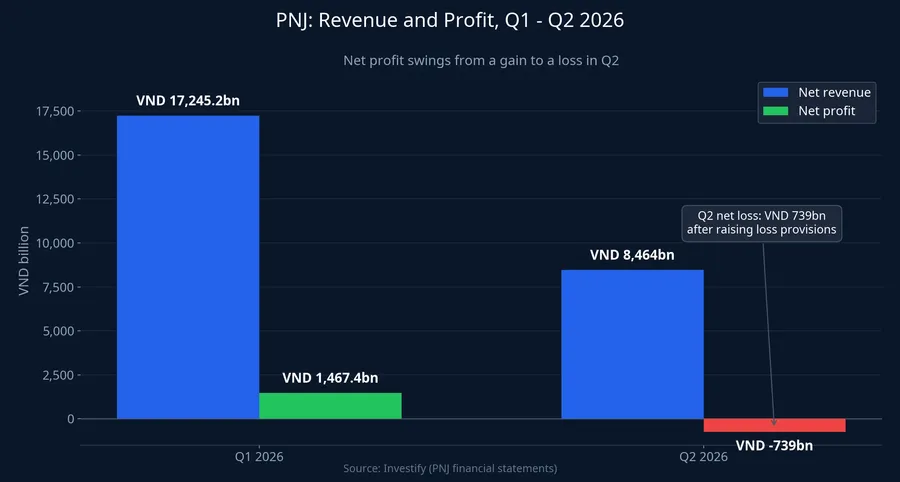
Behind all that pressure sat a business that had genuinely deteriorated. In Q2 2026, PNJ posted VND 8,464 billion in net revenue but a negative gross margin of VND 666.8 billion and a net loss of VND 739 billion; for the first half, revenue rose 49.3% to VND 25,709 billion while net profit fell 34.7% to VND 728.4 billion. The reviewed first-half report published in September further cut profit attributable to parent-company shareholders to nearly VND 728.5 billion, about VND 456 billion lower than what the company had self-reported at the end of July, after raising loss provisions related to its buyback policy to VND 2,267 billion.Markettimes
What fund reports didn't say in time
This is where retail investors get the story most wrong. Funds managed by VinaCapital sold nearly 3.1 million PNJ shares on July 8, cutting their combined stake from 5.6% to 4.99%, when PNJ closed at VND 52,000. The news ran on the morning of July 11,Tuổi Trẻ by which time the most recent close had already fallen to VND 46,600. Readers found out about the sale when the price was already roughly 10% below what the funds had sold at.
The lag at Dragon Capital was even wider. Its member funds sold more than 2.5 million shares on July 16, taking the group's combined stake from 5.05% to 4.56% and losing large-shareholder status as of July 20. On July 16, PNJ closed at VND 40,900. The news hit the press on the afternoon of July 22,Tuổi Trẻ the same session PNJ closed at VND 35,500 with nearly 17 million shares stuck at the floor with no buyers. Those six lagging sessions cost another 13.2% in value. Anyone who read that afternoon's news and sold over the next two sessions would have sold at VND 33,050 or right at the bottom, VND 30,750. From that low through September 16, PNJ has recovered to VND 36,750, about 19.5% above the panic-selling zone.
Open-end fund portfolio disclosures lag even further, since they're only published once a month. The July 31 snapshot showed DCDS and DCDE at zero PNJ, but it reached readers in August, by which point PNJ had already hit the daily limit up three sessions in a row, on August 3, 4, and 5. In other words, what retail investors saw wasn't the fund's action at the moment it happened, but the echo of that action after the price had already traveled a long way.
The 5% threshold cuts the signal short
"No longer a large shareholder" does not mean "sold out." After the July 16 session, the Dragon Capital group still held more than 23.33 million PNJ shares, equal to 4.56% of charter capital. Disclosure rules only require a shareholder to report a transaction that changes large-shareholder status at the 5% mark; once below that line, they can keep selling any amount without disclosure until they cross back above 5%. That's the loophole retail investors need to understand before trusting any "large shareholder" headline.
That same month, the number of funds holding PNJ dropped from 50 to 26, and total fund holdings shrank from over 64.45 million to about 28 million shares.Markettimes Most of that selling never came with any disclosure at all, because it fell below the mandatory threshold.
Absolute share counts don't tell you the weighting
745,100 shares sounds like a meaningful accumulation move. Set against portfolio weighting, the story looks very different. At the end of June 2026, DCDS held 1,823,400 PNJ shares, 1.794% of net asset value; DCDE held 429,600 shares, 2.729%. By the end of August, those weightings had fallen to 0.456% and 0.246% respectively. DCDE reopened its position at only about one-eleventh of its pre-crash weighting.
Zoom out to the entire fund industry and the picture gets clearer. In the very month that DCDS, DCDE, and Lighthouse Dynamic Fund all opened new positions, total fund-held PNJ still fell by 539,200 shares, from over 28 million to 27.47 million, and ownership as a share of total shares outstanding dropped from 5.47% to 5.37%. Three funds buying in didn't reverse the group's net-selling trend.
Why funds bought back remains an open question
The August move has several plausible explanations, and the available data doesn't rule out any of them.
The first reading is that legal risk had cooled off: on August 20, Thanh Hoa provincial police published verification results on the diamonds involved in the case, finding that PNJ had complete import documentation and that its import and distribution process complied with regulations. The stock closed August at VND 42,100, about 35.8% above the end of July. The second reading is simply how open-end funds normally operate: when investors inject new capital, funds must deploy it according to their existing portfolio framework, and a large-cap jewelry retail name can come back into a portfolio for rebalancing reasons rather than a fresh view on the business.
The third reading, and the one best supported by the evidence, is a tentative, exploratory re-entry. The new weightings run from a quarter to an eleventh of the old ones, and total fund ownership across the group kept shrinking in that same month. That's the behavior of an institution holding a placeholder to keep watching, not one that has concluded the risk has passed.
Three questions before trusting a large-shareholder headline
Before believing any "fund X bought/sold stock Y" headline, three questions are worth asking.
When did the transaction happen, and when did the news come out? The gap between those two dates is the piece of the price move investors miss before they even know about it. For PNJ, that gap was six sessions and 13.2%.
How much did the weighting change, not just the raw share count? A fund going from 2.729% of NAV to 0.246% of NAV is telling the opposite story from a "buying back" headline.
How did the whole group of funds behave, not just one fund? In August, three funds opened new positions, but total holdings across all 27 funds still fell.
For PNJ, clearer answers will come from the Q3 financial results and the fund portfolio snapshot at the end of September. The Q3 report will show whether gross margin has climbed back out of negative territory. The end-of-month portfolio snapshot will show whether DCDS's 0.456% weighting was the starting point of a fresh accumulation, or the ceiling the fund set for itself.