


On September 15, 2026, Reuters reported that Vietnam's Ministry of Finance is in talks with investment banks about a USD-denominated government bond for international markets, 10-year tenor, sized between USD 500 million and USD 1 billion.Nguoi Quan Sat If it goes ahead, it would be Vietnam's first return to this channel since the USD 1 billion issuance in 2014.BBW
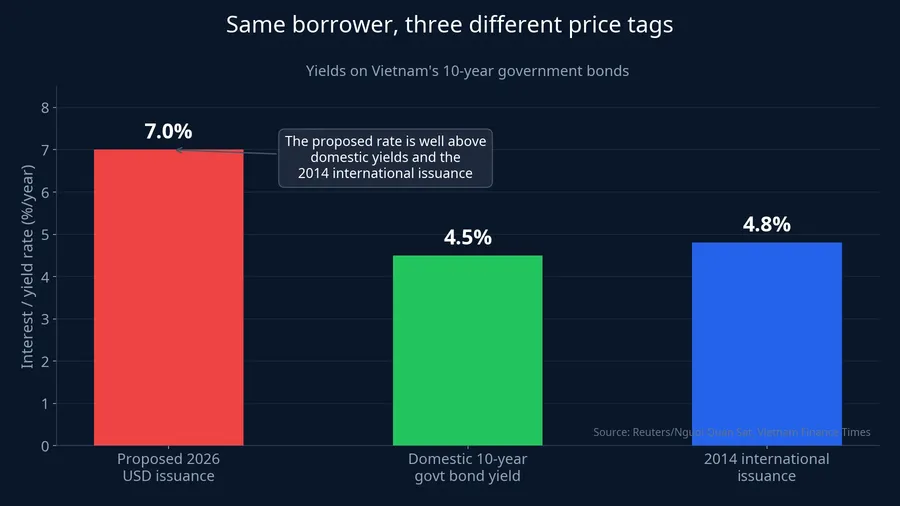
The bigger picture here is that the number drawing attention isn't the size, it's the price. One international lender has proposed paying investors around 7% a year.Nguoi Quan Sat At the same time, domestically, the 10-year government bond yield sits at just around 4.5%.Vietnam Finance Times Same borrower, the Vietnamese government, same 10-year tenor, and the price tags differ by nearly 2.5 percentage points. Worth stating upfront: this is still the term-negotiation stage. The Ministry of Finance has not made a final decision and is weighing funding cost against elevated global yields.
The door opened in February, not today
The international borrowing channel has actually been sitting in the annual plan for months. Decision 352/QD-TTg, dated February 27, 2026, approved the 2026 public debt plan with a maximum borrowing ceiling of VND 969,796 billion, and it explicitly lists three funding sources: domestic government bonds, ODA and preferential foreign loans, and international bond issuance.Tien Phong In other words, what's new on September 15 isn't the policy. What's new is that price negotiations have started.
The groundwork has also been over a year in the making: in March 2026 the Ministry worked with HSBC and held investor roadshows in London, and in June 2026 a delegation traveled to the Philippines to discuss advisory work with HSBC Philippines and Citibank Philippines.Vietnam Finance Times In July 2026, Vietcombank's Chairman called for an international bond issuance, arguing domestic capital accumulation wasn't enough, while the Governor of the State Bank of Vietnam said the agency was evaluating options.CafeF
USD 1 billion doesn't solve the funding problem
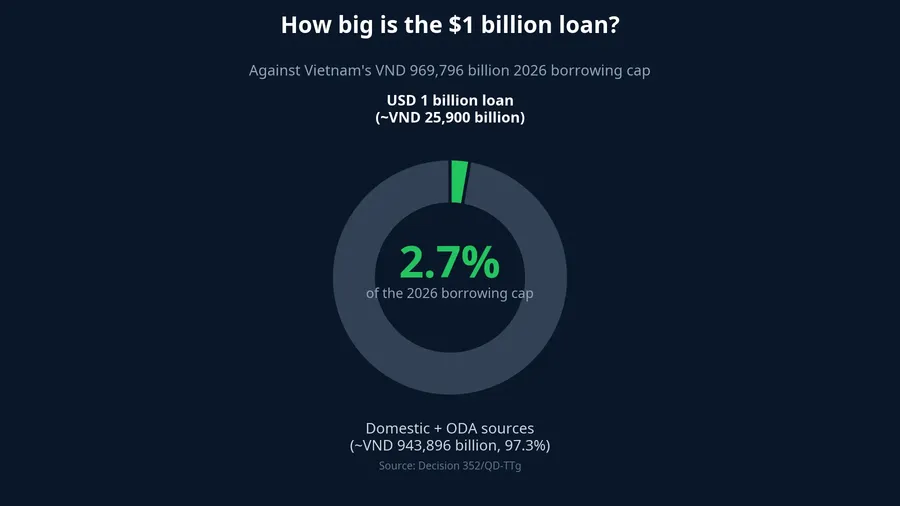
The fastest way to see this issuance isn't primarily about raising cash is to set it against the full-year borrowing plan. At the September 14 exchange rate of VND 25,925.5 per dollar, USD 1 billion is worth roughly VND 25,900 billion. Against the 2026 borrowing ceiling of VND 969,796 billion, that's just about 2.7%. The central budget deficit financing alone this year is VND 583,700 billion. A billion dollars doesn't fill any meaningful gap in that picture.
So if it's not about the money, what is it about? There are two layers of mechanism worth examining, and the first one hits savers' wallets directly.
Two different capital pools, two different games
When the government issues bonds in Vietnamese dong domestically, the buyers are mostly commercial banks, insurers, and funds. The money they use comes straight from household savings deposits, so every dong a bank puts into government bonds is a dong that doesn't flow to businesses.
The banking system is running tight. By the end of March 2026, credit had grown 2.15% since the start of the year while deposit mobilization had grown just 0.44%, forcing banks into a scramble for deposits.VietnamBiz The price of that scramble shows up clearly on deposit-rate boards: in early September 2026, ACB was offering 7.8% a year on 12-month terms, Sacombank 7.5%.Znews By August 22, 2026, dong-denominated mobilization had grown 8.77% since the start of the year, outpacing credit growth of 8.38% for the first time, but at a price of 7-7.8%, not a cheap one.Tap Chi Kinh Te Tai Chinh The State Bank has also loosened a technical valve: Circular 25/2026/TT-NHNN, effective July 1, 2026, raised the cap on short-term funds usable for medium- and long-term lending from 30% to 40%, though that only creates more tenor flexibility, not a single new dong of deposits.Vietnam Finance Times
Set against that backdrop, USD 1 billion from international investors is capital from an entirely different pool. It pulls no dong out of domestic savings accounts, and it competes with no Vietnamese business seeking a bank loan.
Vietnam lost its own pricing benchmark
The second layer of mechanism gets talked about less, but it may be the more legitimate reason behind the 7% figure.
After 12 years without an issuance, Vietnam no longer has a USD reference yield curve in global capital markets; the 2014 bond, with its 10-year tenor, matured back in 2024. When a Vietnamese company wants to borrow USD from foreign investors today, there's no government bond benchmark to price country risk against, so investors are left to estimate on their own, and estimates made without data tend to skew cautious, meaning higher rates. This is exactly what Citibank Philippines recommended when the Ministry of Finance visited in June: keep a regular annual issuance schedule to establish a reference point, rather than showing up once and disappearing.
The credit-rating backdrop helps explain the timing. On May 4, 2026, Moody's raised Vietnam's sovereign outlook from Stable to Positive while keeping the Ba2 rating, and Fitch and S&P both rate Vietnam BB+ with a Stable outlook, one notch below Investment Grade.Tuoi Tre Vietnam is targeting Investment Grade by 2030, and to get upgraded a country needs to demonstrate access to international capital markets, not just clean debt ratios. Vietnam's public debt at around 37% of GDP is low, but a country that's been absent for 12 years gives rating agencies nothing to observe.
The price tag, and who pays it
The cost of buying back that reference point is calculable. If the issuance goes ahead at the proposed 7% for USD 1 billion over 10 years, the extra interest over domestic borrowing at 4.5% works out to about 2.5 percentage points a year, or roughly USD 25 million a year and about USD 250 million over the bond's life, equivalent to more than VND 6,400 billion at current exchange rates. The one paying is the state budget, and ultimately, the taxpayer.
Against the 2014 issuance, the gap is just as clear: that deal priced at 4.8% a year, 2.2 percentage points below today's proposal. Most of that difference doesn't come from Vietnam getting weaker, it comes from the global USD rate environment: the US 10-year Treasury yield has approached the 5% mark in September 2026, the highest level in years.CafeF Against that base, a 7% rate is only about a 2-point spread over US Treasuries, reasonable for a BB+-rated country.
Currency risk isn't an urgent problem right now. The USD/VND rate on September 14 stood at 25,925.5, down 1.42% from the 26,300 level at the start of 2026, meaning the dong has actually appreciated slightly. Borrowing USD in this environment converts more cheaply than it would during a period of dong depreciation. But the tenor is 10 years, and over that span the exchange rate could well move the other way. If the dong depreciates by an average of 2% a year across the tenor, the real cost in dong terms would be meaningfully higher than today's figure.
Three other readings of "why now"
The motive behind this issuance shouldn't be presented as if there's only one explanation. The first reading is genuine foreign-currency need: major infrastructure projects import equipment priced in USD, so borrowing directly in USD skips a currency-conversion step and reduces balance-of-payments risk.
The second reading is capitalizing on a ratings window. Moody's Positive outlook from May is a clear tailwind for this offering, and that window could close if global macro conditions worsen. The third reading is relieving pressure on the banking system, which matches the stated purpose in the original report.
The available evidence leans more toward the second and third readings: USD 1 billion is too small to explain by genuine infrastructure currency need, which typically runs into tens of billions of dollars, but it's just about right for a benchmark-setting issuance, liquid enough to trade in the secondary market and large enough for rating agencies to take notice.
Signals worth watching
For individual investors, this issuance isn't a product to buy. USD-denominated government bonds sold internationally target foreign institutional investors, not domestic retail buyers. Its value to readers lies in what it measures: the actual coupon printed on the bond tells you where the world is pricing Vietnam risk.
If the final rate comes in meaningfully below the proposed 7%, that would signal international investors have already priced in upgrade expectations, and that cheaper benchmark could eventually filter down to Vietnamese corporate USD borrowing costs, indirectly easing pressure on domestic deposit rates, the same rates on your savings account. If the final rate lands at 7% or higher, the market is still charging Vietnam exactly the spread of a BB+ country, and the path to Investment Grade by 2030 still has more to prove. And if the issuance doesn't happen this year at all, that's an answer too: the Ministry of Finance decided the price wasn't worth paying. The outcome of the coming weeks of negotiation is the signal most worth watching.