
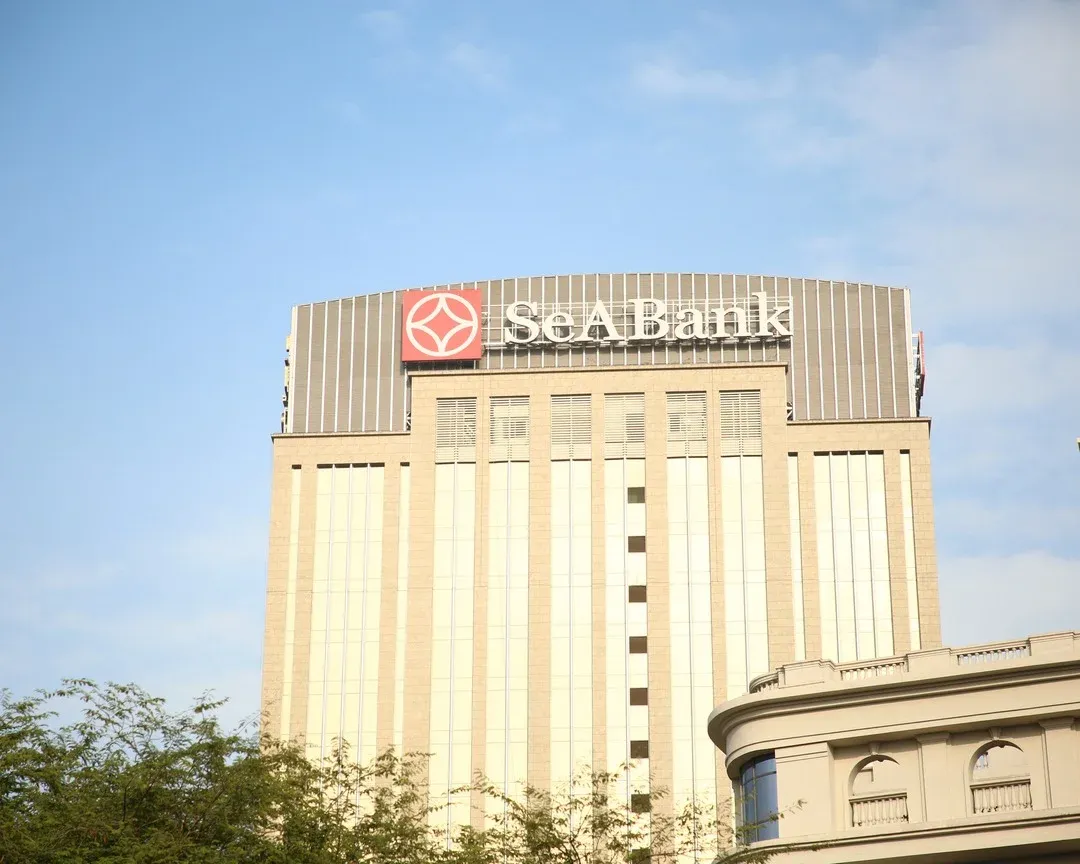

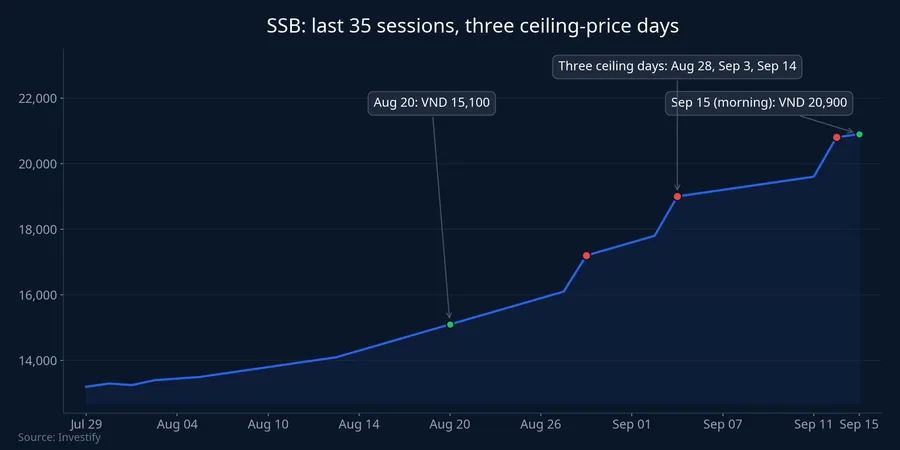
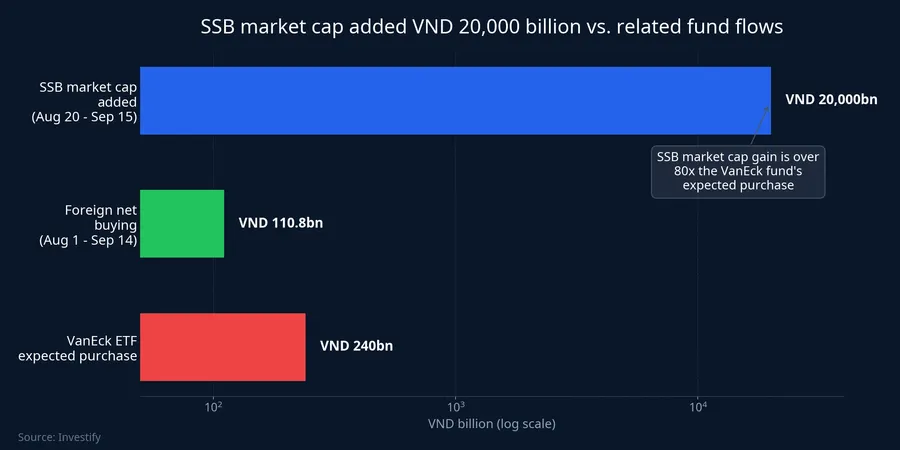
At the close of the morning session on September 15, shares of SSB, the ticker for Southeast Asia Commercial Joint Stock Bank (SeABank), traded at VND 20,900, up 6.91% and the stock's highest level in roughly three years.CafeF Going back to August 20, when SSB traded at VND 15,100, the stock has gained 38.4% in under a month, lifting market capitalization from roughly VND 51,800 billion to VND 72,500 billion.
Looking at the numbers, roughly VND 20,000 billion in market value appeared in under a month. But that figure needs to be read correctly: the added market cap isn't cash that flowed into the stock. It's the market repricing all 3.47 billion outstanding shares at the level of the last matched trades. Separating those two things is the first step to reading this rally with a clear head.
Three catalysts in three weeks
SSB's rally tracks closely with the announcement calendar of international index providers.
On August 21, FTSE Russell released its semi-annual review and added 27 Vietnamese stocks to the FTSE Global All Cap index, including SSB in the small-cap segment.Thời báo Tài chính Việt Nam SSB hit its daily ceiling on August 28, up 6.88% to VND 17,100. August 24 was the ex-rights date for an employee share issuance. SeABank issued an additional 40 million shares, raising charter capital from VND 34,288 billion to VND 34,688 billion.Người Quan Sát The dilution to existing shareholders was only about 1.15%, negligible against per-share book value.
On September 12, MarketVector announced its Q3 review results and added SSB, and only SSB, to the MarketVector Vietnam Local Index while dropping CEO.MarketTimes That index is the benchmark for the VanEck Vietnam ETF. On September 14, SSB hit its ceiling again, up 6.83% to VND 19,550.
The condition enabling this entire chain was actually set more than two months earlier. On June 1, 2026, the State Securities Commission approved SeABank's request to raise the maximum foreign ownership ratio from 5% to 30%.VietnamBiz Under the old 5% cap, the stock could barely meet the foreign-investor liquidity criteria used by global index providers. Raising the cap to 30% was the necessary condition; the two subsequent index reviews were simply where the results got announced.
How big is the index money, really
This is where the numbers cool off relative to the headline, and where investors are most likely to get misled.
The VanEck Vietnam ETF, with assets over $500 million, is expected to buy roughly 13.2 million new SSB shares worth about $9.16 million.Người Quan Sát SSB is the fund's largest purchase by value in this rebalance, but 13.2 million shares equal only about 0.38% of shares outstanding. Converted to VND, that purchase is roughly VND 240 billion, just over 1% of the added market cap.
On the FTSE Russell side, no institution has published a passive-flow estimate specific to SSB. The available figures are all market-wide, and the weighting phase-in runs through September 2027, meaning index money will arrive gradually rather than all at once.
Actual foreign inflows have been of a similar scale. From August 1 to September 14, foreign investors bought a net VND 110.8 billion of SSB, equivalent to roughly 5.6 million shares. What stands out is the distribution: the three ceiling-price sessions on August 28, September 3 and September 14 alone accounted for VND 140.7 billion in net buying, meaning foreign money piled in exactly on news days while other sessions skewed toward net selling. In other words, price ran ahead of the money. The market didn't wait for the fund to actually buy before repricing the stock; it repriced the moment it learned the fund would have to buy.
The business fundamentals point the other way
While the price hit a three-year high, SeABank's first-half report tells a different story altogether.
On scale, the bank is still expanding well. Consolidated total assets exceeded VND 427,100 billion, outstanding credit reached VND 264,453 billion (up nearly 8% from end-2025), and customer deposits plus valuable papers grew 8.1%.Tạp chí Công Thương
On efficiency, the metrics deteriorated clearly. Consolidated pre-tax profit for the first half came to VND 2,625 billion, down 54.6% year-on-year.Tin Nhanh Chứng Khoán Much of that decline comes from the comparison base: the first half of 2025 included a one-off VND 2,607 billion gain from divesting a subsidiary. Strip that gain out of the base period and pre-tax profit still fell roughly 17.3%.BaoMoi
The core efficiency metrics show where the rest of the decline comes from. Quarterly NIM slid from 2.98% to 2.34%. The CASA ratio dropped from 13.61% at end-2025 to 10.74%, meaning the bank's supply of cheap funding is shrinking and its cost of capital will be hard to bring down over coming quarters. The NPL ratio ticked up from 2.06% to 2.25%, pushing six-month provisioning costs up 28.1% to VND 838 billion.
Valuation after the rally
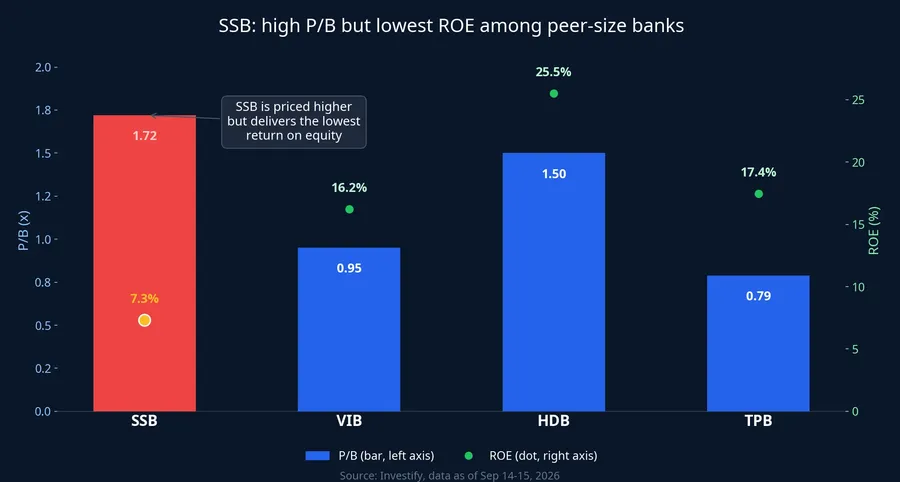
At VND 20,900, SSB trades at a P/E of 24.28x and P/B of 1.72x, with ROE of 7.31%. Set against similarly sized banks, the gap is clear: VIB trades at P/E 6.15x and P/B 0.95x with ROE 16.22%, HDB at 7.06x and 1.50x with ROE 25.49%, and TPB at 5.14x and 0.79x with ROE 17.45%.
It's worth being fair to the numbers: SSB's P/E is elevated partly because the denominator shrank. When trailing 12-month profit drops sharply, P/E inflates automatically even if the price stands still. The more honest metric here is P/B of 1.72x alongside ROE of 7.31%. A bank earning under 8% return on equity but priced at nearly 1.8x book value means the premium is being paid for expectations, not for the profit currently on the books.
Is there another way to read this
Attributing the entire rally to index inclusion is the simplest explanation, but it isn't necessarily the only one.
First, raising the foreign ownership cap to 30% is often read by the market as clearing the runway for a stake sale to a foreign partner, and some analysts flagged that expectation the moment the decision was announced.VietnamFinance If that expectation is the real driver, September 21, when the index rebalance takes effect, won't be the end of this story.
Second, a large share of SSB's liquidity during this period came from negotiated block trades, with nearly VND 3,000 billion changing hands that way.Người Quan Sát Large block trades are typically tied to transfers between shareholder groups, a force entirely separate from index-fund buying.
The available data leans toward the first explanation, since the ceiling-price sessions track the index announcement dates closely and also happen to be the weeks with the strongest net foreign buying. But the other two factors are large enough not to dismiss when weighing this rally.
What to watch next
There's one metric that can help investors separate real money from expectation: SSB's foreign ownership ratio after September 21.
As of mid-September, foreign ownership in SSB remains under 1%, with more than 1 billion shares of room still available. There's no scarcity from a nearly-full foreign room the way there is at some other banks. So if index money genuinely arrives, foreign ownership should tick up visibly within the first few sessions after September 21. If, after a week of trading, that ratio is essentially flat while the price stays elevated, most of this rally was domestic investors chasing the news.
With Q3 results due at the end of October, the two lines worth reading first are NIM and the CASA ratio. If NIM holds above 2.34% and CASA climbs back above 11%, that would suggest funding costs have bottomed out, supporting the optimistic case tied to the foreign-room story and a potential stake sale. But if both metrics keep sliding, the 1.72x book-value valuation will need a different story to justify it, one that isn't about an index calendar that has already passed.