

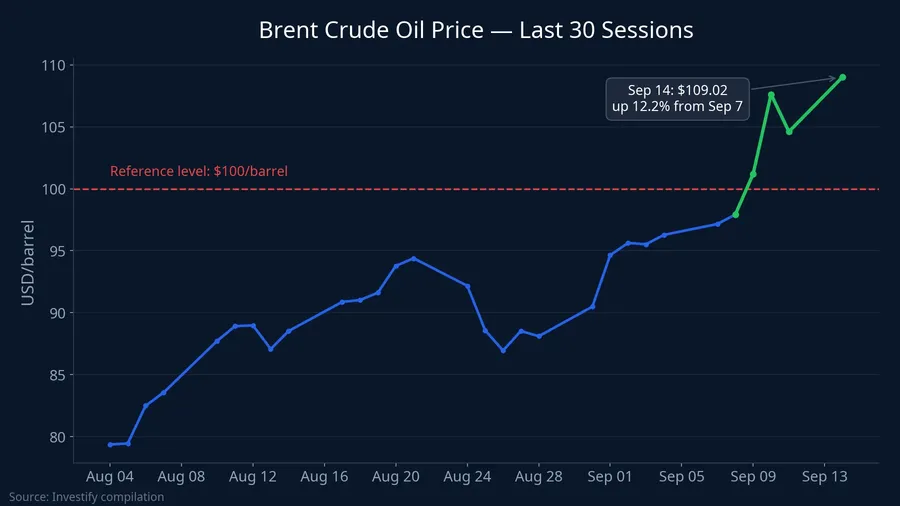
On September 14, US financial markets saw two moves that looked contradictory. The 10-year Treasury yield touched 5.014%, its first break above the 5% psychological threshold since October 2023, then pulled back within the same session.CNBC That same day, Brent crude closed at $109.02 a barrel, up 4.21%, just $0.62 short of its intraday high of $109.64.
If oil is what's pushing yields up, why did oil keep climbing while yields turned back down? The big picture suggests the answer lies in telling apart a genuine cooldown from a technical pause, and that distinction is what determines how to read the entire week.
The pullback from 5% is not a cooldown
The word "reversal" is misleading here. The 10-year yield closed the September 14 session at 4.984%, still higher than the prior session's 4.975% and the highest level in the past 60 trading sessions. The pullback only happened relative to the intraday peak, not relative to the previous day's close. Pressure hasn't eased at all; it simply didn't set a fresh record right at the closing bell.
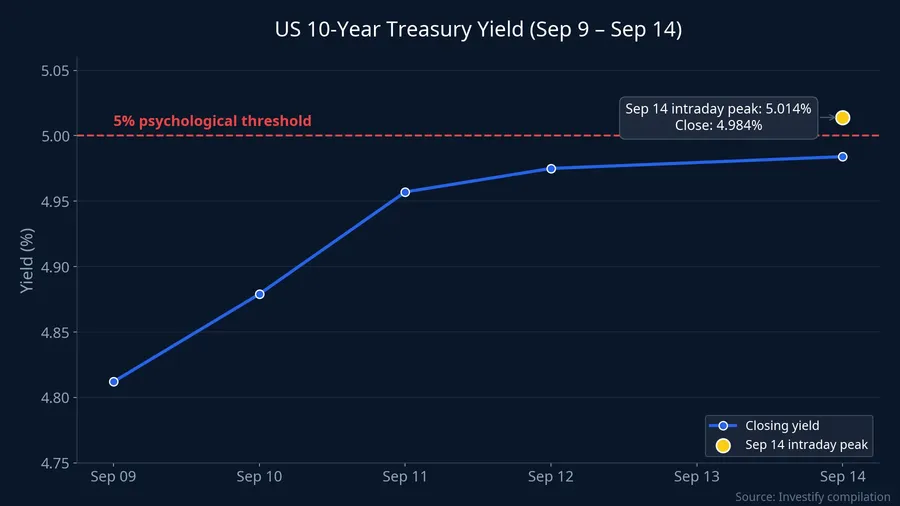
Since September 9, the 10-year yield has climbed almost without pause through every session: 4.812%, then 4.879%, 4.957%, 4.975%, and finally 4.984%. This is a near-continuous upward drift, not a single spike followed by a cooldown.
So why the intraday pullback on September 14? At least three explanations are equally plausible. One is profit-taking on short bond positions as traders trimmed risk ahead of the Fed meeting. Two is round-number buying at the 5% mark, a level many pension funds and insurers view as attractive enough to deploy capital. Three is the US Treasury's long-bond buyback program, which was expanded in scale starting August 19.
The yield curve data leans toward the first two explanations. In the September 14 session, only the 10-year tenor rose; the 2-year (4.643%) and 30-year (5.353%) both edged down 0.1 basis point. A genuine repricing of inflation expectations would drag the whole curve along with it. A move concentrated in just the benchmark 10-year tenor is a signature of technical flows and positioning, not a shift in how markets view long-term inflation.
A pipeline fire and a 5-to-6-week clock
The real link driving yields into this range sits more than 10,000 km from Wall Street. On September 10-11, a wave of drones launched from Iraqi territory struck Saudi Arabia's East-West pipeline, forcing Riyadh to shut it down as a precaution.CNBC
This is not a secondary route that can be shrugged off. The pipeline runs 1,200 km, connecting eastern oil fields to the Yanbu port on the Red Sea, and carries roughly 4-5 million barrels of oil per day.Al Jazeera Its purpose is to bypass the Strait of Hormuz, a route that has been effectively closed since the conflict with Iran erupted back in February. In other words, the front door was already locked, and on September 11 the back door got locked too.

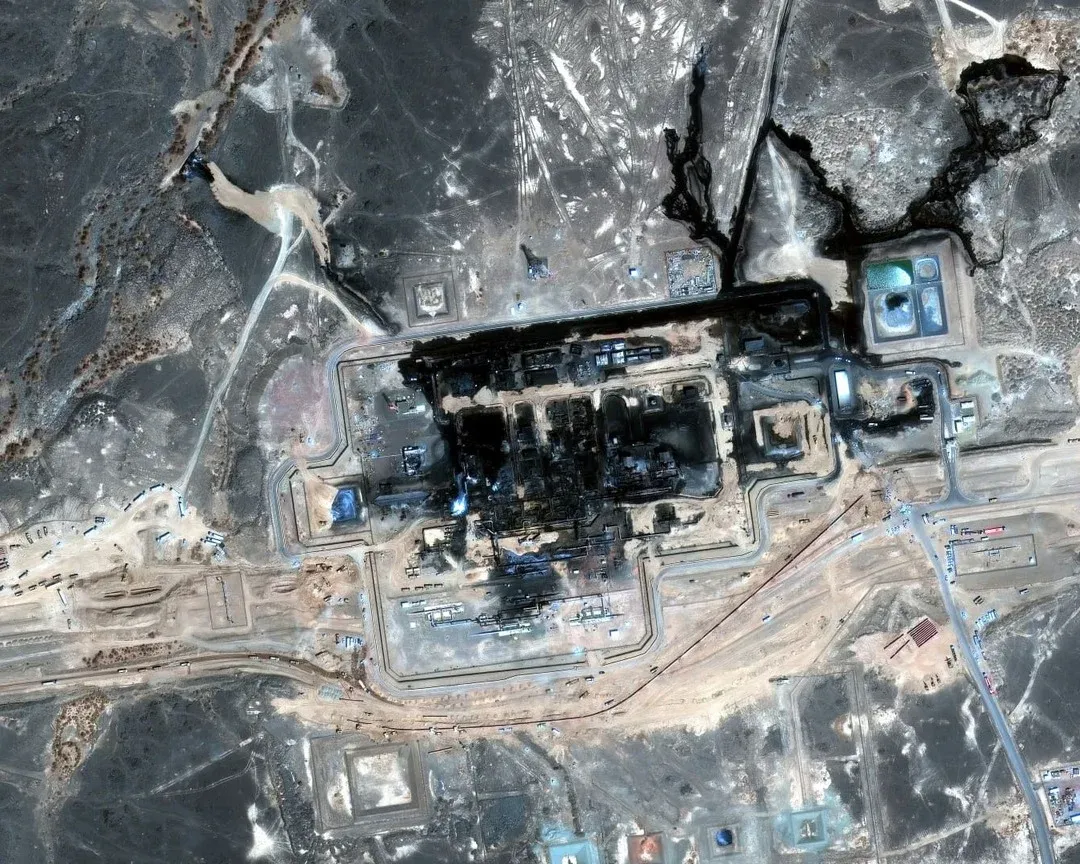
Satellite imagery released by Vantor over the weekend showed a burn scar spreading around a pump station along the pipeline.CNBC Sources say repairs could take 5-6 weeks, though another source suggested operations could resume sooner. That 5-to-6-week figure is the single most important detail in the entire story, because it stretches well beyond the distance from now to the Fed's meeting.
Oil markets have reacted exactly along those lines. Brent went from $97.92 on September 8 to $109.02 on September 14, and against the $88.52 level from August 14, that's a 23.2% surge in just one month. The intraday trading range on September 14 was also markedly wider than prior sessions, reflecting a market repricing supply risk rather than trading under normal conditions.
A two-day Fed meeting, mostly priced in
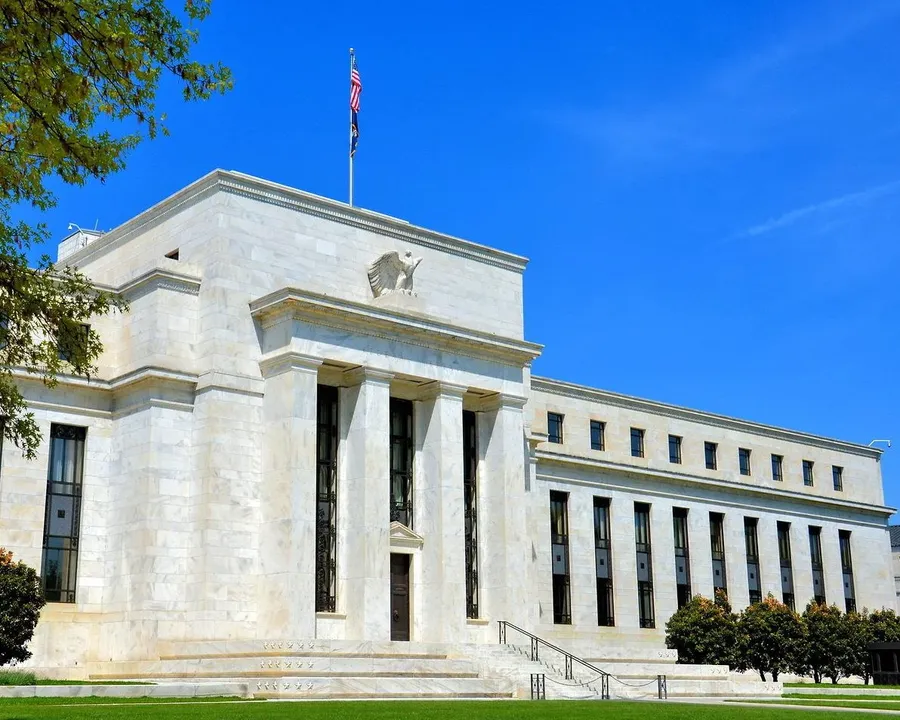
The Fed's meeting runs September 15-16, with the decision due in the early hours of September 17 Vietnam time. CME's FedWatch tool shows markets pricing in over 90% odds of a 25-basis-point hike, which would lift the target rate band to 3.75-4.00%.Yahoo Finance A Reuters survey from September 14 similarly found 85% of economists forecasting the same outcome. If that happens, it would be the Fed's first rate hike since 2023.
What matters for investors is that this outcome is largely already priced in. The VIX volatility index rose 9.2% over the week but only reached the 17 level, still below the 20 threshold that analysts treat as the line between caution and panic. Futures on all three major US indices fell less than 0.5% during the September 14 session. A market that was genuinely fearful would not react this mildly to a tightening move priced at over 90% odds.
The real surprise risk, then, sits in the accompanying message rather than the 25-basis-point figure itself. If the Fed signals another hike is coming in December, global cost of capital gets repriced a second time. The Fed is also caught between two opposing pulls: cost-push inflation from energy demands tightening, while public debt above $40 trillion makes every additional rate hike more expensive to carry.
The channel back to Vietnam: the exchange rate has gone quiet
The usual reflex for Vietnamese investors hearing about rising US yields is to worry about the exchange rate. This time, that reflex is off the mark. The USD/VND rate closed the September 14 session at VND 25,925.5, down 1.42% year-to-date and sitting at its lowest level in three months. Rather than weakening, the dong has actually strengthened for four straight months since peaking at VND 26,371 back in May. Capital is shifting through other, quieter channels that matter just as much.
Domestic gold is the first channel. SJC gold bar's selling price on September 14 was VND 145.6 million per tael, while the world price of $4,271.77 per ounce, converted at the current exchange rate, comes to roughly VND 133.5 million per tael. That 9.04% gap has widened back out from the 0-2.5% trough seen in mid-August, mainly because world prices cooled while domestic prices didn't follow.
Foreign capital flows are the second channel, and they're currently in a tug-of-war. Over the 20 most recent sessions through September 14, foreign investors were net sellers of a cumulative VND 8,155 billion on HOSE, with 14 out of 20 sessions showing net selling. But on September 14 alone, that same group turned net buyers to the tune of VND 815 billion, the largest single-session inflow in the whole run. This session fell right before FTSE Russell's first tranche of index-fund deployment starting September 21, so this net-buying move more likely reflects positioning ahead of the event rather than actual index money having arrived yet.
The third channel is imported inflation, the slowest but also the most persistent. Oil above $100 a barrel flows straight into domestic retail fuel prices through each price-adjustment cycle, then spreads into transport and production costs. In the September 14 session, the VN-Index closed at 1,788.23 points, down 0.39%, with 219 decliners against 83 advancers. The market leaned toward sellers but showed no signs of panic selling.
What to watch over the next two weeks
Given a window of under one month, the deciding variable isn't the Fed's September 16 decision, since that outcome is already priced in at over 90%. The real variable is the repair timeline for the East-West pipeline and tanker traffic through Hormuz. As long as both the front door and back door for Gulf oil stay locked, Brent above $100 remains anchored, and US yields have reason to keep hovering near the 5% mark.
Two numbers worth watching side by side in the coming sessions are the Brent oil price and the net foreign trading value on HOSE. If Brent retreats below $100 alongside continued foreign net buying after September 21, that would signal external pressure is easing and upgrade-driven money is genuinely flowing in. Conversely, if Brent holds above $105 while foreign investors turn net sellers again, index-tracking flows will have to compete against a higher global rate environment, and the upgrade story will need more time to translate into actual index gains.