


Vietnam's banking system runs on two prices of money at once. One resets every single night, capable of jumping fivefold in one session and falling back the next. The other has barely moved backward in nearly a year. The past six weeks make it unusually clear why these two prices don't talk to each other, and why savers watching the wrong one are drawing the wrong conclusion.
A record low at the end of July
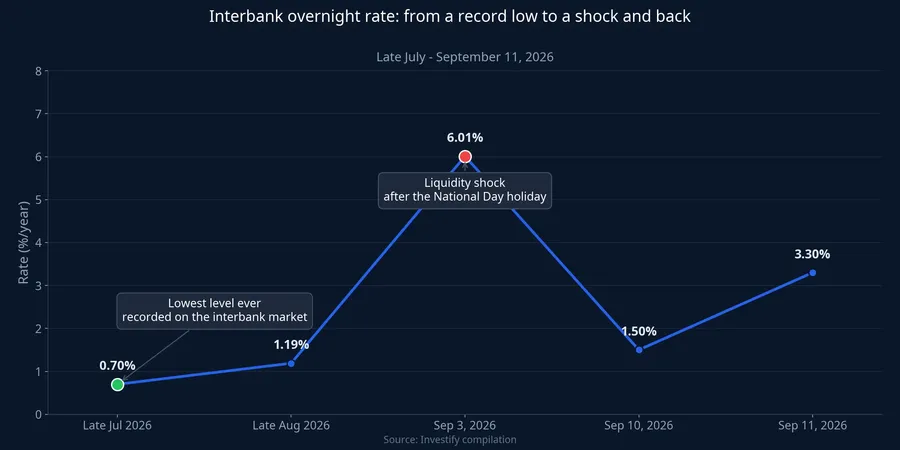
At the end of July 2026, the rate banks charge each other for overnight loans briefly fell to just 0.7% a year, the lowest level ever recorded on Vietnam's interbank market.Vietstock That number reflected a temporary state: banks were holding more cash than they needed for the next few days, so they were willing to lend to each other almost for free. That surplus persisted through the end of August, when the overnight rate still sat at 1.19% a year.Người Quan Sát
A shock after the National Day holiday
Right after Vietnam's National Day holiday, the overnight rate jumped to 6.01% a year on September 3, up more than 4.8 percentage points in a single session.Người Quan Sát The mechanics behind it are mundane: a long holiday backs up payment flows across the economy, and when the system reopens, many banks need cash for the same few days at once. When everyone borrows the same morning, the price of borrowing spikes.

The scale of trading shows the pressure was real: overnight trading volume that week reached roughly VND 898,820 billion, while one-week volume topped VND 1.114 quadrillion. Together, the two tenors exceeded VND 2 quadrillion.Thời báo Tài chính Việt Nam What stands out is that the shock hit only the shortest tenor. At the same time, the one-week rate fell from 7.33% to 6.34% a year and the one-month rate fell from 6.79% to 6.49% a year.Người Quan Sát A jump confined to the very bottom of the tenor curve is a sign of payment-timing mismatch, not a sign the system is short of capital.
The SBV drains cash, and rates keep falling
During the week of September 7-11, the State Bank of Vietnam (SBV) offered VND 66,000 billion through its secured lending channel across 7-, 14-, 35- and 91-day tenors at 4.5% a year. Only VND 47,259 billion was taken up, while VND 80,259 billion matured, for a net drain of nearly VND 33,000 billion from the system, with no accompanying bill auction.Người Quan Sát
Conventional logic says draining cash from the system should push its price up. The opposite happened: the overnight rate fell steadily through the week, closing at 1.5% a year on September 10.Vietstock The paradox resolves once you look at what "net drain" actually measures: it isn't a monetary-tightening decision, just the arithmetic difference between capital maturing and new capital lent in the same session. Banks didn't roll over the full amount because they didn't need to, and Markettimes reported no clear sign of a liquidity shortfall during this period.Markettimes
The rate curve splits in two directions
At the close of September 11 (published September 14, since the SBV releases interbank data with a one-session lag), the overnight VND rate jumped back up to 3.3% a year, up 1.8 percentage points from the prior session.Người Quan Sát Every other tenor moved the opposite way: one week fell to 4.05%, two weeks to 4.2%, one month to 5.5% a year. The shortest tenor rose while every longer tenor fell, meaning the market was absorbing a single night's cash mismatch, not repricing the broader rate outlook. If the market believed rates were headed up across the board, the one-month tenor would have moved too; instead it stayed exactly where it was on September 10, at 5.5%.
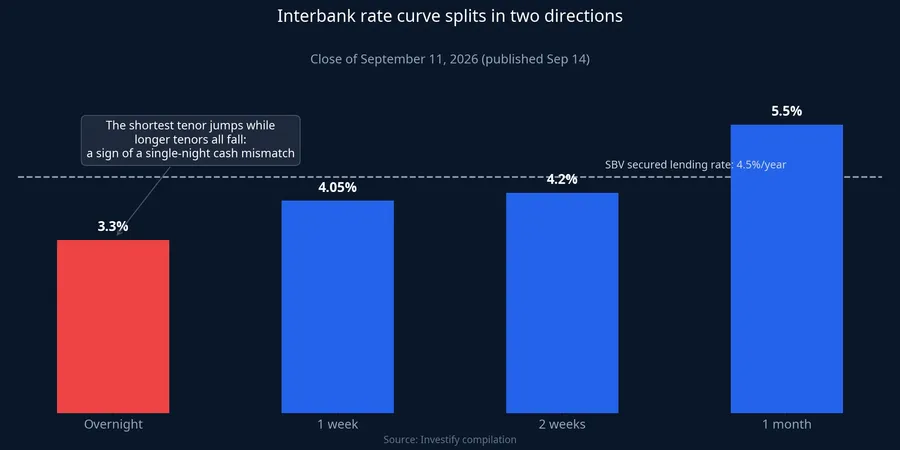
On September 14, the SBV offered a combined VND 7,255 billion across four tenors, all of it taken up at 4.5% a year, while VND 32,139 billion matured. The result was a net drain of VND 24,884 billion, leaving the outstanding balance on the secured lending channel at VND 250,147 billion.Người Quan Sát The system got back less than a quarter of what it owed, forcing banks to cover the rest on the interbank market themselves. Even so, the most recent overnight rate is 3.3% a year, well below the 4.5% the SBV charges on its secured lending facility. If the system were genuinely short of cash, banks would be queuing at the 4.5% window and bidding each other above it. That hasn't happened.
The exchange rate backs up this reading. USD/VND closed September 11 at 25,933.50, down 0.53% from 26,072.50 on September 1. A banking system genuinely starved of domestic currency is unlikely to see its currency strengthen at the same time.
The other price of money only moves one way

While the overnight rate traveled from 0.7% to 6.01% and back to 3.3% in six weeks, household deposit rates barely reacted. SBV data shows average deposit rates for the 6-12 month tenor have risen steadily since October 2025, reaching roughly 7.8% a year.Vietstock Negotiated rates in practice run even higher: 6-month terms at some banks range from 8.5% to 9.3%, 12-month terms on deposits above VND 1 billion have topped 9.7%, and a few smaller banks pay close to 10% a year on deposits above VND 10 billion locked in without early withdrawal.
These two prices are answering different questions. The overnight rate answers whether the system has enough cash for tomorrow. The savings rate answers whether banks have enough capital for the year ahead, and that second answer sits inside a very large gap.
The VND 940,000 billion gap is still there
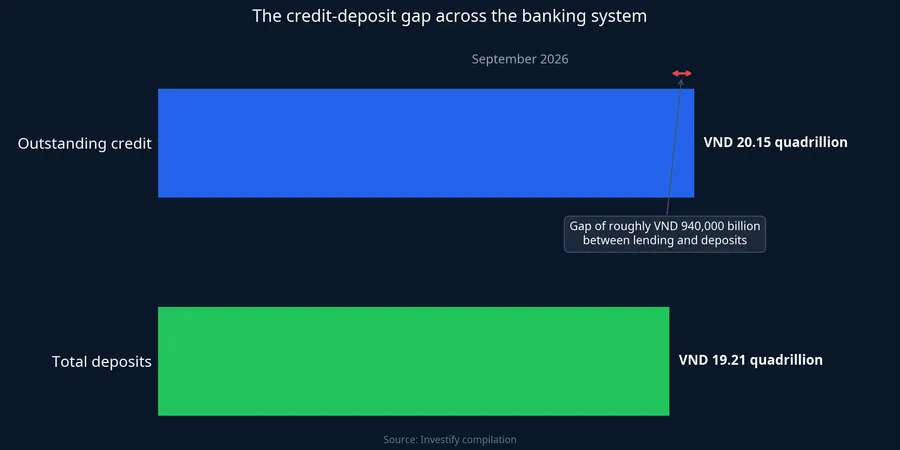
Outstanding credit currently stands at roughly VND 20.15 quadrillion, while total deposits are roughly VND 19.21 quadrillion. Deposits still trail lending by about VND 940,000 billion.Vietstock As long as that gap exists, banks have to keep paying up to hold onto depositors, no matter how cheap overnight funding gets.
There is a new, genuinely positive signal here. As of August 22, VND-denominated deposit growth reached 8.77% year-to-date, outpacing credit growth of 8.38%, the first time deposits have outrun credit after a long stretch of the opposite.Vietstock But Nguyễn Minh Tuấn, CEO of AFA Capital, cautions that no one should expect deposit rates to fall just because one month of deposit growth outpaced credit, given how large the economy's capital needs remain.AFA Capital Credit growth itself has climbed from around 1.5% at the start of the year to 8.36% by August.
How to read this
For anyone weighing fixed-income channels, the current landscape sends a fairly clear message. The yield an issuer has to pay for long-term capital is anchored to the banking system's own funding cost, not to the overnight rate. With 12-month deposits being negotiated around 9.7% a year, any fixed-income product that wants to attract capital has to price its yield competitively against that number. As long as the credit-deposit gap stays near VND 940,000 billion, savers holding idle cash keep the upper hand in negotiations, the reverse of 2024, when deposit rates sat in a low range.
Borrowers or anyone using financial leverage, on the other hand, should not read a 3.3% overnight rate as a sign that funding costs are about to fall. Average lending rates still hover around 10.5% a year, anchored to funding costs rather than the interbank market.
The number worth putting on a calendar is the monthly gap between deposit growth and credit growth, published alongside monetary data early each month. If deposit growth keeps outpacing credit for another two to three months, the VND 940,000 billion gap will start to genuinely narrow, giving deposit rates room to ease. If credit accelerates again in the fourth quarter as it typically does, the race for deposits is more likely to run into 2027.