


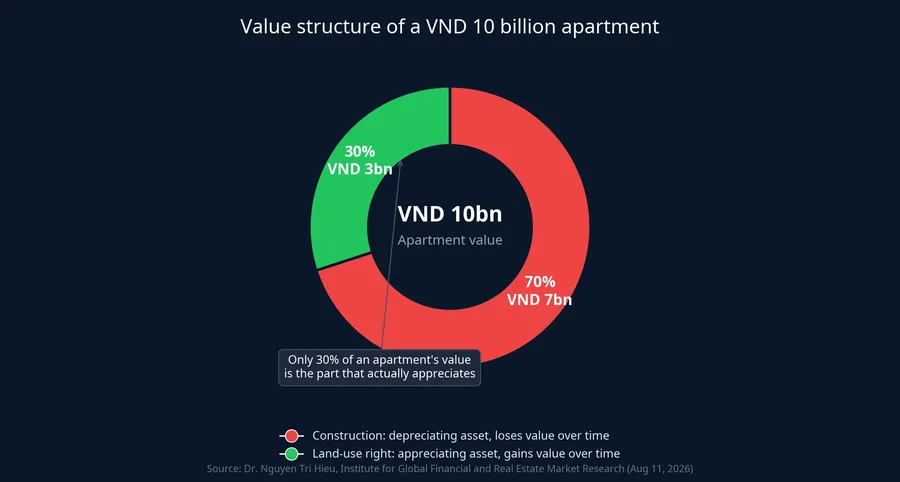
Of every VND 10 billion paid for an apartment, only about VND 3 billion is tied to the land-use right. The remaining VND 7 billion is the structure, and structures age. That is how Dr. Nguyen Tri Hieu, Director of the Institute for Global Financial and Real Estate Market Research, split an apartment into two components in an analysis published on August 11, 2026: the land portion is an appreciating asset, the construction portion is a depreciating one.Soha For a land plot, that split does not exist, because almost the entire price is land.
This seemingly small distinction sits at the center of Vietnam's liveliest real estate legal debate this year, and it answers a very specific question: if your goal is to preserve asset value over ten or twenty years, where exactly do these two property types diverge.
A Deleted Phrase, an Unchanged Mechanism
On July 28, 2026, the Party Central Committee issued Resolution 21-NQ/TW on land policy, directing that newly built apartments have their usage term tied to the building's structural lifespan, while affirming that land for commercial housing sold to buyers remains granted on a stable, long-term basis.Dân Việt Its legal status needs to be clear: this is a Party resolution directing amendments to the 2024 Land Law, not a document with direct legal effect on citizens yet.
The market reacted more forcefully than warranted, to the point that news outlets had to warn against brokers pitching "buy now before long-term ownership disappears."Dân Việt The Vietnam Association of Realtors had to step in, urging the public not to treat the structural lifespan as a countdown clock terminating property rights.MarketTimes Then the tide turned: the latest draft of the amended Housing Law, released in early September, dropped the term "time-limited apartment" from its definitions section, after National Assembly deputies worried the public would misread it as ownership expiring with the building's age, though it kept the technical wording: usage term is determined in the design records, counted from when the structure enters operation.Thanh Niên
The underlying mechanism did not change along with the deleted phrase. Article 58 of the 2023 Housing Law, in effect since January 1, 2025, already set apartment usage terms based on design records: once the term ends, authorities conduct an inspection; if the structure remains safe, residents stay and an extension is announced; if not, it goes into demolition and rebuilding. The recent controversy was essentially about naming, while concrete keeps aging at exactly its own pace regardless of what the law calls it.

What a Decade of Prices Actually Shows
From 2015 to 2025 in central Ho Chi Minh City, land plot prices rose 384%, from VND 25 million to VND 121 million per sqm, while apartments in the same area rose 197%, from VND 31 million to VND 92 million per sqm. Detached houses rose 168% and street-front houses rose 134%.Nhà Đầu Tư
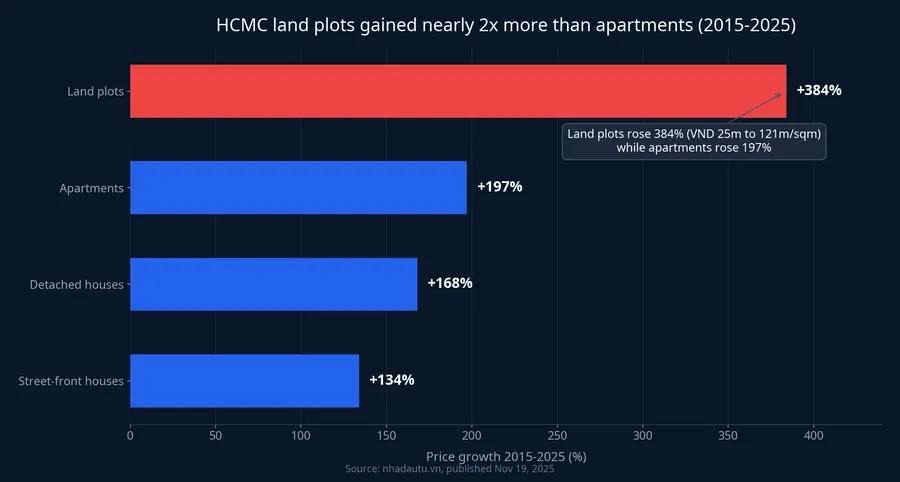
Converted to compound annual growth, land plots ran at roughly 17.1% a year versus roughly 11.5% for apartments. VND 1 billion placed in central land in 2015 would, based on 2025 per-sqm prices, equal roughly VND 4.84 billion; the same amount in an apartment would equal roughly VND 2.97 billion. The nearly VND 1.9 billion gap traces back to a single variable: land's share of the asset. The math excludes rental income an apartment generates over a decade, and it excludes liquidity cost: an apartment can sell in a few weeks, while a large land plot typically takes one to three months.
The trend has not run in one direction. From 2023 to 2025, Hanoi apartments surged to the lead, up 84% in just two years, largely because new supply shifted almost entirely into the mid-to-premium segment, pushing the average price up faster than any individual apartment actually appreciated. That momentum is now cooling: CBRE forecasts Hanoi apartment prices will grow only 3-5% a year going forward, down from 24-25% annual growth in the prior stretch.Người Quan Sát
What Real Depreciation Looks Like
Apartments do not lose value evenly with age; they lose value based on the balance between a deteriorating structure and an appreciating location. In the 25-30 year bracket, the discount is clearest: older units trade at only about 50-70% of new-build prices in the same area.FireAnt On the other hand, the old Trung Tu collective housing block in Hanoi, 40-60 years old, still lists above VND 120 million per sqm despite visible decay, because land value there overwhelms structural value.FireAnt Average locations have no such shield: older budget apartments in Linh Dam, Ngoc Hoi, and Dinh Cong have dropped 5-15% from late-2025 levels.VietStock
Land ratio by location explains this entire divergence. Nguyen Quoc Hiep, Chairman of the Vietnam Association of Construction Contractors and Chairman of GP.Invest, estimates land cost makes up roughly 25-30% of a low-rise home's build cost but only 12-16% of an apartment's.VietStock His figure differs from Dr. Nguyen Tri Hieu's because one measures a developer's input cost and the other measures the asset value a buyer holds, but both converge on the same point: land is always the minority share of an apartment.
How the Land Portion Actually Converts to Cash
This is where the argument "land is still long-term so the asset doesn't disappear" meets a practical test. An owner's land-use right only converts to cash through exactly one channel: a redevelopment project. And that channel is narrow. The 2023 Housing Law requires at least 70% of owners to join the planning process and 75% to approve demolition.FireAnt
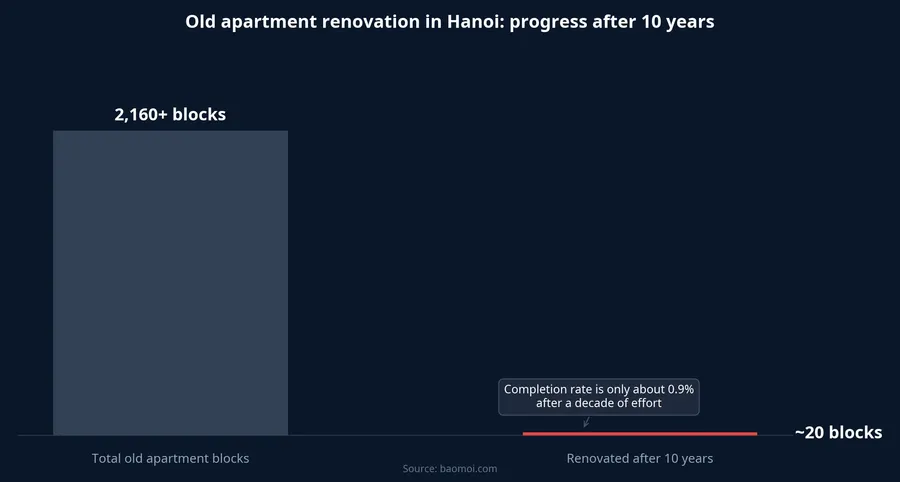
Years of results speak for themselves. Hanoi has more than 2,160 old apartment blocks, but after 10 years renovation progress has not reached 10%, with nearly 20 blocks renovated.Báo Mới Ho Chi Minh City has 474 old apartment blocks, and has only relocated residents from 9 of 16 level-D blocks, the most dangerous category.Người Quan Sát
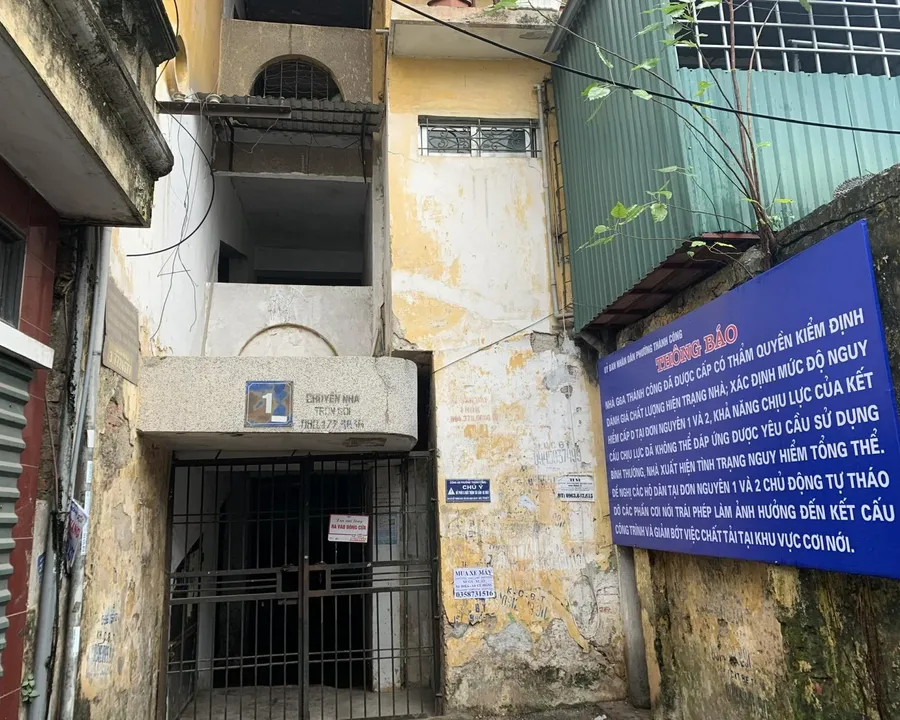
The bottleneck sits in the compensation ratio: residents expect one level, developers can only accept a lower one, and projects stall. Policy is trying to loosen this. The National Assembly authorized Hanoi to force demolition once more than 75% of owners consent, effective December 12, 2025; Hanoi's People's Council then lowered the consensus threshold to 51%, while capping the compensation coefficient (K) at no more than twice the legal floor area.MarketTimes The city also offers temporary housing support of up to VND 15 million per household per month.FireAnt These mechanisms have been running for less than a year; no project has yet fully completed to prove their effectiveness.
Choosing by Investment Goal
Placed side by side on the same criteria, the choice framework becomes fairly clear. If the goal is pure value preservation over a horizon beyond ten years, and you can accept capital sitting idle for one to three months each time you need to exit, land plots or street-front houses tied to emerging infrastructure still capture the full upside of rising land prices. In exchange, this asset type generates no cash flow and requires large equity, typically VND 1.5 to 3 billion or more, plus a 2% transfer tax on each resale.
If the goal is actual residence with rental income and the ability to sell quickly when needed, apartments serve far better, provided you correctly read the land ratio by location: central apartments capture the upside from rising land prices, while suburban apartments retain almost nothing but structural value, which only declines over time.
One data point worth placing alongside the rest: 53% of brokers rate apartments as the best-performing segment over the next six months, well ahead of detached houses at 25% and land plots at 11%, per a Q2 2026 survey by Batdongsan.com.vn. In the same survey, 60% of apartment brokers reported declining transaction volume.MarketTimes Expectations and liquidity are out of sync, and that gap is usually resolved through price.
On the lease-term worry specifically, HoREA has proposed a 99-year maximum usage cap for newly built apartments, modeled on Singapore's HDB scheme, paired with a no-retroactivity principle for units that already hold long-term land-use certificates.Tiền Phong This remains a draft-consultation proposal, not an official regulation.
Signals Worth Watching
The amended Housing Law draft submitted to the National Assembly will reveal the final mechanism. Two provisions worth reading first are how the structural usage term gets determined, and the owner's choice at demolition time between contributing funds for on-site resettlement or accepting compensation for the land-use right's value.
But the weightiest evidence will come from construction sites, not legal text. Among the nine old-apartment renovation projects Hanoi has targeted for groundbreaking in 2026, the number that actually finish and are handed over will be the proof of whether an apartment owner's land-use right can actually convert into real value.
Until that evidence exists, the most reasonable framework is to treat the land portion of an apartment as a genuine but illiquid property right, while the structure keeps depreciating right on schedule. Investors prioritizing long-term value preservation may lean toward land plots or street-front houses in locations with emerging infrastructure. Those who need actual residence and cash flow should choose central apartments, provided the land ratio at that location is large enough to offset the depreciating structure.