
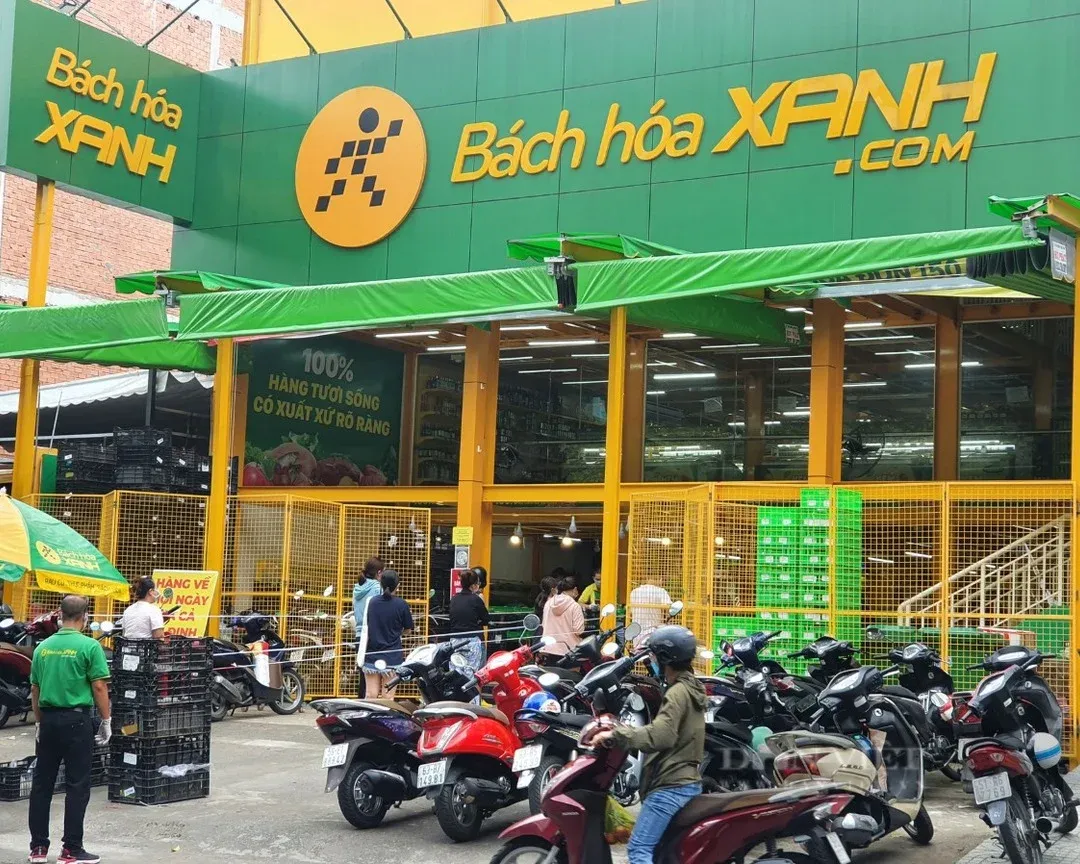

In August 2026, Vietnamese grocery chain Bach Hoa Xanh posted approximately VND 6.2 trillion in monthly revenue, up 55% year-on-year and 11% from the previous month.CafeF It was the first month the chain crossed the VND 6 trillion mark since parent company The Gioi Di Dong (Mobile World Investment Corporation, MWG) launched it in late 2015. On average, the system generated VND 200 billion in daily revenue that month.
Taken alone, that number is impressive but tells you little about the chain's underlying health. To find out, you have to split it into two pieces: the part that comes from adding stores, and the part that comes from each store selling more. That's the breakdown MWG's earnings release doesn't hand you on a plate.
234 New Supermarkets in One Month
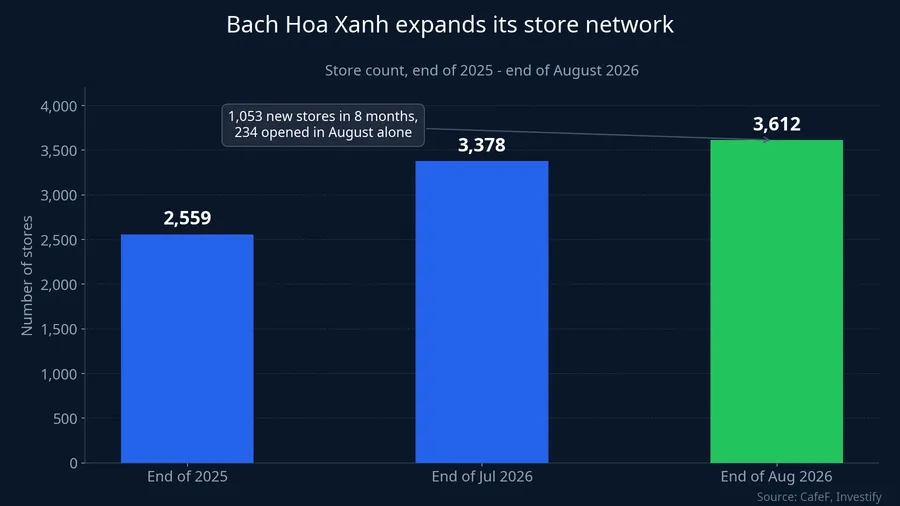
August was also the month Bach Hoa Xanh opened 234 new outlets, equivalent to 7.5 stores a day, or roughly one grand opening every three hours.CafeF That pace is nearly double the rate from earlier in the year.
The network expanded fast as a result. At the end of July, the chain had 3,378 stores; by the end of August, 3,612.CafeF Over eight months, Bach Hoa Xanh added 1,053 stores, hitting its full-year 2026 target of 1,000 new stores with a third of the year still to go. The chain started the year with 2,559 outlets, meaning nearly 29% of its current network opened in the past nine months.
For a retail chain, that kind of expansion rate typically drags average productivity down, because new stores need time for customers to become regulars and for sales to catch up with established locations in the same area. That's why dividing revenue by store count is a more reliable signal than the 55% growth figure on its own.
What the Revenue-Per-Store Math Shows
Divide monthly revenue by the number of operating stores, and you get the metric that decides whether the chain makes money or not: average daily revenue per store. Per MWG's own disclosures, this figure for Bach Hoa Xanh reached VND 53.9 million a day in Q1 2026 and VND 55.4 million a day in Q2 2026.CafeF For August, dividing the two newly released figures (VND 6.2 trillion in revenue, an average network of approximately 3,495 stores) works out to roughly VND 57 million a day.
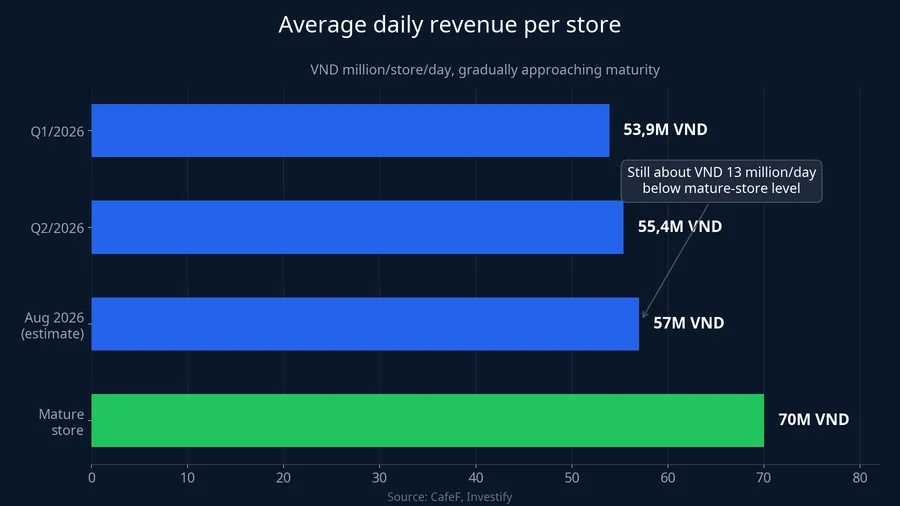
This is the part worth pausing on. Bach Hoa Xanh crammed 421 new stores into the system in July and August alone, expanding the network more than 13% in two months, yet average productivity still ticked up rather than getting diluted. The chain's mature stores are currently selling approximately VND 70 million a day, well above the system-wide average.CafeF With nearly 30% of the network still immature and the overall average still climbing, the math only works if the older stores are genuinely selling more than they did a year ago.
In other words, the 55% jump is mostly driven by new stores, but not entirely. The smaller — and, from a profit standpoint, more durable — piece comes from the outlets that were already open.
Why the Jump Landed in August
Several explanations are plausible at once, and they aren't mutually exclusive. The available data doesn't let us precisely separate how much each one contributed.
The first is a broader pickup in consumer spending. Nationwide retail sales of goods and consumer services rose 13.3% in nominal terms over the first eight months of the year, or 7.6% excluding price effects.VietnamPlus That's far below Bach Hoa Xanh's 32% growth over the same period, so the general consumption wave only explains part of the jump.
The second is a low base effect. In August 2025, the chain had roughly 2,300 outlets, less than two-thirds of its current size, which makes the year-on-year percentage easier to inflate.
The third — and the one most cited in analyst reports — is a policy window opening for modern retail. SSI Research argues the grocery segment is being helped by tighter tax enforcement on individual household businesses, the closure of informal markets that don't meet regulations in Hanoi and Ho Chi Minh City, and stricter food traceability requirements.CafeF
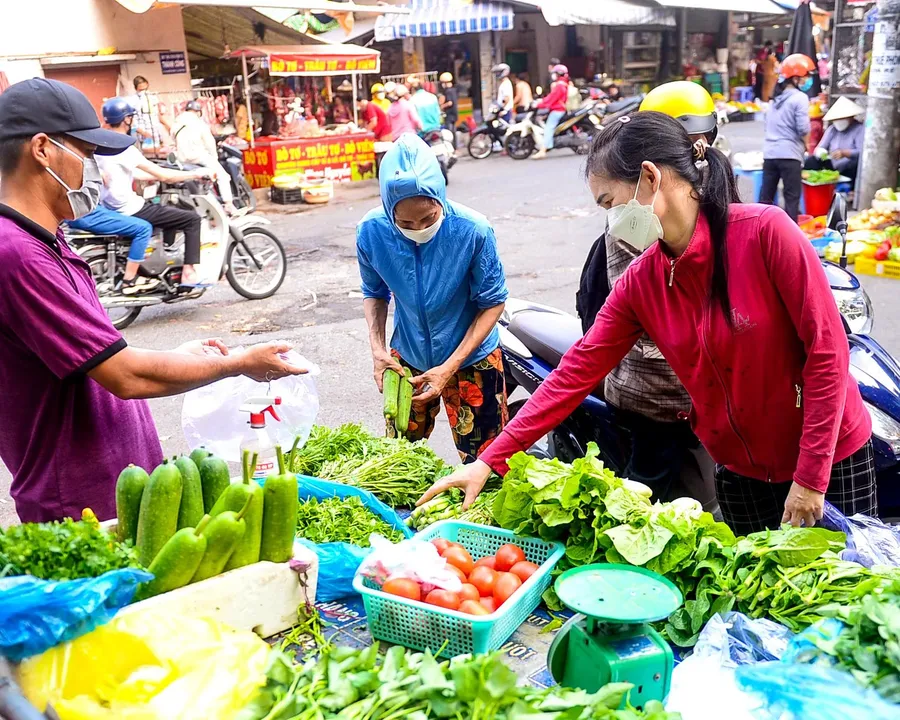
Together, these changes push up compliance costs for market stalls and small grocers while freeing up exactly the kind of real estate supermarket chains want to lease. Modern retail still accounts for only about 14% of Vietnam's food retail market, leaving plenty of room for the shift to continue. What can be said with confidence, even without splitting out each factor's exact contribution, is that Bach Hoa Xanh's 32% growth is nearly two and a half times the industry's 13.3%, measured the same way. That gap means the chain is taking market share, not just riding the broader consumption wave.
From Revenue to Profit
This is the part that actually matters for MWG's stock valuation. In the first half of 2026, Bach Hoa Xanh earned approximately VND 910 billion in profit, more than its entire 2025 full-year profit.CafeF The chain's accumulated losses shrank to approximately VND 7 trillion as a result.
The mechanism here is operating leverage: the chain passed breakeven back in Q2 2024, so incremental revenue at existing stores flows almost straight through to profit, while logistics and system costs get spread across more outlets. Vu Dang Linh, CEO of Mobile World Investment Corporation (MWG), said the first-half results put Bach Hoa Xanh on track to hit its full-year 2026 profit target of VND 1.8 trillion ahead of schedule, and that management is confident it can clear the chain's accumulated losses within two to three years to prepare for an IPO and listing.
It's worth keeping the proportions straight so as not to overstate Bach Hoa Xanh's role in MWG's overall picture. The chain's eight-month revenue reached VND 40.1 trillion out of MWG's total VND 129.431 trillion, or 31%.CafeF But its first-half profit of VND 910 billion is only about 15% of MWG's consolidated after-tax profit for the same period. Grocery retail margins are far thinner than electronics, so on a profit basis, MWG's main engine remains the Dien May Xanh electronics chain, which posted VND 86.8 trillion in eight-month revenue and 30% same-store growth.
On the exchange, MWG shares closed the September 14 session at VND 69,800, down 2.10%, roughly 8% below their late-August levels.
Stacked Against WinCommerce
Compared with WinCommerce, Bach Hoa Xanh operates roughly 1,400 fewer outlets yet generates higher revenue. The gap comes down to spending per store: in Q2 2026, each Bach Hoa Xanh supermarket sold VND 55.4 million a day versus VND 25.5 million a day at WinCommerce.CafeF A higher share of fresh food is the most commonly cited reason: perishables bring customers back daily instead of a few times a week.
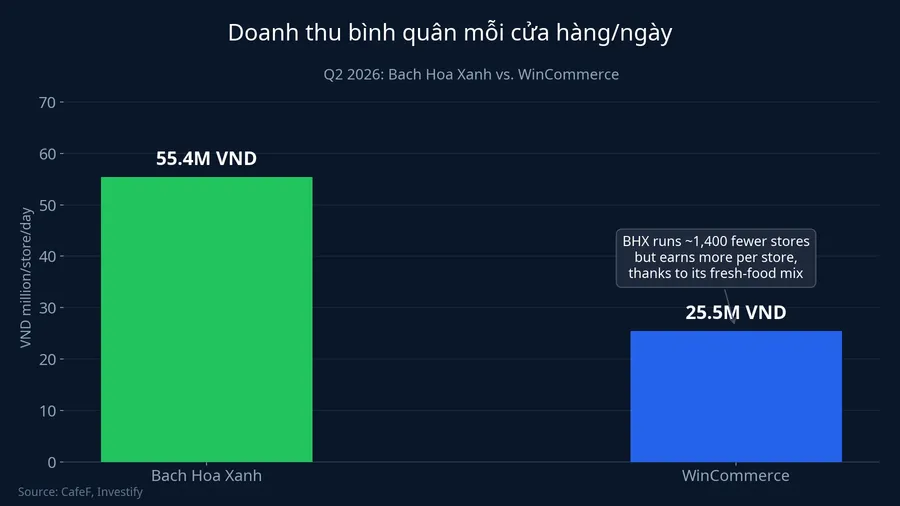
That advantage may not hold once the chain pushes into the north. Northern Vietnam is WinCommerce's home turf, shopping habits differ from the south, and new stores there could need longer to reach target productivity.
The Number Worth Watching Over the Next Two Months
In its eight-month results, MWG disclosed same-store sales growth of 30% for Dien May Xanh and 14% for EraBlue, but gave no equivalent figure for Bach Hoa Xanh. Investors who want to know whether existing stores are genuinely selling more have to reconstruct it themselves, by dividing revenue by store count: the same exercise this article just walked through.
At an opening pace of 7.5 stores a day, average revenue per store is the earliest signal of growth quality. The current evidence isn't enough to draw a firm conclusion either way. If the climb from VND 53.9 million to VND 55.4 million to roughly VND 57 million a day holds through September and October, as the recent wave of new stores comes fully online, then the chain is genuinely expanding and lifting productivity at the same time, and the VND 1.8 trillion profit target rests on solid ground. If that metric reverses instead, the revenue record is being bought by opening more doors, and profit will arrive later than planned. September and October earnings data will be the clearest answer.