


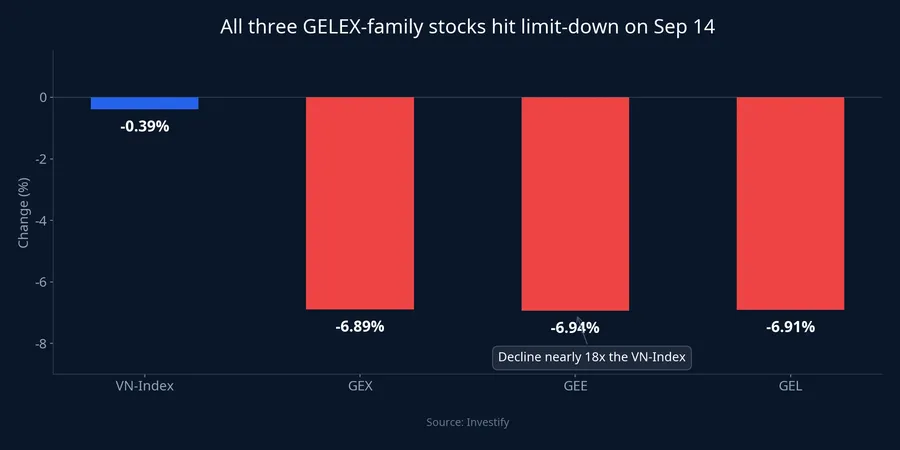
On September 14, 2026, the VN-Index closed at 1,788.23 points, down 6.98 points, or 0.39%.Người Quan Sát A mild decline, mild enough that many investors closed their trading apps without remembering much about the session. But behind that number, the Ho Chi Minh City exchange had 9 stocks hit their daily floor, and three of them shared the same name: GEX, GEE, and GEL, three companies under the same GELEX group.

GEX (GELEX Group) closed at VND 22,300, down 6.89%. GEE (GELEX Electric) closed at VND 57,700, down 6.94%. GEL (GELEX Infrastructure) closed at VND 25,600, down 6.91%. The slightly different percentages aren't a sign of different selling intensity. HOSE's floor is a flat 7%, but the actual floor price has to round to each stock's tick size band. All three effectively hit the same wall.
A sell-off with no bad news attached
No disclosure from the GELEX group on September 14 explains this move. No bad earnings, no personnel change, no major shareholder or insider trade in September. None of the three stocks were under margin restriction or a warning status going into the session. The group's most recent news was actually favorable to shareholders: GEE announced a 5% cash dividend advance for 2026, with the ex-dividend date set for September 17. Holding 75.95% of GEE, GEX expects to collect more than VND 240 billion from that payout.Người Quan Sát
The real anomaly of the session was volume. GEX matched 24.53 million shares, roughly 2.1 times its 20-session average. GEE and GEL also traded at roughly double their averages. Double the volume paired with a limit-down close is the signature of active selling, not a thin-market drift. And the pressure wasn't new: in the prior session on September 11, GEX had already fallen 4.39%, GEE 2.97%, and GEL 2.14%. From its May 19 peak of VND 36,200, GEX has now lost 38.4% of its value. September 14 was an acceleration of a selling trend that had been running for weeks, not a sudden shock.
An ownership structure that turns three stocks into one
This is the part that matters most for anyone holding one of the three. GEX is the parent, holding 75.95% of GEE's charter capital and 70.21% of GEL's, both consolidated into GEX's financial statements.dulieu.nguoiquansat.vn Below GEE sits a chain of electrical equipment manufacturers — Vietnam Electric Cable, THI Electrical Equipment, Hanoi Electromechanical Manufacturing — each majority-owned above 76%. Below GEL sits an infrastructure holding structure, with a 50.21% stake in Viglacera Corporation as its largest contributor.
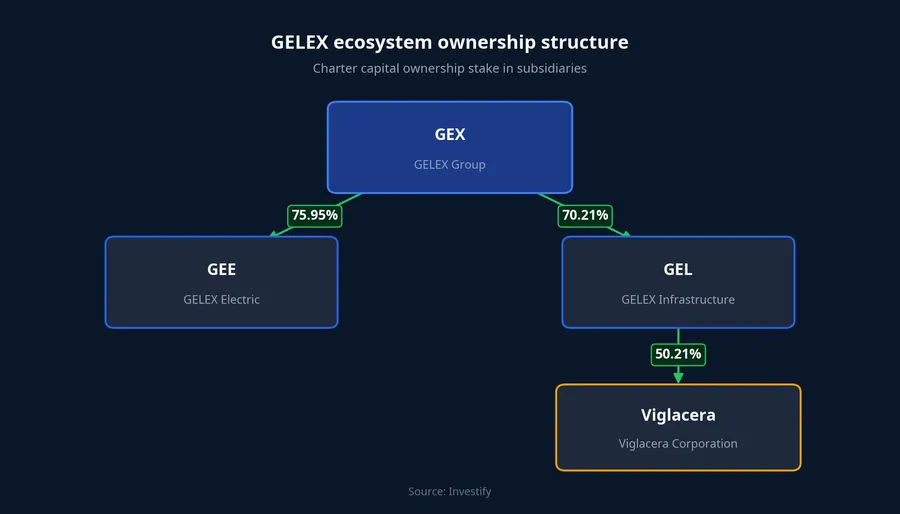
From a portfolio standpoint, buying all three of GEX, GEE, and GEL isn't three independent bets: it's three slices at three different layers of the same underlying asset. When money flows out of the GELEX story, all three slices thin out in the same session. September 14 was living proof: this one group alone accounted for a third of all limit-down stocks on the entire HOSE exchange.
On the flip side, that layered structure also erodes how much of the reported profit actually reaches each stock's own shareholders. In H1 2026, GEX posted revenue of VND 25,201.7 billion, up 39.7%, with consolidated net profit of VND 1,934.6 billion. But the portion attributable to parent shareholders was only VND 785.7 billion, down 11.8% year-on-year. The gap went to minority shareholders at subsidiaries GEX doesn't fully own.
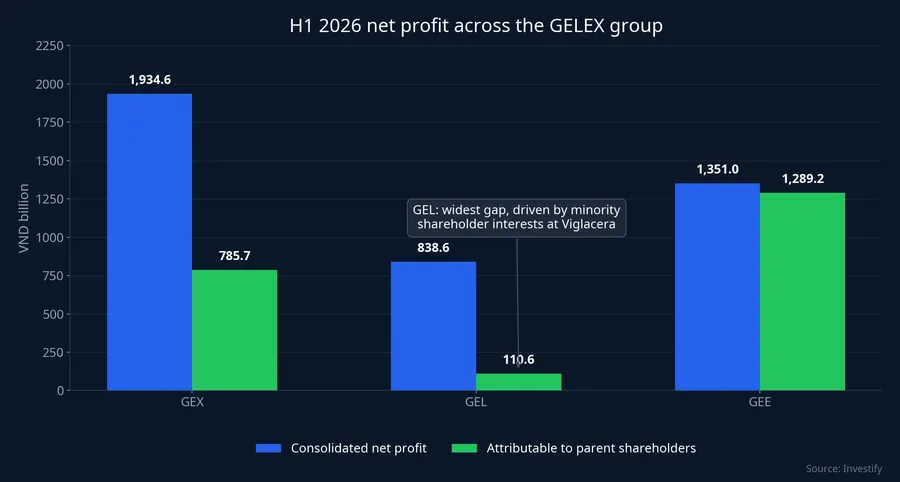
At GEL, the gap is even wider: revenue of VND 8,317.7 billion and consolidated net profit of VND 838.6 billion, but only VND 110.6 billion attributable to parent shareholders, down 73.0% year-on-year, because GEL owns just 50.21% of Viglacera. GEL's ROE is therefore only 3.7%, the lowest in the group. GEE is the positive outlier: profit attributable to parent shareholders reached VND 1,289.2 billion, up 31.6%, with a group-high ROE of 9.0%, because GEE's manufacturing subsidiaries are all majority-owned above 76%, so profit isn't diluted much on the way up.
The market is pricing the parent below its own subsidiaries
After the September 14 session, GEX's market cap stood at roughly VND 20,100 billion, lower than both GEE (VND 21,100 billion) and GEL (VND 22,800 billion), the two companies it controls.
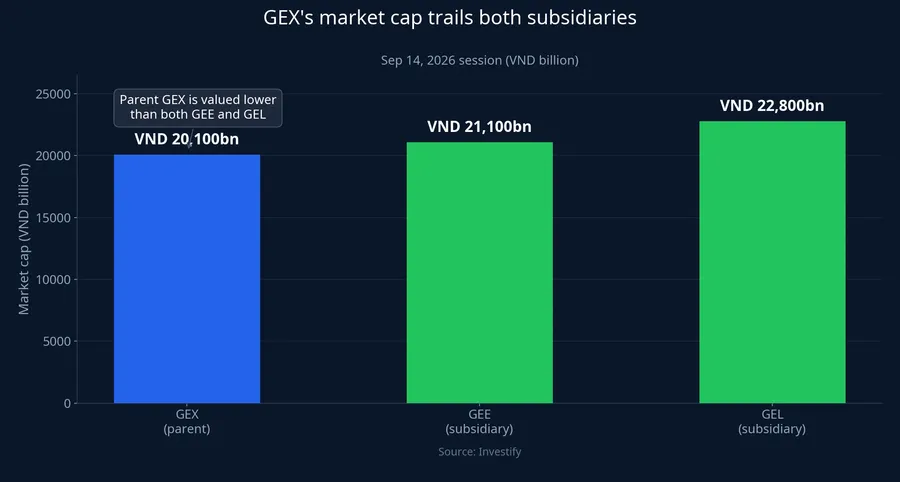
Counting just the two listed stakes, 75.95% of GEE and 70.21% of GEL add up to roughly VND 32,000 billion, about 37% more than GEX's own market cap. That math doesn't even include GEX's other holdings. The parent-company discount shows up clearly in P/B ratios: GEX trades at just 0.82x, versus 4.00x for GEE and 1.27x for GEL. A holding-company discount is normal in any market, since parent shareholders only receive profit after the minority share is carved out, and the parent also carries group-level overhead and debt. But 37% is a large gap, and it cuts both ways: it raises the question of whether the richer valuations at the subsidiary level are actually backed by real earnings. At GEL, the P/E on consolidated profit already sits at 92.0x. Recalculated on the profit that actually reaches parent shareholders, it would be far higher still.
Which explanation best fits September 14
At least three explanations are plausible here, and none should carry the whole blame alone. The first is a broad market pullback: the VN-Index fell 1.86% on September 11 and kept drifting lower on September 14. But the index itself only fell 0.39% while this group hit the floor, so a market-wide mood can't be the primary driver.
The second is prolonged profit-taking from brokerage proprietary trading desks. On August 5 alone, that block net-sold nearly VND 285 billion worth of GEE, part of a run of 5 unusually large net-selling sessions that pulled roughly VND 1,500 billion out of the stock since late May.Người Quan Sát That's background pressure built up over weeks, not a trigger specific to September 14.
The third, and the one the data supports best, is the resonance between an already-broken price trend and the group's structural correlation. The 5-session Chaikin money flow index through September 11 was negative across all three stocks: -0.528 for GEX, -0.387 for GEE, and -0.344 for GEL. Money had been flowing out for several straight sessions before the floor was hit. Once GEX came under heavy selling, the ownership link pulled sell orders into GEE and GEL almost simultaneously. The doubled volume across all three points to selling triggered at once, not in sequence. Foreign investors weren't the driver here: foreign ownership sits at just 0.75% in GEE, 3.42% in GEL, and 6.29% in GEX, far too thin to produce a synchronized limit-down. This selling came from domestic investors.
What to watch in the coming sessions
GEX's own ownership is fairly concentrated too. Nguyễn Văn Tuấn, Chairman of the Board at GELEX Group (GEX) for the 2026-2031 term, holds 23.63% of the company.MekongASEAN The group's own 2026 plan is cautious: consolidated revenue of VND 44,712 billion, up 13.2%, but pre-tax profit of just VND 3,615 billion, down 21.8% from 2025, pressured by interest expense and the cost of ramping up new projects.
Two numbers worth watching in the next session are GEX's matched volume and its price reaction around VND 22,300. If volume falls back to roughly 10 million shares while the price holds above the September 14 close, the selling has likely been absorbed. If volume stays at double its average while the price keeps drifting lower, the distribution phase isn't over yet. One date worth flagging: September 17, when GEE trades ex-dividend. Its reference price will be adjusted down by VND 500 as required. That's a technical adjustment, not a new sell signal. Mistaking that adjustment for continued selling pressure is an easy error for newer investors to make.
The broader lesson from September 14 isn't really about these three stocks specifically. In any portfolio, counting the number of tickers you hold doesn't tell you how diversified you actually are. What matters is whether those tickers share a parent company, a revenue source, or a valuation story. Three stocks hitting the floor in the same session the benchmark only fell 0.39% is the market answering that question with real money. Q3 earnings and the price reaction around September 17 are the next signals worth watching.