

Early Thursday, September 17 Vietnam time, the U.S. Federal Reserve will announce its rate decision following its September 15-16 meeting. Financial markets are now pricing in nearly a 90% chance the Fed raises rates by 0.25 percentage points, according to the CME FedWatch tool, up from about 70% just a day earlier.CNBCCBS News
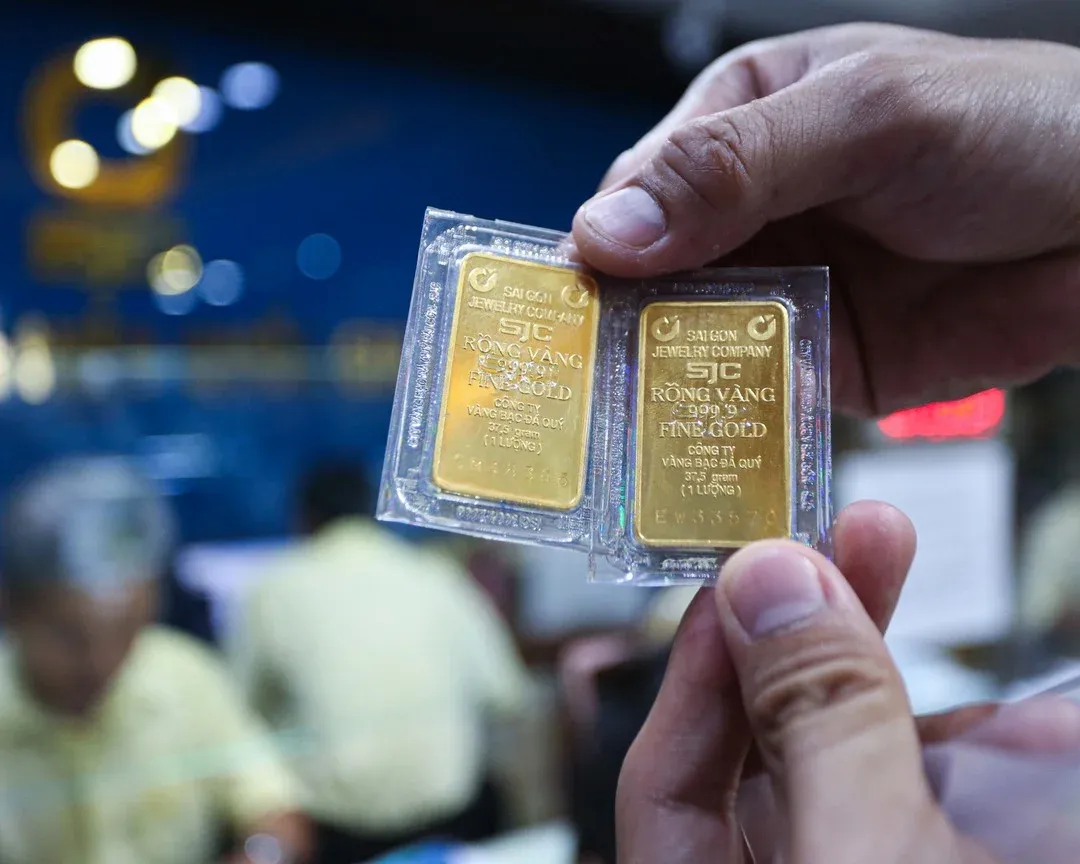
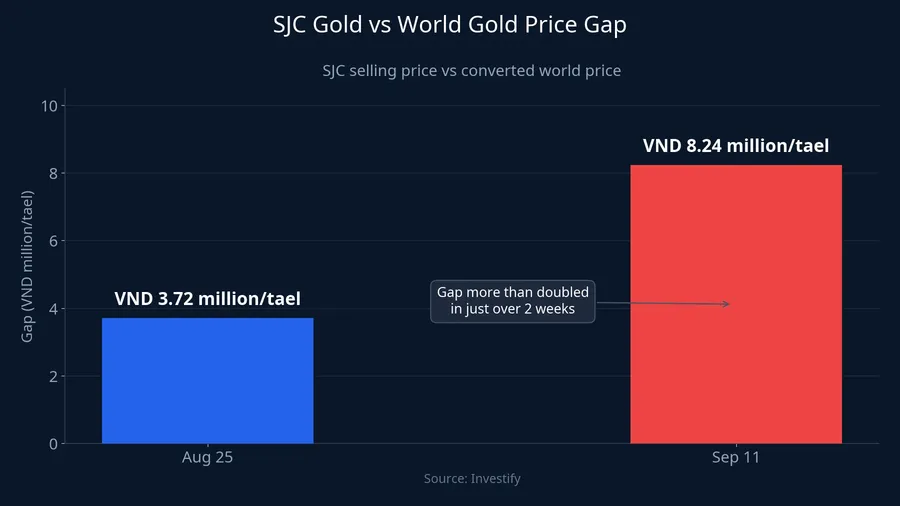
But for Vietnamese gold holders, the more consequential story has already played out. Over three weeks of falling world gold prices driven by tightening expectations, the gap between SJC gold bar selling prices and the converted world price has more than doubled, from VND 3.72 million to VND 8.24 million per tael. That is a concrete, measurable risk, unlike betting on a decision that has not yet been made.
Inflation data pushes Fed odds to near 90%
U.S. consumer price index (CPI) for August rose 0.4% month-on-month and 3.4% year-on-year. Core CPI, which strips out food and energy, rose 0.3%, above the 0.2% forecast. Gasoline prices alone jumped 3.9% and contributed more than a third of the overall basket's increase.CNBC
A day earlier, the August producer price index (PPI) rose 0.4% month-on-month, matching forecasts.CNBC But on a year-over-year basis, PPI jumped to 5.4% from 4.8% in July.Vietstock Crude oil futures climbing back above USD 100 a barrel amid escalating Middle East tensions also added to inflation pressure.Thời báo Ngân hàng U.S. inflation has now run above the Fed's 2% target for 65 straight months, an unusually long stretch in modern U.S. monetary policy history.
Two scenarios and a bet on the FOMC vote count
The scenario markets are pricing in most heavily is the Fed raising rates to a 3.75-4.00% range, its first hike since July 2023. Fed Chair Kevin Warsh's speech at the Jackson Hole symposium in late August was read by analysts as leaning hawkish. "Chairman Warsh's hawkish stance at Jackson Hole implies a high likelihood of a rate hike this month, unless CPI shows a significant surprise decline," Stephen Stanley, Chief U.S. Economist at Santander U.S. Capital Markets, said in a Reuters survey.Thời báo Ngân hàng The CPI report that followed did not decline; it came in hotter than forecast at the core level, reinforcing this scenario.

The other scenario, the Fed holding rates steady, remains the majority forecast among economists. A Reuters survey conducted from September 4-9 of 93 economists found 65, or about 70%, expect rates to stay in the 3.50-3.75% range.Thời báo Ngân hàng But the survey closed on September 9, two days before CPI was released, so the gap between that roughly 70% and the nearly 90% markets are now pricing largely reflects two days of hot inflation data that followed.
The support the market's pricing has not fully absorbed is the FOMC's voting composition: at the July meeting, only 3 of 12 members backed a hike, and ING economists estimate that of the 9 members who favor tightening, only 3 hold a vote this year.Thời báo Ngân hàng U.S. President Donald Trump has also publicly opposed high rates, threatening to halt trade with countries running trade surpluses with the U.S. if the Fed does not cut, adding political pressure on the votes to hold.
Gold moved first, but not evenly
World gold prices fell for three straight weeks, from a peak of USD 4,658.11 per troy ounce on August 25 to USD 4,386.71 on September 11, a decline of 5.83%. SJC gold bars fell much more slowly, from a peak of VND 150.6 million per tael on August 25 to VND 146.0 million on September 12, down just 3.06%.
That gap in speed is what matters most for Vietnamese gold buyers. Converting the world price to VND at the September 11 interbank rate of VND 25,933.5/USD, one tael of world gold was worth about VND 137.16 million, while SJC sold at VND 145.4 million that same session, a gap of VND 8.24 million, or 6.0%. On August 25, that same gap was just VND 3.72 million, or 2.5%. Over three weeks of falling world gold, the premium Vietnamese buyers pay over the international price has more than doubled.
There is also the buy-sell spread on SJC gold bars, VND 3.0 million per tael as of September 12 (VND 143.0 million buy versus VND 146.0 million sell). Anyone who buys today and sells tomorrow loses that spread before the price has a chance to move.
To be clear, gold's three-week decline is not driven by Fed expectations alone. Profit-taking after a very sharp rally in August (from USD 4,334.92 on August 18 to USD 4,658.11 on August 25) and oil above USD 100 a barrel pulling inflation-hedge flows toward energy instead of gold are two other plausible explanations. But the data still leans most heavily toward the Fed explanation: the sharpest single-day drop in the run, 1.84% on September 10, fell on the exact day the PPI report was released. The other two factors amplified the decline but were not the primary driver.
The exchange rate is defying the usual playbook
The common instinct among new investors is that when the Fed hikes, the dollar strengthens and the Vietnamese dong weakens. The past three weeks have not followed that script. The USD/VND rate closed at 25,933.5 on September 11, down 139 dong from August 31 and the lowest level since the start of the year. Compared to 26,300 on January 1, the dong has appreciated 1.39% against the dollar over more than eight months. The international dollar index has also stayed around the 99 level as of September 11, without a sharp move up despite rising tightening expectations.Trading Economics
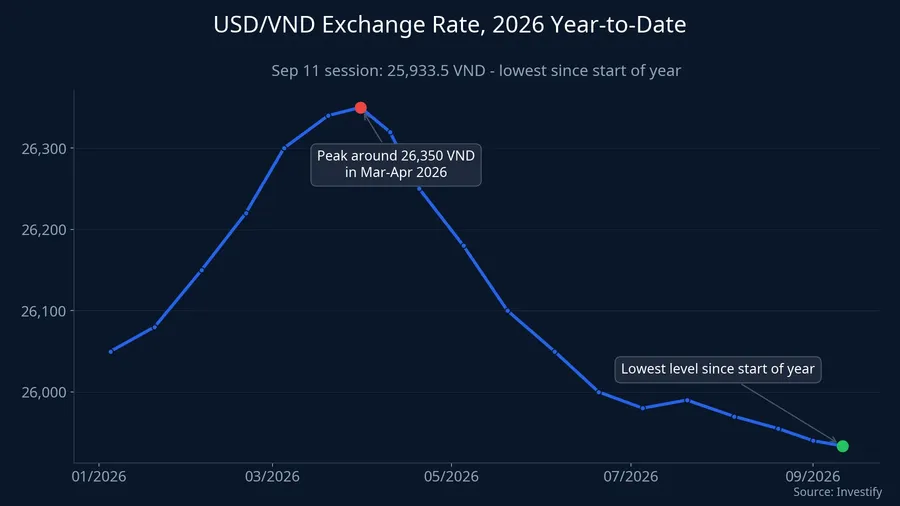
Domestic foreign currency supply, including foreign investment disbursements, remittances, and the trade balance, is the main driver here, not the interest rate gap between the U.S. and Vietnam. The Fed's decision does affect the exchange rate, but over the past three weeks it has not been the dominant factor.
Savings rates untouched by Thursday night
This is the segment least affected in the short term. Deposit rates are set by the State Bank of Vietnam and domestic supply-demand dynamics, not directly linked to the Fed's policy rate. Online rate boards as of September 12 show nine banks offering 7% per year or higher on 12-month terms, led by ACB at 7.8%, a full percentage point above the state-owned banks, a gap driven by domestic deposit competition rather than the Fed.CafeF
An already-signed savings account keeps its rate through maturity regardless of what the Fed decides on the night of September 16. What can change is the rate offered on future terms, and that lag is typically measured in quarters, not days.
Signals worth watching
The bigger picture shows two Fed scenarios still competing at an undecided split: nearly 90% of the market pricing in a hike, but about 70% of economists (as of before CPI) still leaning toward a hold, with the July FOMC vote count skewed dovish. The FOMC statement early on September 17 and Chair Warsh's comments on the Q4 path will be the deciding factor, since markets care about forward guidance almost as much as the rate decision itself on September 16.
For Vietnamese gold buyers specifically, the signal worth watching is not the Fed's decision but the gap between SJC gold selling prices and the converted world price. A narrowing back to the VND 3-4 million range seen in late August would show the domestic market has finished absorbing the Fed-driven move. A continued widening means the premium over the international price is getting heavier, and that is a cost borne by buyers, not by the world price.