
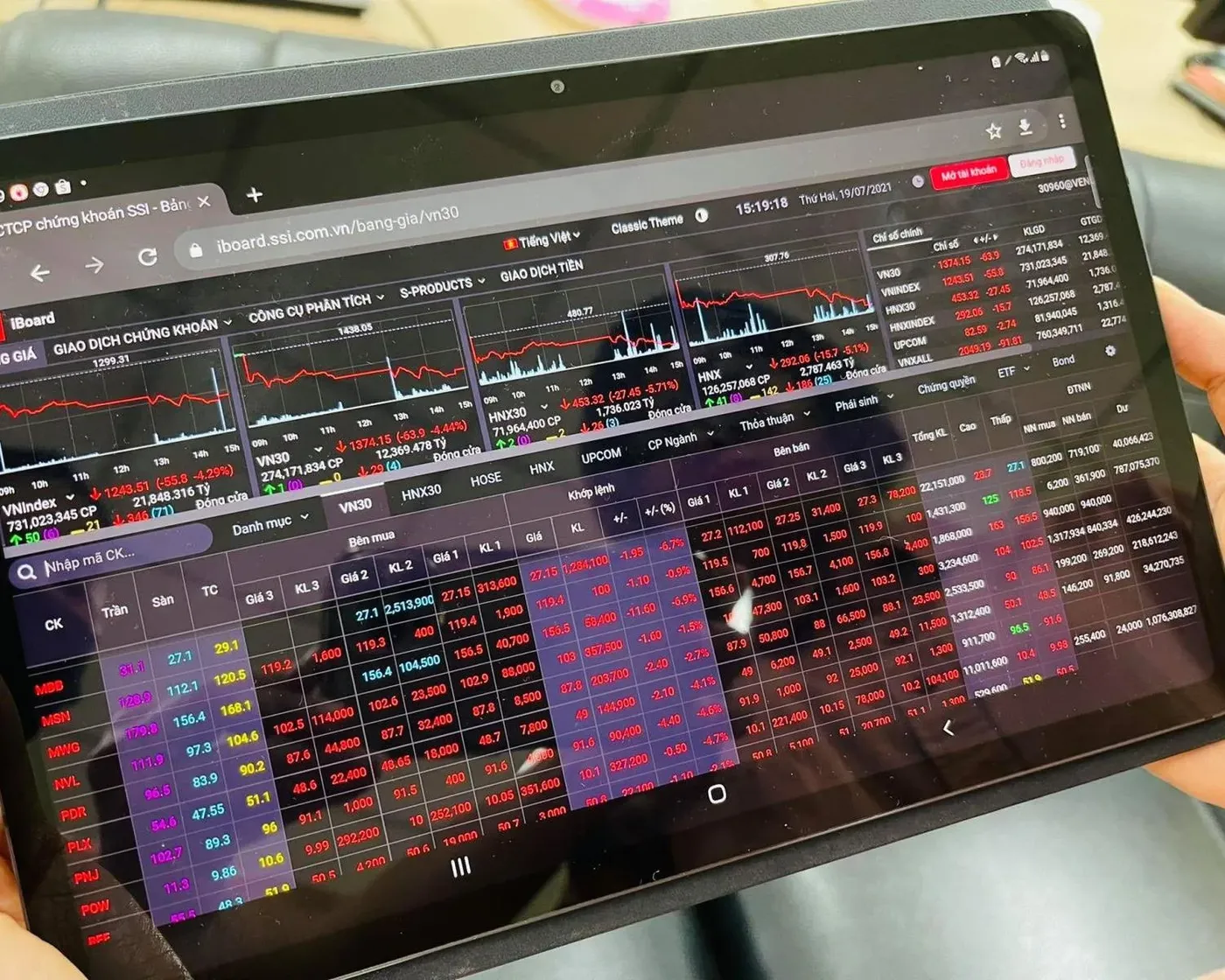

On Friday, September 11, the VN-Index closed at 1,795.21 points, down 34.02 points or 1.86%.VietnamPlus Only 46 stocks rose against 278 decliners, including 5 at the ceiling and 6 at the floor. The 1,800-point level, a psychological threshold the index had held since late August, was broken.
The familiar reflex after a session like this is to hunt for cheap stocks. But before placing an order, it's worth pausing on one question: what number is that instinct based on, and does that number actually measure what an investor needs to know?
The dip-buying instinct has real backing, but it's being misread
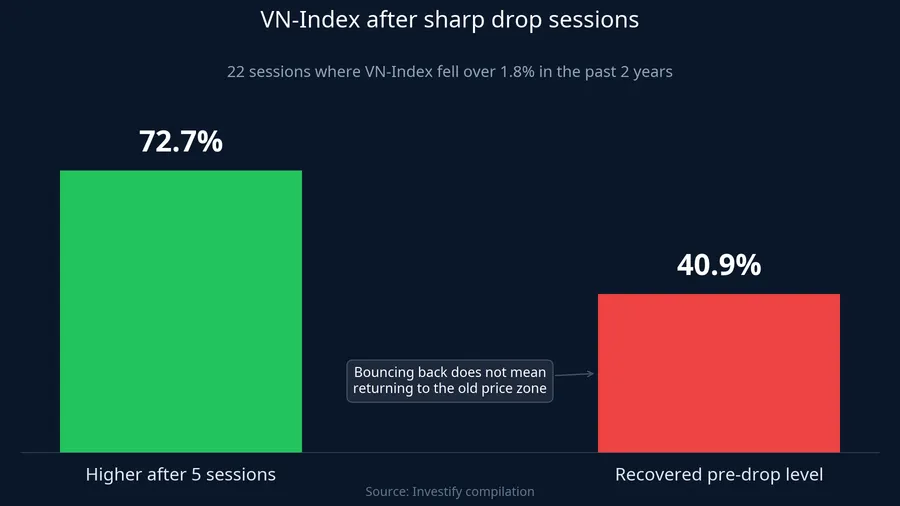
This isn't just sentiment. Over the two years from September 11, 2024 to September 11, 2026, the VN-Index had 22 sessions where it fell more than 1.8%. Looking at the fifth trading session after each of those drops, the index finished higher 16 times, a 72.7% hit rate. The average return over those five sessions was 1.42%, with a median of 2.25%. The most recent case reinforces the pattern: on August 14, the index fell 2.07% to 1,729.08 points, then rose 2.26% over the next five sessions, surpassing its pre-drop level.
The medium-term technical structure hasn't broken either. After the September 11 session, price still sits above the 20-session moving average at 1,791.30, the 50-session average at 1,781.59, and the 200-session average at 1,788.82. The MACD line remains above its signal line, 15.61 versus 13.69. These are the conditions of a pullback within an uptrend, not a confirmed reversal.
What that headline number doesn't spell out is this: 72.7% measures whether the index rises from its post-drop low, not whether someone who buys right after the drop ends up in profit. The two sound similar, but they aren't the same thing.
Four numbers that tell a different story
First, the real break-even probability is much lower. Of the 22 sharp declines, the index recovered its exact pre-drop level within five sessions only 9 times, or 40.9%. Someone buying right after the drop isn't buying at the bottom; they're buying at the post-drop price. They only break even once the index returns to its pre-drop level, and that happens less than half the time.
Second, the rebound tends to arrive only after one more leg down. On average, over the following five sessions the index drifted another 1.63% below the closing price of the drop session before stabilizing. The worst case in the sample was March 2, 2026: the index fell a modest 1.82%, then lost another 10.47% over the next five sessions. Anyone who bought the dip on the first day of that stretch took a heavy loss before getting any chance to recover it.
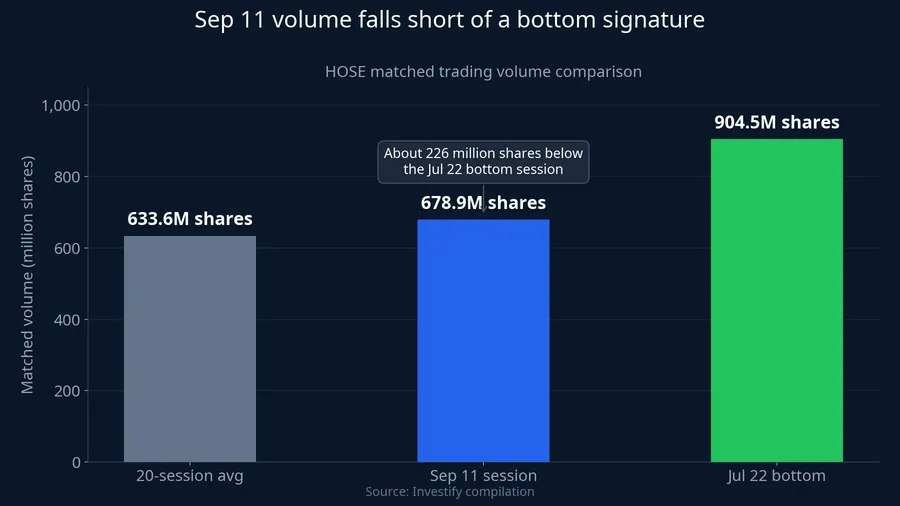
Third, September 11's volume doesn't yet look like a bottoming session. The whole exchange matched 678.9 million shares, about 7% above the 20-session average.Vietstock That sounds notable, but the margin above average is thin. The market's most recent decline, from 1,867.21 points on July 1 to 1,668.53 points on July 22, a 10.64% drop over 15 sessions, ended with a session that matched 904.5 million shares. The two strongest rebound sessions right after that also matched 862.8 million and 837.2 million shares. Bottoms form when holders give up and sell at any price, and that leaves a clear mark on volume. September 11 hasn't left that mark yet.
Fourth, the indicators haven't reached cheap territory. The 14-day RSI sits at 49.89, still far from the oversold threshold of 30. The Stochastic %K is at 23.10, close to oversold but not yet curling upward. Most notable is the MACD histogram, which shrank from 11.98 on September 4 to just 1.91 on September 11. If that contraction holds for one or two more sessions, MACD will cross below its signal line and confirm a sell signal on the chart.
The real risk sits in the gap between those two numbers, 72.7% and 40.9%. Investors who believe the first number while acting as if it were the second are exactly where the most money gets lost.
It isn't only technical
The September 11 decline wasn't caused by a single candlestick pattern. Foreign investors net sold VND 868.7 billion on the Ho Chi Minh Stock Exchange during the session, concentrated in banking, securities and real estate.Nhân Dân The financial services group fell 3.48% on turnover of VND 2,368.8 billion, while real estate saw the heaviest foreign net selling at VND 197.5 billion.
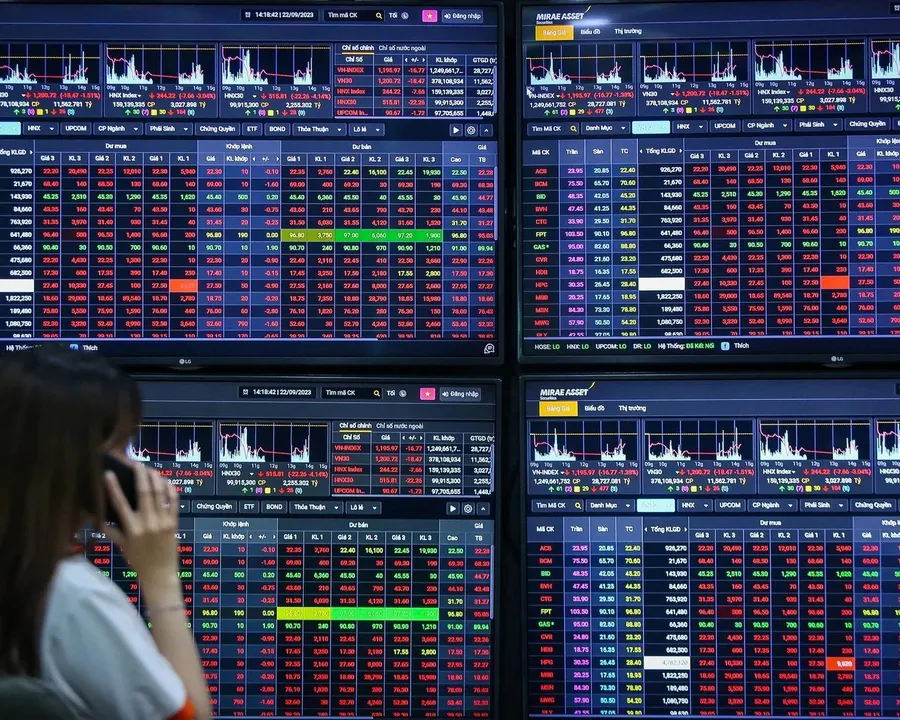
The week of September 14-18 also stacks up a dense event calendar: the Fed's policy meeting on September 15-16, September derivatives contract expiration on Thursday the 17th, and FTSE index fund rebalancing taking effect on September 21. Thời báo Tài chính Việt Nam called it a week of many variables.Thời báo Tài chính Việt Nam That means next week's swings could come from rebalancing flows rather than changes in corporate fundamentals, and it also means a single green session midweek won't be enough to conclude the decline has ended.
The decision zone and what to watch
The nearest boundary is the 1,779-1,791 zone, where the 20, 50 and 200-session moving averages converge. If the index holds this zone through the first session or two of the week, a technical rebound has room to form, with the nearest resistance at 1,810-1,820 points, where the 5-session and 100-session averages sit.
Lose that zone on rising volume, and the next scenario is the 1,700-1,720 zone flagged by nguoiquansat.vn, which is also where the lower Bollinger band currently sits at 1,708.09 points.nguoiquansat.vn From the current closing level, that's a 4.2-5.3% move down.
Local brokerages are pointing in the same direction, if at different degrees of caution. ASEANSC's September 11 note recommended holding average portfolio weight and avoiding chasing rallies, noting that dip-buying demand had appeared but wasn't yet strong enough to reverse the trend.ASEANSC SHS's September strategy also took a cautious stance on adding exposure. No report is encouraging investors to increase leverage right now, which is worth noting for anyone considering margin to buy into this dip.
For those looking to participate, scaling into positions by price zone is more common than buying all at once, since it doesn't require correctly guessing the bottom. For those already holding stocks on margin, cutting leverage to a level where another 5% drop wouldn't force a sale is a reasonable defensive move while technical signals haven't confirmed a bottom.
The earliest signal will come from HOSE matched trading volume over the first two sessions of the week. Volume above 800 million shares while the index still closes above 1,780 would mean selling pressure has been absorbed and the support zone is doing its job. Volume still around 650 million shares while the index keeps drifting lower would mean sellers haven't finished selling, and the 1,700-1,720 zone would be the next stop.