


In the week of September 7-11, 2026, Vietnam's banking system carried two interest rates that looked impossible to reconcile. On September 10, banks lent each other overnight cash at just 1.68% a year, down 2.94 percentage points from the previous weekend.Thoi bao Tai chinh Viet Nam At the same time, prevailing mortgage rates stayed at 12-14% a year, the highest level since Q1 2023.Thanh Nien
The easiest read is bank greed: borrow cheap, lend expensive. But Q2 2026 data points the other way. Most of that gap is absorbed by funding costs and risk provisioning, not banked as profit. Three layers of mechanics stack on top of each other to create this spread, and the first is the one investors overlook most: the tenor of money itself.
Layer one: cheap money is cheap for exactly one night
The interbank market doesn't have a single price. It has an entire curve across tenors, and on September 10 that curve sloped up sharply: overnight at 1.68%, 1 week at 2.70%, 2 weeks at 3.72%, 1 month at 5.27%, and 3 months at 6.42%.Thoi bao Tai chinh Viet Nam
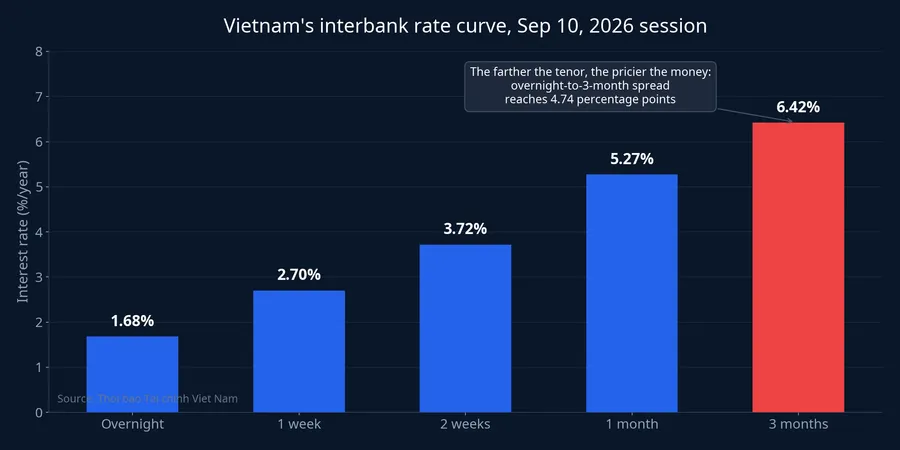
More telling than the price level is the pace of cooling. Overnight rates fell 2.94 percentage points that week, 1-week fell 2.24 points, 2-week fell 2.21 points, while 3-month fell only 0.75 points. The farther out the tenor, the thinner the decline: cash abundance is real, but it only lasts a few calendar weeks and never reaches long-term funding.
A 15-to-20-year mortgage cannot be financed with overnight money. Banks must match it with funding of a comparable tenor, the far end of the curve, where money has never been cheap. That's why retail lending rates don't react to the overnight rate: the two figures sit on different segments of the same curve.
One detail reinforces this: during the week of September 7-11, the State Bank of Vietnam net-withdrew roughly VND 33,001 billion from the system through open-market operations, while the rate on collateralized paper stayed flat at 4.5% a year.Thoi bao Tai chinh Viet Nam Overnight rates kept falling despite that net withdrawal, meaning the cheapness came from banks' instantaneous liquidity position, not from any policy easing.
Layer two: the system has a structural deposit shortfall
Banks' long-term funding comes mainly from household and corporate deposits, and that source is shrinking as a share of the balance sheet. Per TCBS Research, customer deposits fell from 64.6% to 59.8% of total funding in just six quarters, while interbank borrowing rose from 13.4% to 16.5%.Thoi bao Tai chinh Viet Nam
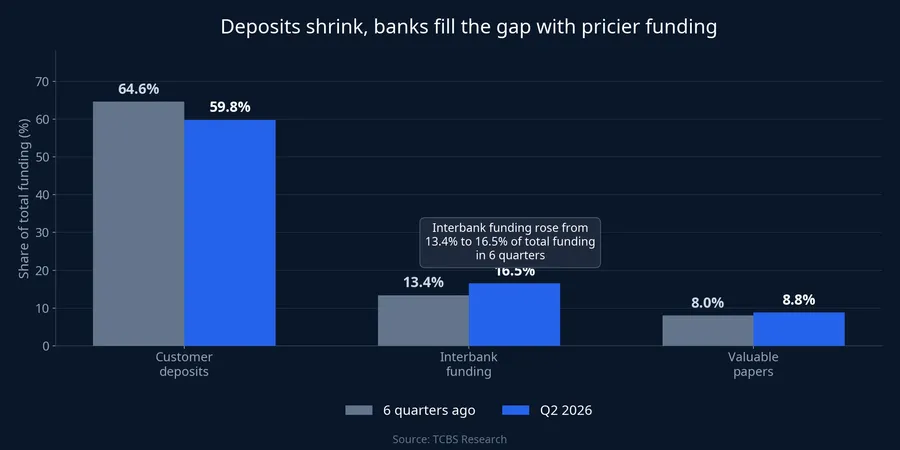
The root cause is a speed gap: since early 2026, credit grew 9% while deposits grew only 5.5%, opening a 3.5-percentage-point gap on the two sides of the balance sheet.Thoi bao Tai chinh Viet Nam 20 of 26 listed banks saw deposits grow slower than loans. The shortfall is plugged with valuable papers, whose balance reached VND 1.96 quadrillion by the end of Q2 2026, up 16.7% year-to-date, nearly three times the pace of deposits. TCBS Research calls this the most expensive funding source in the mix.
The result: the sector's average funding cost has moved sideways to slightly higher, running in the opposite direction of the overnight rate. The sector-wide loan-to-deposit ratio stood at a still-elevated 102.4% at the end of Q2 2026, down from 113% at the end of Q1.Bao Dau Tu When a bank lends out more than it takes in as deposits, it must keep deposit rates high to retain savers. And the deposit rate is exactly the base used to compute the reference rate that anchors every floating-rate loan.
Layer three: risk is being repriced
The third layer is the risk premium, and it's thickening every quarter. The sector-wide bad debt ratio rose to 1.97% in Q2 2026 from 1.88% the prior quarter, per SSI Research the sharpest Q2 increase since 2020.Bao Dau Tu Group-2 debt, the "needs attention" category that typically feeds into bad debt in following quarters, rose 31.6% year-to-date. The defensive buffer is thinning too: the sector-wide bad debt coverage ratio fell to 83% in Q2 2026, from 86% in Q1 and 95% a year earlier.
In real estate specifically, outstanding credit as of June 30, 2026 reached VND 5.146 quadrillion, or 25.5% of total economy-wide credit, and bad debt in the sector rose 10.5% in the first half of the year, outpacing credit growth over the same period.VnEconomy
So where does the 7.2-point spread actually go
S&I Ratings' Q2 2026 housing market report estimates the gap between lending and deposit rates at roughly 7.2 percentage points.Thanh Nien That's a large number, and easy to read as pure bank margin. Three explanations are worth weighing: genuinely expensive funding at the relevant tenor, as the first two layers show; a thickening risk premium alongside deteriorating asset quality; or banks actively widening their margin.
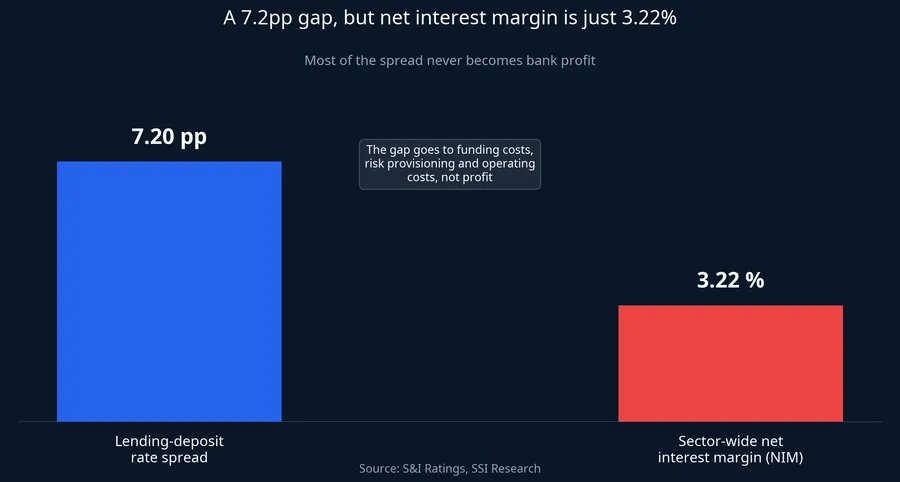
The third explanation is real, but far smaller in scale than first impressions suggest. Sector-wide net interest margin (NIM) in Q2 2026 was 3.22%, up from 3.04% in Q1: an expansion of just 0.18 percentage points in one quarter.Bao Dau Tu Over that same period, floating mortgage rates jumped several percentage points. SSI Research acknowledges NIM recovery is partly due to higher lending rates, but questions its sustainability given funding costs keep adjusting upward. Most of the 7.2-point gap, then, never becomes profit: it flows into funding costs, operating costs and loan-loss provisioning.
Money is flowing toward supply, not toward buyers
This mechanism leaves a clear footprint on the housing market. High borrowing costs push buyers to the sidelines, and lending data confirms it. In Q2 2026, mortgage lending stalled sector-wide, even at banks with ample credit room left: VPBank grew just 2.4%, HDBank was flat, and Techcombank fell 1.4% quarter-on-quarter.Bao Dau Tu At the same time, lending to real estate developers rose 22% quarter-on-quarter.

Supply keeps coming as a result: in the first half of 2026, the market absorbed roughly 102,500 new units, up 40% year-on-year.Thanh Nien But primary selling prices have barely budged, partly because developers themselves are borrowing above 12%, on top of labor costs up more than 25% and materials up 10-20%. Absorption rates in Hanoi and Ho Chi Minh City fell 20-40% versus prior quarters. More inventory, fewer people who can afford it, and prices holding steady.
What actually decides whether mortgage rates fall
If the overnight rate isn't the real signal, where is it? Per a Yuanta Securities survey cited by Thoi bao Tai chinh Viet Nam, the State Bank of Vietnam said it will allocate 2027 credit growth quotas based on how well banks comply with directives to cut lending rates.Thoi bao Tai chinh Viet Nam That's an administrative lever acting directly on retail lending rates, a mechanism entirely different from overnight liquidity.
The second factor is the 3.5-percentage-point gap between credit growth and deposit growth. Until that gap narrows, banks must keep competing for deposits with higher rates, keeping the reference rate elevated. Yuanta itself forecasts household deposit rates will stay elevated in the coming months, as credit growth is pushed while pressure to balance medium and long-term funding persists.
For anyone weighing a mortgage, contract structure matters more than timing. The first-year promotional rate, commonly 7.99-9.56% a year at 6 of 8 surveyed banks, only prices the first year or two.Thanh Nien The cost of the entire loan cycle rests on two other contract terms: the spread added on top of the reference rate, and the repricing interval, meaning how often the bank recalculates the rate.
Investors may want to consider: with real estate bad debt rising and funding costs not yet falling, a prudent standard is to run repayment scenarios at the floating rate of 13-15% a year rather than the promotional rate, and to keep monthly installments below 40% of income.
Conclusion: watch for the credit-deposit gap to narrow
Mortgage rates are unlikely to fall quickly as long as all three layers stay intact: long-term funding remains expensive, the 3.5-percentage-point credit-deposit gap hasn't narrowed, and real estate credit risk keeps thickening. The State Bank's administrative lever could pressure some banks to cut rates to protect their 2027 credit quota, but that's a factor to watch through upcoming quota announcements, not something that has happened yet.
SSI Research also warns the current pricing mechanism could increase repayment pressure on borrowers in coming quarters. That's a two-way risk: it sits on the borrower's shoulders, and it loops back onto the bank's own balance sheet. The pace at which the credit-deposit gap narrows in coming quarters is the single most important signal for whether mortgage rates are genuinely cooling.