
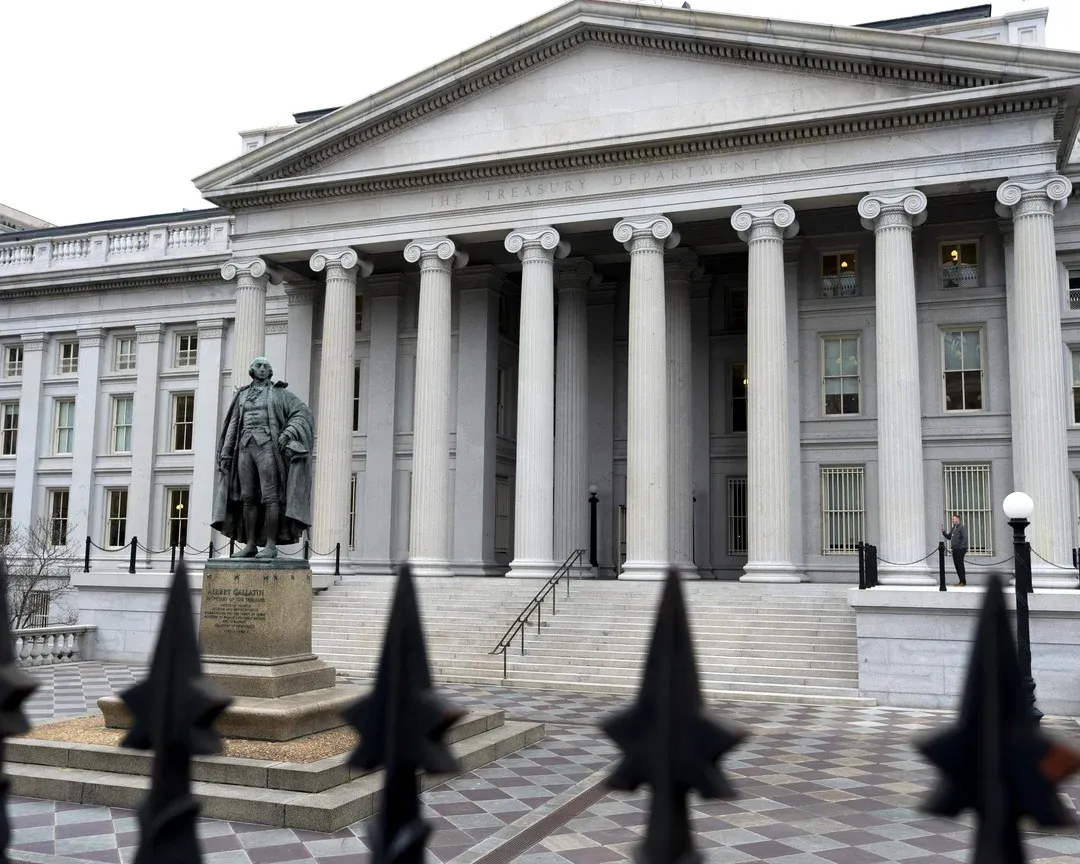

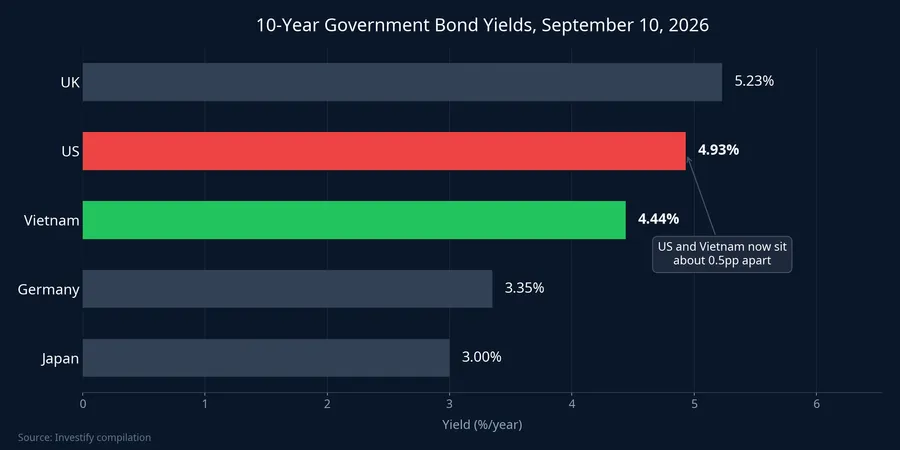
On September 10, 2026, Brent crude closed at $105.35 a barrel, up 4.09% for the day and 18.5% since August 11.Yahoo Finance That same session, the 10-year US Treasury yield hit 4.93%, its highest level since October 2023.CNBC Put those two numbers side by side and a paradox emerges: Vietnam's 10-year government bond yield closed the same day at just 4.44%, meaning Washington is now paying nearly half a percentage point more to borrow for a decade than Hanoi is, even though US Treasuries are still considered the safest asset class on earth.
Why a barrel of oil can shake the bond market
Bonds pay a fixed coupon locked in at issuance, regardless of how much prices rise afterward. When energy costs spike, inflation expectations climb with them, and that fixed coupon steadily loses real purchasing power. Investors respond by selling the bonds they hold. Bond prices and yields move in opposite directions, so heavier selling pushes prices down, and the same fixed coupon divided by a lower price produces a higher yield. Layer on top of that: higher inflation raises the odds that central banks will need to hike policy rates, and a higher policy rate drags the entire yield curve up with it.
This selloff hasn't stayed confined to the US. Japan's 10-year government bond yield broke above 3% for the first time since 1996.CNBC The UK's 10-year gilt climbed to 5.2341%, its highest since June 2008, while the 30-year gilt reached 5.8856%, a level last seen in March 1998. Germany's 10-year Bund rose to 3.3546%, a 52-week high. Each of these is a multi-decade or multi-year milestone measured against a specific window, not an all-time record.
Oil is the trigger, not the whole story
Reading this selloff through the lens of oil alone misses the more important backdrop. At least three other forces have been pushing yields higher throughout September, and all three were building well before crude spiked. First, debt supply: the US Treasury announced a $6 billion buyback plan, triple the usual size, and it still hasn't pulled long-end yields down.CNBC Second, a wave of corporate borrowing: AI-related capital spending alone has driven more than $1.5 trillion in new debt issuance, siphoning capital away from government bonds. Third, Japan itself has been selling US Treasuries to raise the foreign currency needed to defend a weak yen.
The bigger picture: oil is simply the most visible and most recent trigger, while the underlying driver is fiscal anxiety compounded by an oversized wave of new debt supply hitting the market all at once. If oil alone were responsible, it's hard to see how UK and Japanese yields would both hit multi-decade highs within the span of a few trading sessions.
Why Vietnam is sitting this one out
Domestic yields have barely moved. Vietnam's 10-year government bond yield has risen only about 0.4 percentage points since the start of the year, from 4% to 4.43%.VnExpress What's keeping that yield stable isn't the strength of the economy. It's the list of who actually holds the debt.
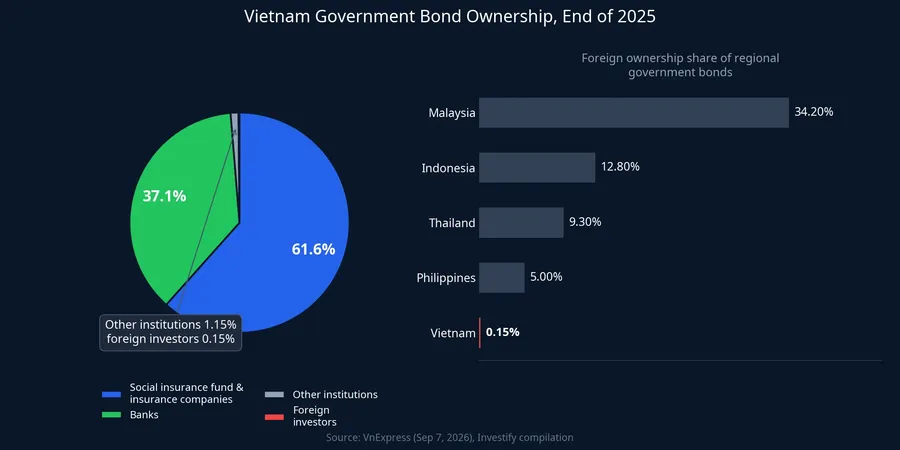
As of the end of 2025, Vietnam Social Security and domestic insurers held 61.6% of outstanding government bonds, banks held roughly 37.1%, and foreign investors held just 0.15%.VnExpress That 0.15% figure is far below regional peers: the Philippines at 5%, Thailand at 9.3%, Indonesia at 12.8%, and Malaysia at 34.2%. Global capital is shifting hard between emerging markets right now, but that flow has almost no way into Vietnam, simply because the foreign-held slice is too small to move.
Diệp Quốc Khang, Senior Fixed Income Manager at Dragon Capital, explains the usual contagion mechanism: when developed markets sell off, hedge funds shorten their portfolio duration by dumping emerging-market government bonds. Vietnam doesn't get hit by that wave because the foreign-held slice is too small to bother selling.
Nguyễn Mạnh Dũng — known professionally as Tyler Nguyễn Mạnh Dũng — Senior Director of Market Strategy Research at Ho Chi Minh City Securities Corporation (HSC), adds two structural barriers keeping foreign capital out: Vietnamese government bonds still aren't included in major indices like the JPMorgan GBI-EM Global Diversified or the Bloomberg EM Local Currency Government Index, and procedural, tax, and indirect capital-account rules make it hard for money to move quickly. On the Hanoi exchange, July trading averaged roughly VND 16,700 billion a session, yet foreign investors accounted for only 3.4% of that value. Dũng was careful to frame this as "a dampening and delay effect in the transmission channel, not full immunity."

The exchange-rate channel is closed, the auction channel is cracking open
The transmission channel experts flag first is the exchange rate: rising US yields typically strengthen the dollar, pressure the dong, force the State Bank of Vietnam to draw down reserves or drain VND liquidity, and that liquidity drain then pushes interbank rates and domestic bond yields up together. In practice, that channel hasn't kicked in yet.
On the morning of September 10, the State Bank of Vietnam set the central reference rate at VND 25,591 per dollar, down 3 dong from the prior session.Thời báo Ngân hàng The market rate on September 9 stood at VND 25,963.5, meaning the dong has strengthened 1.22% since August 3, largely because the dollar is weak on a broad global basis. Pressure from higher US yields does exist, but it's currently being masked by a larger offsetting force.
The channel actually cracking open is the domestic issuance calendar. Per a report covering the week of August 31 to September 4 from Yuanta Securities Vietnam, the State Treasury offered VND 17,000 billion in bonds but received only VND 7,585 billion in bids and sold just VND 2,535 billion.Thời báo Tài chính Việt Nam That's a 14.9% bid-to-cover rate, down sharply from 73.6% the previous week, while the 30-year tranche sold just VND 35 billion of a VND 500 billion offering.
Year-to-date, the State Treasury has raised roughly VND 231,456 billion, only 46.3% of its annual target, meaning more than half of this year's borrowing need is now packed into the final four months, right as primary-market demand is softening. That same week, foreign investors flipped back to net selling of about VND 565 billion after net buying VND 149 billion the week before, though that swing is far too small to move the overall yield level when domestic investors hold more than 99% of outstanding bonds.

Putting 4.44% in context
For anyone weighing a fixed-income allocation, that 4.44% government bond yield only means something once it's set against two other benchmarks.
The first is corporate bonds. Across July and August, the market recorded 46 issuances worth VND 41,990.9 billion at an average coupon of 9.06% a year and an average tenor of 63.7 months. The 4.6-percentage-point gap between the two markets is the price of credit risk, not a free premium. Privately placed corporate bonds are restricted to professional securities investors, while government bonds can be bought through the Hanoi exchange or a bank in denominations as small as VND 1 million.
The second benchmark is the domestic cost of short-term capital. The overnight interbank rate jumped from roughly 1% a year in late August to 6.01% on September 3, even as the State Bank's open-market rate held steady at 4.5%. Short-term liquidity is far more sensitive than long-term yields right now, which is exactly where pressure tends to show up first.
Numbers worth watching in the coming weeks
Global yield pressure will eventually reach Vietnam, but as Dũng put it, by an indirect route and with a lag. The current evidence isn't enough to say when or how forcefully, so rather than guess, there are three numbers worth putting on the calendar.
One is the bid-to-cover ratio and winning yield at the State Treasury's upcoming 10-year auctions: if the bid-to-cover ratio keeps falling below 30% and the winning yield climbs past 4.6%, the budget is paying more to borrow. Two is the central reference rate the State Bank sets every session: a sustained run of increases paired with net liquidity draining would signal the exchange-rate channel opening back up. Three is the US-Vietnam 10-year yield gap: the near-half-point spread currently favors the US, and if it widens further, dong-denominated assets become relatively less attractive right as Vietnam's capital-market opening faces its real test.