


From 3pm on September 10, E5 RON92 gasoline sold for no more than VND 23,744 per liter, up VND 1,258 from the prior pricing cycle.VTC News That is not the full story. The base price, the figure that fully reflects input costs and that regulators publish alongside the retail price, actually rose VND 1,758, or 7.82%.Tap Chi Kinh Te Tai Chinh The VND 500-per-liter gap between those two numbers didn't just disappear. It came out of the Price Stabilization Fund, and only biofuel gasoline got that cushion this cycle. Diesel and fuel oil, the other two products, received exactly zero.
The 500-dong gap: who is paying for whom
Every pricing announcement carries two parallel figures. The base price reflects true input costs; the retail price is what consumers actually pay. This cycle, E5 RON92 had a base price of VND 24,244 per liter but a retail price of only VND 23,744. E10 RON95-III showed the same pattern: base price VND 24,739, retail price VND 24,239.
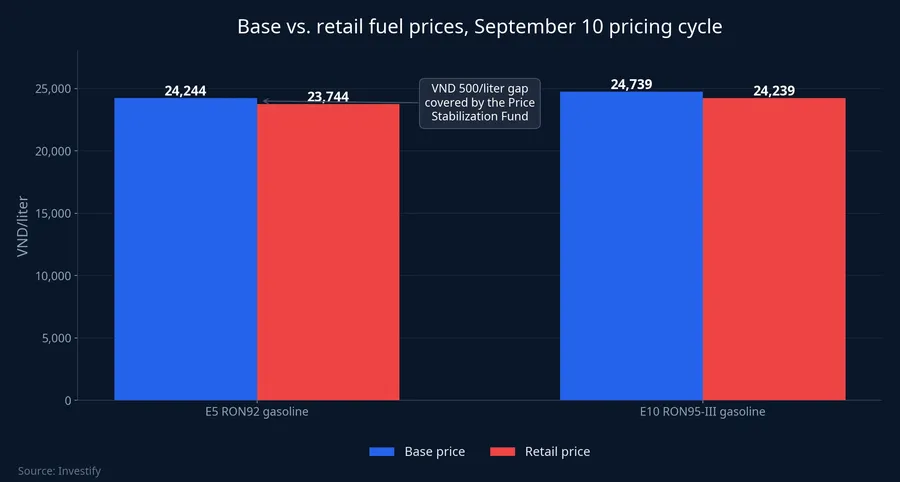
That gap is the amount the Stabilization Fund paid out, but the fund isn't spread evenly across products. Diesel, the primary fuel for trucks, cargo ships and farm equipment, got no cushion at all this cycle. Whoever fills up with biofuel gasoline is having part of the global oil shock absorbed by the state; whoever runs on diesel is taking the full hit.
The big picture: Hormuz pushes Brent above $100 in a month
To understand why input costs jumped so much, look beyond Vietnam's borders. On August 5, Brent crude closed at $79.45 a barrel, its lowest level in over a month. From there prices climbed almost continuously, with some sharp swings along the way, until September 9, when Brent broke above $100 a barrel for the first time since July 2026, closing at $101.21.FireAnt On September 10, prices eased slightly to $100.85.
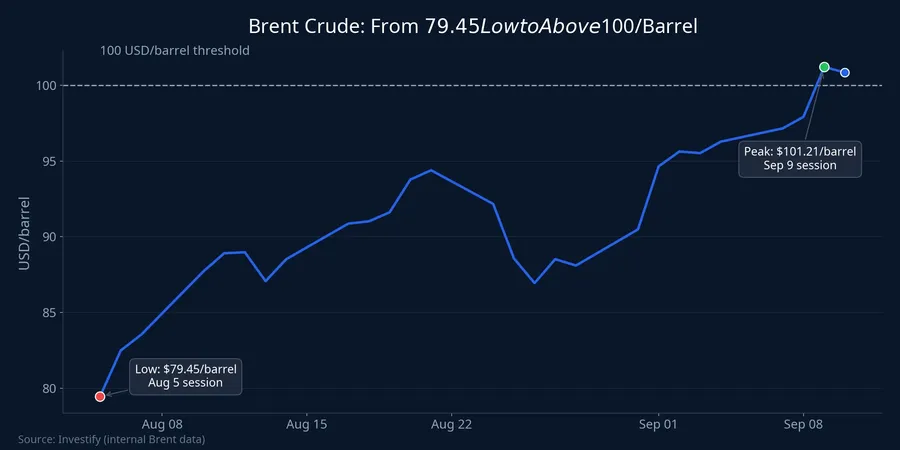
The driver is the Strait of Hormuz, where a series of tit-for-tat strikes between the US and Iran have severely disrupted shipping. Oil flow through the strait has fallen below 2 million barrels a day, down from 8 to 9 million before the clashes.FireAnt On the very session Brent broke $100, Iran announced details of a new exclusion zone in the strait.Dan Tri It's a narrow shipping lane but a critical one for global oil supply, so a single disruption is enough to send crude prices sharply higher.
Why Vietnam's pump prices always lag by a week
Vietnam's retail fuel prices don't track crude oil session by session. They're set using the average price of refined products on the Singapore market over the seven days between pricing cycles. Between the September 3 and September 10 cycles, average RON92 gasoline rose $10.86 to $127.886 a barrel; RON95 rose $11.148 to $132.166; diesel rose only $6.33 to $161.03.VTC News
That gap between the two groups explains why gasoline jumped sharply this cycle while diesel barely moved: refined gasoline got roughly 9% more expensive, versus roughly 4% for diesel. The seven-day lag also explains something that looked contradictory in the prior cycle. On the afternoon of September 3, E5 RON92 gasoline rose VND 723 to VND 22,486 per liter, while diesel actually fell VND 340 to VND 27,740.Dai Doan Ket That cycle, the fund hadn't spent a dong; it was actually building reserves, setting aside VND 200 per liter and per kilogram for diesel and fuel oil. Just seven days later, the fund flipped from taking in money to paying it out.
A forecast miss of 140 dong: the fund is cushioning the shock, not a cooling market
Ahead of this pricing cycle, some forecasts called for gasoline to rise as much as VND 1,400 per liter.Techz The actual increase came in at VND 1,258, about 140 dong lower than expected. The easy — and wrong — conclusion is that global prices softened at the last minute. The data shows the opposite: the base price rose a full VND 1,758, meaning actual input costs were even heavier than the forecast scenario assumed.
Two things happened at once, pulling in opposite directions. Input costs rose beyond what forecasters expected, while the Stabilization Fund paid out VND 500 per liter to keep the retail price under that threshold. There's a reasonable alternative explanation worth weighing: pre-cycle forecasts are often based on refined-product data that hasn't yet covered the full seven days, so a gap of a few hundred dong is normal and doesn't necessarily involve the fund. The deciding factor is the base price itself: if the forecast miss were purely technical, the base price would sit around VND 1,400, not jump to VND 1,758. The evidence favors the first explanation, in which the fund's payout is what drives the gap.
A buffer running thin
The Stabilization Fund is not a bottomless pool of money. According to Ministry of Industry and Trade data published June 2, 2026, the fund balance held by licensed fuel traders stood at over VND 5,611.7 billion on January 1, 2026. Total spending in Q1 came to over VND 5,418.5 billion, leaving just VND 195.9 billion by the end of March 31, 2026.SGGP In other words, more than 96% of the fund's starting balance was gone in three months.
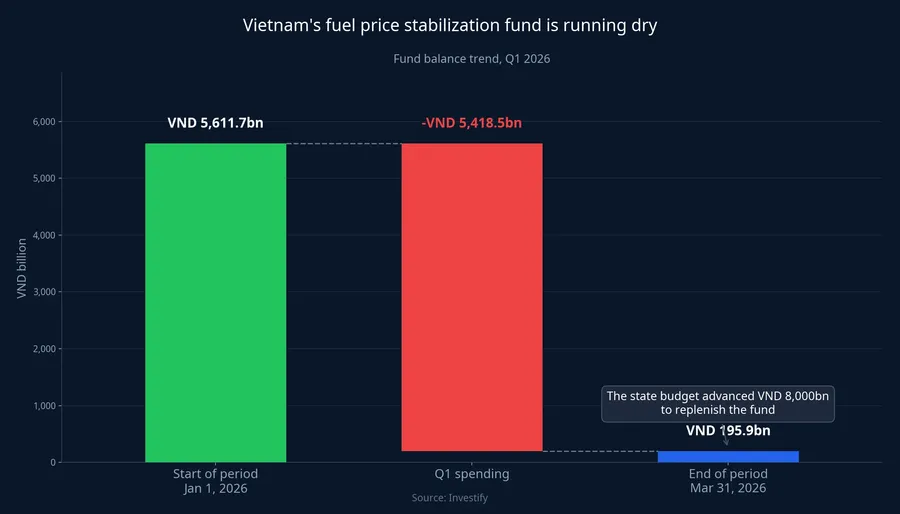
Balances also vary sharply across fuel traders. By the end of Q1, Petrolimex held a positive balance of over VND 1,073.8 billion, while PVOIL was negative by more than VND 1,437.7 billion. The shortfall was covered by the state budget. On March 27, 2026, the government issued Resolution 69/NQ-CP, advancing VND 8,000 billion from 2025's central budget revenue surplus to the Fuel Price Stabilization Fund.SGGP The resolution specifies that this amount must be repaid to the budget once the fuel market stabilizes. In other words, the VND 500 cushioning every liter of gasoline this afternoon is borrowed money, not savings sitting in reserve.
The group left without a cushion
The VND 500 payout only applies to biofuel gasoline. Diesel gets zero, and that shows up clearly in the financial statements of fuel-heavy companies, especially airlines. In Q2 2026, Vietnam Airlines posted a net loss of over VND 606 billion, driven mainly by cost of goods sold rising nearly 60% amid sharp fuel-cost swings.CafeBiz Vietjet reported net profit down 46.5% in the same quarter, even as revenue grew over 70%.VnEconomy
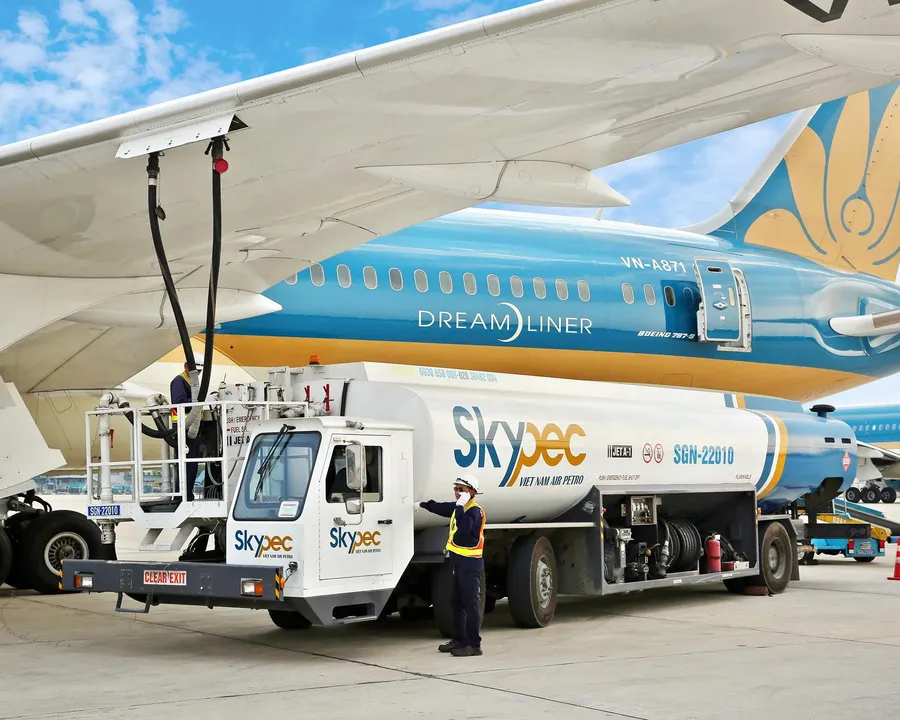
Not every transport company faces the same pressure. Gemadept, a port operator, still posted strong profit growth in Q2 2026 thanks to revenue outside core port operations. That's a sign sensitivity to oil prices varies sharply even within the logistics sector.Mekong ASEAN On the exchange September 10, HVN fell 2.05% to VND 21,450 per share, its second straight losing session, while the VN-Index rose 0.12% to 1,829.23 points. The stocks supposedly benefiting from higher oil prices didn't move in unison either: BSR fell 0.91%, GAS fell 1.28%, PLX fell 0.70%. The market clearly hasn't priced the oil story in one direction.
Three signals to watch for the September 17 cycle
The new seven-day cycle starts from the very session Brent closed at $100.85 a barrel. If oil holds above $100 for the week, the refined-product average for the September 17 cycle will come in higher than this one, pushing the base price up again. The biggest question right now isn't whether oil keeps rising. It's how much longer the Stabilization Fund, already down 96% in Q1 and surviving on a budget advance it has to repay, can keep acting as a buffer.
Three signals are worth watching in the next pricing announcement: whether the fund's gasoline payout holds at VND 500, rises, or stops altogether; whether diesel gets added to the fund's coverage, since that's a direct variable for transport and logistics margins; and how flow through the Strait of Hormuz evolves, since that determines input costs for both groups. For investors holding transport or airline stocks, Q3 earnings reports are worth reading from the gross margin line down, alongside each company's ability to sustain fuel surcharges. Revenue for this group rarely catches up quickly with a cost shock that drags on for weeks.