


In the first half of 2026, Vietnamese households added roughly VND 733 trillion to bank deposits, pushing total household deposits above VND 11.07 quadrillion for the first time, up 7.1% from the end of 2025.Dân Trí In June alone, that inflow grew by nearly VND 242 trillion.Vietstock This is mass behavior, and the mass believes savings accounts are the safest shelter while gold, real estate, and stocks all swing wildly.
That belief is well-founded, but only for half of the rate table. If you keep money in a term deposit under six months for flexibility, there is one number buried in the regulation that most savers overlook when comparing rates.
The belief the data actually supports
To be fair, deposit rates really have climbed this year, and by a meaningful amount. Per the online rate sheet as of September 6, the four state-owned banks — Agribank, BIDV, Vietcombank, and VietinBank — all list 6.6% a year for 6- and 9-month terms, and 6.8% for 12- and 18-month terms.Kenh14 Among joint-stock banks, ACB leads the 12-month term at 7.8%, Sacombank at 7.5%, and LPBank and Saigonbank both at 7.2%. Nine banks now pay 7% or more at that term.
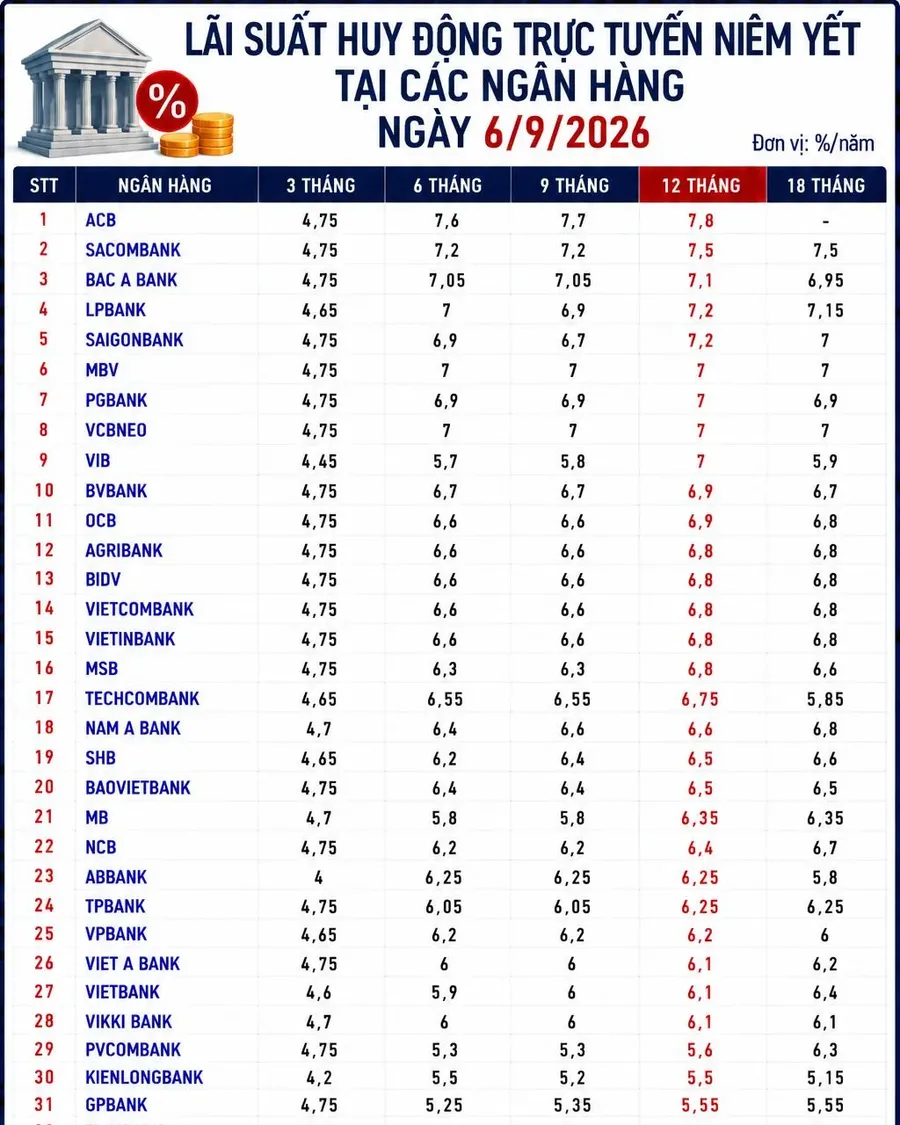
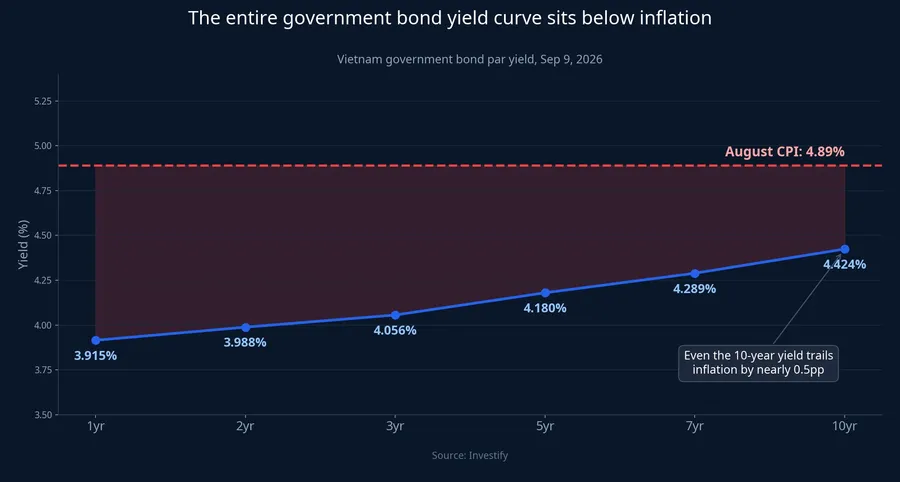
Set against channels with comparable risk, those numbers genuinely look attractive. The 24 open-end bond funds tracked show an average 12-month yield of about 5.71%, spread widely from 2.16% to 7.63%. The government bond yield curve on September 9 ran from 3.915% at the 1-year tenor to 4.424% at 10 years. Longer-term deposits pay more, carry deposit insurance, and don't fluctuate in daily net asset value the way a bond fund unit does.
In other words, anyone who locked in a 12-month deposit in 2026 made a reasonable choice. The problem sits elsewhere: most of a household's idle cash isn't parked at the 12-month term. It's held short, in case the money is needed sooner.
Where the story breaks: one number in the regulation
The State Bank of Vietnam caps the maximum rate on Vietnamese-dong deposits with terms from one month to under six months at 4.75% a year.Dân Trí Above six months, that cap disappears, and each bank sets its own rate based on funding demand. At the same time, August 2026's consumer price index rose 4.89% year over year, per Vietnam's General Statistics Office.Thời báo Tài chính Việt Nam
Put those two numbers side by side and the conclusion is uncomfortable: at terms under six months, no commercial bank is legally allowed to pay enough to offset August's price increase. All four state-owned banks currently list the maximum 4.75% for the 3-month term, still 0.14 percentage points below inflation.
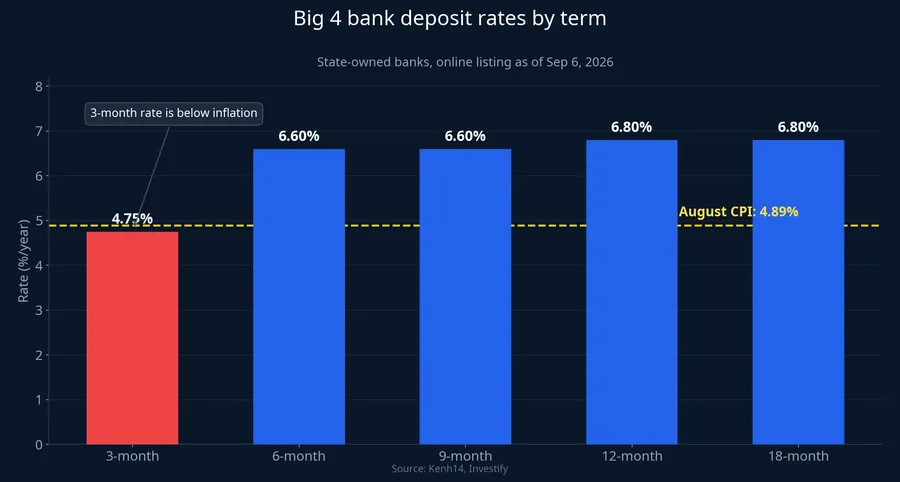
This is the point many savers misread. They think they're comparing one bank against another, hunting for an extra fraction of a percentage point. In reality, at short terms, the decisive variable isn't the bank at all. It's the regulation. Someone rolling over a 3-month deposit to stay flexible is paying a real cost for that flexibility, currently around 2 percentage points a year versus locking in 12 months at the very same state-owned bank.
Lương Duy Phước, Head of Market Research at Kafi Securities, described the mechanism on VTV8's Hộp Tài Sản program on September 10: "Keeping money in a savings account is still a solid way to preserve capital, but if the deposit rate falls below the pace at which essential spending is rising, the real value of that money can still erode."Afamily
Your household's basket is rising faster than the headline number
The second half of that quote matters more than the first. The 4.89% figure is an average across the entire national basket of 11 spending groups. A household's actual spending is concentrated in just a few of them, and those particular groups are rising faster than the headline.
Over the first eight months of 2026, the housing, electricity, water, and construction-materials group rose 6.71% on average, contributing 1.52 percentage points to overall CPI on its own.Thời báo Tài chính Việt Nam Within that group, home-maintenance materials climbed 13.39%, rental housing prices rose 4.92%, and household electricity prices rose 4.78%. The food and catering group rose 4.76%, adding 1.7 percentage points. Transport rose 5.38%, driven mainly by a 9.35% jump in fuel prices.
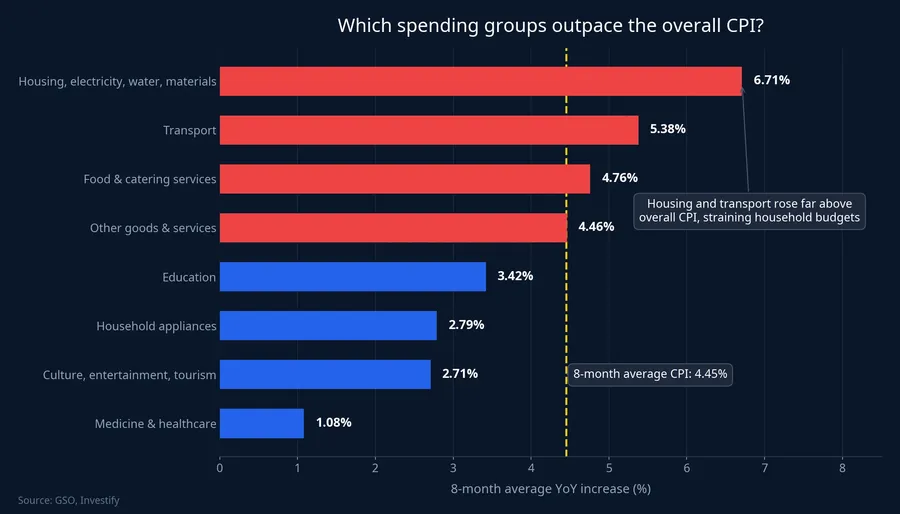
Put both tables together and the picture sharpens considerably. Anyone renting a home and paying a monthly electricity bill is facing a 6.71% cost increase, while a 6-month deposit at a state-owned bank pays 6.6%. That gap has already turned negative, even though the headline index still reads positive. This hits hardest for households whose spending skews toward housing and utilities more than the national average.
There is one reassuring detail. Core inflation — which strips out food, energy, and state-managed prices — averaged just 4.24% over the same eight months, 0.21 percentage points below headline CPI. That means part of today's price pressure comes from volatile factors that could still reverse, not from a permanent shift in the entire price level.
The government bond curve sits below inflation too
Using 4.89% as the benchmark and running it against every other channel, a clear ranking emerges. The entire government bond yield curve, from 3.915% at 1 year to 4.424% at 10 years, sits below that line. This is the risk-free rate, and anyone holding it is accepting a loss of purchasing power in exchange for near-total certainty of cash flow.
The open-end bond fund group, with an average 12-month yield of about 5.71%, clears the inflation line, but that excess still has to absorb management fees and daily net-asset-value swings. Deposits at six months or longer, ranging from 6.6% to 7.8%, are the only group that clears the line by a clear margin while still keeping the certainty of an insured deposit.
What stands out is that the entire yield curve has shifted higher over the past 12 months without the gap to inflation widening much. The 1-year government bond yield rose 116.7 basis points versus the same day a year earlier. Over that same period, CPI moved from 3.24% in August 2025 to 4.89% in August 2026, a 1.65 percentage point increase. Rates are climbing, but prices are climbing faster.
What to watch next
At current levels, the decisive variable for the real return on a deposit is the term, not the bank's name. The 6-month line is a boundary the regulation itself creates. Below it, the 4.75% cap locks every deposit below August's inflation rate. Above it, rates float with the market and currently run 1.7 to 2.9 percentage points above inflation. Money you genuinely need within a few months belongs in a short term: that's a fair price for liquidity. But money with no near-term use that still gets rolled over every three months is paying a fee for flexibility it never uses.
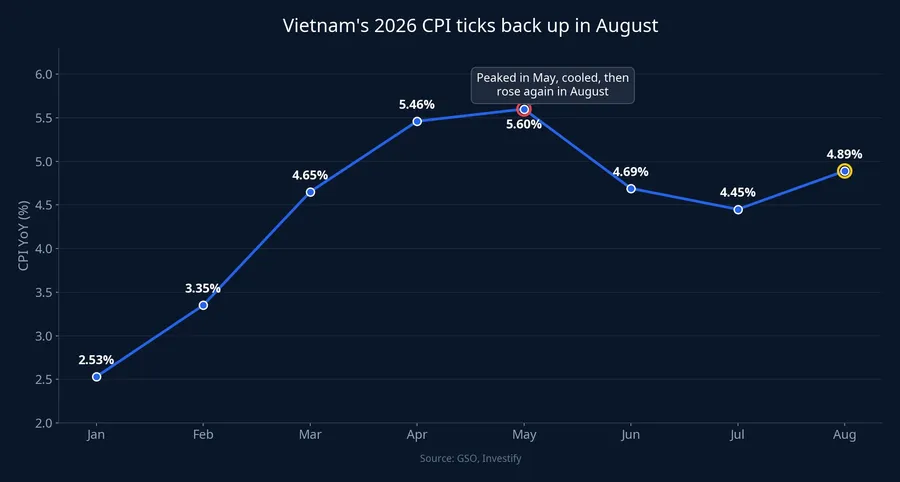
The next number worth watching is September's CPI, due from the General Statistics Office in early October. This year's pattern shows the index is quite sensitive to fuel prices: from 2.53% in January, CPI peaked at 5.6% in May, eased to 4.69% in June and 4.45% in July, then climbed back to 4.89% in August as fuel prices rose again. If September pushes the index back toward the 5.6% zone seen in May, the buffer on 6-month deposits at state-owned banks would narrow to roughly 1 percentage point, and the open-end bond fund group's 5.71% average yield would sit nearly on the line as well. Conversely, if fuel prices cool and CPI retreats toward the 4.4% zone seen in July, the real cushion on longer terms would thicken again without any bank needing to raise rates at all.