


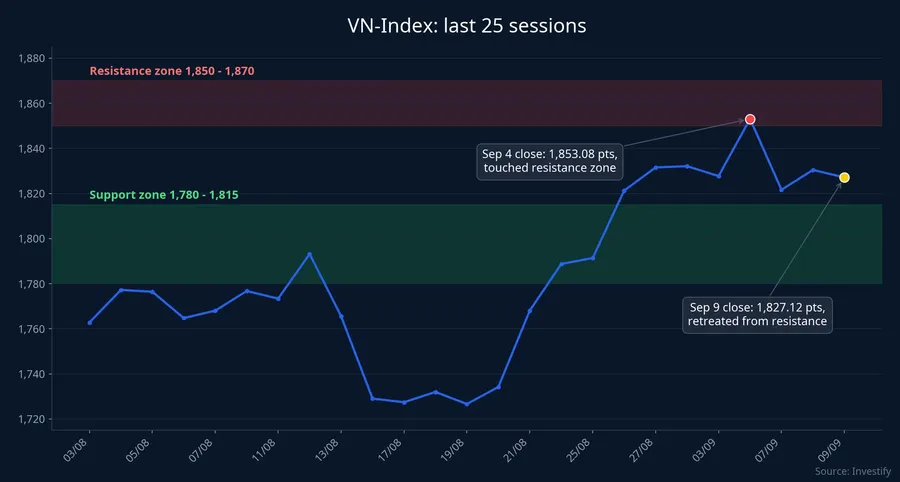
On September 9, VN-Index closed at 1,827.12 points, down 0.18% from the prior session. At first glance, that figure sits almost squarely between the 1,780-1,815 support zone and the 1,850-1,870 resistance zone that analysts had mapped out for September, as if the market were still waiting for a test that hadn't happened yet.
Look closer at the numbers and that test already happened, three sessions earlier. And it failed.
September 4 touched resistance but missed two conditions
VFS Securities' September strategy report didn't just draw the zones. It attached explicit conditions: if VN-Index convincingly clears 1,850-1,870 points, accompanied by improving liquidity and market breadth, the next target could be 1,900-1,930 points. Conversely, if profit-taking pressure builds in that zone, the index would likely retest support instead.Thuong Gia
The very next session, VN-Index rose 1.39% to 1,853.08 points, stepping right into the lower edge of that resistance zone. But look past the headline gain, and neither accompanying condition showed up.
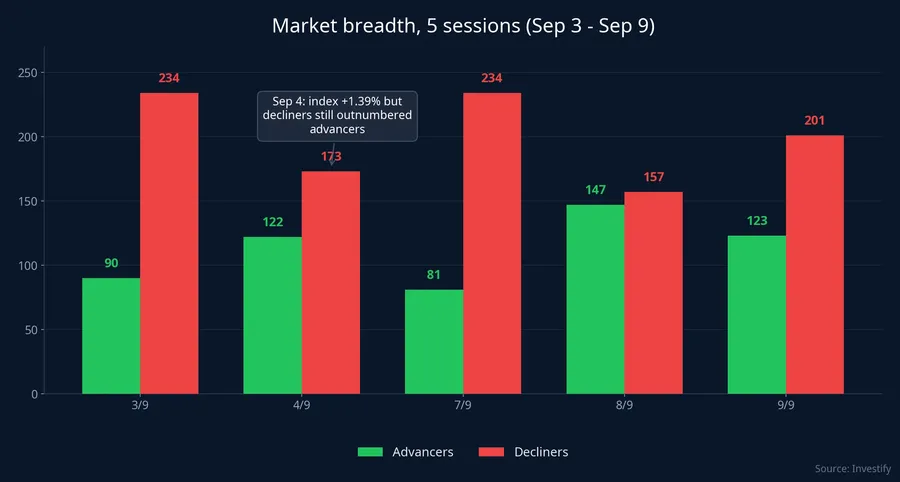
Trading value on September 4 came in around VND 16,457 billion, just 96% of the prior 20-session average of roughly VND 17,066 billion. A session that pushed the index up nearly 26 points ran on turnover below the market's typical daily pace. Breadth told the same story more bluntly: in that very 1.39% up session, the Ho Chi Minh City exchange recorded 122 advancing stocks against 173 decliners. The index climbed while most stocks fell, meaning the gain came from a handful of large-cap names rather than spreading across the broader market.
The reversal came the very next session. On September 7, VN-Index fell 1.70% to 1,821.64 points, with only 81 advancers against 234 decliners, wiping out the entire gain from September 4. In other words, the breakout scenario isn't a hypothesis still waiting to be tested. It already ran once, and it stumbled on exactly the two variables the VFS report had flagged in advance.
Why the bull case isn't dead yet
What keeps the bull case alive is valuation. VN-Index's current P/E sits at roughly 12.46x, well below its 10-year average of 15.32x.Thuong Gia If corporate earnings hold steady and the index reverts to that decade-long average multiple, the theoretical upside exceeds 20%.
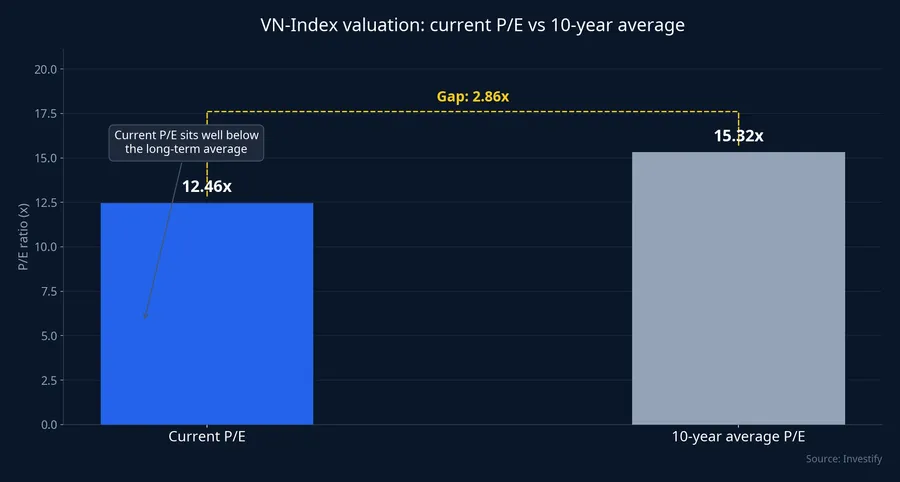
That's why the 1,900-1,930 target isn't a pipe dream. But cheap valuation only describes the available room; it doesn't generate the cash flow needed to fill it. A market can trade below its historical average for multiple quarters without rallying, if buyers simply don't show up in force.
August showed the opposite is possible. VN-Index rose roughly 5.55% from the end of July, with several sessions in the back half of the month posting trading value of VND 19,000-22,000 billion, about 50% more than what the market has managed in its two most recent sessions. In other words, the market has already shown it knows how to mobilize enough capital to push prices further. It just hasn't repeated that in this latest test of resistance.
Two branches, and the variable that resolves them
From here, two scenarios remain open, each tied to a specific trigger.
Branch one: the index breaks higher. The trigger isn't a single green session, but a close above 1,870 points with trading value back above the 20-session average and advancers clearly outnumbering decliners. Only then does the 1,900-1,930 target have real backing, because at that point capital flow would be broad enough to hold the index at a new plateau rather than just lifting a few index-heavy names.
Branch two: the index retreats to retest support. The trigger is a break below the 1,815-1,820 zone, where buying demand had already responded during the September 7 session. Vietcombank Securities noted the index touched support around 1,815 points before bouncing back.Nguoi Quan Sat If that level breaks on rising volume, the 1,780-1,815 zone becomes the next test, equivalent to a roughly 2-3% pullback from current levels.
The variable most likely to resolve these two branches is foreign capital flow and the banking sector. Across the five sessions from September 3 to September 9, foreign investors net-sold roughly VND 2,869 billion on the Ho Chi Minh City exchange, buying net-positive on only one session, September 4, at just VND 94 billion. Banks alone absorbed roughly VND 1,252 billion in net selling over the four sessions from September 3-8, with real estate adding another VND 440 billion. These two groups carry the market's heaviest weighting, so as long as selling concentrates there, breadth is unlikely to genuinely improve. There's a counter-signal too: information technology was the most net-bought sector over the same period, at roughly VND 148 billion.
Reading the September 7 drop fairly
The entire September 7 decline shouldn't be pinned on one single cause. TPS Securities noted that the reliability of that session's technical signal deserves caution, given how heavily VIC's weighting influences the index, meaning VN-Index's swing may not fully reflect the health of the broader stock universe.Nguoi Quan Sat
Still, the breadth figure of 81 advancers against 234 decliners shows the selling pressure that session wasn't confined to one heavyweight stock. The most balanced read is this: the drop was amplified by the outsized weight of large-cap names, but the underlying market was genuinely weak too, not simply dragged down by a single ticker.
Securities firms themselves haven't converged on a single view. Yuanta expects the index to trade in a narrow 1,800-1,810 range and recommends using rallies to trim equity exposure back toward a balance with cash. Bao Viet Securities takes a more constructive stance, arguing that buying demand has responded reasonably well at support, even if capital inflows remain hesitant.

Three signals worth watching next
With valuation below the 10-year average but liquidity below the 20-session average, a sensible framework for this stretch is to hold equity exposure at a balanced weight, deploy capital gradually on pullbacks rather than chasing price near resistance, and limit leverage after a sharp rally. That's also the direction VFS recommended in its September report.Thuong Gia
Three signals worth watching in the coming sessions, in order of importance: whether trading value returns above the 20-session average; whether advancers outnumber decliners in the next up session; and whether foreign investors stop net-selling bank stocks.
If all three show up together, the 1,850-1,870 zone will be retested under very different conditions than September 4. At that point, the valuation gap would finally have a real chance of converting into an actual rally. If only price cooperates while the other two conditions stay absent, the outcome is likely to repeat exactly what this week just demonstrated: a touch of resistance, followed by a slip.