

For most bank-stock investors, net interest margin (NIM) is the first number they check: it shows how much spread a bank earns between lending and deposit rates on every dong of interest-earning assets. A narrower NIM usually tracks a shrinking profit, and a wider NIM usually tracks a growing one. Sacombank's (STB) second quarter of 2026 is a notable exception, and one worth reading closely.
NIM improved: the first thing you'd notice
Sacombank did improve this metric in Q2 2026. According to an analysis by Vietnam Banking Securities (NHSV), the bank's Q2 NIM rose 6.8 basis points to 2.82%, as yields on interest-earning assets climbed faster than funding costs.Người Quan Sát Net interest income reached VND 6,247 billion, up 3.4% quarter-on-quarter, though still down 5.1% year-on-year.Người Quan Sát
The operating engine looked even better. Operating expenses fell 11.7% year-on-year, non-interest income more than doubled to VND 3,703 billion, and total Q2 operating income rose 28.1% year-on-year.Người Quan Sát Stop reading there, and the natural conclusion is a bank clearly on the mend.
The contradiction: profit still lost nearly half its value
The consolidated financial statements tell the rest of the story. Sacombank's Q2 2026 pre-tax profit came to VND 2,030 billion, down 44.5% year-on-year; first-half profit reached VND 4,136 billion, down 43.6%.Báo Đầu tư
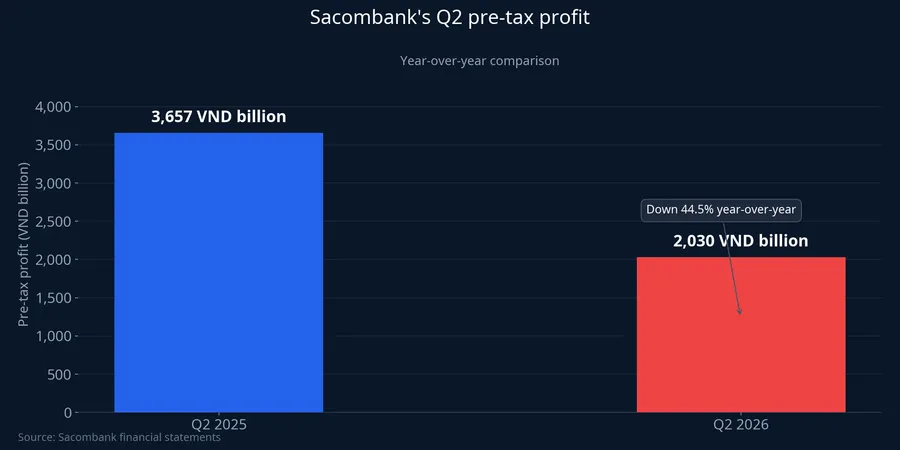
What sits between these two pictures is credit-loss provisioning expense. In Q2 alone, the bank set aside VND 5,095 billion, 5.5 times the year-ago figure; first-half provisioning reached VND 7,119 billion, up 542.7%.Báo Đầu tư In other words, Sacombank's net operating profit before provisions actually rose more than 33%, but almost all of that increase was diverted straight into the provisioning cushion instead of flowing down to the bottom line.Báo Đầu tư
This is where the belief that "rising NIM means a healthier bank" runs into its limits. NIM prices the cost of capital: whether a bank lends at a wider or narrower spread over its funding cost. But NIM cannot answer a more urgent question for a bank still working through restructuring: whether loans already disbursed actually come back. The metric that answers that question is credit cost, the amount a bank must set aside for loans at risk of loss.
The right metrics: bad debt, coverage, and group-2 loans
If there is a set of metrics to substitute for NIM when reading Sacombank right now, it is the bad debt ratio, the bad debt coverage ratio, and group-2 (special-mention) loans.
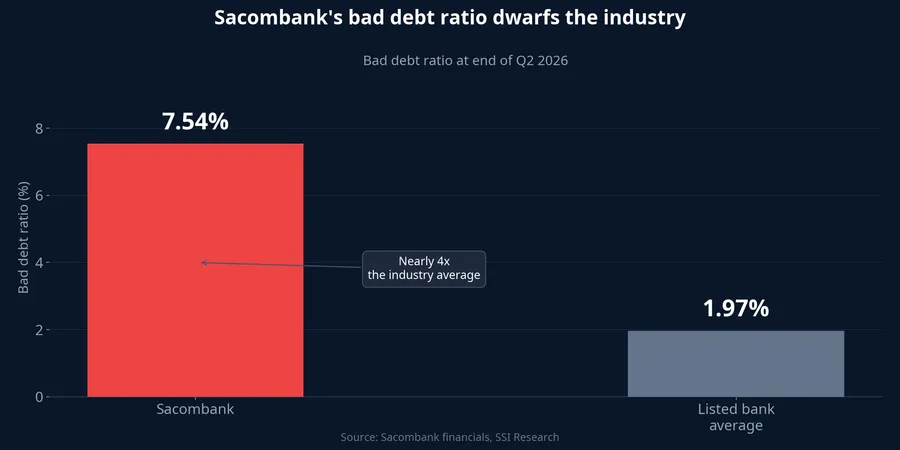
At the end of Q2 2026, Sacombank's bad debt balance stood at VND 47,957 billion, pushing the bad debt ratio from 6.41% at the start of the year to 7.54%.Báo Đầu tư The industry average at the same point, per SSI Research, was 1.97%.VnEconomy That nearly fourfold gap is exactly why a micro-level metric like NIM cannot carry the weight of representing a bank's overall health.
Sacombank also raised its loan-loss reserve to VND 27,177 billion, up 35.5% from the start of the year, lifting the bad debt coverage ratio from 50% to 57%.Báo Đầu tư That improvement is real, but still well below the industry average of 83% at the end of Q2.VnEconomy Every dong of bad debt at Sacombank is currently backed by roughly 57 cents of provisions, leaving the rest to be absorbed by profit in future quarters.

Group-2 loans are the most telling forward-looking metric. Sacombank's special-mention loans rose by 1.7 percentage points to 2.6% of total loans.Người Quan Sát Group 2 is the waiting room for bad debt: a portion of it migrates into non-performing categories whenever borrowers miss payments, and each migration triggers a fresh round of provisioning. NHSV flags this as the single biggest risk to Sacombank's profit in the coming quarters.
Why provisioning spiked right now
There are several plausible explanations for the VND 5,095 billion in provisioning, and it pays not to stop at the first one that sounds reasonable.
The first: this was an active choice. Sacombank used an unusually strong quarter of non-interest income to reinforce its buffer rather than let a flattering profit number stand. Supporting this reading is the fact that the coverage ratio was lifted in the exact quarter operating income peaked.
The second: asset quality genuinely deteriorated. Loans in groups 3 through 5 rose 19.5% from the start of the year, while group-2 loans climbed 1.7 percentage points in just six months.Báo Đầu tư This is not a development the bank chose.
The third: part of it reflects loan reclassification during a broader balance-sheet cleanup. Loic Faussier, CEO of Sacombank, said the review and cleanup of legacy problem loans has only just finished its preparatory stage, and as asset quality is more fully reflected, the scale of bad debt could keep rising in coming quarters.Báo Đầu tư
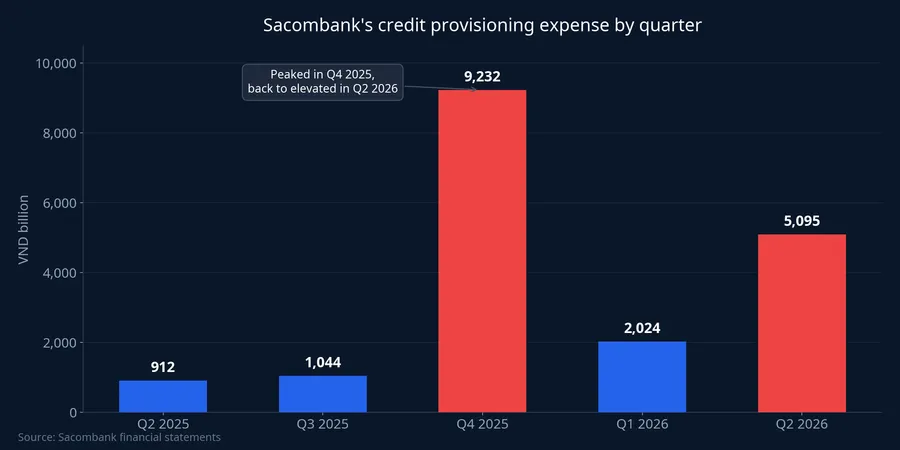
The data leans toward a combined reading: the underlying deterioration in asset quality is real, while the timing and intensity of provisioning is a choice the bank makes. Q4 2025 was the peak provisioning quarter at VND 9,232 billion and pushed Sacombank to a VND 3,360 billion pre-tax loss, showing the bank is willing to front-load costs into a single quarter rather than spread them evenly. The simple "business is deteriorating" narrative is undercut by pre-provision profit itself, which shows the bank's revenue engine actually running better than a year ago.
The unresolved knot: a 32.5% stake held at VAMC
Sacombank's restructuring plan has reached its final stretch, and the piece still unresolved is a loan secured by 32.5% of STB shares from the group led by former Vice Chairman Trầm Bê, which was transferred to the Vietnam Asset Management Company (VAMC).Báo Đầu tư The related principal has already been 100% provisioned. The bank has submitted a proposal to the State Bank of Vietnam to auction this block of shares and is awaiting approval; as of early September 2026, no transaction has been completed.

This knot cuts both ways: a successful auction could generate a large provision reversal and reshape the profit base in subsequent quarters, while continued delay would keep provisioning pressure weighing on profit for several more quarters, exactly as management itself has warned.
On plan progress, Sacombank's annual shareholder meeting in April 2026 set a full-year pre-tax profit target of VND 8,100 billion and aimed to bring the bad debt ratio below 5%.Vietstock With VND 4,136 billion booked after six months, Sacombank has reached about 51% of its profit target. The bad debt target, meanwhile, is moving further away from goal rather than closer.
What order should investors read this in
Sacombank's case illustrates a general rule for reading bank earnings: the order in which you read matters as much as the numbers themselves. For a bank with a clean balance sheet, NIM is a reasonable place to start, since most profit swings come from the lending spread. For a bank still working through legacy problems like Sacombank, the order should flip: credit cost and group-2 loans first, bad debt coverage second, NIM last.
Set VND 7,119 billion in first-half provisioning against a loan book of VND 636,029 billion, and Sacombank's credit cost works out to roughly 2.24% annualized, large enough to swallow every basis point of NIM improvement whole.Báo Đầu tư That does not make Sacombank a weak bank: its revenue engine is running better than a year ago, operating costs are down, and customer deposits are still up 4.8% from the start of the year.Báo Đầu tư The stock's story over the next 12 months will be decided by the pace of balance-sheet cleanup, not by a few basis points of quarterly NIM.
Two specific signals are worth watching in coming quarters: whether group-2 loans stabilize near 2.6% or keep climbing in the Q3 report, and whether the State Bank of Vietnam approves the VAMC share-auction plan in the second half of the year. If group-2 loans keep rising, the more likely scenario is that provisioning expense stays elevated through the second half, and full-year profit tracks close to, rather than beats, the VND 8,100 billion target.