
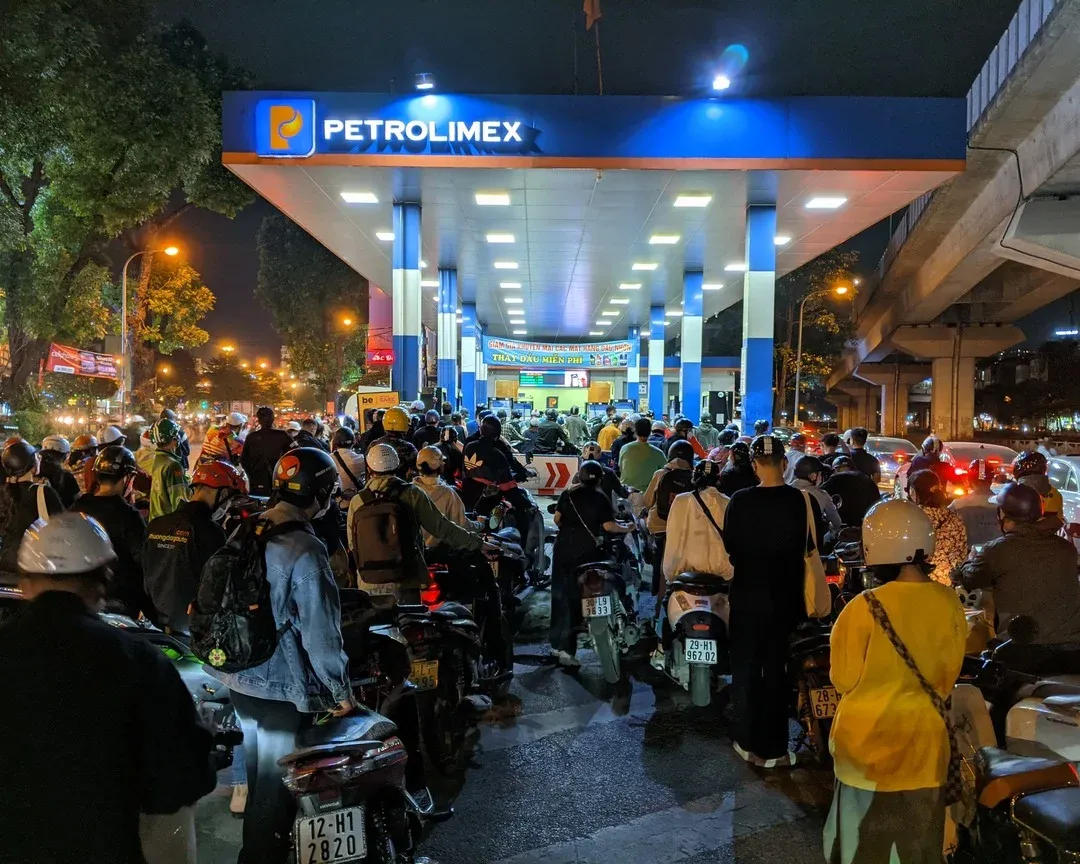

Brent crude is approaching $100 a barrel after a week of military escalation in the Middle East, and that is flowing straight into Vietnam's retail fuel prices. At 3pm on Thursday, September 10, the state price authority will announce a new retail price band, the first review to fully absorb ten days of attacks on Iranian oil tankers and Saudi Arabian energy infrastructure. But the bigger story isn't what motorbike riders pay at the pump. It's the widening gap between diesel and gasoline, where trucking, aviation and chemicals are carrying the heaviest part of the burden.
Middle East escalation pushes Brent toward its old highs
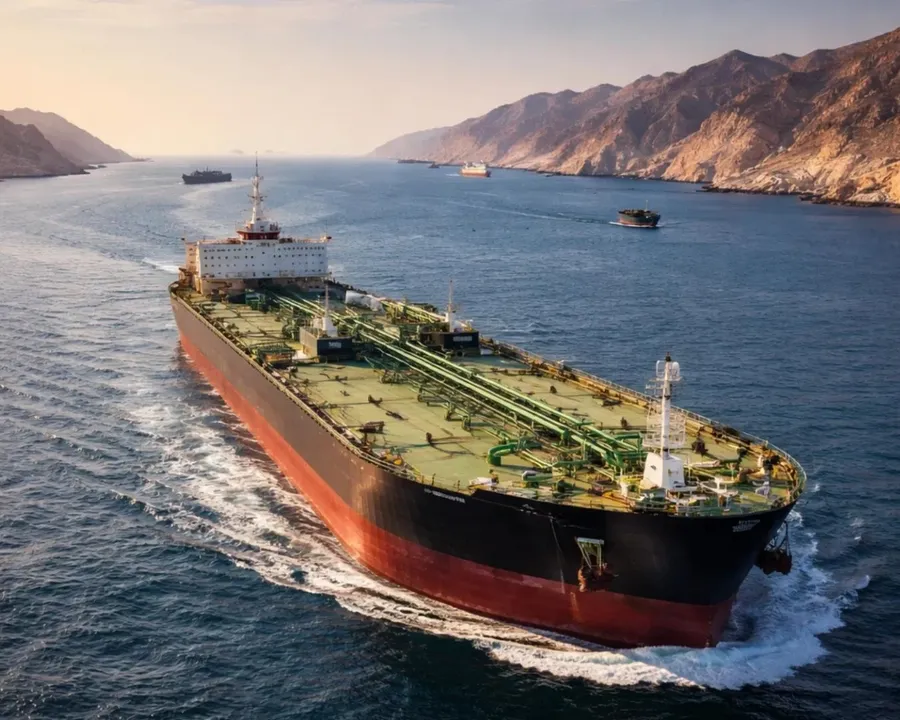
On September 8, Houthi forces launched dozens of drones and ballistic missiles at four areas in southern Saudi Arabia, sparking fires at Saudi Aramco facilities and injuring 73 people.CafeF Jazan, one of the targeted areas, is home to a refinery with a capacity of 400,000 barrels a day.Seoul Economic Daily Markets reacted within the session: Brent touched $99.22 a barrel intraday, the highest since July 24, before settling at $97.41.Seoul Economic Daily

What matters here isn't the size of the price move, it's that the type of target has shifted. For months, supply-side risk centered on the possibility of a Strait of Hormuz blockade. Since early September, two new lines have been crossed: the US military began directly striking Iranian government oil tankers under a "tanker-for-tanker" policy approved by US President Donald Trump, hitting three more tankers on September 5-6,Người Quan Sát and the Houthis opened a new front targeting Saudi Arabia's own energy infrastructure, the region's largest exporter and the country most relied upon to cover any supply shortfall.
One caveat worth stating clearly, so the whole move isn't pinned on geopolitics alone: Brent had already recovered from a low of $71.57 a barrel in early July, meaning the war-risk premium is stacking on top of an existing demand-recovery trend. Even if tensions ease, oil is unlikely to fall back to the $70 range it traded at mid-year.
Why Vietnam's pump prices are about to rise, and by how much
Vietnam's retail fuel prices don't track daily Brent swings. They follow the seven-day average of Singapore refined product prices instead. That's why tomorrow's increase reflects the entire run of sessions from September 3 to 9, not just the September 8 spike, and why the forecast increase is fairly even across gasoline and diesel rather than jumping only on the Saudi headlines. Distributors expect an increase of roughly VND 1,400 per liter for E5 RON92 gasoline, VND 1,300 for E10 RON95-III, and VND 700 for diesel.Techz If the forecast holds, E5 gasoline would rise to around VND 23,900 per liter and E10 RON95-III would break VND 24,500, up from the current band set on September 3 at 3pm.LuatVietnam These are still distributor estimates, not accounting for any offset from the Price Stabilization Fund, so the final figure depends on tomorrow's 3pm decision.
Diesel is outpacing gasoline 5-to-1: who's absorbing the gap
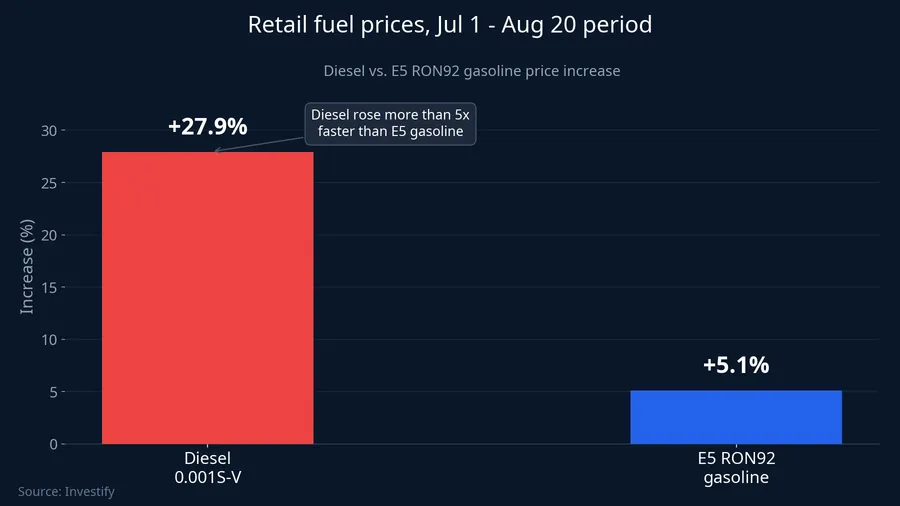
Zooming out beyond a single price review, the more telling number isn't Brent. It's the gap that has built up over weeks between the two fuels. From the July 1 to August 20 pricing period, diesel 0.001S-V rose from VND 23,960 to VND 30,640 per liter, up 27.9%, while E5 RON92 gasoline edged up only from VND 20,780 to VND 21,830, a 5.1% increase. Motorbike riders barely felt it. Businesses running trucks, ships and generators absorbed nearly all of that gap.
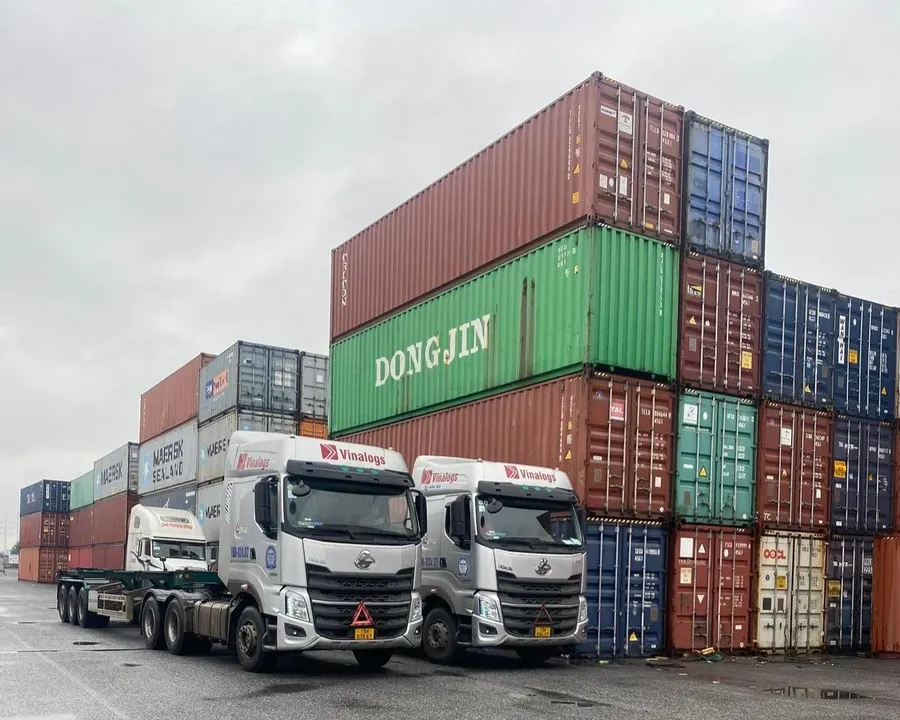
Fuel costs are stratifying sharply by sector as a result. Aviation has the thinnest cushion: in Q2 2026, HVN's gross margin was just 4.2%, its operating margin was negative 1.7%, and its debt-to-equity ratio reached 6.7x. VJC still posted a gross margin of 5.6% and stayed profitable, but profit fell 46.5% year-on-year even as revenue rose 70.6%. Road transport, courier services, plastics and chemicals (whose feedstock tracks oil prices), and nitrogen fertilizer (produced from natural gas) all face similar cost pressure.
The Price Stabilization Fund cushion is thinning
The Price Stabilization Fund is the only tool that can dampen the size of a single price adjustment, but public data on the fund is scarce. As of the September 2, 2026 reporting period, Saigon Petro withdrew a net VND 29.7 billion and made no new contributions, leaving a balance of VND 27.6 billion. The largest distributors haven't updated their Q3 figures: Petrolimex's most recent reported figure is a positive balance of VND 928 billion as of April 8, 2026, while PVOIL's stood at negative VND 1,671 billion as of April 21, 2026.
Given that limited coverage, it's not possible to say definitively whether the fund is building up or thinning out over the July-September period. But the one signal available, Saigon Petro spending without replenishing, points toward erosion rather than accumulation, which suggests tomorrow's review will likely have less shock-absorbing capacity than previous ones.
Money has already started repricing oil and gas stocks
The September 8 session showed domestic markets didn't wait for the price review to react to Brent. Oil and gas stocks reversed sharply after Monday's decline: PVT rose 6.77% to VND 21,300 per share, PVS gained 4.29%, BSR added 2.66%, GAS was up 1.93%, and PLX rose 1.71%. The VN-Index edged up 0.48% that same session to 1,830.44 points.
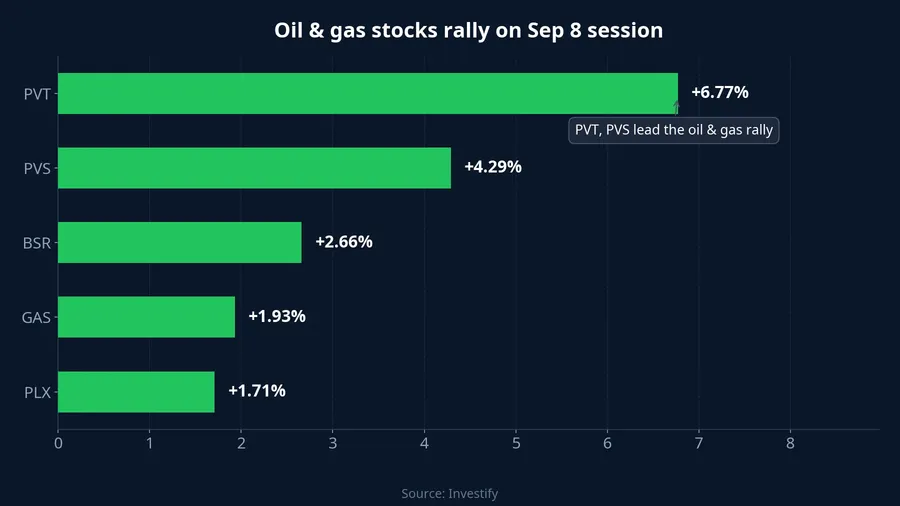
On the beneficiary side, refining stands out most clearly: in Q2 2026, BSR posted a 15% gross margin and profit up 805.6% year-on-year. PLX benefits more on the revenue line than on margin, with a gross margin of just 5.6%. But "high oil prices" don't automatically translate into profit for every oil and gas name: PVD's Q2 2026 profit fell 28.5% even as revenue rose 24.1%, and the stock has lost 43.1% of its value from late June through the September 8 session, the steepest decline in the group. For a drilling contractor, revenue depends on rig day-rates and signed contracts, not today's Brent quote. The September 8 rally in oil and gas stocks may also partly reflect bargain-hunting after the prior day's decline, not purely the oil price move.
Four signals worth watching
The actual price increase announced at 3pm on September 10, and how much the Stabilization Fund is drawn down alongside it, is the first signal. If the increase comes in well below forecast, the gap likely reflects fund spending: information about room to maneuver in future reviews, not just about today's price. September CPI data is the second signal, since transportation carries meaningful weight in the CPI basket and reacts almost immediately to fuel prices.
The state of the Strait of Hormuz and Saudi Arabia's retaliatory response is the third signal. Saudi Arabia has warned it will respond to the Houthis; if retaliation spreads to the Red Sea and Bab al-Mandab shipping lanes, Saudi Arabia's alternative export route would also come under threat, making a sustained oil price above $100 a more plausible scenario. Finally, Q3 earnings from fuel-consuming sectors, due out at the end of October, will show which companies managed to pass costs through to prices and which had to absorb them into margin.
Conclusion: two scenarios, one deciding factor
The picture right now splits into two scenarios. In the first, geopolitical tension eases over the coming weeks, Brent retreats to the $85-90 range, and cost pressure on trucking and aviation gradually fades with the next price review. In the second, Saudi Arabia's retaliation escalates, keeping oil prices elevated in the $90-100 range for longer, widening the diesel-gasoline cost gap further and eroding the already-thin margins at HVN, VJC and road transport operators.
The deciding factor between these two scenarios is what happens at Hormuz and how Saudi Arabia responds in the coming days, not tomorrow's domestic fuel price increase. Investors may want to track the Stabilization Fund drawdown at each price review and the Q3 earnings from fuel-consuming sectors to see who is actually managing to pass costs through to prices, rather than reacting to every daily swing in Brent.