

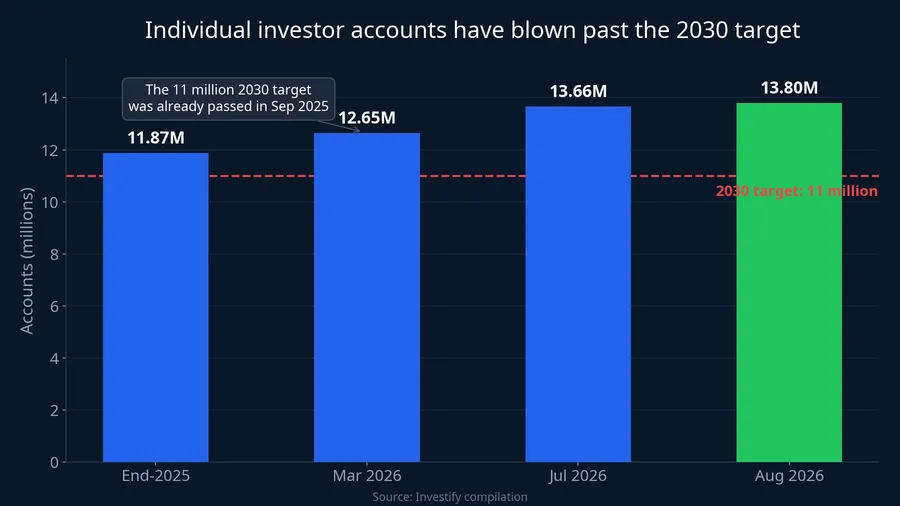
In late December 2023, Vietnam's Securities Market Development Strategy to 2030 set a specific target: 9 million trading accounts by 2025 and 11 million by 2030.Chinhphu.vn The 11-million mark was crossed by the end of September 2025, five years ahead of schedule.Dân trí By the end of August 2026, domestic individual investors held more than 13.8 million accounts, equivalent to nearly 14% of the population, with over 2 million accounts opened in the first eight months of the year alone.CafeF
A policy target beaten this badly is usually good news. But set against liquidity trends on the Ho Chi Minh City exchange over the same window, the picture gets more complicated. And the most telling detail isn't the 13.8 million figure itself: it's that the regulator has already moved on to a different yardstick.
From the 2021 peak to the cost of arriving late
In 2020, falling deposit rates and pandemic lockdowns pushed an entirely new cohort of investors toward the trading screen. In 2021, domestic individual investors opened more than 1.5 million accounts, one and a half times the combined total opened across all four years from 2017 to 2020.CafeF The VN-Index closed that year at 1,498.28 points, up 35.73%, after peaking at 1,511.68 points on November 26, 2021. For most newcomers, year one on the market was a profitable one.
The cycle's true peak came on January 10, 2022, at 1,536.45 points. Ten months later, the index bottomed at 873.78 points on November 16, 2022, down roughly 43% from the top; for the full year 2022, the VN-Index fell 32.78%. This is the least-discussed stretch of the story, and the costliest: anyone who opened an account in Q4 2021 or January 2022 had almost no way to dodge that drawdown, short of already knowing how to cut losses. New account openings stayed cold for a long time afterward, and just how cold only becomes clear against the present: 2026's strongest month for new accounts is still only the highest since mid-2022. That's nearly four years without a single month matching the intensity of the 2021 peak.
2025 and a target left behind
The market regained its footing from 2024 and broke out in 2025. The VN-Index closed 2025 at 1,784.49 points, up 40.87% — the strongest annual gain since 2021 — despite a mid-year drop to a trough of 1,073.61 points on April 9, 2025. New accounts followed that momentum back: the market added nearly 2.6 million accounts over the full year, pushing the total to 11.87 million by year-end and completing the 2030 target five years early.Nhân Dân
The first eight months of 2026 continued that rhythm, but unevenly. The strongest month was March, with 346,406 new accounts, the highest since June 2022.Vietstock Notably, that was also the month the VN-Index hit its yearly low, 1,582.26 points on March 23, 2026. Two events sharing a month isn't enough to conclude that new investors have learned to buy the dip. March is also peak media season after Tết, and part of that month's account openings tie to investors transferring between brokerages. But set against 2021, when new accounts flooded in right as the index was climbing to its peak, this is still a shape worth noting.
In the second half of the year, account openings slowed noticeably: July saw just 227,300 new accounts, the lowest in a year, bringing the total to 13.66 million, before August ticked back up to nearly 230,000.Vietstock
More people, less money
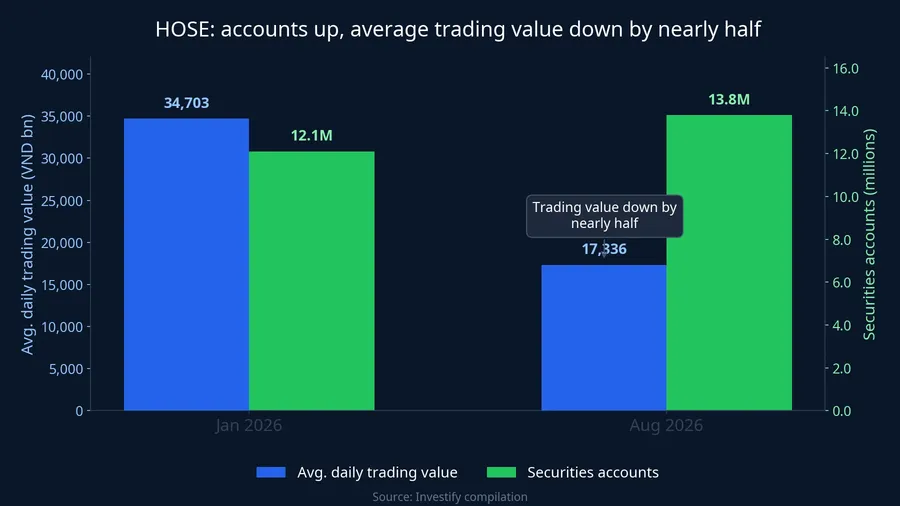
This is where the 2026 chapter departs from every stage before it. In January 2026, average daily trading value on HOSE reached more than VND 34,703 billion per session, up nearly 47% from the prior month.Etime Dân Việt By August 2026, that figure had fallen to just over VND 17,336 billion, down roughly half, even as the market added over 2 million accounts across the same stretch.Thời báo Ngân hàng
A rough division makes the shift concrete. At the end of January, each of the roughly 12.1 million accounts then on record corresponded to about VND 2.9 million of matched trading value per session. By the end of August, that figure had fallen to roughly VND 1.3 million per account across 13.8 million accounts. This is a mechanical split across every account ever opened, not a real person's actual trading value, but the direction is unmistakable.
There are at least three plausible explanations for this gap, and none of them rules out the others. The first is a base effect: January 2026 was an unusually high-liquidity month, and using a peak as the comparison point will always exaggerate the decline. The second is the technical nature of some new accounts: per Tin nhanh Chứng khoán, clients who switch brokerages and use margin are required to open a new account, so a rising account count doesn't necessarily mean more actual new investors.Tin nhanh Chứng khoán More than a year of broker staff turnover has also driven many accounts to be re-opened at new firms.
The third is the structure of capital flows: in August, the VN-Index rose 5.55% from July and HOSE market capitalization topped VND 8.84 quadrillion, but VIC stock alone accounted for over VND 25,943 billion of that month's trading value.Thời báo Ngân hàng When money concentrates in a narrow group of stocks, the index can still climb while most individual portfolios don't share in the gain proportionally. All three explanations point to the same conclusion: the account count has stopped functioning as a measure of real individual investor participation.
The state has already changed its yardstick too
This isn't just an observation from market analysts. On September 12, 2025, almost exactly when the 11-million account mark was crossed, the Ministry of Finance issued Decision 3168/QĐ-BTC approving the Scheme for Restructuring Investors and Developing the Securities Fund Industry.Chinhphu.vn Its headline target this time isn't the account count: it's the number of fund certificate holders, 2.5 million by 2030 and 5 million by 2035, alongside a target of 500 securities investment funds and total fund net asset value equal to 5% of GDP by 2030.
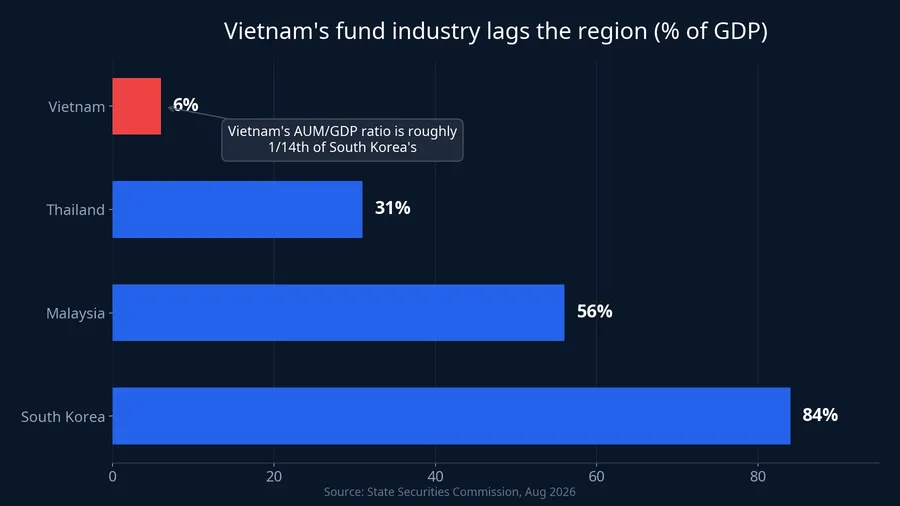
The gap to that new target remains wide. At a conference held September 25, 2026 by the State Securities Commission of Vietnam, Nguyễn Công Minh, Director of the Fund Management Companies and Securities Investment Funds Department at the State Securities Commission of Vietnam, said total assets under management in the fund industry grew from roughly VND 124 trillion at the end of 2015 to more than VND 846 trillion by the end of June 2026, but that's still only about 6% of GDP, compared with over 31% in Thailand, over 56% in Malaysia and 84% in South Korea.Tạp chí Kinh tế Tài chính The number of open-end funds grew from 34 in 2020 to 82, and ETFs from 7 to 21.
Put the two targets side by side and the gap becomes clear: the nationwide goal of 2.5 million fund certificate holders by 2030 doesn't even reach a fifth of the trading accounts already opened as of today. In other words, the regulator is now betting on the quality of capital flows rather than the number of participants, just as the account count has stopped reflecting that quality.

What this means for anyone who just opened an account
The lesson of the 2021 wave isn't "stay out of the market." The real lesson is that entry timing determines most of a first-year experience, and no one gets to choose that timing. What can be chosen is how to participate.
For long-term capital that a new investor doesn't have time to track stock-by-stock, allocating through open-end funds or index ETFs is the common default choice, since it removes the stock-picking step, something a newly opened account doesn't yet have the tools to do well. For risk capital set aside to learn the craft, self-directed trading is reasonable, as long as its weight stays small enough that a 40% drawdown like 2022's doesn't drive someone out of the market for good. This is also the direction Decision 3168 sets at the policy level: shifting focus from the number of individual investors to the quality and professionalism of capital flows.
What to watch next
In early October, September's new account figures will be published. That number should be read alongside September's average trading value on HOSE, not in isolation. If both lines move up together, this year's wave gains more evidence of being backed by real money. If accounts keep rising while trading value stays flat or falls below August's level, the 13.8 million figure is measuring registration coverage more than actual participation.
The FTSE upgrade takes effect on September 21, right in the middle of that window. That makes September's reading worth watching all the more closely.