

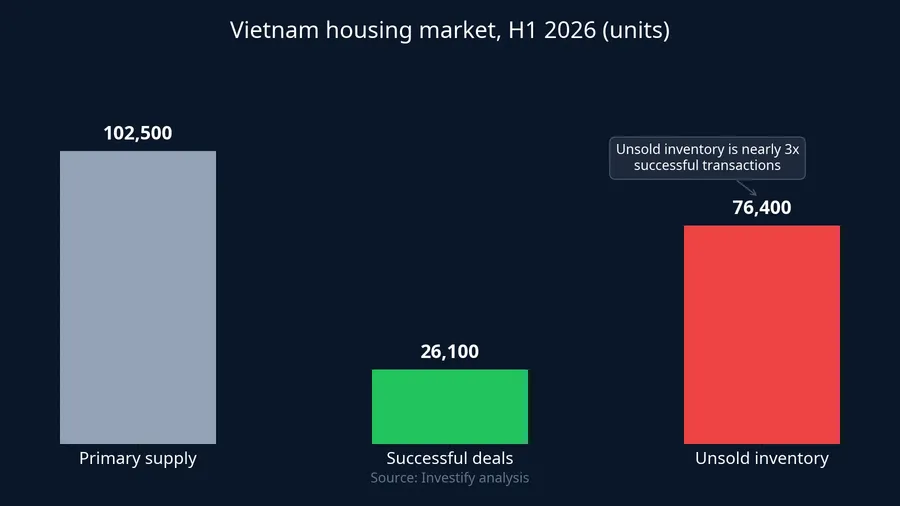
There's a rule almost every real estate investor has heard: more supply means lower prices. The first half of 2026 looks like textbook conditions for that rule to kick in. Nationwide primary supply reached 102,500 units, successful transactions totaled just 26,100 units, and unsold inventory sat around 76,400 units.Thời báo Ngân hàng The absorption rate dropped to 25.5%, down from 47.5% for all of 2025. That's a textbook setup for a price correction. But the six-month data shows what buyers are waiting for likely isn't coming, and the reason isn't seller psychology.
The numbers check out, but three-quarters of the stock finds no buyer
S&I Ratings' Q2 2026 housing market update recorded transaction volume falling year-on-year while supply surged, pulling the absorption rate below one-quarter.Thời báo Ngân hàng The 25.5% figure is calculated against total primary supply currently on offer, including unsold units from earlier launches, so it reads lower than the new-supply absorption rate some other research firms publish. Both methods are valid; this piece uses the broader one to capture the full stock currently sitting on the market.
On the transaction side, data compiled from local authority reports shows the whole country recorded more than 100,000 successful real estate transactions in Q2, equal to just 71.5% of Q1 and 63.7% of the same period in 2025.CafeF Weak buying power is real, and it shows up across multiple independent sources.
What's rising isn't what buyers are waiting for
This is where the textbook supply-demand rule gets misapplied. Supply and demand can only compress prices when they meet in the same segment, and in the first half of this year they didn't. Hanoi recorded 9,700 primary units in Q2, with newly launched apartments alone reaching more than 8,590 units, up 25.4% year-on-year. The six-month cumulative total hit 16,600 units, the highest first-half figure since 2020.Thời báo Ngân hàng Taken on its own, that number suggests the market is more oversupplied than at any point in six years.
But more than 70% of those new apartments sit in the high-end and luxury segments, and units priced under VND 60 million per square meter simply didn't appear on Hanoi's market in 2026. That's not scarcity, it's absence. Hanoi sold 5,800 apartments in Q2, up 12% year-on-year, yet the ratio of transactions to new supply reached only 67%. Buyers waiting for lower prices are mostly in the owner-occupier group, budgeted below that VND 60 million threshold, while the added supply sits above it. Both groups show up in the same statistics table but never trade with each other, so inventory pressure at the top doesn't transmit into price pressure at the bottom.
Part of the rise in average price also comes from this compositional shift itself, not from every single unit getting proportionally more expensive. When everything sold is luxury-tier, the average price rises automatically. That's a genuine statistical effect, and it explains part of the phenomenon, not all of it.

The cost floor: why developers won't cut list prices
The rest of the story is input costs, and this is the real price-locking mechanism. Borrowing costs for contractors and developers can run above 12% a year, while the average bond coupon rate for the real estate sector reached about 11.4% in Q2 and 11.3% for the first half.Thời báo Ngân hàng The spread between lending and deposit rates through Q2 is estimated at 7.2 percentage points. Construction costs are climbing too: labor costs are up more than 25% in some areas, and materials are up 10-20%.
When capital costs more than 12% a year and construction costs keep rising, the room to cut selling prices on an already-launched project is close to zero. Cutting the list price also carries two consequences developers dread: the list price becomes the reference point for future launch phases, and it's the basis for valuing mortgaged collateral. So they reach for other tools instead: interest-rate support, principal grace periods, lower equity requirements, extended payment schedules, and bigger discounts, rather than a direct price cut. This is the point the simplified supply-demand rule misses: real estate supply isn't fixed, and when prices come under pressure, sellers tend to adjust sales policy rather than cut the listed price.
But prices have genuinely fallen somewhere
Saying real estate prices haven't fallen at all would be an overstatement. Prices have fallen, just not where people expected. For townhouses and villas, the average primary price in Ho Chi Minh City fell 3% to VND 216 million per square meter.Thời báo Ngân hàng In the land-plot segment, Q2 inventory reached 11,148 plots, up roughly 25.4% from the prior quarter, and asking prices have shifted to a decline of roughly 2-6%.CafeF
The difference between segments that held their price and those forced to cut isn't about supply-demand balance. It's about who needs cash. Secondary-market units held by individual investors carry monthly interest payments and have no discounting tool besides lowering the asking price. Primary-market units belonging to developers still have room to hold out through sales policy. Apartment prices are still edging up: average primary price in Ho Chi Minh City is around VND 92 million per square meter, up 1% quarter-on-quarter; secondary price is around VND 69 million, up 2%.
Corporate balance sheets are the real variable ahead
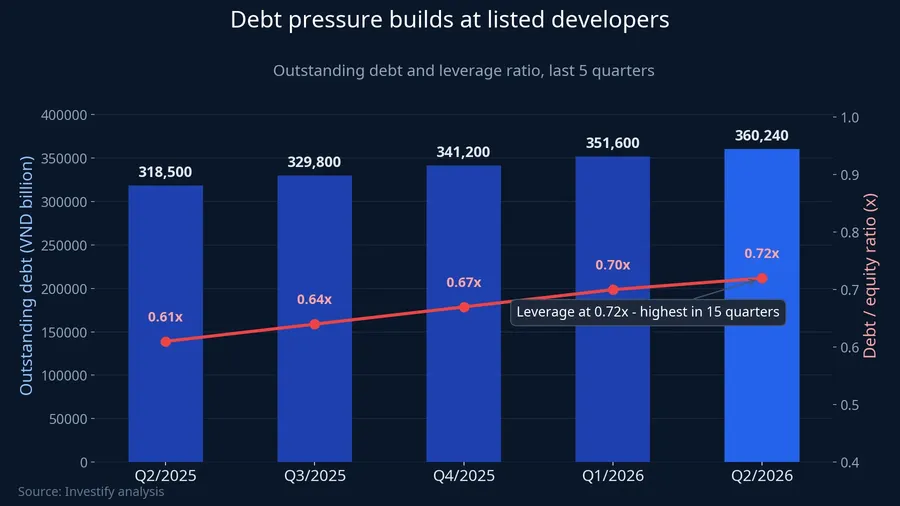
If cost of capital is what's holding prices up, corporate balance-sheet resilience is what determines how long that hold can last. Total outstanding debt at listed real estate companies reached VND 360,240 billion at the end of Q2, up 20.3% in a single quarter.VnExpress The debt-to-equity ratio rose from 0.61x to 0.72x, the highest in 15 quarters.
With bank credit constrained, bonds are back. In Q2 alone, the real estate sector issued VND 102,400 billion in bonds, up 228% year-on-year, with more than 80% of that value coming from Vingroup, Masterise, and Sun Group.Người Quan Sát Three names carrying nearly all of the issuance also means the rest of the sector has a much harder time accessing this channel. Real estate bonds maturing in 2027 total VND 156,521 billion, up 16% from 2026, and not every company has the cash flow lined up to clear that bar.
How the market is reading this story
In the morning session of September 8, liquid real estate stocks fell slightly more than the broader index. The VN-Index eased 0.25% to 1,817.00 points, while VHM fell 1.21% to VND 73,600, NLG fell 1.37% to VND 25,150, PDR fell 1.24% to VND 11,900, NVL fell 1.15% to VND 12,850, and DXG fell 0.87% to VND 11,400.
The moves are small, and one morning session doesn't establish a trend. But the direction is worth noting: news of a strong supply recovery wasn't read as good news for developers. Against a backdrop of rising debt and bond obligations, more inventory means higher carrying costs, not necessarily more certain future revenue. That's one reasonable reading among several possible ones, and the evidence available isn't enough to say it's the sole reason these stocks underperformed the index this session.

A more accurate picture: price as a cost variable
The rule that more supply means lower prices still holds, but it needs two conditions Vietnam's market didn't have in the first half of 2026: supply and demand must sit in the same segment, and selling price must be a free variable. Here, supply grew in the luxury tier while demand waited in the affordable tier, and primary prices were floored by a cost of capital above 12% a year plus rising construction costs.
The more accurate reading: listed primary prices are currently a cost variable, not a short-term supply-demand equilibrium variable. As long as borrowing rates stay in the 12-14% band and real estate corporate bonds keep pricing above 11%, listed price levels will hold, regardless of whether inventory is 76,400 units or higher. The risk most worth watching isn't rising inventory, it's the VND 156,521 billion bond maturity wall in 2027, arriving just as the sector's leverage ratio sits at a 15-quarter high. That risk doesn't reverse the price thesis, but it determines which companies survive this high-cost-of-capital cycle.
A genuine correction, if it comes, will show up in two other places: secondary prices, where sellers carry interest costs directly and have no tool besides lowering the asking price; and the actual price paid on primary contracts, through discounts, principal grace periods, and extended payment schedules. Buyers comparing two projects should line up total cost after policy incentives rather than the sticker price, because that's where the real gap sits.
Two signals worth watching in the coming quarters: whether apartments under VND 60 million per square meter return to Hanoi's new-launch lineup, and whether mortgage rates leave the 12-14% band. Until at least one of those happens, the inventory figure growing each quarter remains a corporate balance-sheet story, not yet a price-tag story.