
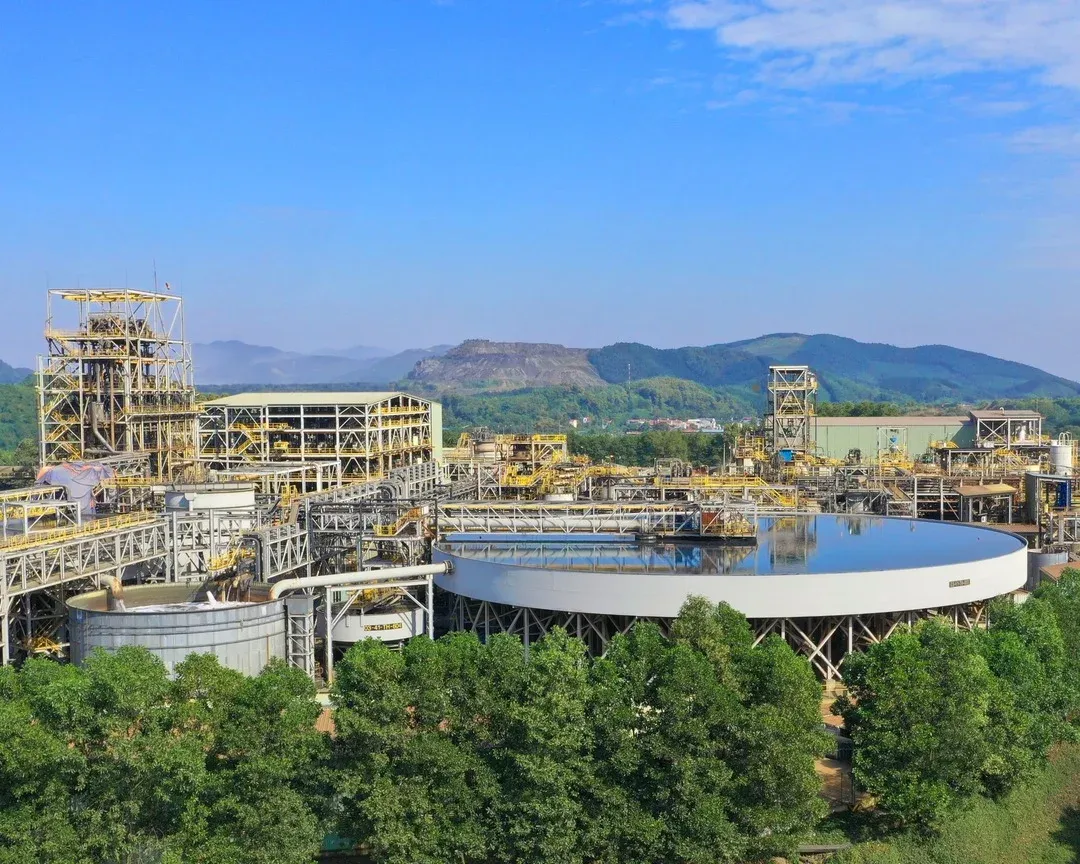

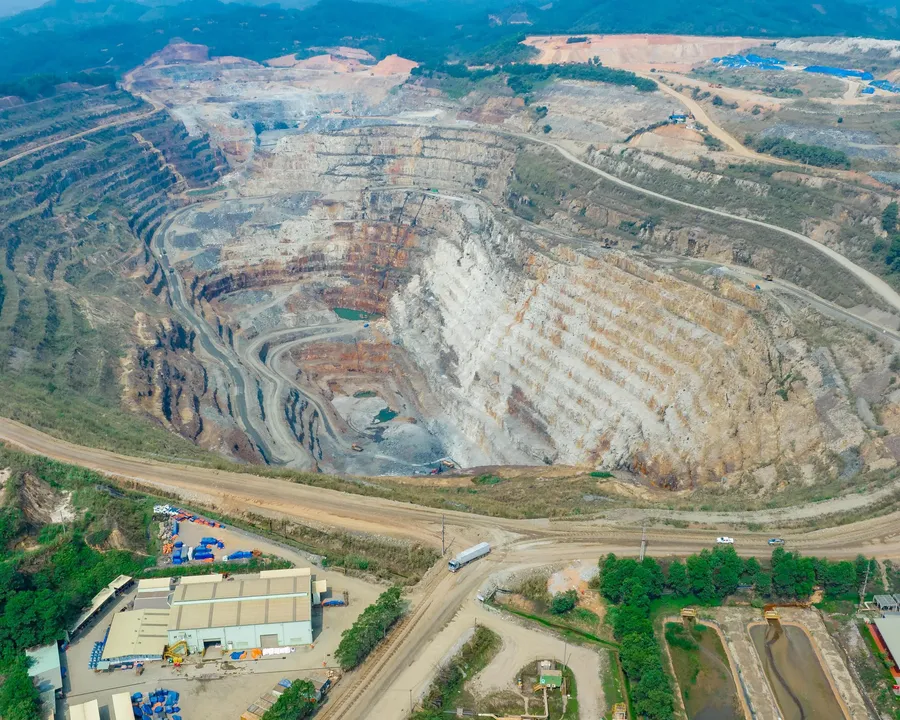
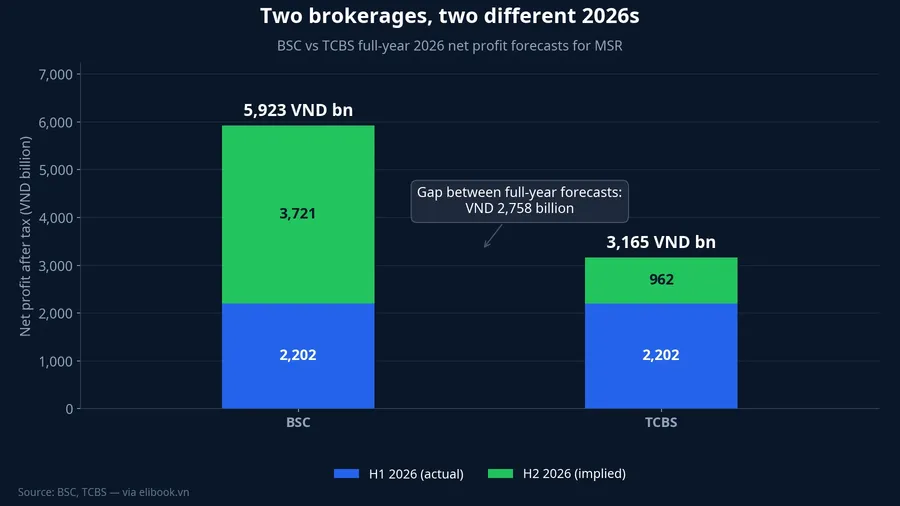
On August 26, 2026, two Vietnamese brokerages published research on Masan High-Tech Materials (UPCoM: MSR), which operates the Núi Pháo polymetallic mine in Thái Nguyên. Both read the same audited semi-annual results, yet arrived at wildly different profit calls: BSC forecasts full-year 2026 net profit after tax of VND 5,923 billion, while TCBS puts the number at just VND 3,165 billion. That's a gap of VND 2,758 billion, meaning BSC's estimate runs 87% higher than TCBS's.Elibook
For a company already halfway through its fiscal year, that spread is unusual. The disagreement isn't about the past, since both sides agree on what already happened; it's about how each brokerage is betting on the second half.
The first half: nobody disputes this part
In H1 2026, MSR posted net revenue of VND 11,131 billion, up 270% year-on-year, and net profit after tax of VND 2,202 billion, compared with a VND 216 billion loss in H1 2025.Elibook According to Người Quan Sát, this half-year profit alone equals the company's cumulative profit from the previous 16 years of operation.Người Quan Sát
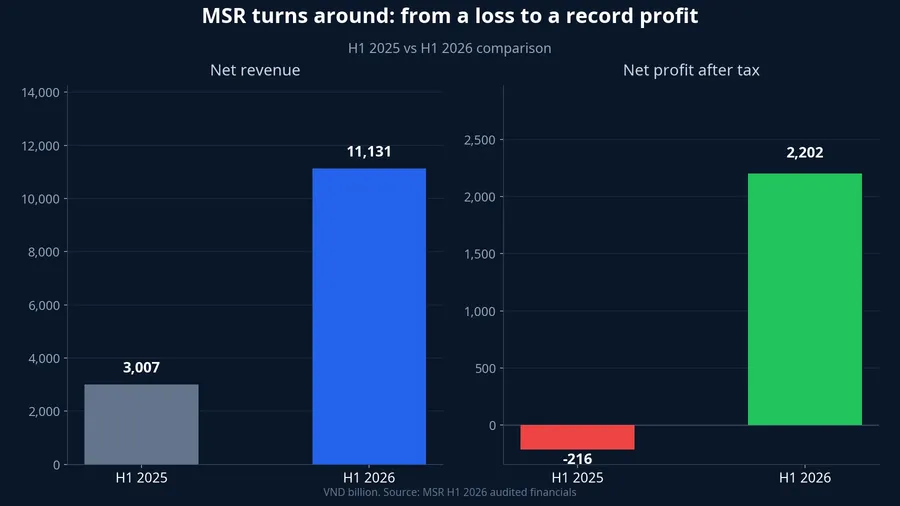
Q2 alone contributed VND 8,138 billion in revenue, 5x the year-ago quarter, and net profit attributable to parent shareholders of VND 1,666 billion, versus a mere VND 6 billion in Q2 2025. That made it the largest quarterly profit in MSR's history. Through the first half, the company had already achieved 129% of its full-year revenue target and 88% of its full-year profit target, both set by management at the start of the year.
Notably, none of this came from one-off gains: Q2 EBITDA reached VND 2,346 billion, up 4.7x year-on-year, meaning the profit came from real operations.
Why the turnaround happened so fast
Looking at the profit structure, the dominant driver was selling price. Ammonium paratungstate (APT), Núi Pháo's main refined tungsten product, averaged USD 3,245/mtu in Q2 2026, while MSR's own annual plan had assumed only USD 1,164-1,246/mtu, meaning realized prices ran roughly 2.6x above the original assumption.Elibook Nearly all of that excess flowed straight to profit, since the cost of mining a ton of ore doesn't rise with the world price.
The price rally came from both supply and demand. On supply, China tightened mining quotas and now permits only around 15 companies to export tungsten in 2026-2027.Elibook On demand, defense now accounts for roughly 12% of the global tungsten market and is growing about 8% a year, since tungsten is hard to substitute in armor-piercing rounds and extreme-heat equipment; MSR also cited additional support from data-center and semiconductor demand.
Volume was the second, smaller but real, driver: refined tungsten output rose 91% and processed ore output rose 29% year-on-year, as the company expanded its external concentrate-purchasing network to run its refining plant at full capacity instead of waiting for its own mine to supply enough feedstock.
A third, less-discussed factor was tax: the effective tax rate in Q2 was just 4.7% (VND 82 billion on pre-tax profit of VND 1,748 billion), thanks to carried-forward losses from 2023-2024, an advantage that will fade as the accumulated losses are used up.
The first-ever cash dividend, and its actual legal status
On August 12, 2026, MSR's board approved seeking shareholder written consent for an interim cash dividend of 10% of par value (VND 1,000 per share), for a total payout of roughly VND 1,100 billion (about 50% of H1 net profit), with a record date around September 17 and payment around September 24, 2026.Elibook
The legal status matters here: this is a plan still pending shareholder consent, not a payout that has already cleared procedure. At the September 8 closing price of VND 47,900, the proposed dividend works out to a yield of only about 2.1%, not the stock's main attraction right now.
The more telling number is where the cash is coming from: short-term cash and financial investments rose from VND 255 billion (June 30, 2025) to VND 4,339 billion (June 30, 2026), net debt to EBITDA fell to 2.1x, and Q2 interest expense, though up 21.1% to VND 310 billion, now consumes just 15% of gross profit versus 64.3% a year earlier. That's a qualitative shift in the business's financial structure, not just growth in scale.
Where the two brokerages diverge
BSC forecasts 2026 revenue of VND 30,998 billion and net profit of VND 5,923 billion, with a buy rating and a target price of VND 52,800 per share (target P/E of 8.5x). Its core assumption is that APT prices hold above USD 3,000/mtu and climb more than 30% further above the H1 average, alongside processed ore output rising another 10-20%. Subtracting the VND 2,202 billion already booked, this scenario implies H2 profit of roughly VND 3,721 billion, 69% higher than H1 itself.
TCBS is far more conservative: it forecasts 2026 revenue of VND 24,710 billion and net profit of VND 3,165 billion, without a target price, recommending only to hold and monitor. By TCBS's math, H1 already delivered 45% of full-year revenue but 69.6% of full-year profit, leaving only about VND 962 billion for the rest of the year, more than 56% below H1.
The cautious case rests on three details from the Q2 report itself: gross margin stood at 25.3%, roughly flat versus 24.7% a year earlier and well below the 30.6% posted in Q1, as a higher share of externally purchased concentrate carries a higher cost; inventory jumped from VND 3,676 billion at end-Q1 to VND 8,726 billion at end-Q2, or 23.7% of total assets; and total borrowings rose from VND 11,327 billion to VND 13,288 billion, with short-term debt alone climbing from VND 2,872 billion to VND 5,362 billion to fund working capital.
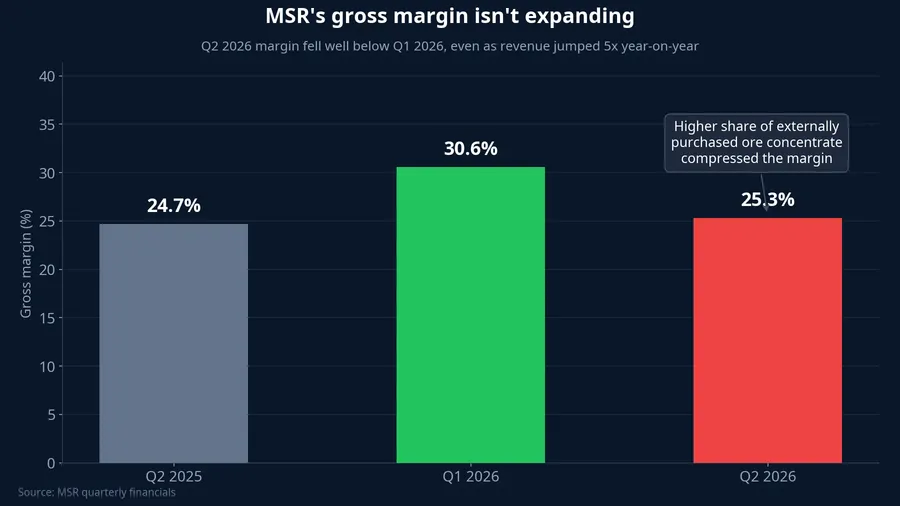
In short, Q2 profit grew mainly on volume and price, not on per-unit efficiency. With gross margin not expanding, every swing in the APT price flows straight through to profit with no buffer in between.
Which way does the current data point
As of early August 2026, European APT prices ranged between USD 3,000-3,279/mtu, essentially flat around the Q2 average and not climbing further.Elibook If this range holds, BSC's assumption of another 30%-plus increase looks like a fairly aggressive bet, while TCBS's cooling scenario looks more grounded on the pricing side.
To be fair to the optimists, both China's supply squeeze and rising defense demand are long-term forces that show no sign of reversing, and a fresh supply shock could easily push prices above the current range, in which case TCBS would turn out to have been too cautious. MSR has also secured legal milestones for roughly 115 million tons of additional resources, plus plans to lift tungsten oxide capacity to more than 8,000 tons of WO3 a year by 2027. That's a mine-life story that belongs to the long-term layer, not to Q3 or Q4 of this year.
For investors, the sensible framework at this juncture is to separate two layers: the long-term layer (reserves, position outside China, processing capacity) is genuinely improving and depends little on any single quarter, while the short-term layer (full-year 2026 profit) depends almost entirely on one variable MSR doesn't control, the APT price. The stock has already risen about 10.1% in just two weeks, from VND 43,500 on August 21 to VND 47,900 on September 8, so a meaningful chunk of the optimistic case is already priced in.

The Q3 report is where this argument gets settled. Three numbers to watch: the average realized APT price for the quarter, the share of self-mined ore in total feedstock, and whether gross margin expands out of the 25% range. If margin returns to the 30% band seen in Q1, BSC's scenario gains real support; if inventory keeps swelling while margin stays flat, TCBS's number will be the one closer to reality.