


On September 7, Brent crude briefly touched USD 98 a barrel, its highest level since July 24, after Iran said it had struck energy infrastructure across the Middle East in retaliation against the US.CafeF It closed at USD 97.16, up 0.92% on the day. On Vietnam's stock exchange the same session, oil & gas stocks did not benefit evenly the way the headline price move might suggest.
The VN-Index dropped 31.44 points to 1,821.64, down 1.70%, with 234 decliners against 81 gainers. All six major oil & gas names fell, but by six different amounts: PVD dropped 3.65%, PVS 3.62%, PLX 2.36%, BSR 1.68%, OIL 1.46%, and GAS 1.43%.
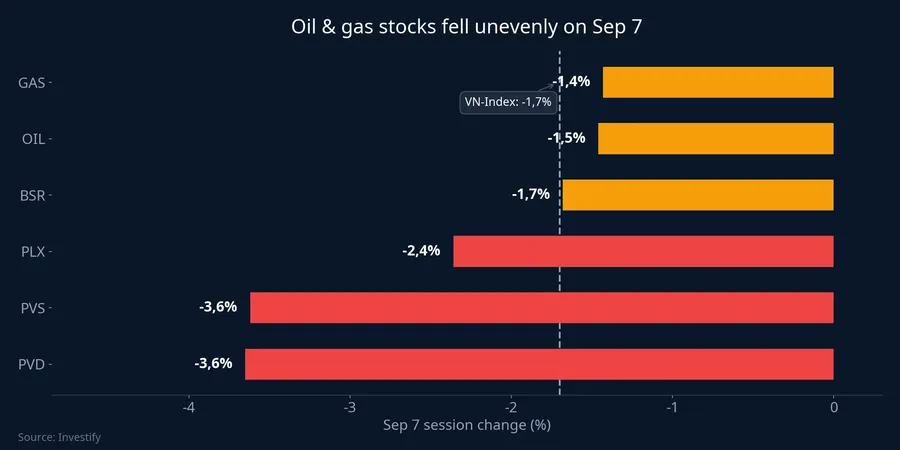
The order itself is the interesting part. BSR, the one company on the list whose input cost tracks crude prices day by day, actually fell less than the index. The two steepest decliners, PVD and PVS, are companies whose quarterly revenue is barely touched by a single session's 1% move in Brent. That counterintuitive ranking is the starting point for unpacking three distinct business models hiding inside the phrase "oil & gas stocks."
Refiners: profit comes from the spread, not the price level
A refinery buys crude and sells gasoline, diesel, and jet fuel. Its profit, known in the industry as the refining margin, is the gap between what it sells products for and what it pays for crude. The level of crude prices alone decides nothing; what matters is whether that gap widens or narrows.
The Hormuz shock is currently widening that gap in refiners' favor, at least for distillate products. Between August 31 and September 7, Brent rose USD 6.67 a barrel, while international finished diesel prices rose the equivalent of nearly USD 10.9 a barrel over the same window. Output prices moved up faster than input costs, so the margin refiners capture widened by roughly USD 4.3 a barrel.
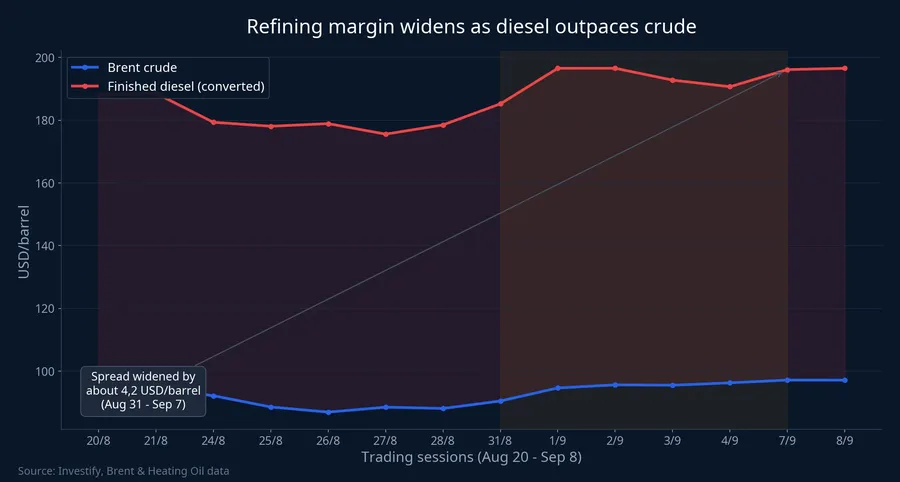
The reason is fairly direct: the Strait of Hormuz is not just crude's exit route, it's also the exit route for refined products from Gulf refineries. Kpler data cited by CafeF shows tanker traffic through the strait has averaged just 10 vessels a day over the past ten days.CafeF As fewer tankers pass through, the market runs short of finished product faster than it runs short of crude, so product prices move first. Gasoline tells a different story: over the same window, international finished gasoline prices rose the equivalent of just USD 5.88 a barrel, slightly slower than crude, leaving that particular gap almost flat. The widening is concentrated in diesel, not the entire refined product basket.

BSR's sensitivity to this spread shows up clearly in its financial statements. In Q2 2026, the company posted net revenue of VND 58,716 billion, cost of goods sold of VND 49,919 billion, and gross profit of VND 8,798 billion, a gross margin of 14.98%. The prior quarter's margin was 20.70%. In Q3 2024, cost of goods sold had actually reached 104.6% of revenue, meaning the company lost money at the gross-profit line. Same refinery, same capacity, yet gross margin swung from negative 4.6% to over 20% purely because the crude-to-product spread moved.
Distributors: selling prices are locked to a pricing cycle
PLX and OIL buy fuel at market prices but sell at administratively set prices, published on a fixed schedule. The most recent cycle, effective from August 20, set RON 95-V at VND 24,060 a liter, 0.001S-V diesel at VND 30,640 a liter, and E5 RON 92 gasoline at VND 21,830 a liter. Between August 25 and September 7, Brent climbed 9.7%, and none of that increase has yet been reflected in any retail price.

For distributors, this is a stretch where the cost of the next shipment has already risen while the selling price stays fixed. Retail margins per liter run only a few hundred dong, so even a few weeks of lag from the pricing cycle is enough to squeeze real pressure onto quarterly profit. This is the fundamental mirror image of the refining case above: the same oil price increase benefits refiners because their spread widens, while it hurts distributors because their selling price is locked on a schedule. Two opposite directions inside the same value chain.
Drilling services: prices already agreed don't move with today's oil price
PVD leases drilling rigs; PVS provides mechanical and technical services for exploration and production projects. Their revenue comes from day rates and contract values already signed, typically fixed for months or years. A single session where Brent rises by roughly 1% changes nothing on their invoices this quarter.
Higher oil prices reach these two companies only through a long detour: a field operator sees an attractive price outlook, approves new capital spending, then puts a drilling program out to tender, a chain that takes multiple quarters to play out. More importantly, this particular price spike stems from shipping-disruption risk rather than rising demand, and geopolitical risk can vanish as quickly as it appeared, so operators rarely commit multi-year drilling programs on the back of it.
So why did PVD and PVS fall the most
It's worth being honest about the limits of this reading. September 7 was a broad sell-off session, the index lost 1.70% after three straight weeks of gains, and most of the decline across all six oil & gas stocks simply sits inside that broader drop. Only the excess decline of PVD and PVS relative to the index is genuinely specific to them.
At least three explanations for that excess decline are equally plausible, and the available evidence leans clearly toward one. A sector re-rating looks weak, since neither company had any company-specific bad news that day. Broad-based panic selling also falls short, since other oil & gas names fell by much less. The remaining explanation, profit-taking after a long rally, fits the data best: PVS had risen from VND 33,300 in late July to VND 38,700 on September 4, a 16.2% gain. PVD's matched volume on September 7 hit 6.23 million shares, about 1.8 times its 20-session average, while foreign investors were still net buyers. The heavy selling came from domestic investors, a pattern that looks more like profit-taking than a fresh repricing on news.
Oil & gas stocks are not a tool for betting on oil prices
The broader lesson from September 7: the phrase "oil & gas stocks" lumps together three business models that oil prices touch in three different ways, sometimes in opposite directions within the same value chain. Buying this basket to bet on oil prices is a roundabout approach, and that detour can produce the opposite of the intended result, as shown by BSR falling less than the index on the very session oil prices spiked.
Anyone who wants direct exposure to oil price moves has a dedicated channel: listed commodity contracts through the Vietnam Mercantile Exchange (MXV), under the Ministry of Industry and Trade, which settle T+0 and offer smaller contract sizes that lower the capital threshold to participate. In exchange, this channel uses margin, so account swings are far larger than with equities, and it isn't suited to anyone unfamiliar with risk management. The point to remember is that the two channels answer two different questions: one is a bet on the oil price itself, the other is a bet on how a specific company operates as oil prices change.
Three signals worth watching
The next fuel pricing cycle is the nearest milestone. If retail prices fully catch up to Brent's rise since late August, the pressure on distributor margins eases, while refiners stay roughly unaffected since they live off the spread, not the price level.
The second signal is the gap between international finished diesel prices and crude. Whether that gap widens or narrows will say more about BSR's next-quarter profit than the Brent headline in tomorrow's newspaper.
The third signal is tanker traffic through the Strait of Hormuz. The 10 vessels a day that Kpler recorded is already a sharp drop; if traffic recovers, the risk premium currently baked into oil prices will unwind quickly, and with it the wider spread refiners are currently enjoying.