
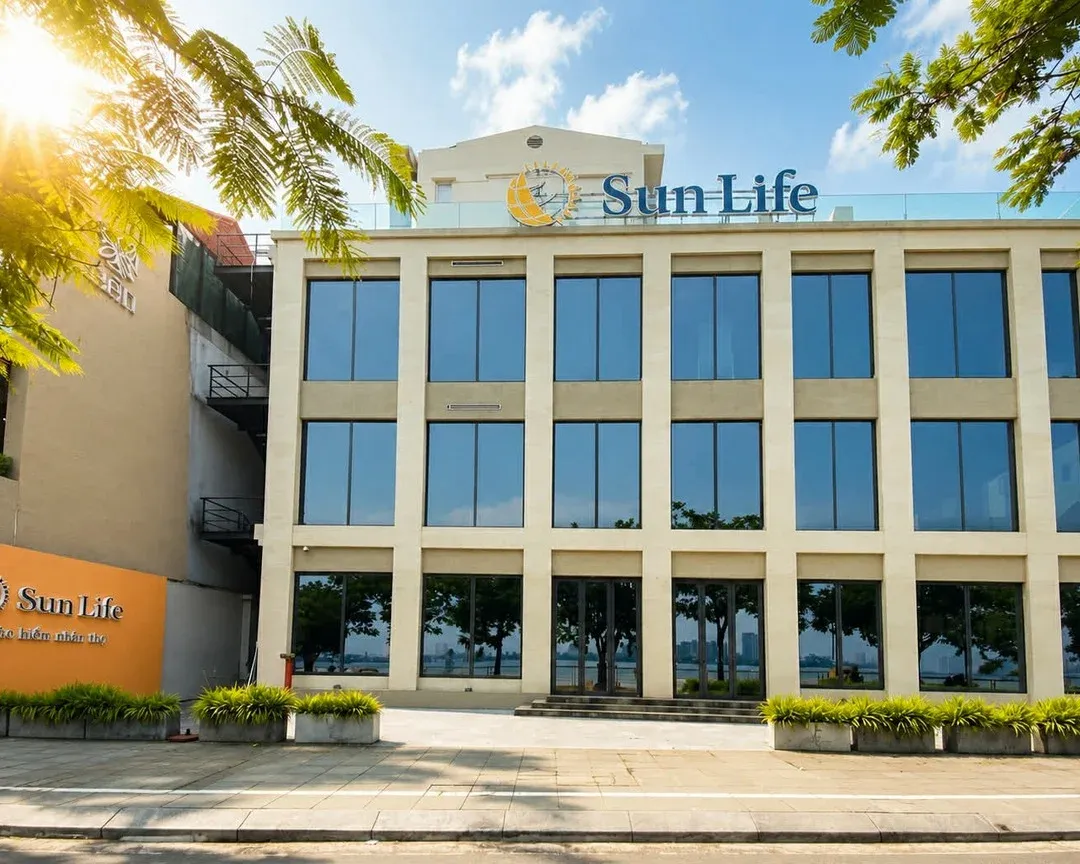

Sun Life sells policies that run 15 to 20 years in Vietnam, and it just closed its 12th straight losing year in this very market. The H1 2026 financial statement released on 7 September shows the company has contributed VND 18,909 billion in charter capital, yet accumulated losses have climbed to VND 10,272 billion as of 30 June 2026.Nguoi Quan Sat Remaining equity stands at just VND 8,638 billion against total assets of VND 20,352 billion. Put plainly, more than half of what the parent group poured into Vietnam has been eaten by a string of losses.
The real question isn't whether your policy is safe. It's whether you're even looking at the right number to answer that.
A large capital contribution is not a safety signal
Many buyers pick a life insurer using a logic that feels solid: the older the foreign parent, the larger its capital contribution, the safer the policy. That logic isn't entirely wrong. Sun Life entered Vietnam in 2013 through a joint venture with PVI, starting with just VND 1,000 billion in charter capital, and the parent group kept injecting more for over a decade, most recently raising it to VND 18,909 billion in March 2026.Tin Nhanh Chung Khoan
What the filing doesn't tell you is this: at a life insurer, rising capital doesn't mean the business is winning and expanding. For Sun Life, capital had to rise because accumulated losses had already eaten past half of equity, and the company needs to keep its solvency margin above the regulatory floor. That's an oxygen tank keeping the company compliant, not a trophy for performance.
Why the losses have run for 12 straight years
The real risk sits in how the whole industry books new-business accounting, not something specific to Sun Life. Agent commissions and selling costs on a 15-to-20-year policy are typically front-loaded into the first two or three years and expensed immediately, while premium revenue is spread across the full policy term. The harder an insurer sells this year, the bigger its accounting loss this year, even when policy quality hasn't deteriorated at all.
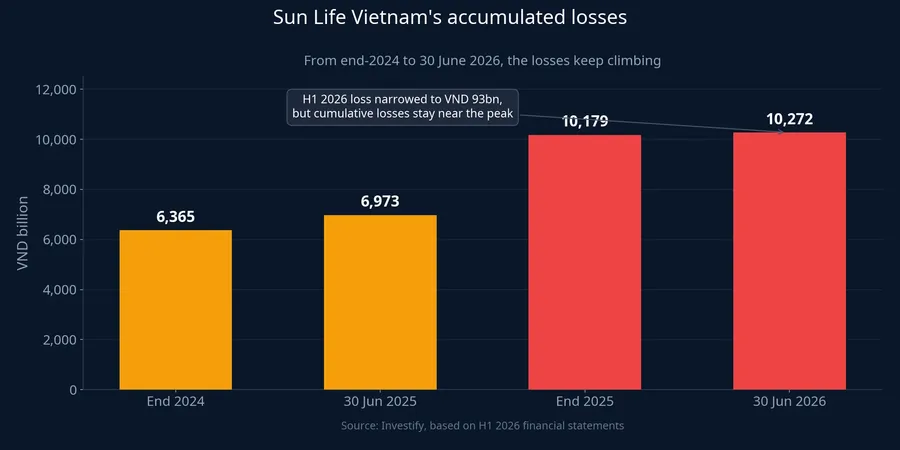
The clearest evidence comes from this very year. When Sun Life sharply cut selling and administrative expenses, the loss narrowed from VND 608 billion in H1 2025 to VND 93 billion in H1 2026, an 84.7% drop, even as insurance revenue kept falling.Nguoi Quan Sat Underwriting cost structure, not risk quality, is what actually drives the bottom-line number.
Two other factors matter too, and shouldn't be ignored. Technical provisions jumped as interest rates fell: in H1 2025 alone, Sun Life's technical provision expense rose 31% to VND 708 billion, pushing total claims and provisions to VND 928 billion versus VND 733 billion in the same period of 2024.Bao Moi At the same time, the company's investment portfolio skews conservative, mostly bank deposits and government bonds, so investment income isn't enough to offset the underwriting loss. The 2025 loss alone, VND 3,814 billion and the largest in the company's history, pushed accumulated losses at end-2025 to VND 10,179 billion from VND 6,365 billion at end-2024, and no single cause for that jump has been explained in any public source yet.
A loss-making core business is the norm, not the exception
This is the most counter-intuitive piece of data here, and also the one worth the most caution. Buyers tend to assume that an insurer reporting billions in profit must have an efficient underwriting business. The 2025 numbers say the opposite.
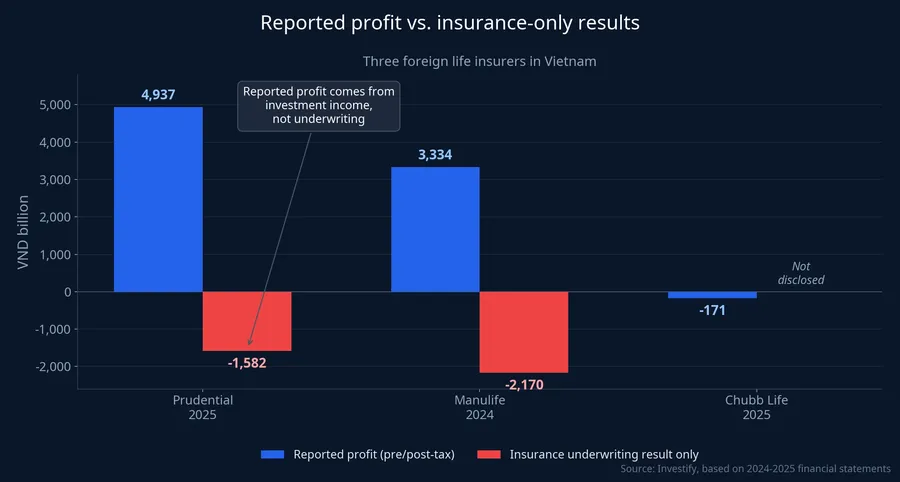
Prudential Vietnam led the industry in profit with VND 4,937 billion in pre-tax income.Tin Nhanh Chung Khoan But in its insurance business alone, net revenue of VND 19,576 billion fell short of total costs of VND 21,159 billion, producing a gross underwriting loss of VND 1,582 billion.Thoi Bao Tai Chinh Vietnam The entire headline profit came from more than VND 11,414 billion in net financial investment income, not from the core business.
Manulife Vietnam posted VND 3,334 billion in after-tax profit in 2024, while its core insurance segment lost more than VND 2,170 billion.Nguoi Quan Sat Chubb Life Vietnam flipped entirely into the red: from a profit of nearly VND 84 billion in 2024 to a loss of over VND 171 billion in 2025, as premium revenue fell 16% to VND 3,967 billion while claims paid rose 7.5% to nearly VND 3,414 billion.Vietstock
None of this means the life insurance industry is about to collapse. It means the profit figures splashed across headlines mostly reflect an insurer's investment portfolio, not the quality of its underwriting. Sun Life differs from the others in just one way: its conservative investment book doesn't generate enough income to mask its underwriting loss, so that loss shows up in full on the financial statement instead of being diluted away.
What actually comes out of your money
A company's loss doesn't get deducted directly from your policy account. What does get deducted is the initial fee schedule, and that's the number you should be reading closely before you sign anything.
Circular 67/2023 from the Ministry of Finance caps initial fee deductions for unit-linked products: up to 50% of the first-year premium, no more than 30% in year two, up to 20% from years three through five, and just 2% from year six onward.Tin Nhanh Chung Khoan The cap became mandatory from 1 July 2025 under Decree 46/2023's two-year transition schedule.
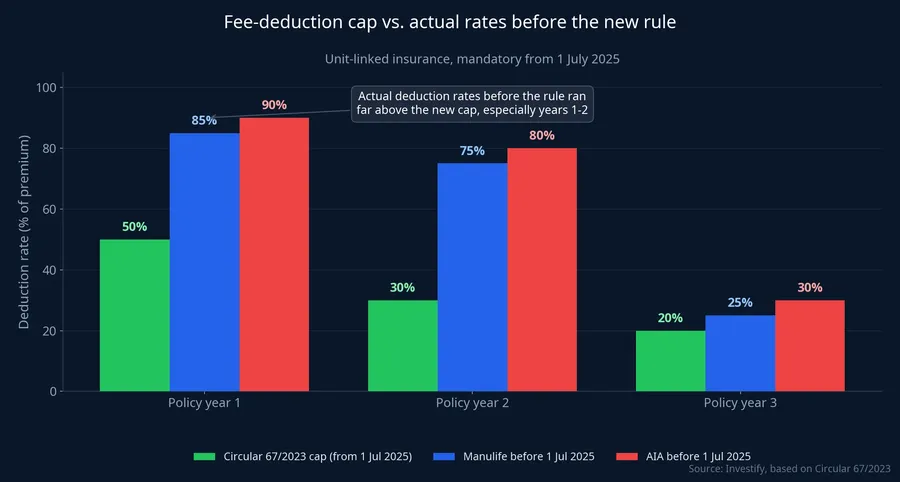
Before that date, actual market practice ran much higher. Manulife's illustration deducted 85% of the first-year premium and 75% in year two; AIA's was 90% and 80%. Under the old formula, someone paying VND 100 million a year for the first three years could see an account balance near zero if they tried to withdraw. Under the new cap, the same cash flow leaves roughly VND 200 million in the account after three years. Same premiums paid, two very different outcomes depending on the deduction schedule, and that's the number that actually hits your wallet, not the insurer's profit or loss.
Also effective 1 July 2025, Article 101 of Decree 46/2023 required unit-linked products to separate protection benefits from investment benefits. Protection coverage under this product line narrowed to death and total permanent disability only; supplementary benefits like accident or critical illness were split into standalone riders.Tin Nhanh Chung Khoan Manulife and AIA stopped selling their old product lines from that date.
Who bears the investment risk
This is the single most important classification question, and the one least often asked at the advisory desk.
With participating whole-life products, the leftover premium after costs goes into your policy account and earns an insurer-declared rate, plus a minimum guaranteed floor. The insurer bears most of the investment risk, and the buyer has a floor. But that guarantee is only a floor: the actual annual rate is set by the insurer based on market conditions, and there's no single market-wide figure since each product publishes its own rate in its illustration documents.
With unit-linked products, premiums buy fund units, and the policy's value equals the number of units times a periodically published unit price. There's no guaranteed rate here at all. Investment risk sits entirely with the buyer, just like directly buying a fund certificate, except with an added layer of risk-insurance and fund-management fees deducted periodically. The question to ask your agent isn't "is the company big?" It's "what type of policy is this, and who absorbs the loss if the fund drops?"
The market has already started reacting
Vietnamese buyers are already voting with their feet. New policies issued in the first four months of 2026 fell 22.2%, new-business premium in H1 2026 dropped 17%, and the total number of in-force policies fell 4.5% year-on-year through April 2026.Tin Nhanh Chung Khoan
What's more concerning is that the market still lacks one key metric. Most insurers disclose only revenue and profit, not persistency rates or lapse rates by distribution channel.Tin Nhanh Chung Khoan That's exactly the number that would show how many customers stick around past year two, the most direct measure of advisory quality there is. Until that metric shows up, buyers are left to find substitutes on their own.
Three metrics worth reading instead of the profit line
Sun Life's VND 10,272 billion loss isn't a signal that your policy is about to lapse. But it's also not a criterion for picking an insurer, and more importantly, neither is the profit figure at any other insurer.

Solvency margin is the regulatory capital-safety metric, and it's far more sensitive than profit. Dai-ichi Life's own case shows just how sensitive: its solvency margin fell from 228% to 192% after a single supplementary tax obligation of VND 546.3 billion.CafeF
The year-by-year initial fee schedule in the specific product's illustration document. The legal cap is 50% for year one; if the illustration shows a rate above that cap, that's a product worth questioning on the spot.
Product type and who bears the investment risk, participating or unit-linked, which determines who absorbs the loss if markets turn down.
For buyers whose main need is pure protection, splitting the two needs is a more common and safer allocation: buy a pure protection product for the risk portion, and put the savings portion in a channel where every cost is transparent, such as term deposits or fund certificates with clearly published management fees. For buyers who genuinely want to combine both needs into one policy, the cost of that convenience sits in the fee schedule, and that schedule needs to be read before signing, not after trying to withdraw and finding out the hard way.
Two parallel figures are worth watching over the coming quarters: whether Sun Life's H1 2026 loss, now narrowed to VND 93 billion on cost cuts, continues to shrink, and whether industry-wide new-business volume keeps posting double-digit declines. If both trends continue, the business model built on large upfront commissions will have to shrink before the industry's balance sheet returns to normal.