
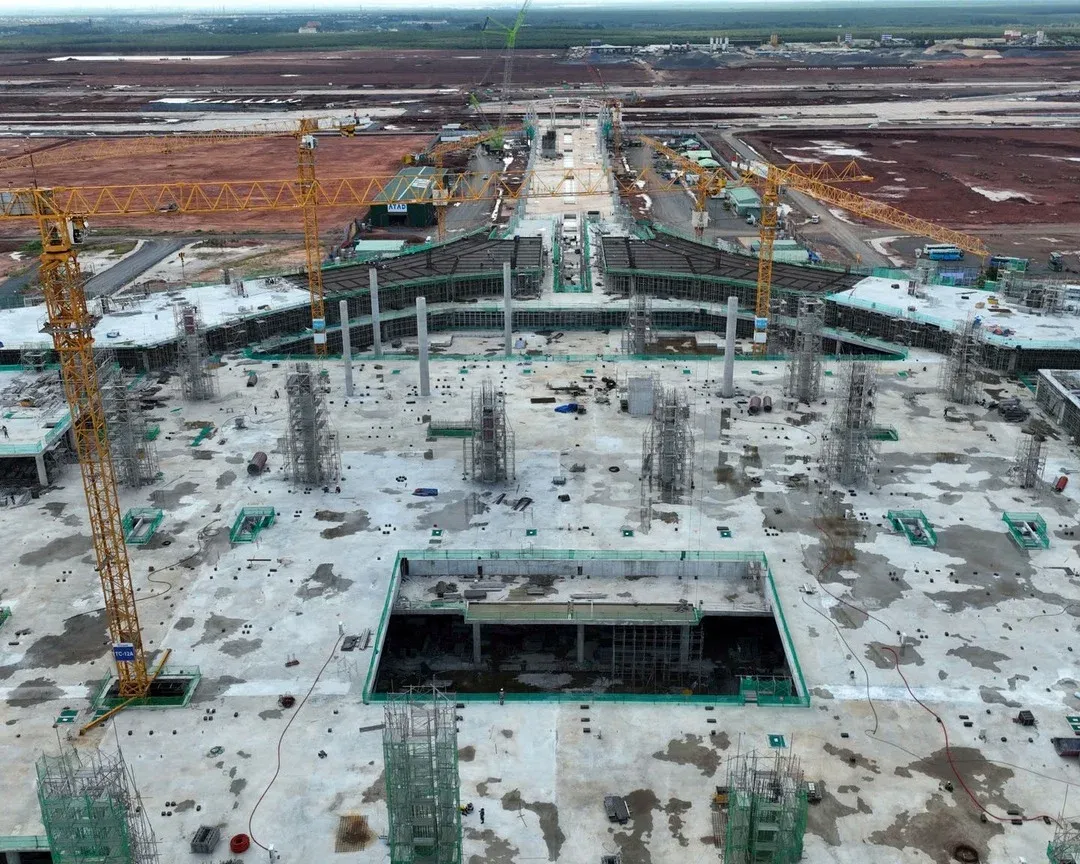

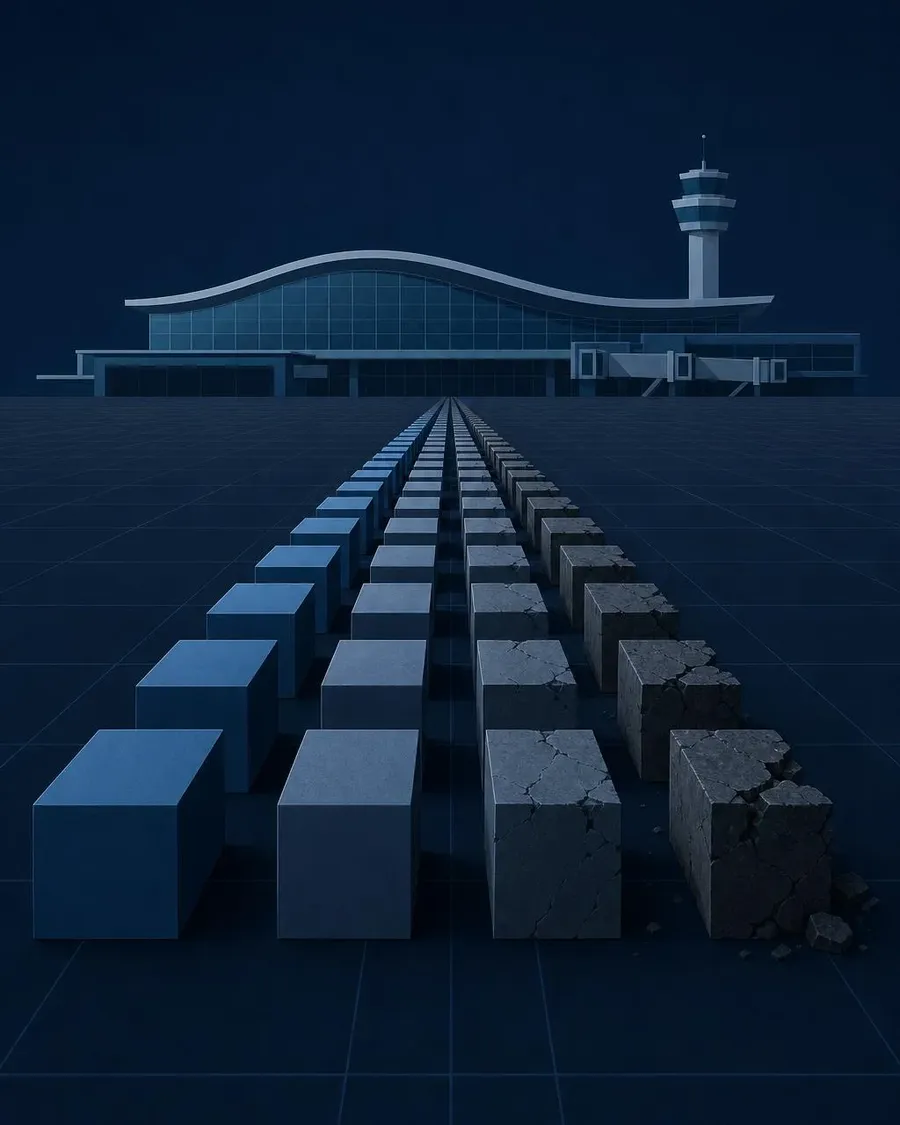
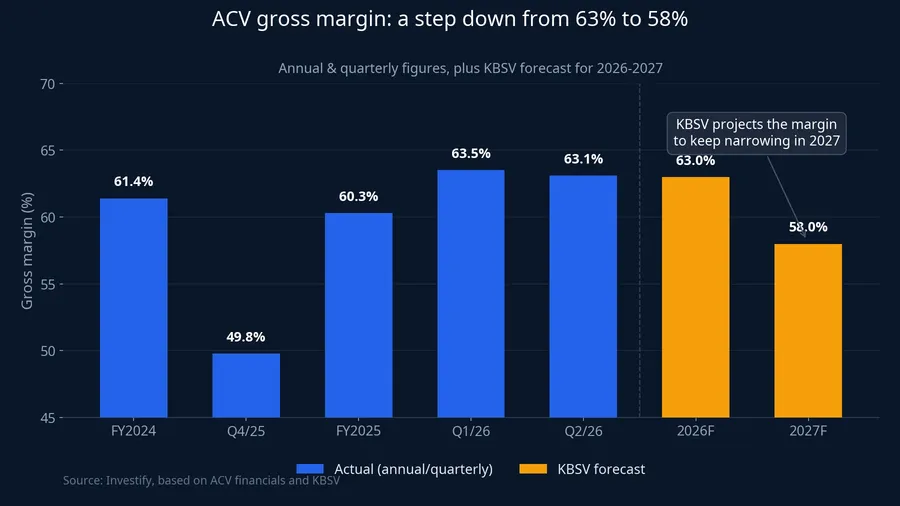
For nearly a decade, every progress milestone at Long Thanh airport has been read by the market as good news for Airports Corporation of Vietnam (UPCoM: ACV), the operator of nearly the entire national airport network. A September 7 update from KB Securities Vietnam (KBSV) recasts that milestone from a different angle: the same day the new terminal takes its first commercial flight is the day ACV starts carrying depreciation on the VND 109 trillion asset it just completed. Per KBSV, ACV's gross margin is set to fall from an estimated 63% in 2026 to 58% in 2027.Người Quan Sát
Depreciation is a direct accounting consequence, not a hidden risk
This isn't a surprise risk, it's basic accounting. Once a fixed asset enters service, a company starts allocating its investment cost into expenses period by period. Long Thanh phase 1 carries a total investment of VND 109 trillion, of which ACV's own portion had reached nearly VND 40 trillion as of end-June 2026.VietnamBiz For years, that money sat under construction-in-progress on the balance sheet, never touching the income statement.
On the day the terminal takes its first commercial flight, the completed portion of the asset moves to fixed assets and depreciation begins, a cost that recurs every quarter for decades regardless of how many passengers pass through that quarter. So the apparent tension between "major infrastructure milestone" and "shrinking margin" is only surface-level. Both are consequences of the same action: putting a very large asset into operation.
In money terms, five percentage points of gross margin is a meaningful number. ACV's net revenue in the first half of 2026 reached VND 13,164 billion, meaning each percentage point of margin is worth roughly VND 130 billion over six months.MekongASEAN That's a floor reference at best, since 2027 revenue should be higher precisely because of Long Thanh, and margin is a ratio, not a fixed sum.
Today's record profit isn't coming from the core business
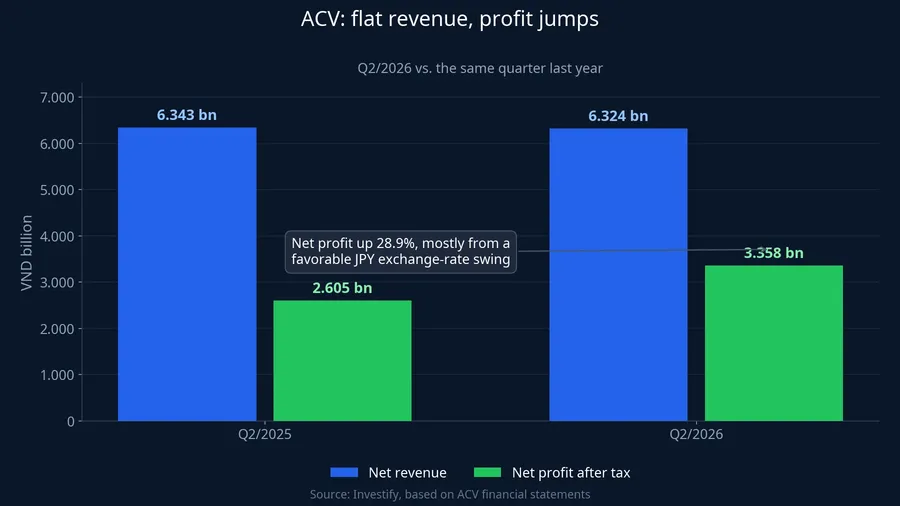
Before turning to 2027, it's worth reading the current numbers correctly. In Q2 2026, ACV posted net revenue of VND 6,324 billion, down 0.3% year-on-year.Tạp chí Kinh tế Tài chính Net profit after tax, however, hit VND 3,358 billion, up 28.9% and the highest on record. The gap between those two numbers comes from currency: ACV borrows part of its capital in Japanese yen, and in Q2 2025 a stronger yen forced the company to book VND 739 billion in financial expenses. In Q2 2026, the exchange rate moved the other way and that line turned into a net gain of VND 42 billion.
That single FX swing accounted for most of the VND 940 billion increase in pre-tax profit. In other words, revenue from core airport operations was essentially flat, while the profit gain came mostly from a variable the company doesn't control. Over the first half, revenue rose 3.7% and net profit after tax reached VND 6,704 billion, up 17.1%.
Gross margin already swings hard by season
Gross margin in the first two quarters of 2026 was 63.5% and 63.1% respectively, exactly the base KBSV uses for its projection. One detail that gets less attention: ACV's margin has always been highly seasonal. Full-year 2024 margin was 61.4%, and 2025 was 60.3%, both well below the early-quarter levels because Q4 always dips sharply, with Q4 2025 alone falling to 49.8%. Long Thanh depreciation will stack on top of a base that already swings hard by season, not a flat starting line.
A 5-year-low valuation: has the market priced in enough
KBSV notes ACV's P/B is hovering around a 5-year low, reflecting meaningful concern over depreciation pressure, even as ROE has stayed stable in the 15-16% range. Trading data supports that valuation read: at the September 7 close, ACV shares settled at VND 40,600, implying a P/B of roughly 1.96x, 22% below the 5-year average of 2.52x. On profitability, the actual figures run higher than the range KBSV cites: 2025 ROE was 19.2%, and trailing-four-quarter ROE stands at 19.4%, partly thanks to the same FX gain noted above.
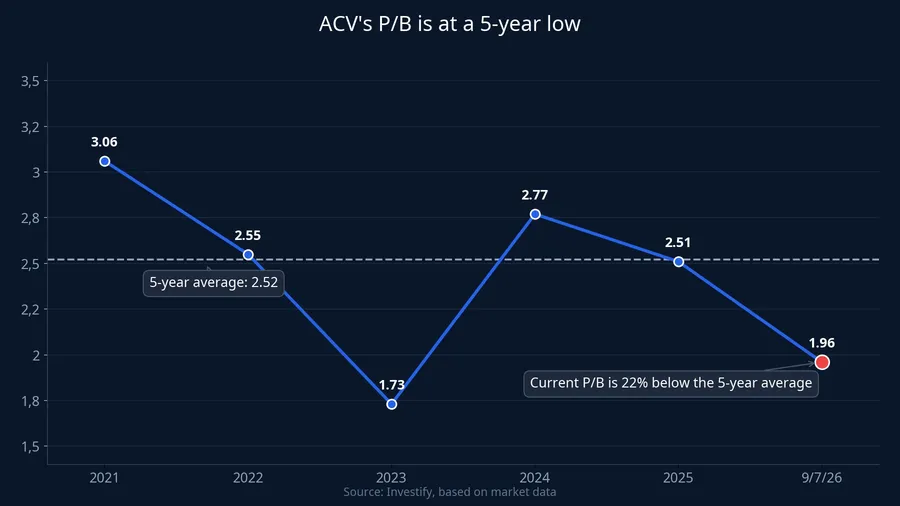
Whether that 22% discount is driven solely by depreciation worry is impossible to say with certainty. At least three other explanations coexist. First, ACV trades on UPCoM with thin liquidity, matched volume on September 7 was just 507,500 shares, which can pull its valuation away from comparably sized listed peers. Second, the broader market is under pressure, with the VN-Index down 1.70% on September 7 alongside 251 decliners. Third, a July 2026 Government Inspectorate conclusion on bidding and contract-management violations at packages 5.6 and 5.10 adds governance risk, though KBSV assesses no material quantified financial damage to ACV so far.Người Quan Sát
Analyst forecasts for ACV are also widely dispersed, which makes "has the market priced in enough" harder to answer. KBSV's 58% sits toward the milder end. In a late-2025 report, Vietcap projected ACV's 2027 gross margin retreating to around 43%, a much deeper margin compression. The gap between those two scenarios is wider than the current valuation discount itself.
The other side of the same asset
Depreciation is a cost that's already locked in; the revenue that asset generates still needs time to build. Long Thanh phase 1 adds capacity for 25 million passengers and 1.2 million tonnes of cargo per year.Người Quan Sát Connecting infrastructure is nearly done too: the Ben Luc-Long Thanh expressway is over 99% complete and expected to open fully by late September 2026, a factor KBSV says will help the airport reach over 80% capacity utilization by 2030.
The lag between cost and revenue is the crux of the matter. ACV has locked in a commercial operations timeline starting December 1, 2026, in three phases transitioning traffic between Long Thanh and Tan Son Nhat.VnExpress KBSV, meanwhile, projects full completion and commercial operation starting early 2027. In the first phase, from December 1, 2026 to March 27, 2027, Long Thanh will prioritize international routes and all cargo flights, meaning initial passenger volume won't fill the 25-million capacity right away.
There's one more revenue lever less tied to construction progress: non-aeronautical services. In Q2 2026, this segment brought in VND 1,147 billion, about 18% of net revenue, well below the share typical at major airports elsewhere in the region. A new terminal with large commercial space is an opportunity to lift that share, but that's a multi-year story, not a matter of a few quarters. Behind all this sits another investment cycle: ACV was assigned as investor for phase 2 starting January 2026, with a planned total investment of VND 76.6 trillion, construction from 2028-2031, and operations starting in early 2032.
Signals worth watching
For investors holding or considering ACV, the 2027 story will be answered by data, not forecasts. The Q4 2026 and Q1 2027 financial reports will be the first two periods showing how much actual Long Thanh depreciation gets booked, and whether gross margin settles near the 58% KBSV projects or drifts deeper toward Vietcap's scenario.
Two accompanying signals are worth tracking in parallel: how quickly airlines shift international routes to Long Thanh in the first quarter of operations, and the share of non-aeronautical revenue. The first determines whether revenue can grow fast enough to keep pace with costs. The second determines whether margin gets a new floor.
At current valuation, the market has priced in a moderate margin-compression scenario, closer to KBSV's projection than to Vietcap's. If the first quarter of actual data leans toward the more pessimistic camp, a 22% discount to the 5-year average may not turn out to be a wide enough margin of safety.